

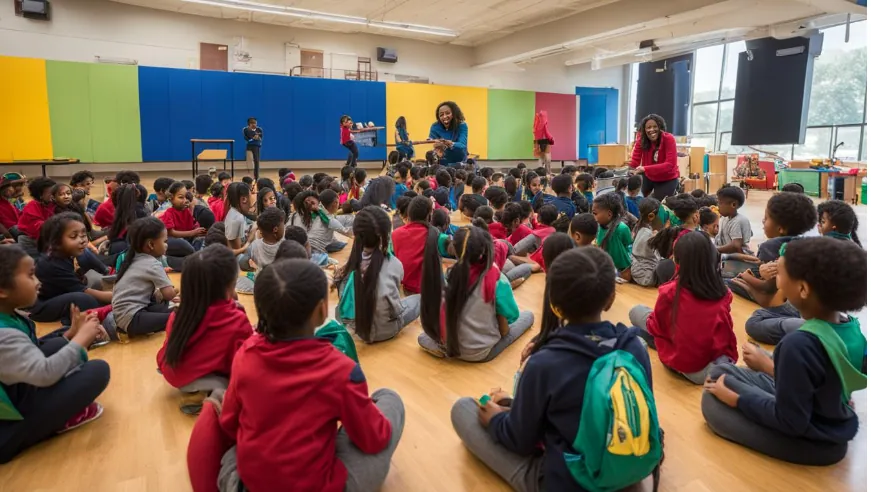

School assemblies shape campus culture, but only when students actually participate. A 2025 Gallup study found that students with five or more engaging school experiences show a 65% thriving rate, compared to just 38% among those with fewer. Meanwhile, research from CASEL shows that interactive, social-emotional learning experiences raise academic performance by 11 percentile points, with gains persisting years after participation.
Those numbers tell a clear story: passive assemblies waste time, and interactive ones produce measurable results. The challenge is knowing which interactive assembly ideas fit your school, your students, and your schedule.
Most administrators face real obstacles when planning assemblies. Budgets are tight, gym time is limited, and teachers worry about losing instructional minutes to programs that feel like “just entertainment.” Coordinating 300 to 1,000 students in one space creates logistical headaches. And choosing the wrong format for a grade level turns excitement into chaos. These challenges keep many schools stuck in the lecture-and-clap assembly model, even when staff know it falls flat.
Why Traditional Assemblies Fall Short
The standard assembly formula puts students in rows, a speaker at the front, and asks everyone to sit still for 45 minutes. Elementary students fidget. Middle schoolers tune out. High schoolers pull out phones. The format itself works against engagement because it treats students as an audience, not participants.
Interactive assembly ideas flip that dynamic. When students answer questions, compete in teams, vote on outcomes, or move through stations, their brains shift from passive reception to active processing. That shift is what produces the retention and behavioral outcomes administrators actually want from assembly time.
What Makes Interactive Assemblies Hard to Plan
Recognizing the value of interaction is the easy part. Execution is where schools struggle.
- Budget constraints: Many districts allocate minimal funding for assembly programming, forcing coordinators to choose between quality and frequency.
- Time pressure: Assemblies compete with instructional hours. Administrators need programs that deliver educational value, not just fun.
- Age-range gaps: A format that works for second graders often bombs with eighth graders. Schools serving K-8 or K-12 populations need adaptable programs.
- Logistics at scale: Moving hundreds of students into a gym or auditorium, keeping energy high without losing control, and wrapping up on time requires tight coordination.
- Teacher buy-in: If faculty see assemblies as wasted time, they disengage, and students follow their lead.
The best interactive assembly ideas address every one of these issues by building educational content into high-energy formats that require minimal setup from school staff.
Game Show Assemblies: The Format Students Request Again
It’s PlayTyme Game Shows has built its reputation on exactly this format. Their live, hosted game show assemblies put students on stage as contestants, turn the audience into active participants through crowd voting and team competition, and wrap educational messaging into every round. Schools across New Jersey, New York City, and Connecticut bring them back year after year because the format works for every grade level.
Game show assemblies succeed because they use a structure students already understand. Formats modeled on popular TV shows (team feud rounds, trivia challenges, physical minute-to-win-it contests) create instant recognition. Students know the rules before the host explains them. That familiarity removes the awkward warm-up period and gets energy high from the first minute.
What Makes This Format Different
- A professional host manages the room, so teachers observe rather than facilitate.
- Content themes (anti-bullying, STEM, health and wellness, Black History, reading incentives) align with curriculum goals.
- Team-based play means every student participates, not just the loudest volunteers.
- Setup and teardown happen without pulling staff away from their responsibilities.
Interactive Assembly Ideas by Grade Level
Not every interactive format fits every age group. Here is what works and why.
Elementary (K-5)
Young students respond to movement, music, and call-and-response energy. Effective formats include dance-along competitions, sing-along challenges with educational lyrics, and simple trivia rounds with physical answer zones (students move to corners labeled A, B, C, or D). Keep rounds short (2 to 3 minutes each) and rotate activities frequently. Visual props and sound effects hold attention far better than spoken instructions alone.
Middle School (6-8)
This age group craves social status and peer recognition. Assemblies that let students compete on stage in front of classmates tap into that motivation. Game show formats, lip-sync battles, and team relay challenges with a leaderboard all drive participation. The key: give middle schoolers a reason to care about winning without singling out anyone for embarrassment.
High School (9-12)
Older students respond to production value and authenticity. Low-budget assemblies with a teacher reading from a script get tuned out instantly. High schoolers engage when the assembly feels like an event: professional sound, lighting, a skilled host, and stakes that matter (even small ones like a pizza party for the winning homeroom). Interactive polling through phones, live scoring displays, and student-vs-teacher rounds all generate genuine excitement.
Theme-Based Assembly Ideas That Reinforce Curriculum
The strongest interactive assemblies tie entertainment to educational outcomes. When administrators pair a format with a theme, the assembly earns its place in the school calendar.
Anti-Bullying and Character Education
Scenario-based game rounds present real situations and ask teams to choose the best response. The competitive format keeps students engaged while reinforcing empathy, bystander intervention, and digital citizenship. These assemblies align with state-mandated character education requirements in New Jersey, New York, and Connecticut.
STEM and Academic Incentive
Trivia assemblies built around science, math, and technology content reward students for academic knowledge in a public, celebratory setting. Schools use these as capstone events for reading challenges, science fairs, or testing season motivation.
Cultural Celebration and Heritage Months
Interactive trivia and music-identification rounds centered on Black History Month, Hispanic Heritage Month, or other cultural celebrations educate the entire student body while honoring the communities within the school. The game format prevents these assemblies from becoming passive lectures.
Health, Wellness, and Prevention
Substance abuse prevention, distracted driving awareness, and mental health topics land better when students discuss scenarios in teams rather than sit through a keynote. The interactive format creates peer-to-peer conversation, which research shows is more influential than adult-delivered messaging for adolescents.
Planning an Interactive Assembly: A Step-by-Step Approach
Good interactive assembly ideas need good execution. Follow this sequence to avoid the most common planning failures.
- Define the outcome first. Decide what students should think, feel, or do differently after the assembly. Every format decision flows from this answer.
- Match format to audience. A K-2 assembly and a high school assembly should never use the same format. Choose a provider or structure that adapts to your specific grade range.
- Secure the space and schedule early. Gym and auditorium availability drives timing. Book the date before selecting the program, not after.
- Brief the staff. Teachers who understand the assembly’s purpose participate actively. Send a one-page overview at least a week in advance with the theme, format, and their role (which should be minimal).
- Let professionals handle production. Schools that try to DIY game-show-style assemblies spend weeks on preparation and still get uneven results. Professional providers like It’s PlayTyme bring equipment, a trained host, and a tested program. The school provides the space and the students.
Measuring Whether Your Assembly Worked
Interactive assemblies justify their cost and calendar space when schools track results. Three simple measures tell the story.
- Student feedback: A three-question survey (paper or digital) immediately after the assembly captures engagement levels while the experience is fresh. Ask what students learned, what they enjoyed, and what they would change.
- Behavioral data: Track discipline referrals, bullying reports, or attendance patterns in the weeks following a themed assembly. Schools that run anti-bullying game show programs often see measurable drops in office referrals.
- Rebooking rate: The simplest indicator of success is whether teachers and students ask for the program again. Programs that produce genuine engagement get requested by name for the following year.
What to Ask Before Booking a School Assembly
Start with three questions. First, what is the educational or cultural goal for this assembly? Second, what grade levels will attend (and does the program adapt to that range)? Third, does the provider handle all logistics, or will your staff absorb the setup and facilitation burden?
The right program checks all three boxes: it delivers a message that matters, it engages the specific age group in the room, and it runs without pulling teachers away from their students. Schools that prioritize these criteria consistently report stronger assembly outcomes and higher rebooking rates.
If you are planning an interactive assembly for your school in New Jersey, New York City, or Connecticut, reach out to It’s PlayTyme Game Shows to discuss formats that match your goals. Explore their full lineup of school assembly programs and prevention-themed assemblies to find the right fit for your campus.
Frequently Asked Questions (FAQs)
What are the best interactive assembly ideas for elementary students?
Movement-based games, call-and-response activities, and simple team trivia work best for elementary students. Formats that use music, props, and short rounds (2 to 3 minutes) keep young learners focused. Game show assemblies with audience participation sections give every student a role, not just the volunteers on stage.
How long should an interactive school assembly last?
Most effective interactive assemblies run 45 to 60 minutes. Shorter sessions feel rushed and limit participation. Longer sessions risk losing student attention, especially for younger grades. Professional providers pace their programs to maintain energy throughout the full time block.
How much does a professional interactive assembly cost?
Pricing varies by provider, format, and group size. Schools should request a direct quote based on their specific needs. Many providers offer bundled pricing for multiple assemblies per year, which reduces the per-event cost and allows schools to build a consistent assembly calendar.
Do interactive assemblies count as instructional time?
When assemblies are tied to curriculum standards, character education mandates, or state-required prevention programming, they qualify as instructional time in most districts. Schools that pair assemblies with pre- and post-activities (classroom discussions, writing prompts, or follow-up lessons) strengthen the instructional case for administrators and boards.
What topics work best for interactive school assemblies?
Anti-bullying, STEM enrichment, reading motivation, cultural heritage celebrations, and health and wellness are the most requested themes. The format matters as much as the topic. A well-produced interactive assembly on any of these subjects outperforms a passive lecture on the same material because students process information more deeply when they participate actively.