Teams in the top quartile of employee engagement are 21% more profitable than those in the bottom quartile, according to Gallup’s meta-analysis of 2.7 million workers. Yet most companies still treat team building as a calendar checkbox: one afternoon per quarter, a generic activity, and a hope that something sticks.
Google’s Project Aristotle research found that psychological safety is the single strongest predictor of high-performing teams. Not talent, not resources, not seniority. Safety to speak, disagree, and take risks without judgment. The question for HR leaders and event planners is not whether to invest in team building, but which activities actually create those conditions and which are just expensive downtime.
Here is where most programs fail. Ropes courses reward the physically dominant. Cooking classes keep extroverts talking while introverts chop onions in silence. Escape rooms let one or two people solve everything while the rest watch. The format itself determines whether an activity produces observable behavioral change or just a round of forced smiles. Game show strategies for team building address this directly: when you choose the right format, scoring model, timing structure, and facilitation approach, every person in the room participates, and the outcomes carry back into Monday morning.
This guide breaks down 10 specific strategies drawn from It’s PlayTyme Game Shows, a provider that has facilitated over 3,000 live corporate events across New Jersey, New York City, and Connecticut. These are not generic suggestions. Each strategy is tied to a measurable team-building outcome, explained through the behavioral dynamics that make it work.
What Breaks in Traditional Team-Building Programs
Before examining what works, it helps to understand why so many team-building programs produce disappointing results. The problems are structural, not motivational.
- Extrovert-dominant formats: Activities that reward speed of speech or physical confidence create a stage for 20% of the room. The other 80% becomes an audience. This reinforces existing power dynamics rather than disrupting them.
- No participation mechanism: Without a structure that requires every person to contribute, quiet team members self-select out. Facilitators notice this too late (or not at all).
- Competition that fractures rather than bonds: Poorly designed competitive structures pit departments against each other. Teams leave with stronger in-group identity and weaker cross-department relationships.
- No observable outcomes: Most activities produce anecdotal feedback (“it was fun”) but zero data on who participated, how teams communicated, or what behavioral patterns surfaced.
- One-size programming: A team of 15 engineers and a sales floor of 120 people have different dynamics, different communication defaults, and different barriers to connection. Identical programming ignores these differences entirely.
Game show formats are not immune to these problems. A trivia night with open shouting produces the same extrovert dominance as any other activity. The difference is that game shows offer structural controls (buzzer systems, scoring rules, timed rounds, rotation mechanics) that a skilled provider uses to engineer specific outcomes. The strategy is in the structure, not the entertainment.
How Format Selection Controls Who Participates
The single largest variable in team-building effectiveness is participation breadth. An activity where 30% of attendees actively engage produces different results than one where 95% engage. Format selection is the lever that controls this number.
Buzzer Rounds Pull Reserved Team Members Forward
In a traditional group discussion, speaking up requires interrupting or waiting for a gap. For reserved or introverted team members, that barrier is high enough to prevent participation entirely. Buzzer-based game show rounds change the mechanics. The buzzer creates a defined, sanctioned entry point: press it, and you have the floor. No interrupting required. No social negotiation needed.
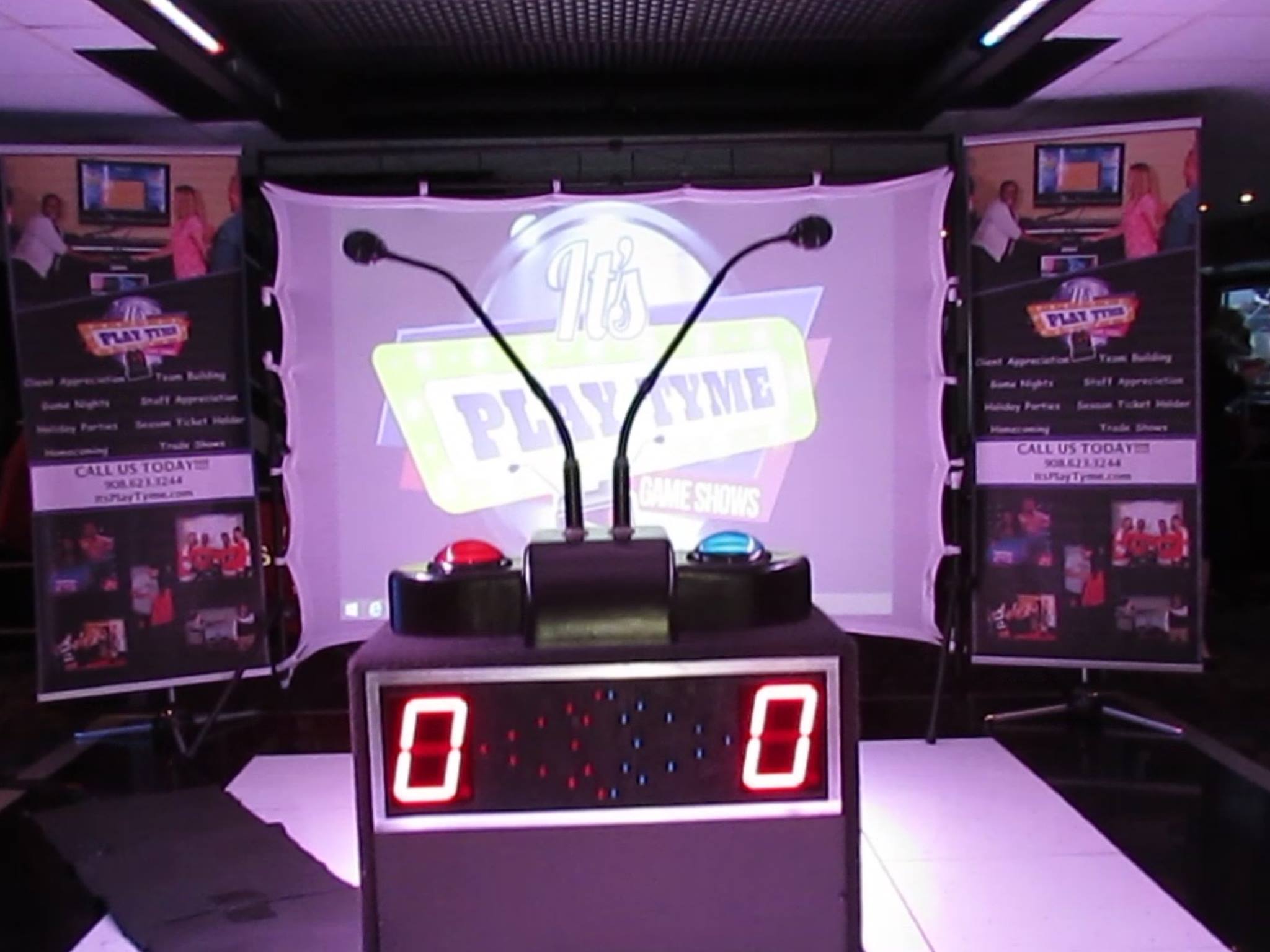
It’s PlayTyme uses wireless buzzer systems where every team has a physical device. The tactile act of pressing a button is lower-friction than raising a hand or speaking over someone. In events with teams of engineers, analysts, and other roles that skew introverted, buzzer rounds consistently produce participation from people who stayed silent during the first few open-response rounds.
The behavioral mechanism is simple: the buzzer removes the social cost of speaking. The person did not interrupt anyone. The format invited them. This distinction matters enormously for teams where hierarchy or personality dynamics suppress contribution.
Survey and Opinion Rounds Create Universal Entry Points
Knowledge-based trivia inherently advantages people with specific domain expertise. A team member who does not know the answer to a history question has no way to contribute to that round. Survey and opinion rounds eliminate this barrier.
In a survey round, the question has no objectively correct answer. “What percentage of Americans have eaten pizza for breakfast?” requires a guess, not knowledge. Every person in the room is equally qualified to answer. For teams where education levels, tenure, or cultural backgrounds vary widely, survey rounds create a level playing field where contribution depends on judgment, not memorization.
Opinion rounds (“rank these four vacation destinations”) go further: they invite personality expression. Quiet team members reveal preferences and reasoning that colleagues have never heard. This is where bonding actually starts, because people learn something real about each other.
Scoring Architecture That Shapes Competitive and Collaborative Dynamics
How you keep score determines whether teams compete or cooperate. This is not a minor detail. Scoring architecture is the single most overlooked variable in game show strategies for team building, and it produces dramatically different behavioral outcomes.
Point-Based Head-to-Head Scoring
Traditional head-to-head scoring (Team A vs. Team B vs. Team C, highest score wins) activates competitive energy. For sales teams, trading floors, and groups that already thrive on competition, this format amplifies existing motivation. Teams strategize internally, celebrate together, and experience the dopamine of winning as a unit.
The risk is real, though. Head-to-head scoring between departments (sales vs. engineering, for example) reinforces tribal boundaries. If the goal is cross-department connection, this structure works against you. Use head-to-head scoring only when teams are pre-mixed across departments or when the group already shares strong baseline trust.
Collaborative Point Pooling
In a collaborative scoring model, individual team scores contribute to a collective total. Every team’s points add to a shared goal: “Together, this room needs to reach 500 points.” Teams still compete round by round, but the emotional frame shifts from “beat them” to “contribute to us.”
This structure is particularly effective for post-merger integrations, newly formed cross-functional teams, and organizations recovering from internal conflict. The scoring tells the room a story: we succeed together or not at all. It’s PlayTyme uses this model for events where the client identifies collaboration (not competition) as the primary objective, and the behavioral shift is visible within the first two rounds.
A hybrid approach works well for groups of 60 or more: competitive scoring in early rounds to build energy, then a collaborative final round where all teams pool their accumulated points toward a shared target. This sequence gives people the thrill of competition and the satisfaction of collective achievement in the same event.
Why Timed Rounds Transform Team Decision-Making
Time pressure changes how teams communicate. Without a clock, groups default to their existing communication patterns: the most senior person decides, the most vocal person argues longest, and consensus emerges slowly (if at all). Add a 30-second timer, and those patterns break immediately.
Under time pressure, teams make three behavioral shifts that are directly relevant to workplace performance:
- Delegation emerges naturally. When a team has 30 seconds to answer, they stop trying to reach consensus and start assigning roles. “You know sports, take this one.” “You’re the math person.” This is distributed leadership in action, happening without a facilitator telling them to do it.
- Listening sharpens. With limited time, teams cannot afford to have two people talk simultaneously. Members learn to listen for the useful signal and act on it. The feedback loop is instant: poor listening costs points.
- Risk tolerance increases. A team with unlimited time deliberates. A team with 15 seconds commits to an answer even when uncertain. This repeated practice of “decide with incomplete information” directly mirrors the conditions teams face in fast-paced work environments.
Varying the timer across rounds creates additional insight. Short timers (10 to 15 seconds) expose reflexive communication patterns. Longer timers (45 to 60 seconds) reveal how teams organize discussion when given breathing room. The contrast between the two tells a facilitator (and the team itself) where their communication breaks down.
Team Size, Rotation, and Cross-Department Connection
The Participation Threshold: Why 4 to 6 Per Team Changes Everything
Research on group dynamics consistently shows that individual contribution drops as group size increases. In a team of 10, social loafing is almost guaranteed: three people do the work, seven observe. In a team of 4, hiding is impossible. Everyone’s presence (or absence) is felt.
For game show team building, the ideal team size is 4 to 6 people. This range is large enough to distribute knowledge across domains (someone knows geography, someone knows pop culture) but small enough that every person contributes at least once per round. It’s PlayTyme configures team sizes based on the client’s total headcount and primary objective: 4-person teams for maximum individual participation, 6-person teams when the priority is cross-functional mixing.
Multi-Round Rotation Breaks Departmental Silos
Static teams (same group for the entire event) strengthen existing bonds but do nothing for cross-department connection. Rotation mechanics solve this by reshuffling team composition between rounds.
In a rotation model, Round 1 teams are organized by department (comfortable, familiar). Round 2 shuffles everyone into cross-functional groups. Round 3 shuffles again. By the third rotation, every person in the room has collaborated with at least 8 to 12 colleagues they do not normally work with.
The behavioral impact goes beyond the event. When a marketing associate and an engineer have spent 20 minutes strategizing under time pressure, laughing at wrong answers, and celebrating a correct one, they have a shared experience. That shared experience lowers the friction of the next email, the next Slack message, the next cross-department request. This is not abstract theory. It is observable in post-event surveys and, more importantly, in how quickly cross-functional projects spin up in the weeks following the event.
Layering Physical and Mental Challenges to Surface Hidden Leaders
Pure trivia rewards one cognitive type: the person who retains facts. Pure physical challenges reward another: the person who moves quickly or has coordination. Hybrid rounds that combine both types surface a third category of contributor entirely: the strategic coordinator.
In a hybrid round, a team faces a trivia question whose answer unlocks a physical task (or vice versa). The person who knows the answer is not necessarily the person who performs the task best. Teams must quickly assess who does what. This is leadership identification in real time, without anyone being assigned a “leader” title.
For organizations running leadership development programs or succession planning events, hybrid rounds provide observable data. Who steps up to organize the team? Who defers? Who communicates the plan? Who executes? These behaviors are difficult to observe in a conference room but emerge naturally under game show conditions because the stakes feel real (the team wants to win) while remaining psychologically safe (it is a game, not a performance review).
Difficulty progression plays a related role. Starting with easy rounds builds confidence and participation. Increasing difficulty across the event creates a natural arc where teams must adapt their strategies. Early rounds reward individual knowledge. Later rounds reward team coordination. The transition from “I know this” to “we need to figure this out together” is exactly the behavioral shift that transfers to workplace collaboration.
Live Host Facilitation: The Variable Most Planners Overlook
A game show without a skilled live host is just a quiz on a screen. The host is the real-time adjustment mechanism that makes every other strategy work. This is the single biggest differentiator between a DIY game show and a professionally facilitated one, and it is where most planners underinvest.
A skilled host reads the room continuously. When energy drops, they shorten the timer or insert a high-energy physical round. When one team disengages because they are losing badly, the host introduces a bonus round that resets the scores. When a quiet team member answers correctly, the host amplifies the moment with recognition that encourages future participation.
These adjustments happen in real time and cannot be pre-programmed. A playlist of trivia questions on a laptop does not notice that Table 6 has checked out. A professional host does, and acts on it within 30 seconds.
It’s PlayTyme’s hosts are trained specifically in corporate event facilitation, not just entertainment. They understand that the goal is not to put on a show but to create conditions where teams interact productively. This means knowing when to increase competitive pressure and when to de-escalate, when to spotlight an individual and when to direct attention to the group, and how to manage the energy arc of a 60- to 90-minute event so that the final round lands at peak engagement rather than post-lunch fatigue.
This is also why game show strategies for team building produce inconsistent results when organizations attempt them internally. The format is only as effective as the person facilitating it. A trivia template and a volunteer host from accounting will not produce the same outcomes as a trained facilitator with thousands of events of pattern recognition.
The Debrief Round: Where Game Insights Become Workplace Habits
The most underutilized strategy in game show team building is the structured debrief. Most events end with a winner announcement and applause. The learning stays in the room.
A structured debrief changes this. In the final 10 to 15 minutes, the host or facilitator guides teams through a series of reflection questions:
- How did your team make decisions under time pressure? Was there a pattern?
- Who emerged as a coordinator, and was that person the same as your team’s formal leader?
- When did your team communicate most effectively? What was different about those moments?
- What would you do differently if you played again?
These questions transform the game show from entertainment into experiential learning. Teams identify their own communication patterns, leadership dynamics, and decision-making defaults without a consultant telling them what they did wrong. The insights are self-generated, which makes them far more likely to stick.
For organizations that integrate game shows into broader development programs (onboarding cohorts, management training, quarterly team resets), the debrief is where the return on investment lives. The game creates the experience. The debrief extracts the lesson.
| Strategy | Primary Team Outcome | Best For | Ideal Group Size |
|---|---|---|---|
| Buzzer-based rounds | Broad participation from reserved members | Introverted or hierarchical teams | 20 to 50 |
| Survey/opinion rounds | Universal engagement regardless of knowledge | Diverse tenure or background groups | Any size |
| Head-to-head scoring | Competitive energy and team cohesion | Sales teams, pre-mixed groups | 20 to 100 |
| Collaborative point pooling | Cross-team bonding and shared identity | Post-merger or cross-functional groups | 30 to 80 |
| Timed rounds (15 to 30 sec) | Faster decision-making under pressure | Teams needing communication improvement | 20 to 60 |
| Small teams (4 to 6 people) | Elimination of social loafing | Events prioritizing individual contribution | 15 to 50 |
| Multi-round rotation | Cross-department relationship building | Large organizations with siloed departments | 40 to 200 |
| Physical-mental hybrid rounds | Hidden leadership identification | Leadership development programs | 20 to 60 |
| Difficulty progression | Confidence building before high-pressure rounds | New hire onboarding, new teams | 15 to 50 |
| Structured debrief | Behavioral transfer to workplace habits | Development programs, quarterly resets | 20 to 80 |
How to Match Game Show Strategies to Your Team’s Specific Needs
Choosing the right game show strategies for team building starts with diagnosing the behavioral outcome you need, not picking an activity that sounds fun. Work backward from the problem.
If your team struggles with participation breadth (the same three people dominate every meeting), prioritize buzzer-based formats, survey rounds, and small team sizes. These structural choices force broad contribution without singling anyone out.
If your organization recently merged teams or restructured departments, use collaborative scoring and multi-round rotation. The scoring model tells the room “we are one group,” and the rotation ensures every person interacts with colleagues outside their immediate circle.
If your team needs to improve decision-making speed, lean into timed rounds with progressively shorter timers. The repetition builds a habit of committing to decisions under imperfect information, a skill that transfers directly to daily work.
If you are running a leadership development initiative, hybrid physical-mental rounds with structured debriefs give you observable data on who leads, who coordinates, and who executes without assigning anyone a role in advance.
The common thread across all of these is that the strategy must be intentional. A game show where the host simply reads trivia questions for an hour is entertainment. A game show where the format, scoring, timing, team composition, and facilitation are selected based on your team’s specific dynamics is a development tool.
It’s PlayTyme Game Shows builds every event around this diagnostic approach. Before the event, their team identifies the client’s goals: participation, collaboration, competition, leadership development, or silo-breaking. The game show format, round structure, scoring model, and facilitation plan are then configured to produce that specific outcome. With over 3,000 corporate events delivered across the tri-state area, the pattern library is deep enough to match any team size, personality mix, or organizational challenge.
Ready to build a game show event around your team’s actual needs? Get in touch with It’s PlayTyme to discuss your group size, goals, and timeline. Every event is customized, never off-the-shelf.
Frequently Asked Questions (FAQs)
What makes game show strategies for team building more effective than traditional activities?
Game shows offer structural controls that most activities lack: buzzer systems ensure broad participation, scoring models shape competitive or collaborative dynamics, and timed rounds create observable communication patterns. These mechanics produce measurable behavioral outcomes rather than generic fun. A professionally facilitated game show creates the psychological safety that research links to high-performing teams.
How large does a group need to be for a corporate game show?
Game shows work for groups as small as 15 and as large as 200 or more. The key variable is team size within the event: teams of 4 to 6 maximize individual participation, while larger teams of 8 to 10 work when cross-functional mixing is the priority. It’s PlayTyme configures team sizes based on headcount and the client’s primary objective.
Do game show team-building events work for introverted or reserved teams?
They work especially well for reserved teams when the format is designed for it. Buzzer-based rounds give introverts a structured entry point that does not require interrupting or speaking over someone. Survey and opinion rounds eliminate the knowledge barrier entirely, so every person contributes regardless of expertise. These format choices consistently draw out participants who stay silent in open-discussion activities.
How long does a typical corporate game show event last?
Most corporate game show events run 60 to 90 minutes, which fits within a lunch block, afternoon session, or offsite agenda. Shorter formats (30 to 45 minutes) work for high-energy openers or conference breakout sessions. The duration is determined by the number of rounds, the complexity of the format, and whether a structured debrief is included at the end.
How do you measure the results of a game show team-building event?
Results show up in three ways. During the event, facilitators observe participation rates, communication patterns, and leadership emergence across rounds. Immediately after, teams complete short reflection exercises that surface self-identified insights. In the weeks following, organizations track proxy metrics: cross-department communication frequency, meeting participation breadth, and speed of decision-making. The structured debrief round is the bridge that connects in-game behavior to workplace application.
What does Google’s research say about what makes teams high-performing?
Google’s Project Aristotle research found that psychological safety is the single strongest predictor of high-performing teams, not talent, resources, or seniority. Safety to speak, disagree, and take risks without judgment is what separates the best teams from the rest.
Why do activities like ropes courses or cooking classes fall short for team building?
Ropes courses reward the physically dominant and leave others behind. Cooking classes keep extroverts talking while introverts chop onions in silence. Activities that sort people by ability or personality rather than giving everyone an equal role tend to widen divides instead of closing them.