

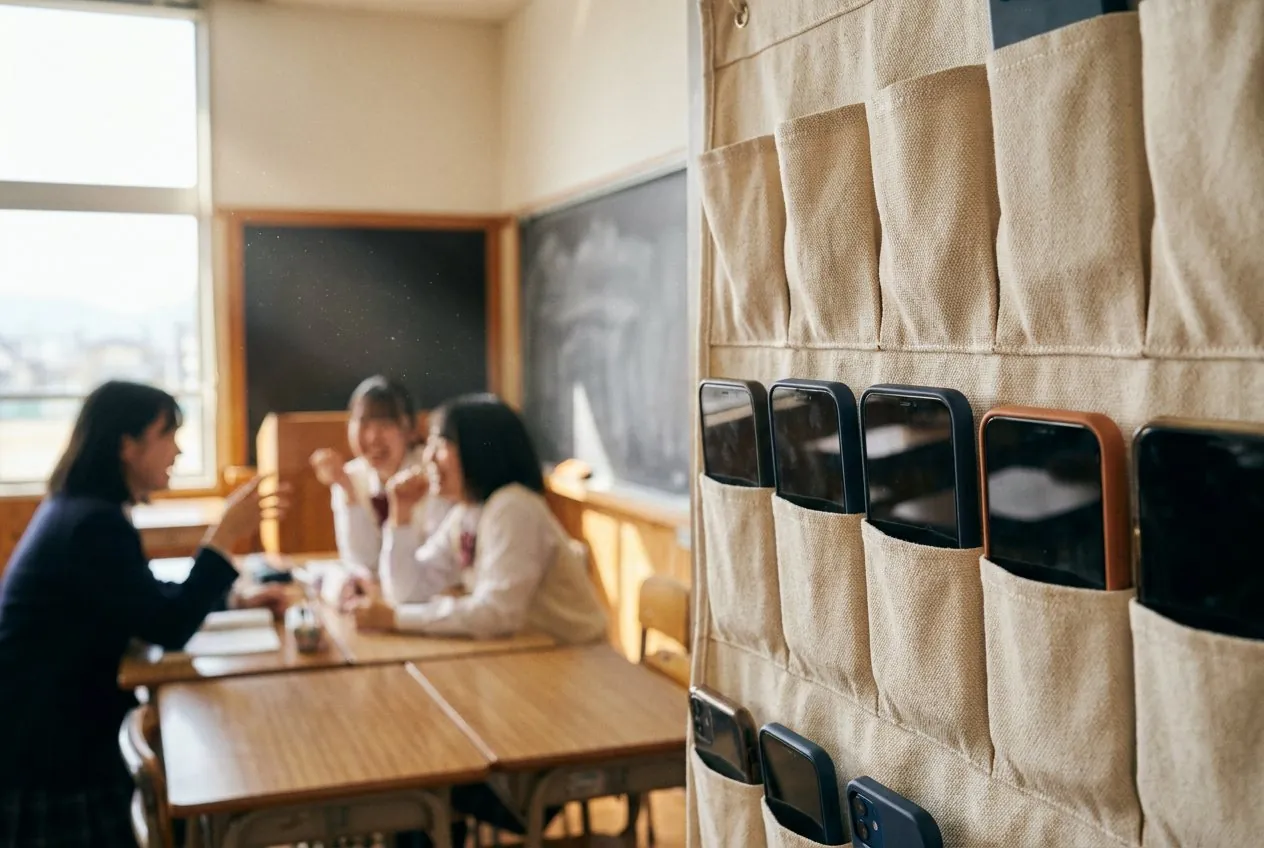

Quick answer: New Jersey public districts now limit non-academic personal device use for the full school day, first bell to last, in the 2026-2027 school year. Students with documented medical needs or device accommodations in their IEPs are exempt. Districts set their own storage rules, and most pair the policy with structured screen-free activities.
New Jersey public schools are operating under that statewide bell-to-bell policy this year, and most were already moving that way. The National Center for Education Statistics reports that 77 percent of U.S. public schools prohibit non-academic cell phone use during school hours. New York started its own bell-to-bell restriction in the 2025-2026 school year through the FY2026 state budget. Writing the rule is the easy part.
The hard part lands on principals, superintendents, PTO leaders and the teachers enforcing it every period. A quiet cafeteria is not the same thing as a connected one. Students who spent years talking through a screen need a reason to talk to each other in person, and that reason has to beat the phone they just handed over.
The Essentials
- What changed: New Jersey districts limit non-academic personal device use bell to bell, in force for the 2026-2027 school year.
- Who is exempt: Students with documented medical needs, and students with device accommodations in their Individualized Education Programs (IEPs).
- Regional context: New York started its own statewide bell-to-bell policy in the 2025-2026 school year through the FY2026 state budget.
- What compliance does not solve: Removing phones creates quiet. Building participation takes a planned, structured activity.
Why Offline Connection Is Harder Than Enforcement
Locking up phones stops the scrolling on day one. It also exposes a skill gap. Teenagers who communicate mostly by text sit down in a cafeteria or an auditorium without the conversational stamina to fill the space. Screen-free socialization is a skill, and skills need practice.
The enforcement load falls on teachers. Collecting devices at the door, settling arguments over a pouch and repeating the same rule every period wears staff down fast, especially when nobody hands them a replacement activity. Policing pockets is not a student engagement strategy, and for 2026-2027 it leaves the people most responsible for the policy with the least support.
Students feel it too. A school-wide digital detox strips away the thing they used to manage a room full of near-strangers, and the first weeks bring real awkwardness in hallways, lunch periods and study halls. That is why social-emotional learning (SEL) activities belong alongside the policy rather than months after it.
The gap gets loudest at large gatherings. Put a speaker in front of 500 students and you get 500 tuned-out faces, phones or no phones. Schools cannot order camaraderie into existence. They have to give students a structured reason to get out of their seats.
What New Jersey’s Bell-to-Bell Rule Requires
The rule covers the full school day, not just class time. Non-academic personal device use is off the table from the first bell to the last. Districts write their own storage and enforcement procedures inside that frame.
Accommodations stay protected. Students who need a phone or a monitor for a documented medical condition keep access, as do students whose IEPs call for device support. Most districts handle the logistics with locking pouches, classroom caddies or assigned lockers.
New Jersey is not working alone here. New York began its statewide bell-to-bell policy in the 2025-2026 school year, funded through the FY2026 state budget. Phones are out of the instructional day across the region, so the real work now is post-ban school culture: what fills the space once the pouches are locked.
Five Screen-Free Student Engagement Activities, Compared
Every format below works without screens. They differ in how many students they reach, how much planning they take from staff, and how much students actually do.
| Format | Group size it fits | Staff planning lift | What students do |
|---|---|---|---|
| It’s Playtyme Game Shows live game show | 50 to 500 plus | Low: our host runs the room | Compete in teams on stage and from their seats |
| Building-wide collaborative challenge | Whole school | High: stations plus staff monitors | Rotate stations, solve puzzles in cross-grade teams |
| Faculty-versus-student tournament | 200 to 800 | Medium: scripting and player rosters | Rotate in as players, cheer by grade |
| Skill-based creative workshops | 15 to 40 per session | Medium: presenters and materials | Build, paint, perform, present |
| Reinvented pep rally | Whole school | Medium: club and band coordination | Compete by bleacher section in vocal and trivia rounds |
1. Anchor the Day with a Live Game Show
In 14 years of putting large groups on their feet, It’s Playtyme Game Shows has held to one standard: a great event is not measured by how many students attend, it is measured by how many participate.
Our professional hosts bring television-style formats into your gymnasium or auditorium. Face-2-Face Feud and fast-paced team trivia make students huddle, argue, decide and shout. We run interactive offline student assemblies across New Jersey, New York City, New York State and Connecticut, and our host runs the room so your staff is not managing the crowd.
Shows run 60 or 90 minutes. For schools, pricing depends on how many shows you run and how many grade levels you are covering, and the package details sit on our interactive screen-free school assembly programs page. PTOs and school boards also get our guarantee: every show is backed by a 100% Satisfaction Guarantee, with no deposit required to book. Students leave having proved to themselves that a screen-free hour beat the alternative.
2. Run a Building-Wide Collaborative Challenge
Give the whole school one goal. Split students into cross-grade cohorts and send them through stations built around trivia, relay tasks and logic puzzles. The structure removes the social risk of unstructured free time, which is exactly what makes the first weeks of a phone policy feel long.
Freshmen end up solving problems with seniors, which rarely happens on its own. The shared story carries into hallway conversation for weeks and gives staff something to point back to.
3. Stage a Faculty-Versus-Student Tournament
Nothing pulls a gymnasium in faster than watching the principal miss a trivia question. Putting teachers and administrators on stage against students flattens the hierarchy for an hour and builds real mutual respect, which matters most in the term when staff are also the ones collecting devices.
Keep the format fast and rotate the roster so dozens of students get a turn. The message under the laughter counts too: the whole building is adjusting to the new policy together.
4. Add Skill-Based Creative Workshops
Not every student lights up in a packed gym. Smaller hands-on sessions give those students somewhere to engage, and they carry the social-emotional load better than any assembly can. Dedicate a half day to rotating workshops on engineering challenges, improv and collaborative art.
The rule for presenters is straightforward. No lecturing from the front. Hand out materials in the first five minutes and put students to work, and the quiet kids come out of their shells.
5. Rebuild the Pep Rally Around Everyone
Administrators hunting for fresh school assembly program ideas in New Jersey should start with the pep rally. The traditional version spotlights athletes and leaves most of the bleachers watching.
Bring in the academic clubs, the theater department and the band. Then add segments where bleacher sections compete against each other in vocal and trivia rounds. When every section has something at stake, nobody reaches for a pocket.
Keep Professional Development Days Just as Active
Teachers carry this policy every period, so train them in the format you want them to run. A faculty game show during a professional development day does double duty. Staff experience the engagement model firsthand and get a morale lift before they carry it into the gym.
Moving the session off campus helps. A different room resets expectations and keeps staff off their own laptops for an hour.
Three Questions That Settle Which Format Your School Books
First, how many students are in the room at once? At 200 or more you need a host and a stage format, because station-based challenges break down at that scale. At 40 or fewer, workshops win.
Second, who is doing the planning? Collaborative challenges and reinvented rallies run on volunteer labor, and a thin PTO or an already-stretched faculty will feel it. A hosted show moves the planning and the crowd control off your team.
Third, what is the goal for this term? Cross-grade mixing calls for cohort challenges. Morale after a tough policy change calls for faculty versus students. School-wide buy-in calls for whichever format gets the most students participating in the least time. Answer those three and the booking decision makes itself.
It’s Playtyme Game Shows brings the host, the formats and the team-building structure for 50 to 500 students across New Jersey, New York City, New York State and Connecticut. Contact us to talk through your assembly date and student count.
Frequently Asked Questions (FAQs)
What does New Jersey’s bell-to-bell cell phone rule require?
New Jersey public districts limit non-academic personal device use for the entire school day, not just during class periods. The requirement applies in the 2026-2027 school year. Each district sets its own storage and enforcement procedure inside that frame.
Are there exemptions to the policy?
Yes. Students who need a personal device for a documented medical condition keep access. Students with device accommodations written into their Individualized Education Programs (IEPs) are also exempt.
How are schools storing phones during the day?
Districts use lockable pouches, classroom caddies and assigned lockers, and some collect phones at the classroom door. The method matters less than consistency from room to room.
What are the best interactive school assemblies for a phone-free environment?
The formats that put students in teams and on their feet. A hosted live game show reaches 50 to 500 plus students in one room with a professional host running the show, and It’s Playtyme Game Shows runs these assemblies across New Jersey, New York City, New York State and Connecticut.
How do schools keep student morale up without personal devices?
Replace idle screen time with something students want to be part of. Hosted live game shows, cross-grade challenges and faculty-versus-student tournaments give students a concrete reason to interact face to face.