

Most corporate teams in New Jersey schedule at least one team building event per year. Few of those events produce measurable results. According to Gallup’s State of the Global Workplace report, only 20% of employees worldwide are actively engaged at work, a figure that dropped two full percentage points in a single year. Meanwhile, research from the Society for Human Resource Management (SHRM) confirms that organizations investing in workplace culture see stronger employee loyalty and lower turnover rates.
The gap between “we did a team building event” and “our team actually improved” is wide. Bridging it starts with better planning.
If you are responsible for planning team building events in New Jersey, you already know the friction points. Employees roll their eyes at trust falls. Attendance feels forced. The event wraps up, everyone goes back to their desks, and nothing changes. These are not isolated complaints. They reflect a structural problem with how most corporate outings are designed, scheduled, and followed up on.
Three Reasons Standard Team Building Events Miss the Mark
Before mapping out a better approach, it helps to understand why the default playbook fails. Most underwhelming team building events in New Jersey share three root causes.
1. Low Engagement
Generic icebreakers and trust exercises put introverts on the spot and bore extroverts. When only a handful of people participate, the rest check their phones. The event becomes an obligation, not an experience.
2. No Structure
A loose agenda (“show up at the park, we’ll figure it out”) wastes everyone’s time. Without a clear format, competitive element, or facilitator, the group splinters into cliques. The event reinforces existing social patterns instead of breaking them.
3. Post-Event Amnesia
Even well-run events fade fast when there is no debrief, no follow-through, and no connection to the team’s daily work. Two weeks later, nobody remembers what they did or why it mattered.
What to Plan for Before Booking NJ Team Venues
New Jersey adds its own layer of logistical complexity. The state spans dense urban corridors near New York City, sprawling suburban office parks, and shore towns with seasonal availability. Planning team building events in New Jersey means juggling several variables at once.
- Venue availability: Popular event spaces in Bergen County, Essex County, and the Jersey City waterfront book months in advance, especially during Q4 holiday season.
- Commute and geography: A team split between Newark and Princeton faces a 60-minute drive each way. Choosing a central location matters more here than in a single-city market.
- Weather unpredictability: Outdoor activities work from May through September, but spring rain and summer humidity derail plans regularly. Indoor-ready backup options are not optional.
- Budget scrutiny: NJ cost-of-living pressures mean HR and ops leaders face tighter approval processes for discretionary spend. Events that look like “just a party” get cut first.
- Group size variation: NJ companies range from 15-person startups in Hoboken to 500-person departments in corporate campuses along Route 287. One format does not fit both.
How Interactive Game Shows Solve Each Problem
The three failure modes (low engagement, no structure, post-event amnesia) share a common fix: a professionally hosted, competition-driven format that gives every person a role. Interactive game shows deliver exactly that.
Low Engagement Becomes Full-Room Participation
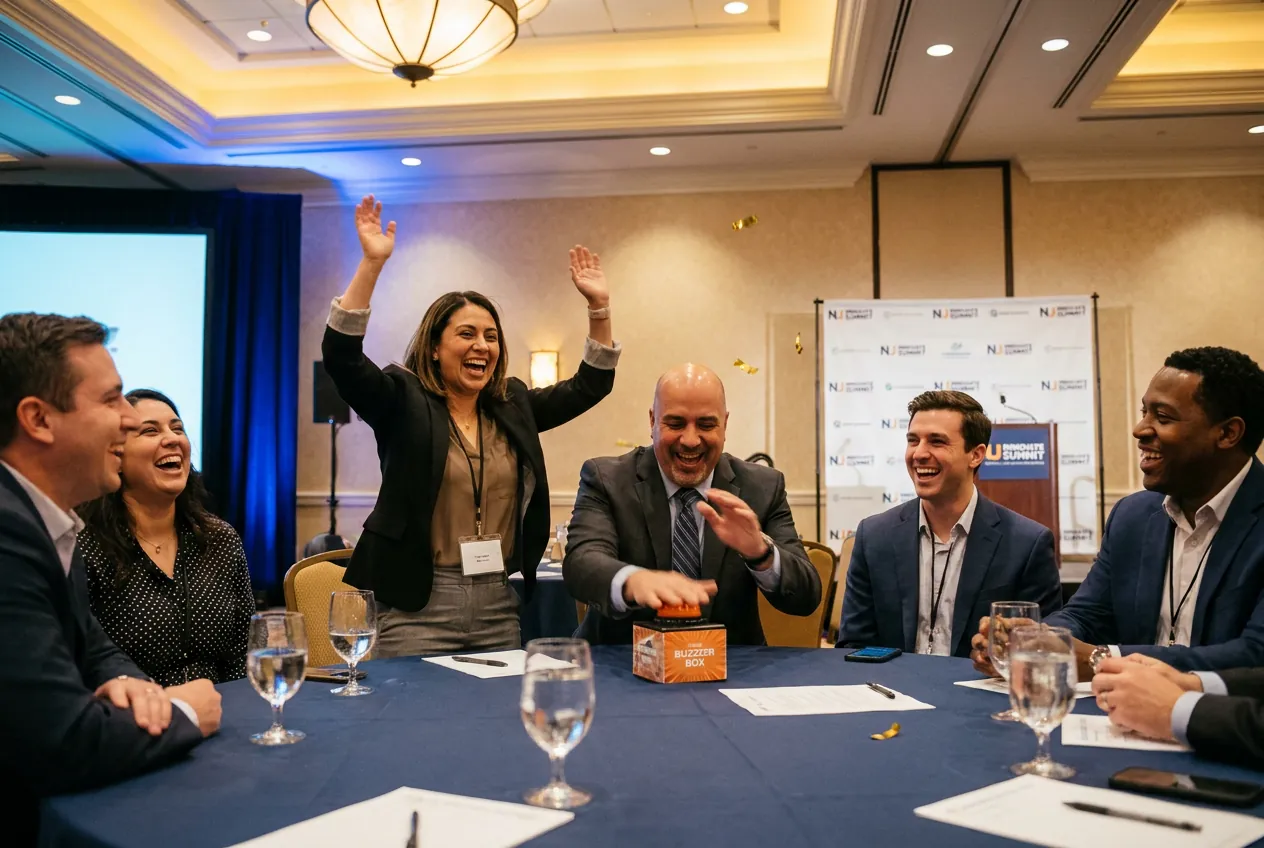
Game show formats split the room into teams and rotate questions across categories. Everyone contributes because the format demands it. Buzzers, countdown timers, and scoreboards create natural energy without forcing anyone into awkward solo performances.
No Structure Becomes a Turnkey Production
A professional host runs the event on a set timeline with clear rules, rounds, and scoring. The planning team does not need to improvise. Equipment, AV, and game content arrive ready to go.
Post-Event Amnesia Becomes Shared Memory
Competitive moments stick. Teams remember the question they got wrong, the comeback in round three, the colleague who surprised everyone. These shared stories circulate in the office for weeks and create reference points for future collaboration.
A Practical 6-Step Guide to Planning Team Building Events in New Jersey
Use this framework whether you book a game show, an outdoor challenge, or any other format. Each step eliminates a common planning mistake.
Step 1: Define the Objective
Start with the outcome, not the activity. Ask: what should be different about this team after the event? Common objectives include improving cross-department communication, welcoming new hires, or resetting morale after a difficult quarter. A specific objective shapes every decision that follows.
Step 2: Choose the Format
Match the format to the objective. A trivia-style game show builds camaraderie and friendly competition. A problem-solving challenge tests communication under pressure. A creative workshop encourages innovation. The format is not the first decision; it flows from the objective.
Step 3: Lock the Venue
For NJ events, prioritize indoor venues with flexible floor plans. Hotel conference rooms, corporate training centers, and event halls along the I-95 and Route 287 corridors offer central access for distributed teams. Confirm AV capabilities, parking capacity, and catering options before signing a contract.
Step 4: Confirm Headcount and Team Composition
Get a firm headcount at least three weeks out. Divide attendees into balanced teams that mix departments, seniority levels, and tenure. Pre-assigned teams prevent the clique problem and give newer employees a chance to connect with veterans.
Step 5: Pick the Date Strategically
Avoid Mondays (low energy) and Fridays (early departures). Mid-week events in the late morning or early afternoon generate the best attendance. Steer clear of NJ school holiday weeks when parents are unavailable. Q1 (January through March) and early Q4 (October) are strong windows.
Step 6: Plan the Debrief
Schedule a 15-minute debrief immediately after the event and a short follow-up survey within 48 hours. Ask what worked, what surprised people, and what they want next time. This closes the feedback loop and gives leadership data to justify future events.
Traditional Activities vs. Game Show Formats
| Factor | Traditional Activities | Game Show Format |
|---|---|---|
| Participation rate | Uneven (some opt out) | Full room (team-based rounds) |
| Setup responsibility | Internal team plans everything | Professional host handles production |
| Scalability | Works for small groups only | Scales from 20 to 300+ |
| Memorability | Fades within days | Shared competitive stories last weeks |
| Indoor/outdoor flexibility | Often weather-dependent | Fully indoor-ready |
| Customization | Limited to off-the-shelf kits | Custom questions, branding, themes |
Why It’s PlayTyme Game Shows Stands Out in New Jersey
It’s PlayTyme Game Shows runs live, TV-style game show experiences built specifically for corporate teams across New Jersey, New York City, and Connecticut. Their format addresses every failure mode outlined above.
A professional emcee hosts the entire event. Teams compete in rounds of trivia, music identification, word puzzles, and custom company-specific content. The production includes buzzers, LED scoreboards, sound effects, and stage lighting. It looks and feels like a real television game show, not a DIY team exercise.
Formats include Face-2-Face Feud (a survey-style showdown), Name That Hit Song (music-based competition), Word Play (word puzzle rounds), 60 Seconds of Fame (fast-paced trivia), and fully custom game shows tailored to a company’s industry, values, or training content. Events scale from intimate leadership retreats of 20 people to company-wide gatherings of 300+.
For NJ-based companies, It’s PlayTyme operates throughout the state: Bergen County, Hudson County, Essex County, Morris County, Middlesex County, and the Shore region. They bring all equipment and handle setup, so the venue only needs a room with power and enough space for the group.
Which Format Fits Your Next New Jersey Team Event
Choosing between team building formats comes down to three questions.
What is the group size? For teams under 30, workshops and problem-solving challenges work well. For groups of 30 or more, a game show format keeps everyone involved without the chaos of self-directed activities.
What is the objective? If the goal is relationship building, go with a format that mixes departments into new teams (game shows excel here). If the goal is skill development, pair a workshop with a competitive element to maintain energy.
How much planning bandwidth does your team have? If you have a dedicated events coordinator with weeks of lead time, a custom multi-activity day works. If planning team building events in New Jersey is one more task on an already full plate, a turnkey option like a hosted game show removes the production burden entirely.
The best team building events share three traits: full participation, a clear structure, and a reason to talk about it afterward. Start with those criteria and the right format becomes obvious.
Ready to plan your next team building event in New Jersey? Browse corporate event options from It’s PlayTyme Game Shows or request a quote to get a custom proposal for your group size, date, and objectives. You will also find format details on the NJ team building activities page.
Frequently Asked Questions (FAQs)
How far in advance should I start planning team building events in New Jersey?
Book at least four to six weeks ahead for most formats. If your event falls during peak season (September through December), aim for eight weeks or more. Popular NJ venues and hosted entertainment providers fill up fast during Q4.
What is a reasonable budget for a corporate team building event in NJ?
Budgets vary by format and group size. Hosted 90-minute game shows for corporate groups start at $2,995 for groups of 20 or more (see our pricing estimator). That cost covers a professional emcee, all equipment, setup, and a fully produced event. DIY activities cost less upfront but require more internal labor.
Are game show events effective for large groups over 100 people?
Yes. Game show formats are specifically designed to scale. Teams of 8 to 10 people compete in rounds, so a group of 200 runs just as smoothly as a group of 40. The competitive structure keeps energy high regardless of headcount.
What types of companies benefit most from interactive team building?
Any company with departments that rarely collaborate benefits immediately. Sales and operations teams, newly merged organizations, and remote-hybrid teams attending an in-person gathering all see strong results from structured, competitive formats that force cross-functional interaction.
Do I need a special venue for a game show team building event?
No. A standard conference room, hotel ballroom, or office common area works. The hosting company brings all AV equipment, buzzers, and staging. The venue needs power outlets and enough floor space for your group to sit in teams. Outdoor setups work too with a covered area.