Employee engagement sits at historic lows. Gallup’s State of the Global Workplace report found that only 20% of employees worldwide were engaged at work in 2024, a drop from 20% the prior year. That disengagement costs the global economy an estimated $10 trillion annually in lost productivity. Meanwhile, SHRM’s 2025 State of the Workplace report found that nearly half of CHROs cite maintaining morale and motivation as a top organizational challenge.
These numbers tell a clear story: teams are disconnected, and the standard approach to fixing it is not working. Team building exercises for employees should be the antidote, yet most organizations rely on the same tired formats that produce eye rolls instead of results.
Here is the reality HR leaders and managers face every day. Employees sit through awkward icebreakers that feel forced. Introverts dread being put on the spot. Remote and hybrid workers get excluded from in-person activities. And after spending budget on a half-day retreat, leadership sees no measurable change in collaboration or retention. The disconnect is not that team building fails. The disconnect is that poorly chosen, poorly run exercises fail. The format, the facilitation, and the follow-through all determine whether your team walks away energized or resentful.
What You Need to Know
- Only 20% of employees worldwide were engaged at work in 2024, per Gallup’s global workplace report.
- Employee disengagement costs the global economy an estimated $10 trillion annually in lost productivity.
- Nearly half of CHROs surveyed by SHRM in 2025 cite maintaining morale and motivation as a top organizational challenge.
- Most standard team building formats produce eye rolls because they rely on forced, awkward icebreakers.
- Remote and hybrid team members face added disconnection challenges that typical in-person formats fail to address.
What Breaks When Team Building Feels Mandatory
Before exploring formats that work, it helps to understand why so many team building exercises for employees fall flat. Recognizing these patterns prevents repeating them.
- Forced fun syndrome: Employees sense when participation is mandatory and the activity has no connection to their actual work. Trust erodes when “optional” activities carry unspoken pressure to attend.
- One-size-fits-all programming: A ropes course that thrills your sales team terrifies your accounting department. Activities that ignore personality differences, physical abilities, and comfort levels alienate the people who need connection most.
- No clear outcome: When leadership treats team building as a checkbox (“we did our annual retreat”), employees see it as wasted time. Every exercise needs a purpose participants understand before it starts.
- Poor facilitation: A manager reading trivia questions from a phone creates a different experience than a trained host who reads the room, adjusts pacing, and keeps energy high. Facilitation quality determines whether an activity builds bonds or builds resentment.
- Excluding remote workers: Hybrid teams get left behind when every team building exercise requires physical presence. Formats must include distributed participants or risk deepening the in-office vs. remote divide.
7 Morale-Boosting Team Building Exercises for Employees
Not every format delivers the same return. The exercises below are ranked from professionally facilitated (highest impact) to self-directed (lowest cost), so you see exactly where each option fits.
1. Facilitated Game Shows
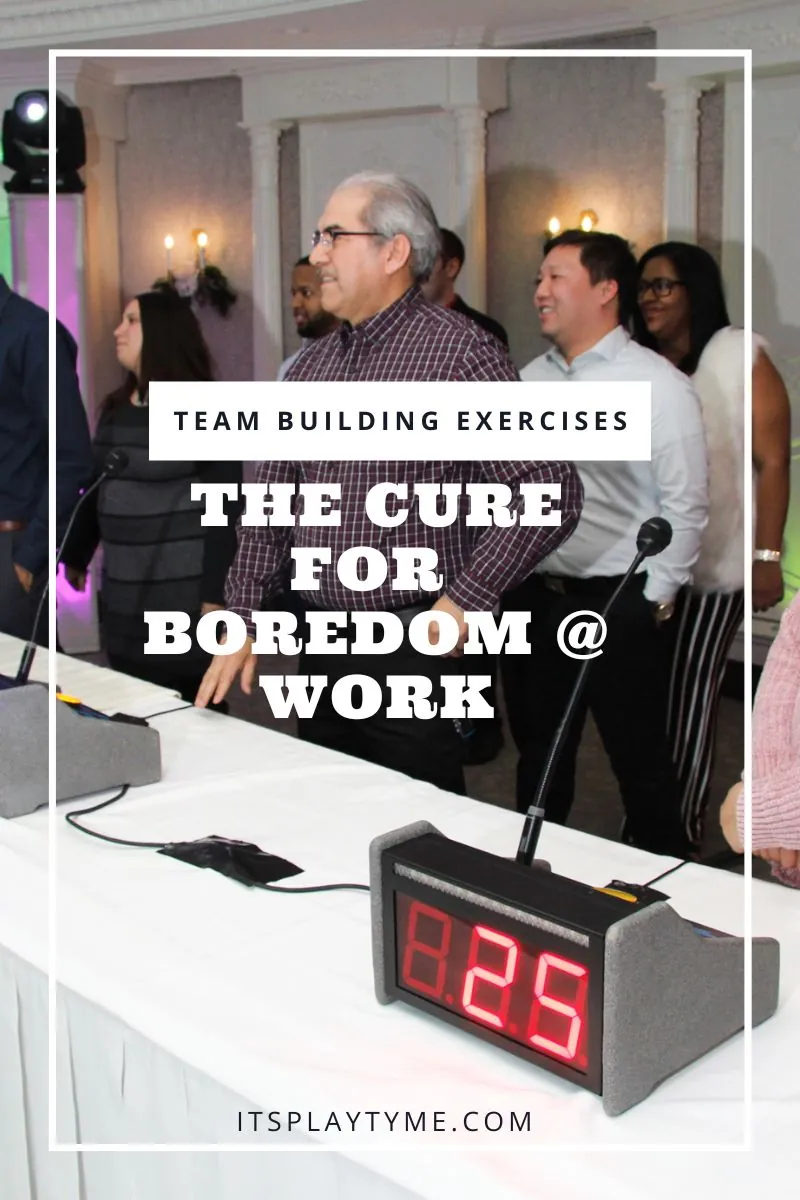
Live, hosted game shows modeled after popular TV formats (think Family Feud, Jeopardy, or Name That Tune) are the gold standard for group engagement. A professional emcee manages energy, pacing, and participation so every person in the room contributes without feeling singled out. It’s PlayTyme Game Shows specializes in exactly this format, bringing custom-branded game show experiences to corporate events across New Jersey, New York City, and Connecticut. Teams compete in rounds, laugh together, and build shared memories, all without the awkwardness of trust falls. Game shows work for groups of 20 to 300+ and adapt to any venue.
2. Improv Workshops
Guided improv sessions teach “yes, and” thinking, active listening, and quick collaboration. A trained facilitator leads structured exercises that feel playful but develop real communication skills. Improv strips away workplace hierarchy: the VP and the intern are equally funny (or equally awkward), and that shared vulnerability creates authentic connection. Sessions run 60 to 90 minutes and work best for groups under 50.
3. Collaborative Problem-Solving Challenges
Escape-room-style puzzles, scavenger hunts, and timed design challenges force teams to communicate under pressure. The best versions assign rotating leadership roles so quieter team members step up. These exercises reveal collaboration patterns (who dominates, who withdraws, who mediates) and give teams a shared language for discussing group dynamics afterward.
4. Volunteer and Give-Back Projects
Building bikes for charity, assembling care packages, or spending a morning at a food bank gives teams a purpose beyond the office. Shared altruism creates emotional bonds that outlast the event. These exercises also signal company values to employees who care about social responsibility, which is a growing majority of the workforce under 40.
5. Cooking or Creative Workshops
Cooking competitions, painting sessions, or pottery classes put employees in unfamiliar territory together. Nobody holds a title advantage when everyone is learning to make pasta from scratch. These activities lower defenses and encourage informal conversation that rarely happens in conference rooms.
6. Outdoor Adventure Challenges
Kayaking, hiking, or obstacle courses appeal to physically active teams. The shared adrenaline and mutual encouragement create strong bonds. However, these formats carry the highest exclusion risk: employees with physical limitations, health conditions, or simple discomfort with outdoor activities will disengage. Always offer an alternative track.
7. Quick Office Icebreakers
Two-minute activities like “two truths and a lie,” rose/thorn check-ins, or lightning-round introductions cost nothing and fit into any meeting. They are the lowest-investment option and deliver proportionally modest results. Icebreakers work best as warm-ups before a more substantial exercise, not as the main event.
DIY Icebreakers vs. Professionally Facilitated Events
The gap between a manager running a quick icebreaker and a professional facilitator running a game show is the same gap between a pickup basketball game and a coached tournament. Both involve the same sport. Only one produces measurable growth.
| Factor | DIY Icebreakers | Facilitated Game Shows & Improv |
|---|---|---|
| Engagement Level | Low to moderate | High (full-room participation) |
| Group Size | Best under 15 | 20 to 500+ |
| Facilitator Skill | Varies (often untrained) | Professional host reads and adjusts to the room |
| Inclusivity | Often favors extroverts | Structured so every personality type participates |
| Lasting Impact | Minimal (forgotten by next meeting) | Shared memories referenced for months |
| Cost | Free | Investment with measurable morale return |
DIY icebreakers have a place: they warm up a Monday standup or break the silence on a video call. But when the goal is genuine morale improvement, retention support, or cultural transformation, facilitated experiences deliver results that free activities simply do not match.
What Makes Facilitated Game Shows the Premium Tier
Among all facilitated formats, game shows consistently produce the highest participation rates. The reason is structural. Game shows remove the two biggest barriers to engagement: performance anxiety and social awkwardness.
In a game show, the rules are clear. Teams compete together (not individuals). The host carries the energy. Participants respond to prompts rather than generating content from nothing, which eliminates the “I don’t know what to say” freeze that kills improv and icebreakers for shy employees. The competitive format taps into natural motivation without creating real stakes or conflict.
It’s PlayTyme Game Shows builds on this structure by customizing content around a company’s industry, inside jokes, and team milestones. When survey questions reference the CEO’s famous meeting catchphrase or a department’s biggest project win, the laughter is louder because it is personal. That customization transforms a generic team building exercise into a shared experience that reinforces company culture.
Game shows also scale. A team building activity that works for 25 people often collapses at 100. Game shows thrive at every size because the format is built for large audiences. It’s PlayTyme regularly runs events for groups ranging from small leadership retreats to company-wide conferences with hundreds of participants.
How to Overcome Employee Resistance to Team Building
Even the best-designed team building exercises for employees hit resistance if the rollout is wrong. These strategies disarm skepticism before it takes hold.
Name the purpose upfront. Tell employees exactly why the activity exists and what outcome you expect. “We noticed cross-department collaboration dropped after the reorg, and this session is designed to rebuild those connections” is infinitely better than “mandatory fun day.”
Choose formats that protect dignity. No one should feel embarrassed, physically uncomfortable, or put on the spot in front of peers. Game shows and team-based challenges protect individual dignity because the team shares both credit and blame.
Make it opt-in whenever possible. Genuinely voluntary participation produces better outcomes than forced attendance. When the activity is good enough, word spreads and attendance grows organically.
Debrief afterward. Spend 10 minutes after any exercise asking teams what they noticed about how they worked together. This reflection converts a fun hour into a lasting behavioral shift.
Hire professionals for high-stakes moments. Annual retreats, onboarding cohorts, post-merger integration events: these carry too much weight for a DIY approach. Professional facilitators earn their fee by reading the room, managing difficult group dynamics, and ensuring every personality type feels included.
How to Choose Team Building Exercises That Employees Actually Want to Attend
Start with three questions. First: what is the specific outcome you need? Improved cross-team communication requires a different format than celebrating a product launch. Second: what is your group size and composition? A team of 12 engineers has different needs than a 200-person all-hands with sales, marketing, and operations together. Third: what is your budget relative to the stakes? A $0 icebreaker before a weekly standup is appropriate. A $0 icebreaker as your post-layoff morale strategy is not.
For high-impact moments (annual kickoffs, leadership retreats, culture resets), invest in a professionally facilitated experience. Game shows and improv workshops deliver the highest engagement-per-dollar because they include every personality type, scale to any group size, and create shared memories that outlast the event.
For everyday connection (weekly meetings, onboarding check-ins, remote standups), use quick icebreakers and structured check-ins. Keep them short, rotate formats, and never force participation.
For mid-tier needs (quarterly team days, department outings), mix formats. Open with a quick icebreaker, move into a facilitated game show or collaborative challenge, and close with a 10-minute debrief. This layered approach gives employees variety and builds momentum through the session.
If you are planning a corporate event, leadership retreat, or team building day in New Jersey, New York City, or Connecticut, get in touch with It’s PlayTyme Game Shows to design a custom game show experience your employees will talk about long after the event ends.
Frequently Asked Questions (FAQs)
What are the best team building exercises for employees who hate team building?
Game shows and team-based trivia work best for resistant employees because the format is familiar, the rules are clear, and no one is singled out. The competitive structure channels skepticism into energy. Employees who dread trust falls and awkward icebreakers consistently rate facilitated game shows as enjoyable because the host carries the social pressure, not the participants.
How often should companies run team building exercises for employees?
Run lightweight icebreakers weekly or biweekly during regular meetings. Schedule a professionally facilitated event quarterly or at key milestones (kickoffs, post-reorg, new hire cohorts). Annual retreats supplement but do not replace consistent smaller touchpoints throughout the year.
Do team building exercises for employees actually improve productivity?
Yes. Teams that build trust through shared positive experiences communicate faster, resolve conflict earlier, and collaborate with less friction. Gallup’s research shows that teams with high engagement outperform disengaged teams by 20% in profitability. The quality of the exercise determines the outcome: poorly run activities waste time, while well-facilitated events produce measurable gains.
How much does a professionally facilitated team building event cost?
Costs vary by format, group size, and location. A facilitated game show for 50 to 200 employees typically ranges from a few hundred to a few thousand dollars, depending on customization and duration. Compare that to the cost of replacing a single disengaged employee (SHRM estimates $4,700 on average) and the investment becomes clear.
What team building exercises work for remote or hybrid teams?
Virtual game shows, online trivia competitions, and remote improv sessions all translate well to video platforms. The key is professional facilitation: a trained host who manages breakout rooms, keeps energy high on camera, and ensures remote participants engage as fully as those in the room. It’s PlayTyme Game Shows offers a hybrid format on request for distributed teams.
What does employee disengagement actually cost a business?
Gallup’s 2024 State of the Global Workplace report found that only 20% of employees worldwide were engaged at work, and that global disengagement costs an estimated $10 trillion annually in lost productivity — a figure that makes a structured team building investment straightforward to justify.