Only 20% of employees worldwide are actively engaged at work, according to Gallup’s State of the Global Workplace report. That disengagement costs organizations hundreds of billions in lost productivity every year. One of the fastest ways to re-energize a group is to get them solving problems together, and brain teasers are purpose-built for that.
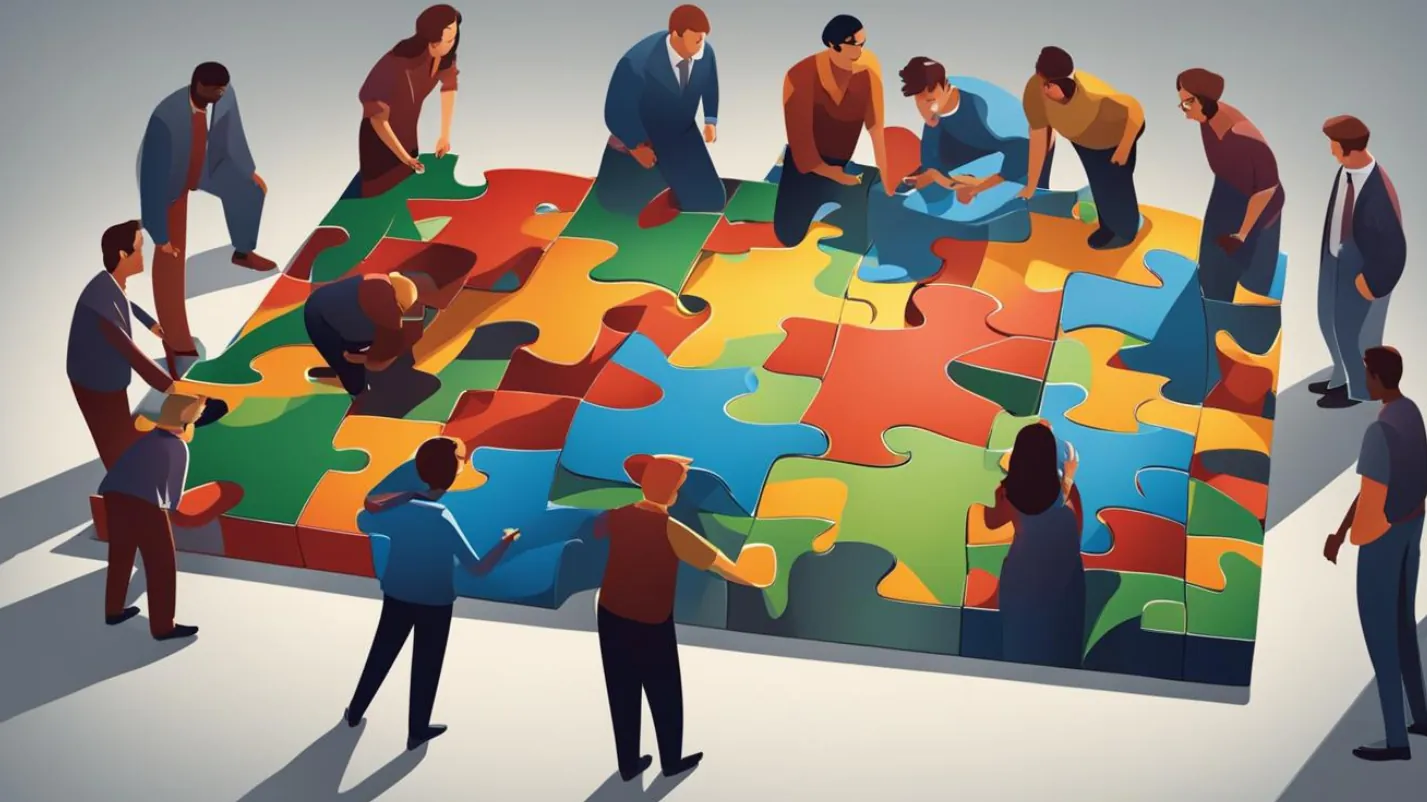
Research published in Harvard Business Review found that teams with higher cognitive diversity solve problems significantly faster than homogeneous groups. Brain teasers force exactly this kind of thinking: they reward different perspectives, lateral logic, and the willingness to speak up with an unconventional answer. That makes them one of the most effective (and cheapest) team building tools available.
Still, most teams never use brain teasers beyond a single awkward icebreaker question. Facilitators pick puzzles that are too easy (everyone groans) or too obscure (nobody speaks). There is no structure, no scoring, and no connection to larger team goals. The result is a flat activity that people forget within the hour. This guide fixes that. Below you will find 21 tested brain teasers organized by difficulty, complete answer explanations, and a practical playbook for turning them into a high-energy team session.
Why Brain Teasers Work for Team Building
Brain teasers succeed where many corporate activities fail because they strip away hierarchy. A new hire and a senior director stand on equal footing when the question is “What has keys but no locks?” Nobody’s job title gives them an edge. That dynamic opens communication channels that stay shut during normal work hours.
They also build three skills that transfer directly to the workplace:
- Lateral thinking – teasers train people to look beyond the obvious first answer, which is the same muscle used in creative problem solving on real projects.
- Active listening — in a team setting, solving a tricky riddle requires hearing and building on other people’s ideas rather than waiting for your turn to talk.
- Comfort with being wrong – brain teasers normalize trial and error. Teams that practice failing fast on a riddle carry that resilience into higher-stakes work.
Where Standard Team Icebreakers Fail to Include Everyone
Most icebreaker activities suffer from the same set of problems. Understanding these makes it clear why brain teasers, done right, are a stronger alternative.
- Low participation: “Tell us a fun fact about yourself” puts introverts on the spot. Half the room checks out immediately.
- No shared objective: Without a puzzle to solve together, there is no reason for teammates to actually collaborate. The activity becomes a series of solo performances.
- Difficulty mismatch: Activities designed for small groups fall apart at 30, 50, or 100 people. Facilitators rarely adjust the format for group size.
- Zero follow-through: Even when an icebreaker lands, there is no bridge connecting the warm-up energy to the rest of the event. The momentum dies.
Brain teasers solve each of these when you organize them into rounds with escalating difficulty, team-based scoring, and a competitive format. That structure turns a simple riddle into a genuine team experience.
Easy Team Building Brain Teasers (Warm-Up Round)
Start every session here. These teasers get people talking without intimidating anyone. Give teams 30 seconds per question.
1. I speak without a mouth and hear without ears. I have no body, but I come alive with the wind. What am I?
Answer: An echo. Sound waves bounce off surfaces and return to the listener. The “wind” clue points to how sound travels through air. This teaser teaches teams to focus on the metaphor rather than taking the words literally.
2. What has keys but no locks?
Answer: A piano. The word “keys” triggers an assumption about doors and security. Teams that solve this quickly have already started thinking laterally.
3. What gets wetter the more it dries?
Answer: A towel. The verb “dries” pulls attention toward evaporation. The trick is recognizing that “dries” here means “dries something else.”
4. What has a head and a tail but no body?
Answer: A coin. This one rewards the team member who thinks about everyday objects instead of animals. It is a good early confidence builder.
5. What has hands but cannot clap?
Answer: A clock. Another misdirection based on a double meaning. Teams start to see the pattern: brain teasers exploit the gap between a word’s common meaning and its alternate meaning.
6. What travels around the world while staying in a corner?
Answer: A postage stamp. This teaser rewards general knowledge. It also works well as a conversation starter because most people under 30 have barely used physical stamps.
7. If you have me, you want to share me. If you share me, you no longer have me. What am I?
Answer: A secret. This riddle sparks group debate because the logic feels paradoxical. It is an ideal bridge into the medium round because teams realize the puzzles are getting trickier.
Medium Team Building Brain Teasers (Group Discussion Round)
These require teams to talk through the logic together. Give 60 seconds per question and encourage groups to discuss before locking in an answer.
8. A man looks at a photograph. Someone asks, “Whose picture is that?” He replies: “Brothers and sisters I have none, but that man’s father is my father’s son.” Who is in the photograph?
Answer: His son. “My father’s son” is the man himself (he has no siblings). So “that man’s father is me” means the person in the photo is his son. This teaser exposes how groups handle complex sentence structures and whether they slow down to parse the logic.
9. You see a boat filled with people, yet there is not a single person on board. How is that possible?
Answer: All the people on the boat are married. The word “single” is the trap. This teaser always gets a laugh and rewards the teammate who catches the double meaning first.
10. What disappears as soon as you say its name?
Answer: Silence. Short, elegant, and surprisingly difficult under time pressure. Teams that overthink this one learn a useful lesson: sometimes the simplest answer is correct.
11. I have cities but no houses, forests but no trees, and water but no fish. What am I?
Answer: A map. This teaser tests whether teams think abstractly about representations versus physical reality. It is a strong discussion prompt.
12. A farmer has 17 sheep. All but 9 die. How many sheep does the farmer have left?
Answer: 9. The phrasing “all but 9” tricks people into doing subtraction (17 minus 9). The answer is stated directly in the question. Teams learn to read carefully before calculating.
13. Two fathers and two sons sit down for breakfast. They eat exactly three eggs, each person eating one egg. How is that possible?
Answer: They are three people: a grandfather, a father, and a son. The father is both a son (to the grandfather) and a father (to his own child). This teaser rewards teams that question assumptions about the number of people involved.
14. What comes once in a minute, twice in a moment, but never in a thousand years?
Answer: The letter M. This is a pure wordplay teaser. It shifts teams from logical reasoning to pattern recognition, which keeps the session from feeling one-dimensional.
Hard Team Building Brain Teasers (Championship Round)
Save these for the final round. Give teams 90 seconds to two minutes per question. These teasers reward structured thinking and genuine collaboration.
15. You are in a room with three light switches. Each controls one of three bulbs in the next room. You get to enter the next room only once. How do you figure out which switch controls which bulb?
Answer: Turn on switch 1 and wait several minutes. Turn it off, then immediately turn on switch 2. Enter the room. The lit bulb connects to switch 2. Touch the remaining two: the warm bulb connects to switch 1, and the cold bulb connects to switch 3. This teaser introduces the idea of using multiple senses (sight and touch) to gather data, which mirrors real-world problem solving where the answer requires more than one source of information.
16. A man pushes his car to a hotel and tells the owner he is bankrupt. Why?
Answer: He is playing Monopoly. The entire scenario describes a board game, not real life. This teaser tests whether teams challenge the assumed context of a problem, a skill that directly applies to workplace decision making.
17. You measure my life in hours, and I serve you by expiring. I am quick when I am thin and slow when I am fat. The wind is my enemy. What am I?
Answer: A candle. Each clue maps to a physical property of a candle. “Quick when thin” refers to how a thin candle burns faster. This teaser rewards methodical, clue-by-clue analysis over guessing.
18. I am not alive, but I grow. I do not have lungs, but I need air. I do not have a mouth, but water kills me. What am I?
Answer: Fire. Every line contains a contradiction that points to the same answer. Teams that assign each clue to a different member and then compare notes solve this fastest.
19. Three boxes are labeled “Apples,” “Oranges,” and “Apples & Oranges.” Every label is wrong. You draw one fruit from one box without looking inside. How do you correctly label all three boxes?
Answer: Draw from the box labeled “Apples & Oranges.” Since every label is wrong, this box contains only one type of fruit. If you draw an apple, this box is “Apples.” The box labeled “Oranges” cannot actually contain oranges (wrong label) and cannot contain only apples (that label is taken), so it must be “Apples & Oranges.” The remaining box is “Oranges.” This teaser teaches constraint-based reasoning: eliminating impossible options to find the answer.
20. You have 8 identical-looking balls. One is slightly heavier. Using a balance scale only twice, how do you find the heavier ball?
Answer: Divide the balls into three groups: 3, 3, and 2. Weigh the two groups of 3 against each other. If they balance, the heavier ball is in the group of 2 (weigh them to find it). If one side is heavier, take those 3 balls, weigh 1 against 1. If they balance, the third ball is the heavy one. If one side drops, that ball is heavier. This teaser rewards teams that think in decision trees rather than brute-force trial and error.
21. Three guests check into a hotel room that costs $30. Each pays $10. The manager realizes the room is only $25 and gives $5 to the bellhop to return. The bellhop keeps $2 and gives $1 back to each guest. Each guest has now paid $9 (totaling $27), plus the $2 the bellhop kept equals $29. Where is the missing dollar?
Answer: There is no missing dollar. The $27 the guests paid already includes the $2 the bellhop kept ($25 for the room plus $2 tip). Adding the $2 to $27 double-counts it. The correct accounting: $25 (room) + $2 (bellhop) + $3 (returned) = $30. This teaser is a masterclass in how framing distorts perception, a lesson every team benefits from when reviewing budgets, timelines, or project scopes.
How to Run a Brain Teaser Round in a Real Team Session
Having great brain teasers is only half the equation. The format determines whether your session feels electric or awkward. Follow this structure for groups of 20 to 300+ people.
Step 1: Split Into Teams
Divide participants into groups of 4 to 6. Mix departments and seniority levels. Assign each team a name (or let them choose one in 60 seconds for an instant bonding moment).
Step 2: Set the Rounds
Run three rounds matching the difficulty tiers above. Display each teaser on a screen or read it aloud. Teams write their answer on a whiteboard or buzzer system.
| Round | Difficulty | Questions | Time per Question | Points per Correct Answer |
|---|---|---|---|---|
| 1 | Easy | 7 | 30 seconds | 1 |
| 2 | Medium | 7 | 60 seconds | 2 |
| 3 | Hard | 7 | 90 seconds | 3 |
Step 3: Reveal and Discuss
After each round, walk through the answers. Ask a team to explain their reasoning, not just their answer. This is where the real team building happens: people learn how their colleagues think.
Step 4: Crown a Winner
Tally scores and announce the winning team. A small prize (bragging rights, a trophy, first pick at lunch) keeps the competitive energy high without making it feel corporate.
Why It’s PlayTyme Game Shows Builds Brain Teasers Into Every Event
Running a brain teaser session yourself takes preparation, timing, and a facilitator who reads the room. It’s PlayTyme Game Shows handles all of that. Their corporate game show format includes brain teaser rounds alongside trivia, physical challenges, and multimedia questions, all run by a professional host with full sound, lighting, and scoring technology.
The difference between a DIY brain teaser session and an It’s PlayTyme event is production quality and pacing. Their hosts adjust difficulty on the fly based on how the group responds. They rotate puzzle types so energy never dips. And they handle groups from 20 to 300+ people across New Jersey, New York City, and Connecticut, bringing all equipment to your venue. Brain teasers become one high-energy segment inside a complete team building experience rather than a standalone activity you have to design from scratch.
Getting Brain Teaser Difficulty Right for Your Group
Not every brain teaser works for every audience. The right selection depends on three factors: group size, familiarity level, and session goals.
For new teams or onboarding groups, stick to easy and medium teasers. The goal is conversation, not competition. Teasers 1 through 14 from this list work well because they generate discussion without making anyone feel lost.
For established teams looking for a challenge, jump straight to the medium and hard rounds. These teasers reward structured reasoning and collaboration, both skills that strong teams want to sharpen.
For large events (50+ people), a hosted game show format works far better than a self-run session. Professional facilitators keep the energy consistent across the room and make sure every team stays engaged, not just the loudest table. That is exactly what It’s PlayTyme delivers at corporate events and team building trivia sessions throughout the tri-state area.
If you want to turn brain teasers into a full team building event your group actually remembers, get in touch with It’s PlayTyme and let their team design a custom game show around your goals.
Frequently Asked Questions (FAQs)
How many brain teasers should I use in a team building session?
Plan for 15 to 21 brain teasers split across three difficulty rounds. This gives you 45 to 60 minutes of content with time for answer reveals and group discussion between rounds. Fewer than 10 teasers makes the session feel too short to build real momentum.
Do brain teasers work for large corporate groups?
Yes. Brain teasers scale well because teams of 4 to 6 people discuss each question internally before submitting an answer. Groups of 100 or more run smoothly with a professional host, a visible scoreboard, and a buzzer or whiteboard system for answers.
What is the best team size for brain teaser activities?
Groups of 4 to 6 people produce the best results. Smaller teams lack enough perspectives to solve harder teasers. Larger teams (8+) often have members who disengage because they cannot contribute to the conversation.
Are brain teasers appropriate for all industries and departments?
Brain teasers are industry-neutral. They test logic, wordplay, and lateral thinking rather than domain expertise. This makes them ideal for cross-departmental events where participants have different professional backgrounds and knowledge bases.
How do I keep competitive brain teaser rounds from getting too intense?
Use a scoring system that rewards collaboration over speed. Award bonus points when a team explains their reasoning clearly, not just when they answer correctly. Mixing easy rounds between hard ones also keeps the mood fun and prevents frustration from building up.