

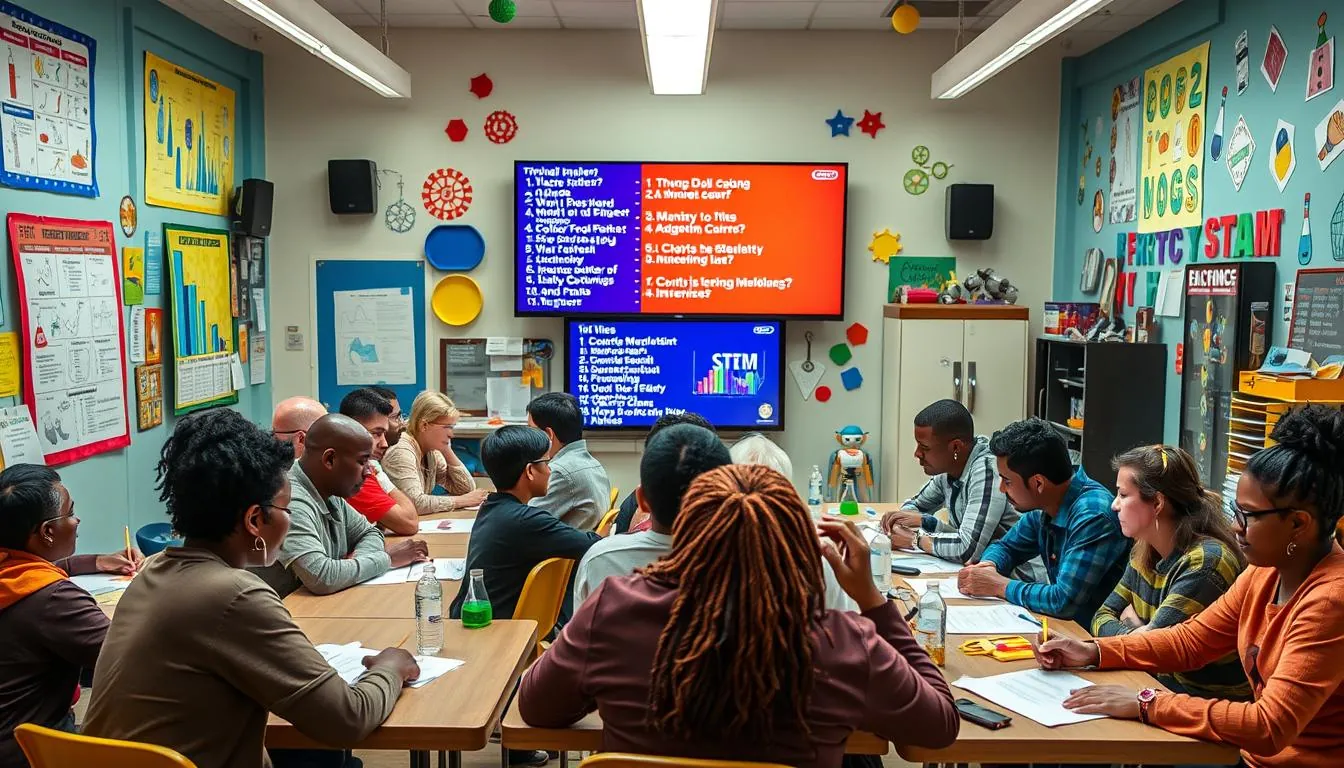

A STEM trivia challenge works when it is run as a live competition with a host, teams and a scoreboard, in front of the whole grade. Handed out as a worksheet it is a quiz. Run as a game show it becomes the event students talk about in the hallway afterwards, and that difference is the entire reason schools book one.
The subject matter is worth the airtime. The Bureau of Labor Statistics projects STEM employment to grow 8.1% from 2024 to 2034 against 3.1% for all occupations, with a median annual wage of $103,580 for STEM roles compared with $48,000 for non-STEM roles. New Jersey takes it seriously enough that March is formally designated NJ STEM Month by legislative resolution and gubernatorial proclamation, coordinated by the New Jersey STEM Pathways Network.
Schools still struggle to program it. A STEM assembly that lectures loses a middle-school audience in minutes. A club competition reaches the 30 students already interested. And the students the school most wants to reach, the ones who have decided science is not for them, are exactly the ones who do not sign up. A live team format solves that by making participation the default rather than a choice.
STEM Event Formats Compared
| Format | Reaches | Grade Band | Staff Prep | Best Used For |
|---|---|---|---|---|
| Hosted STEM game show assembly | Whole grade or whole school, 50 to 300+ | Grades 3 to 12, content scaled | Minimal, production travels | Kicking off NJ STEM Month or a STEM week |
| Classroom quiz bowl | One class at a time | Any | High, teacher writes questions | Unit review |
| Science fair | Students who opt in | Grades 4 to 12 | Very high, months of coordination | Deep individual projects |
| Robotics or coding club | A small committed cohort | Grades 5 to 12 | High and ongoing | Sustained skill building |
| Guest speaker or career day | Whole grade, watching | Grades 6 to 12 | Low to moderate | Connecting subjects to careers |
| Hands-on lab day | One class or grade at a time | Any | High, materials and supervision | Practical experience |
Where School STEM Programming Falls Short for Most Students
Five constraints shape what a New Jersey school can realistically run.
- Opt-in formats reach the already-converted. Clubs and fairs draw the students who like science. The students who have written themselves off never sign up, and they are the reason the event exists.
- Teacher prep time is the scarcest resource. Anything that requires a teacher to write 60 questions and run the technology competes directly with lesson planning.
- Mixed ability in one room. A grade-wide event spans several years of readiness. Questions pitched at the top third lose everyone else within two rounds.
- Space is a gym or a cafeteria. Most New Jersey schools have no theatre. Any production has to bring its own sound and set and work in a room with poor acoustics.
- Calendars are locked early. With NJ STEM Month in March and testing windows in spring, the assembly slot has to be booked months ahead.
How a Hosted STEM Challenge Runs
A professional emcee runs the grade as competing teams with a full game show set, sound system and live scoreboard. Rounds mix science, technology, engineering and math content with visual and estimation questions so that a student who is weak on recall can still contribute. Teams answer together, so nobody is exposed alone, and scoring is weighted so a late round can still change the outcome.
The whole production travels to your gym, cafeteria or auditorium, which removes bussing and permission slips from the plan. Content is scaled to the grade band, and questions can be built around what the school is actually teaching that term, which turns the assembly into review as well as an event.
A typical run is 45 to 75 minutes depending on grade level and period length. Elementary audiences do better with shorter rounds and more visual content; high school audiences can carry longer rounds and harder recall. See our school assembly programs for how a booking is structured.
Building Questions That Include the Whole Grade
The design goal is that every team scores in every round. Four rules get you there.
- Mix question types: recall, visual identification, estimation and applied reasoning. A student who cannot name the parts of a cell can still estimate how many times a heart beats in a day.
- Start easy. The first round exists to get every team on the board, not to separate the field.
- Tie some content to local context: New Jersey industries, local rivers and geology, engineering the students pass on the way to school.
- Keep rounds short. Two to three minutes per question maximum, then move, so a team that starts badly stays in it.
Where It Fits the New Jersey School Calendar
March is the obvious slot. NJ STEM Month is a formal state designation coordinated by the New Jersey STEM Pathways Network, so an event scheduled that month connects to a wider programme and gives the school something to publicize.
Autumn works as well for schools that want the event to set a tone for the year rather than to cap it. Avoid the spring testing window entirely, and book by the previous term, since March fills quickly across the state. New Jersey operates hundreds of school districts and thousands of public schools, and the competition for March dates reflects that.
Making It Count Beyond the Assembly
An event that stands alone is a good afternoon. Three cheap follow-ups turn it into a programme:
- Publish the winning team and the hardest question in the school newsletter the same week.
- Give teachers the question set so they can rerun rounds in class as review.
- Use the event to recruit for the robotics or coding club while interest is still high, since the students you most want in the club have just discovered they are good at this.
Choosing the Right STEM Event for Your School’s Goal
Start with who you are trying to reach. If the goal is to deepen the skills of committed students, a club or a fair is the right investment and an assembly will not substitute for it. If the goal is to reach the students who have decided STEM is not for them, you need a format that includes everyone by default, which means a whole-grade event with team scoring.
Then check staff capacity honestly. A teacher-run quiz bowl costs nothing in budget and a great deal in preparation. A hosted production costs budget and almost no preparation. Districts running lean on staff time usually get more delivered per dollar from the hosted option.
Finally, match content to the room. One grade band at a time works better than a K-8 assembly, because a question set that fits third grade will not hold eighth. If you have to combine, split the scoring so younger teams compete against each other.
Send us your grade levels, student count and the space you have, and we will scale the question set and the run of show to your school. Middle schools can start with our middle school assembly programs.
Frequently Asked Questions (FAQs)
What is a STEM trivia challenge?
A live competition where students play in teams against a question set covering science, technology, engineering and math, run by a host with a scoreboard in front of the whole grade. It differs from a classroom quiz because participation is the default, teams answer together rather than individuals, and the format is built to keep every team scoring rather than to rank them.
What grade levels does a STEM game show work for?
Grades 3 through 12, with the content and round length scaled to the band. Elementary audiences need shorter rounds and more visual questions. Middle school handles a mix of recall and estimation well. High school can carry longer rounds and harder content. Running one grade band at a time works better than combining a wide age range.
When should we schedule a STEM event in New Jersey?
March is the natural slot, since it is formally designated NJ STEM Month by the state and coordinated through the New Jersey STEM Pathways Network. Autumn works for schools that want the event to set the tone for the year. Avoid the spring testing window, and book at least a term ahead because March dates fill quickly.
How long does a STEM assembly take?
Forty-five to seventy-five minutes depending on grade level and period structure, plus setup time before the first bell. Elementary schools usually run the shorter version. Allow about 90 minutes of load-in for the set and sound system, and confirm gym or cafeteria availability for that window when you book.
Do we need special equipment or a stage?
No. The production travels with its own set, sound system and scoreboard and works in a gym, cafeteria or auditorium. What you need is a clear front of the room, standard power access, and seating with a sightline for the back rows. Confirm access for load-in and any district insurance requirement when the date is set.
Why do New Jersey schools schedule dedicated STEM assemblies?
New Jersey formally designates March as NJ STEM Month by legislative resolution and gubernatorial proclamation. Schools use that window to reinforce STEM career awareness, with the Bureau of Labor Statistics projecting STEM employment to grow at nearly three times the rate of all occupations through 2034.