
Companies that prioritize team engagement outperform their competitors in measurable ways. Gallup’s meta-analysis found that business units with highly engaged teams produce 21% greater profitability. Separately, research published in Harvard Business Review showed that employees with a strong sense of belonging at work demonstrate a 56% increase in job performance. A dedicated team building day gives your organization a focused opportunity to strengthen both engagement and connection in a single, high-impact event.
But filling an entire day (six to eight hours) with activities that actually hold attention is a different challenge than booking a quick afternoon workshop. A full team building day requires intentional pacing, variety across activity types, and built-in energy management so the group stays locked in from the first icebreaker through the final award.
Most organizers run into the same wall when searching for team building day ideas for work: they string together a handful of activities that sound fun on paper, then watch energy crater after lunch. Mixed personality types complicate things further. Introverts check out during loud group games. Competitive employees dominate quieter exercises. And the people who didn’t want to be there in the first place never get pulled in. Without a deliberate structure, even well-intentioned team building days become forgettable.
The Hard Parts of Planning an All-Day Team Event
Organizing a team building day that works from 9 a.m. to 4 p.m. introduces planning problems that shorter events avoid entirely.
- Energy management: Attention spans fluctuate throughout the day. The post-lunch dip is real, and passive activities during that window guarantee disengagement.
- Personality diversity: Your team includes people who thrive on competition and people who dread being put on the spot. A full-day format must accommodate both without watering down the experience for either group.
- Activity fatigue: Repeating the same type of exercise (all icebreakers, all physical challenges, all discussion-based workshops) wears thin quickly. Variety in format is non-negotiable.
- Meaningful outcomes: Leadership wants results: better communication, stronger cross-department relationships, improved morale. Generic trust falls and scavenger hunts rarely deliver on those goals.
- Logistics at scale: Coordinating space, food, timing, and facilitators across 30, 50, or 100+ participants adds operational complexity that a two-hour session never touches.
These challenges explain why so many companies either avoid full-day events or settle for underwhelming ones. The solution is a structured agenda arc that matches the right activity type to each part of the day.
The Ideal Team Building Day Agenda Arc
The best team building days follow a three-act structure: warm-up, peak competition, and a strong close. This mirrors how energy naturally flows through a group over several hours. Start low-stakes to build comfort, ramp into high-energy competition during peak alertness, then bring the group together for recognition and reflection before wrapping up.
This arc keeps participants engaged because each phase serves a specific purpose. The morning builds psychological safety. The midday block channels that safety into spirited competition. The afternoon converts shared experience into lasting team identity. Every section feeds the next.
Morning: Icebreakers That Set the Tone
The first 60 to 90 minutes of a team building day determine whether people lean in or mentally check out. Start with activities that are quick, low-pressure, and genuinely entertaining.
Quick-Fire Trivia Rounds
Short trivia bursts (pop culture, company history, industry facts) get people talking and laughing immediately. Small teams of four to six work well here because everyone participates.
Two Truths and a Game Show Twist
Take the classic “two truths and a lie” format and turn it into a scored competition. Teams guess which statements are false about their colleagues, earning points on a visible leaderboard. This builds familiarity across departments while keeping the energy playful.
“Speed Round” Introductions
Pair people from different teams for 90-second rapid-fire Q&A sessions. Rotate partners three or four times. By the end, every participant has connected with people they rarely interact with during normal work.
The goal of the morning block is simple: get every person in the room comfortable, laughing, and ready to compete. A professional host who reads the room and adjusts pacing on the fly makes a significant difference here.
Midday: Competitive Game Rounds That Build Momentum
This is the centerpiece of the day and the block where a team building event either soars or stalls. Midday energy is highest, and the format needs to match that intensity.
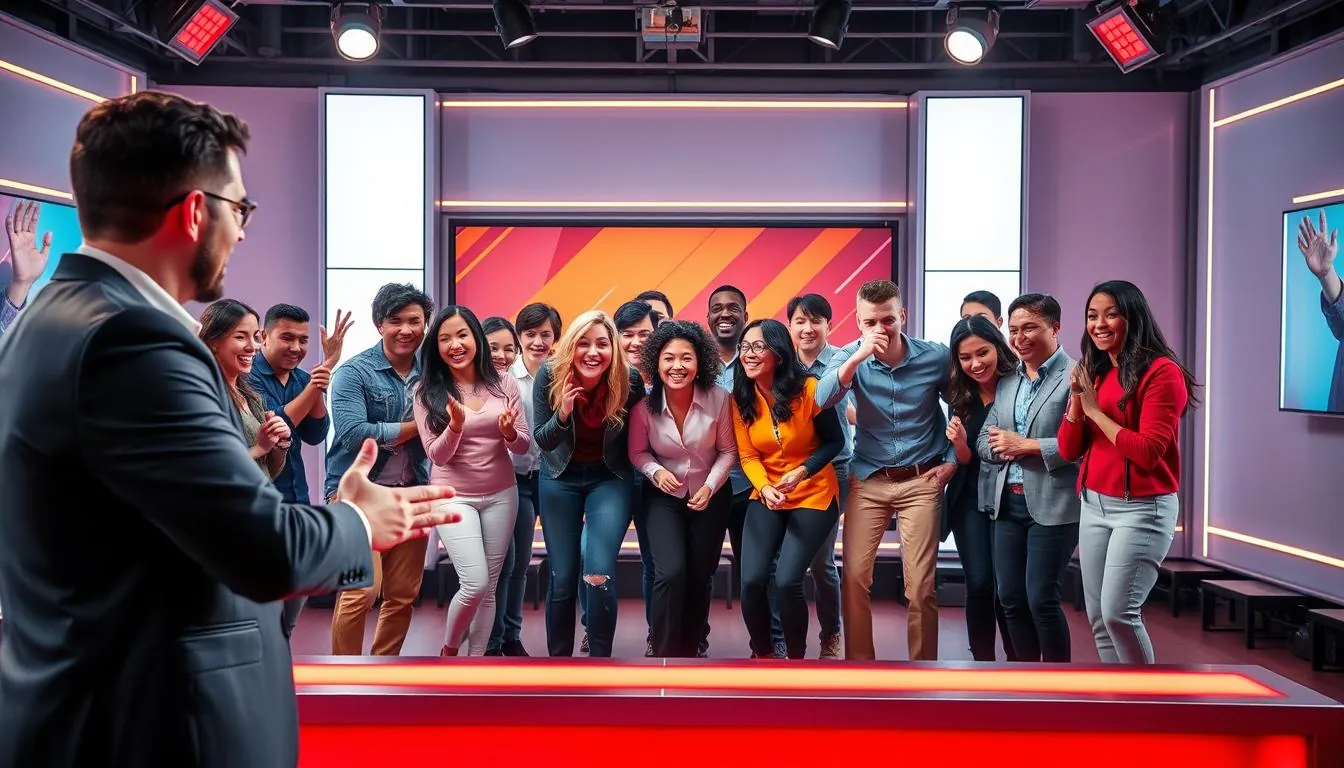
It’s PlayTyme Game Shows specializes in exactly this kind of programming. Their multi-round game show format is built for sustained engagement across large groups. Think buzzer-based team competitions, interactive challenges projected on large screens, and a professional host who keeps the pace sharp and the energy high. Teams rotate through rounds that test different skills (trivia knowledge, physical coordination, strategic thinking) so no single personality type dominates.
The game show structure works because it creates natural momentum. Each round builds on the previous one, scores accumulate on a visible leaderboard, and the stakes increase as teams approach the final round. Participants who started the morning as strangers are now strategizing together, celebrating correct answers, and trash-talking rival teams. That kind of organic bonding is exactly what a team building day is designed to produce.
Afternoon: Awards, Reflection, and the Strong Finish
The final 60 to 90 minutes of a team building day determine whether the experience sticks or fades by Monday morning. A strong close has three components.
Awards Ceremony
Recognize the winning team, but also hand out awards for standout moments: best comeback, best team name, funniest wrong answer, MVP of a specific round. Broad recognition ensures everyone leaves feeling acknowledged, not just the winners.
Team Debrief
Give teams five to ten minutes to discuss what worked well during the day: what communication strategies clicked, who stepped up in unexpected ways, what they learned about each other. Keep it short and forward-looking rather than turning it into a corporate feedback session.
Group Photo and Closing Energy
End on a high note. A final all-hands moment (group photo, team cheer, or one last lightning-round question) sends people out with positive energy instead of the slow fizzle that plagues poorly planned events.
Why Game Show Formats Outperform Traditional Team Building Activities
Escape rooms, ropes courses, cooking classes, and volunteer projects all have their place. But none of them are designed to sustain energy across a full six- to eight-hour day the way a structured game show format is.
Game shows solve the core problem of full-day programming: pacing. Every round has a defined start, middle, and end. Transitions happen naturally between rounds. A professional host reads the room and adjusts timing, humor, and difficulty in real time. The competitive format gives participants a reason to stay engaged even during the post-lunch window that kills passive workshops.
It’s PlayTyme’s corporate event programs are specifically structured for extended engagements. Their team has run full-day programs for companies across New Jersey, New York City, and Connecticut, adapting the game show format to groups ranging from 20 to 300+ participants.
Sample Full-Day Team Building Agenda
| Time Block | Activity | Purpose |
|---|---|---|
| 9:00-9:30 AM | Arrival, coffee, and informal mingling | Settle in and reduce first-hour awkwardness |
| 9:30-10:30 AM | Icebreaker rounds (trivia, speed intros) | Build comfort and cross-team familiarity |
| 10:30-10:45 AM | Break | Reset before main competition |
| 10:45 AM 12:15 PM | Game show rounds (Phase 1) | Channel energy into structured team competition |
| 12:15-1:00 PM | Lunch | Refuel and socialize |
| 1:00-2:30 PM | Game show rounds (Phase 2, higher stakes) | Re-engage post-lunch with escalating competition |
| 2:30-2:45 PM | Break | Final reset before closing |
| 2:45-3:30 PM | Championship round and awards ceremony | Peak moment and team recognition |
| 3:30-4:00 PM | Team debrief, group photo, close | Lock in the experience and end strong |
This agenda provides a complete framework, but every team is different. The right provider adjusts timing, activity types, and difficulty based on your group’s size, industry, and goals.
Choosing the Right Format for Your Team Building Day
Selecting the right team building day format comes down to three factors: group size, desired outcomes, and how much of the logistics you want handled for you.
If your primary goal is improving cross-department communication, prioritize formats that mix teams rather than keeping existing departments together. If you need to energize a large group (50+ people), choose a format with a professional host and AV setup that projects to the entire room. If you want your team building day to be genuinely fun (not just HR-approved fun), pick a provider whose entire business is built around audience engagement.
It’s PlayTyme Game Shows checks every box. Their programs are designed for groups of all sizes, facilitated by experienced hosts, and structured to deliver measurable energy from the first round to the final award. They handle the planning, equipment, and execution so your team focuses on participating, not organizing.
Ready to plan a team building day your employees will actually talk about? Get in touch with It’s PlayTyme to discuss your group size, goals, and preferred date. Their team works with companies across the tri-state area to build custom team building programs that keep every participant engaged from start to finish.
Frequently Asked Questions (FAQs)
How long should a team building day last?
Most successful team building days run six to eight hours, including breaks and meals. This gives your group enough time for icebreakers, multiple competition rounds, and a proper awards ceremony without rushing through any phase.
What team building day ideas work for large groups over 50 people?
Game show formats are ideal for large groups because they use AV equipment, projected scoreboards, and a professional host to engage the entire room simultaneously. Activities like escape rooms or cooking classes struggle at this scale because they require splitting into small, isolated groups.
How do you keep energy high after lunch during a team building day?
Schedule your most competitive, high-stakes rounds for the post-lunch block. A skilled host re-engages the room quickly, and escalating competition (higher point values, elimination rounds) pulls participants back in. Avoid passive presentations or discussion-heavy activities during this window.
How far in advance should we book a team building day?
Book at least four to six weeks in advance, especially if your event falls during peak seasons (spring and fall). Popular providers like It’s PlayTyme Game Shows fill dates quickly, and earlier booking gives you more flexibility on scheduling and customization.