Quick answer: Book a professionally hosted team building session at your agency’s annual meeting or January sales kickoff. Put producers and service staff on mixed teams. A live game show gives each table a shared task and gives colleagues across roles and offices a reason to talk.
Think back to last year’s annual meeting. Producers sat with producers, and account managers caught up with their own desks. Colleagues who only meet on screen went home without a real conversation.
Everyone was in the same room, but the seating chart still looked like the org chart. A hosted session gives an agency owner, HR director, or office manager one block where sales, service, and operations work on the same task. Start by naming the people you want talking across tables by the end of the day.
What Does Team Building for Insurance Agents Look Like?
For insurance agents and producers, team building means working alongside the people who carry an account after the sale, whether you work at an independent insurance agency or a regional brokerage. Seat producers with account managers, client service representatives (CSRs), and operations staff. If you run more than one office, mix branches too.
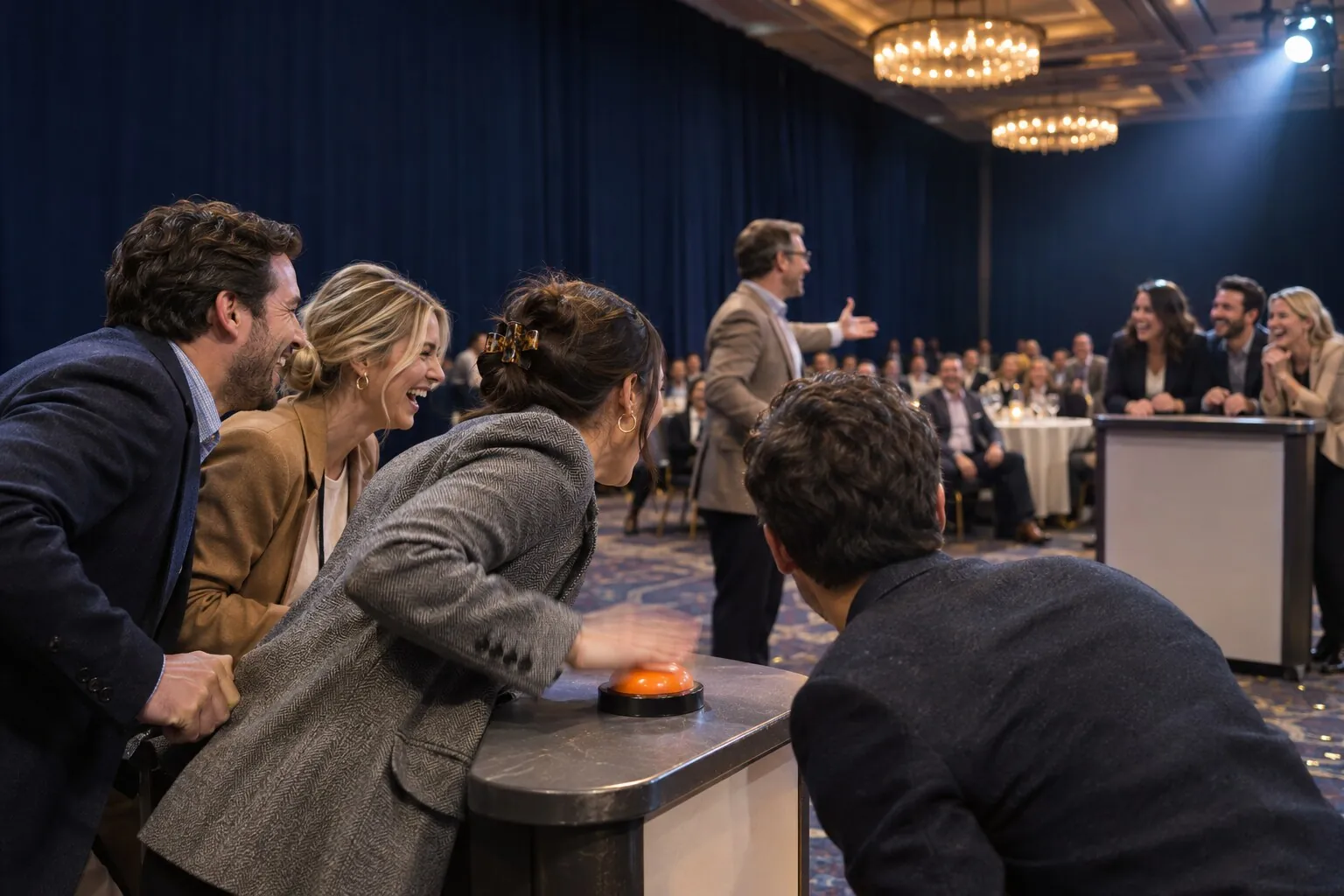
It’s Playtyme Game Shows has run hosted corporate team-building sessions since 2012 for groups of 20 to 300+ people. Face-2-Face Feud, a survey-style team format, gives each mixed team a question to discuss and one answer to agree on. The host explains the rules, keeps the rounds moving, and tells each team when it’s their turn.
Use the seating plan to create introductions your staff won’t make on their own. A producer from one branch and an account manager from another walk into lunch with something to talk about. That conversation is why the session earns its spot on the agenda.
Why Does Team Building Matter for Insurance Agencies?
Clients see your agency as one team. Behind that, a producer gathers the information, an account manager moves the work forward, and service staff handle questions and changes. Many of those colleagues know each other only through requests, notes, and deadlines.
A hosted session gives them time together with no renewal or service request on the table. The person who was just a name in a shared inbox now has a voice and a way of thinking you’ve heard firsthand. That makes the next conversation about producer and CSR handoffs easier.
Our founder started It’s Playtyme Game Shows in 2012 after 20+ years as a choreographer. At event after event, the pattern was the same: a handful of people participated while everyone else watched. That observation still drives every session: “Great events aren’t measured by how many attend; they’re measured by how many participate.”
Set one goal you can observe. If you acquired a branch or hired several people this year, watch for conversations across offices and between new hires and veterans. Those interactions tell you more about the session than a full room does.
Why Traditional Insurance Agency Meetings Leave Service and Branch Teams Disconnected
People Sit With Colleagues They Already Know
Open seating follows branch and department lines, especially when people arrive together from another office. Once those groups settle in, they stay put through the next agenda block and the break after it. Staff from a newly acquired office feel this most: they often walk into their first annual meeting knowing only the people they came with, while everyone else already knows the shorthand for systems and carriers. Assign mixed teams in advance, with a table for every person, so new hires and visiting colleagues know exactly where to go. Split acquired-office staff across every team so each table includes someone from the legacy agency and someone from the new branch.
Sales Roles Get More Time in the Room
An annual meeting built around production results gives producers most of the floor. In a hard market, account managers and CSRs spend renewal season explaining rate increases and tighter carrier terms to clients, then spend the meeting listening to sales numbers. Give the hosted session its own slot on the agenda, with questions drawn from everyday knowledge so every role has an opening.
Not Everyone Gets a Say at the Table
Seasoned brokers and detail-minded service staff have sat through enough icebreakers that single people out, and if they expect another one, they check out before it starts. At a table with a senior leader or a few outspoken colleagues, the first suggestion turns into the decision. Both problems come down to how teams confer: a host who gives each table time to discuss before calling for one team answer lets quieter staff be heard, and no one has to address the room alone. Tell the host your seniority mix, ask how answers are collected, and tell your team what to expect before the day.
How Can an Annual Meeting Improve Staff Morale?
Give service staff and account managers a visible role. If the agenda already recognizes sales results, set aside a separate moment for work that kept renewals on track, gave clients clear answers, or got a difficult handoff moving. Specific examples show people what their colleagues contributed.
During the session, give each mixed table a question it can work through together. The host collects one team answer, so the person who listens all morning takes part without addressing the room.
Afterward, ask staff two questions: which colleague did you get to know, and did you get a chance to contribute? The answers give you concrete feedback on engagement and participation for next year’s plan.
How Does Team Building Shape Agency Culture?
How you run the session shows people whose input you value. When agency leaders play on mixed teams and hear suggestions before settling on an answer, staff see shared decisions firsthand. Spread those leaders across tables so more employees get that experience.
Carry one conversation back into the workweek. A producer and an account manager who met during the session can compare what each needs when a new account moves from sales to service. For more on bringing departments together, read our guide to cross-functional team building.
How Do You Connect Hybrid, Remote, and Multi-Branch Insurance Teams in Person?
Bring remote and hybrid staff to the annual meeting or January sales kickoff and run the hosted session in person. Mix remote and office-based employees across teams. Treat branch and work location as seating factors alongside role.
Schedule the session after arrivals and well before people leave for home. Arrange coverage for client calls and urgent service requests so staff stay with their teams for the full block. Keep teams together through the next break so a conversation that starts in a round has room to continue.
How Much Time and Budget Should You Set Aside?
Hosted sessions run 60 or 90 minutes. Choose 60 minutes when you have one block between agency updates and lunch. Choose 90 minutes when the kickoff has room for a longer shared session and time together afterward.
Once the block is on the agenda, protect it. A carrier update runs long, the leadership Q&A spills over, and the team block gets cut first. A compressed session means fewer rounds and less time to confer, and at a hotel ballroom or country club, the room flip between presentations and the session adds pressure. Give the session a firm start, build a buffer into the block before it, and agree with your host on a plan for delays and setup timing.
Corporate sessions are priced starting at $2,995. That covers a professional host, crew, game-show set, screens, audio/visual equipment, and a sound engineer. Setup, breakdown, delivery, and travel within New Jersey, New York City, and Connecticut are included.
Travel outside that area, extensive customization, lodging, multiple event spaces, specialized equipment, or extra staffing may add cost. Send the host your estimated attendance, venue, room layout, and agenda. Flag any room change between the business program and the session so the crew can plan around it.
Three Questions to Ask Before You Book Your Agency’s Session
Put these to every host you’re considering. How will they build mixed teams from your roster? How will they gather answers from every table, including the quiet ones? And how will the session hold up if the block before it runs long?
Book the partner with clear answers to all three. Then match the session length to your agenda and protect that block.
Tell us your date, venue, estimated headcount, and the groups you want to bring together, and we’ll return a custom production plan within two business days. Request your production plan. No deposit is required to book, and the session comes with a 100% Satisfaction Guarantee.
Solve the participation problem
Ready to get the whole room in the game?
Frequently Asked Questions (FAQs)
Should we hold the session at the annual meeting or the January sales kickoff?
Pick the meeting that brings the most producers, service staff, operations colleagues, and remote employees together, whether that is the annual meeting, a January sales kickoff, or an annual agency retreat. If attendance is similar, choose the agenda with a protected block and time to talk afterward.
How many employees can take part in a hosted session at once?
Sessions are built for groups of 20 to 300+ people. Large groups can answer with audience-response keypads or cellphones, so every table stays involved. Share your estimated headcount when you request a plan so the host can organize teams and seating.
What does our venue need to provide for a hosted session in NJ, NYC, or CT?
The crew brings the game-show set, screens, audio/visual equipment, and a sound engineer, and setup, breakdown, delivery, and travel within New Jersey, New York City, and Connecticut are included. Your venue provides the room and seating for mixed teams. Send the layout, agenda, and any room change so the crew can plan around them.
Do the questions have to be about insurance?
No. General-interest questions give every department and experience level an opening. For agency-specific material, ask about a custom game show built on topics staff across roles will recognize.
Can people participate from their seats?
Yes. Teams discuss questions and contribute suggestions from their tables. Share seating, hearing, or mobility needs with the host in advance so the room setup works for everyone.