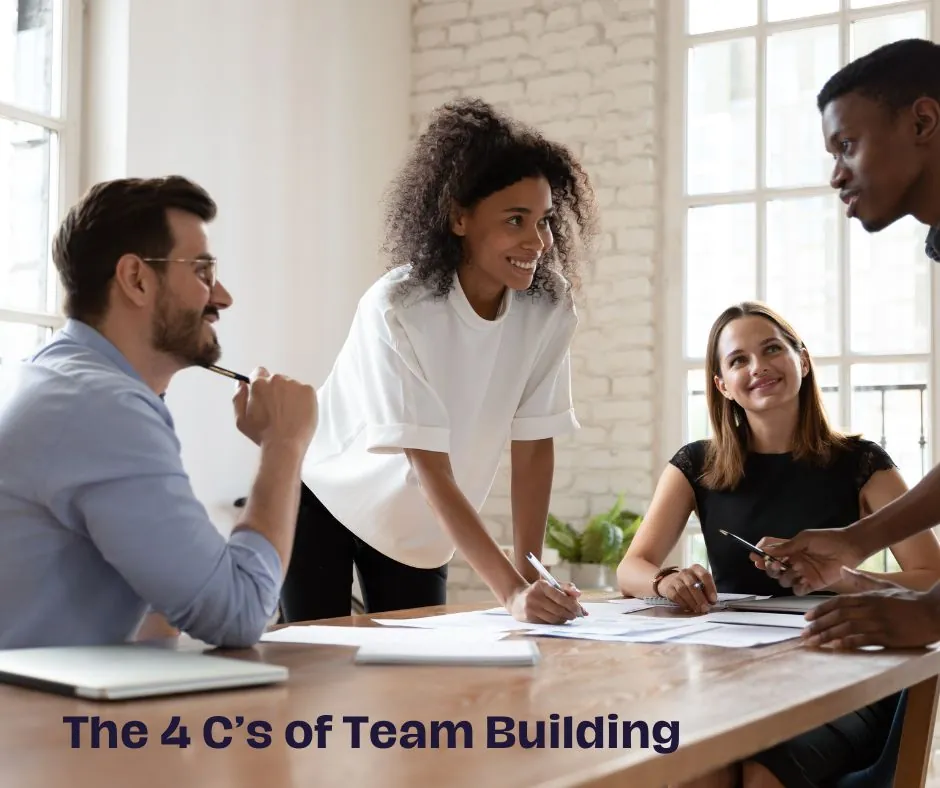
Only 20% of employees worldwide report feeling engaged at work, according to Gallup’s State of the Global Workplace report. That disengagement costs the global economy an estimated $8.9 trillion each year. Meanwhile, research from the McKinsey Global Institute shows that organizations improving internal collaboration raise knowledge-worker productivity by 20 to 25 percent. The gap between those two numbers represents a massive opportunity for any team willing to invest in how people actually work together.
The 4 Cs of team building offer a framework that closes that gap: Communication, Collaboration, Creativity, and Commitment. These four pillars are not abstract theory. They describe the specific skills that separate high-performing teams from groups of individuals who happen to share an office.
Yet most organizations struggle to develop all four at once. Traditional workshops focus on one skill in isolation. A presentation on “active listening” does nothing for creative problem-solving. A brainstorming session ignores accountability. Teams leave these events having checked a box without building the interconnected habits that drive real performance. The question is not whether these skills matter. The question is how to build all four simultaneously, in a format people actually remember.
Before You Read On
- The 4 Cs are Communication, Collaboration, Creativity, and Commitment.
- Only 20 percent of employees worldwide feel engaged, costing the global economy $8.9 trillion annually.
- Better internal collaboration raises knowledge-worker productivity by 20 to 25 percent, per McKinsey.
- The 4 Cs describe specific skills that separate high-performing teams from individuals sharing an office.
- Most organizations struggle to develop all four pillars simultaneously with traditional workshops.
What Are the 4 Cs of Team Building?
The 4 Cs of team building represent four interdependent capabilities that every effective team needs. Think of them as load-bearing walls: remove one and the entire structure weakens.
- Communication is the ability to share information clearly, listen actively, and give feedback without defensiveness.
- Collaboration is the practice of combining individual strengths toward a shared goal, where the group’s output exceeds what any single person produces alone.
- Creativity is the willingness to approach problems from new angles, challenge assumptions, and generate ideas under pressure.
- Commitment is the sustained follow-through that transforms a one-time team activity into lasting behavioral change.
When all four are present, teams resolve conflicts faster, adapt to changing priorities, and hold each other accountable without micromanagement. When even one is missing, dysfunction fills the gap.
Communication: The Foundation of Every Strong Team
Communication failures cost more than awkward meetings. Missed deadlines, duplicated work, and unresolved interpersonal tension all trace back to teams that talk past each other instead of to each other. The fix is not another email thread or Slack channel. It is practice.
Effective team communication involves three distinct skills: articulating ideas under time pressure, listening to understand rather than to respond, and translating nonverbal cues accurately. Most workplaces only test the first one. The other two atrophy because they rarely get exercised in a conference room.
What Communication Looks Like Under Pressure
Real team communication is tested when stakes are high and time is short. A live game show format, for example, forces teammates to relay answers quickly, interpret each other’s signals, and course-correct in real time. That kind of rapid-fire exchange builds communication muscle memory that transfers directly to workplace scenarios like product launches, client calls, and cross-functional sprints.
Collaboration: Moving Beyond Individual Effort
Collaboration is more than dividing a task list among group members. True collaboration requires negotiating roles on the fly, deferring to the person with the best idea (regardless of seniority), and adjusting strategy based on live feedback from the group.
Many team-building exercises fail here because they assign fixed roles. One person leads, others follow, and the hierarchy from the office reproduces itself in the activity. The best collaborative exercises shuffle those roles constantly, so the quietest team member ends up directing strategy while the usual leader contributes from the sidelines.
Why Format Matters for Collaboration
Activities that rotate leadership within rounds or require different knowledge sets for each challenge naturally disrupt default hierarchies. Game-show-style competitions do this well: one round rewards pop culture knowledge, the next rewards logic, the next rewards speed. No single person dominates, and the team learns to trust contributions from unexpected sources.
Creativity: Breaking Out of Routine Thinking
Creativity in a team context is not about artistic talent. It is about cognitive flexibility: the ability to reframe a problem, connect unrelated ideas, and generate options when the obvious solution fails.
Most corporate teams operate on autopilot. Meetings follow predictable patterns. Projects use the same templates. Decisions default to the most senior opinion. Over time, this rigidity suppresses exactly the kind of lateral thinking that drives innovation.
How to Activate Team Creativity
Creativity activates when people face unfamiliar challenges with real (even playful) consequences. Timed puzzles, surprise categories, and rapid-fire rounds force teams to think outside their daily expertise. The competitive energy lowers inhibition: people volunteer ideas they would normally filter out in a boardroom. That spontaneity is where breakthrough thinking originates.
Commitment: Turning Short-Term Effort Into Long-Term Results
Commitment is the least glamorous of the 4 Cs, and the most important for long-term team performance. Without it, communication skills fade, collaborative habits erode, and creative energy dissipates within weeks of a team-building event.
Commitment has two dimensions. The first is emotional buy-in: team members genuinely care about each other’s success. The second is behavioral consistency: people follow through on agreements made during the activity and carry those behaviors back to the office.
Building Commitment Through Shared Experience
Events that create strong emotional memories produce stronger commitment. A forgettable icebreaker generates no lasting bond. A high-energy, competitive experience where the team rallied together under pressure creates a shared reference point. Weeks later, someone says “remember when we came from behind in round three?” and the team reconnects with the collaborative energy from that moment. That is commitment in action.
Why Forced Icebreakers Kill Engagement Before It Starts
Organizations invest in team building for a reason, but common obstacles prevent those investments from paying off.
- Low participation energy. Forced icebreakers and trust falls generate eye rolls, not engagement. Teams disengage before the activity even starts. The 4 Cs address this by demanding active participation: you cannot communicate, collaborate, create, or commit from the sidelines.
- Skill silos. Most programs target one capability. A ropes course builds trust but ignores communication. A workshop on feedback techniques skips creativity entirely. The 4 Cs framework insists on all four working together.
- No transfer to the workplace. Activities that feel disconnected from real work produce no lasting change. When the 4 Cs are exercised under realistic pressure (time constraints, competing priorities, rapid decisions), the skills transfer because the context mirrors actual job demands.
- Remote and hybrid team disconnection. Distributed teams miss the informal interactions that build rapport. Structured events designed around all 4 Cs recreate those moments of connection in a compressed, high-impact format.
- One-size-fits-all programming. Generic activities ignore the specific dynamics of each team. A framework built on the 4 Cs adapts to any group size, industry, or experience level because the underlying skills are universal.
How Live Game Shows Address All 4 Cs at Once
It’s PlayTyme Game Shows runs live, TV-style game show events for corporate teams across New Jersey, New York City, and Connecticut. What makes this format uniquely effective for the 4 Cs of team building is that every round exercises all four capabilities simultaneously, not sequentially.
| The C | How a Live Game Show Activates It | Typical Workshop Approach |
|---|---|---|
| Communication | Teams relay answers under time pressure, read nonverbal cues, and negotiate responses in seconds | Lecture on active listening techniques |
| Collaboration | Rotating question categories force different team members to lead each round | Assigned group roles on a static project |
| Creativity | Surprise categories and rapid-fire rounds demand lateral thinking and risk-taking | Structured brainstorming with sticky notes |
| Commitment | Shared emotional highs (comebacks, victories, rivalries) create lasting team bonds | Post-event survey with forgotten action items |
Formats like Face-2-Face Feud, team trivia, and 60 Seconds of Fame keep energy high across multiple rounds. Because the competition is real (teams keep score, rivalries develop, underdogs rally), participation is genuine rather than obligatory. That authentic engagement is what converts a single event into lasting team improvement.
It’s PlayTyme customizes every show to the group’s industry, inside jokes, and company culture. That personalization activates creativity (questions feel relevant, not generic) and deepens commitment (the event feels built for this team, not pulled from a catalog).
What to Ask Before Booking Your Next Team Activity
Not every team-building activity addresses all 4 Cs equally. Before booking your next event, evaluate each option against these criteria.
Does It Require Active Communication?
If participants sit and listen more than they talk, the activity fails the communication test. Look for formats where every person speaks, responds, and reacts within every round.
Does It Rotate Leadership?
Fixed roles reproduce office hierarchies. The best activities shuffle who leads based on the challenge, ensuring collaboration across all levels.
Does It Introduce Novelty?
Creativity requires unfamiliarity. If the activity feels predictable after the first five minutes, it will not stretch anyone’s thinking.
Does It Create Memorable Moments?
Commitment forms around emotional peaks. Events that generate laughter, friendly rivalry, and collective triumphs produce stories teams retell for months. Those stories are the vehicle for lasting behavioral change.
Does It Fit Your Group?
Team size, industry context, and event goals all matter. A format that adapts its content to your specific organization delivers stronger results than a generic program. Ask providers whether they customize content for your team or run a standard script.
If you are planning a corporate event, leadership off-site, or team-building day and want an activity that strengthens all 4 Cs in a single session, explore team building activities from It’s PlayTyme Game Shows. Reach out to the team to discuss formats, group sizes, and custom content for your next event.
Frequently Asked Questions (FAQs)
What are the 4 Cs of team building?
The 4 Cs of team building are Communication, Collaboration, Creativity, and Commitment. Together, these four skills form a framework for developing high-performing teams. Each one reinforces the others: strong communication enables collaboration, collaboration sparks creativity, and shared creative experiences build commitment.
Why is a framework like the 4 Cs better than a single team-building exercise?
Single exercises target one skill in isolation, which limits their impact. The 4 Cs framework ensures that every team-building investment develops multiple capabilities at once. Teams that practice all four together see faster improvement because the skills compound rather than compete.
How do game shows work as team-building activities?
Live game shows split attendees into competing teams and run multiple rounds of trivia, challenges, and interactive games hosted by a professional emcee. Formats like Face-2-Face Feud and team trivia keep energy high while exercising communication, collaboration, creativity, and commitment simultaneously. Each round rotates the type of challenge so different team members lead.
How large of a group works for a game-show-style team-building event?
Game show formats scale from small leadership teams of 10 to 15 people up to company-wide events with hundreds of participants. The format adapts by adjusting the number of competing teams, round structure, and question complexity. Larger groups benefit from the spectator energy that builds between rounds.
How do you measure whether a team-building event improved the 4 Cs?
Look for observable changes in the weeks following the event. Stronger communication shows up as fewer misunderstandings in meetings. Better collaboration appears when team members voluntarily seek input from colleagues outside their usual circle. Creativity surfaces as new approaches to recurring problems. Commitment is visible when people reference the shared experience and hold each other to the standards they set during the activity.
How much can improving internal collaboration boost productivity?
Research from the McKinsey Global Institute shows that organizations improving internal collaboration raise knowledge-worker productivity by 20 to 25 percent.