
Professional development days carry enormous potential, yet most fall short. Gallup reports that only 36% of U.S. employees are actively engaged at work, and disengagement spikes during mandatory training sessions that feel disconnected from daily responsibilities. Meanwhile, LinkedIn’s Workplace Learning Report found that 94% of employees would stay longer at a company that invests in their development. The gap between what people want and what they get on PD days is wide.
Whether you organize professional development for school staff or corporate teams, the challenge is the same: filling the agenda with activities that teach something real without putting the room to sleep. Teachers dread another PowerPoint marathon. Sales teams tune out during lecture-style compliance reviews. The format matters as much as the content.
Most planners face a short list of recurring problems. Budgets are tight, so activities need to serve large groups without ballooning costs. Attendees arrive skeptical because past PD days wasted their time. And organizers struggle to find activities that bridge skill-building with genuine interaction. The result is a day that checks a box but changes nothing. This guide breaks down activities for professional development day programs that solve those problems, starting with the formats that consistently get the highest engagement scores from both educators and corporate professionals.
What Kills Energy at Professional Development Days
Before choosing activities, it helps to understand why so many PD days disappoint. These are the obstacles that trip up even experienced planners.
Passive Formats That Kill Energy
Sitting through a 90-minute presentation is not professional development. It is an endurance test. Adults retain roughly 10% of what they hear in a lecture, compared to 75% of what they practice. Yet most PD agendas still default to slide decks and talking heads.
One-Size-Fits-All Content
A room full of teachers spans first-year newcomers and 20-year veterans. A corporate team includes marketers, engineers, and operations staff. Blanket content bores half the audience and overwhelms the other half.
No Measurable Outcomes
Without clear goals tied to each activity, organizers have no way to evaluate what worked. Attendees leave without knowing what they learned, and leadership sees no return on the investment.
Low Buy-In From Attendees
When people feel forced into a room, resistance is the default. PD days earn a reputation as wasted time, and that reputation follows every future event. Breaking the cycle requires activities that feel different from the first minute.
Interactive Game Show Activities for Professional Development
It’s PlayTyme Game Shows runs live, hosted game show experiences designed specifically for professional development settings. These are not icebreakers or trivia apps on a phone. A professional host runs the room with studio-quality buzzers, scoreboards, and custom question rounds built around your training objectives.
The format works because it taps into competition, collaboration, and recall simultaneously. Teams answer questions drawn from your actual training content (compliance policies, curriculum standards, product knowledge, safety protocols) while competing for points. The energy stays high because the game structure creates natural momentum. Participants remember what they learned because they actively retrieved it under mild pressure, which is one of the strongest memory-encoding techniques in cognitive science.
It’s PlayTyme serves schools, corporate offices, and organizations across New Jersey, New York City, and Connecticut. The game content is fully customizable, so a school district running a curriculum alignment day and a financial services firm running a quarterly development day both get programming built for their specific objectives.
Activities for School Staff Professional Development Days
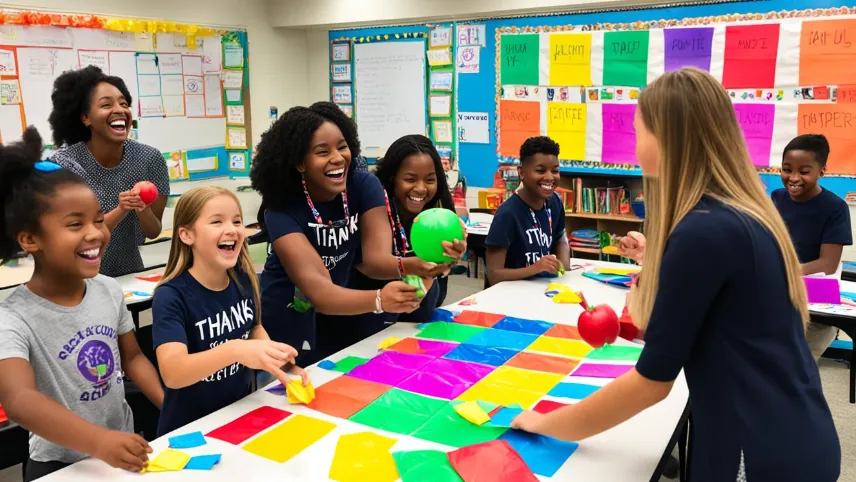
School-based PD days have a unique constraint: teachers already spend all day facilitating learning for others. Asking them to sit passively while someone else lectures is counterproductive. The best activities put educators in the learner seat using the same active strategies they use with students.
Curriculum-Based Game Show Rounds
Game show formats let school staff review new standards, test their knowledge of updated policies, and practice instructional strategies in a competitive team format. Rounds cover topics like differentiated instruction, classroom management scenarios, and new technology tools. Teachers walk away with content knowledge reinforced through retrieval practice.
Collaborative Lesson Design Workshops
Small teams build lesson plans together under a time constraint, then present to the group. This mirrors the collaborative planning that strong schools use throughout the year and produces usable materials that teachers take back to their classrooms the next day.
EdTech Exploration Stations
Rotating stations let staff try new classroom technology tools (learning management systems, formative assessment apps, AI-assisted grading platforms) with guided practice rather than a demo video. Each station includes a hands-on task that teachers complete and evaluate.
Peer Observation Debriefs
Structured discussion protocols let teachers share what they observed during classroom visits. Protocols like “see, think, wonder” keep conversations productive and focused on instructional practice rather than personality.
Activities for Corporate Professional Development Days
Corporate PD days serve a different audience but face the same engagement problem. Employees show up expecting death-by-PowerPoint and mentally check out before lunch. These formats change that dynamic.
Team-Based Trivia Competitions
Custom trivia rounds built around company knowledge, industry trends, and professional skills keep teams engaged while reinforcing content that matters. Corporate game show events from It’s PlayTyme turn dry material (compliance training, product updates, HR policies) into something people actually want to participate in.
Cross-Department Problem-Solving Challenges
Teams made up of people from different departments tackle a real business problem together. This builds relationships across silos and often surfaces solutions that single-department thinking misses. Structure the challenge with a clear deliverable and a short presentation at the end.
Skills-Based Workshops With Immediate Application
Workshops on communication, negotiation, data analysis, or project management work best when participants practice the skill during the session. Role-play exercises, live data sets, and scenario-based decision-making keep the learning active.
Leadership Panels With Audience Q&A
Senior leaders answer unscripted questions from staff in a moderated panel format. This builds transparency, gives employees access to decision-makers, and surfaces concerns that surveys miss. Keep it to 30 minutes so it stays energized.
| Activity Type | Best For | Group Size | Engagement Level | Prep Required |
|---|---|---|---|---|
| Live Game Show (It’s PlayTyme) | Schools & Corporate | 20 to 300+ | Very High | Low (host handles everything) |
| Collaborative Workshops | Schools & Corporate | 10 to 40 | High | Moderate |
| EdTech / Tech Stations | Schools | 15 to 50 | Moderate to High | High |
| Problem-Solving Challenges | Corporate | 20 to 100 | High | Moderate |
| Lecture / Keynote | Large Groups | 50 to 1,000 | Low | Low |
| Peer Discussion Protocols | Schools | 8 to 30 | Moderate | Low |
How Game Shows Build Real Skills During PD Days
Game show formats are not just entertainment. They activate specific learning mechanisms that passive formats ignore.
Retrieval practice is the act of pulling information from memory rather than re-reading it. Every time a participant answers a game show question, they strengthen the neural pathway to that knowledge. Research consistently shows retrieval practice outperforms review for long-term retention.
Social accountability changes effort levels. When your answer affects your team’s score, you pay closer attention. The mild competitive pressure mirrors real workplace dynamics where individual performance affects group outcomes.
Immediate feedback closes the learning loop. Participants find out instantly whether their answer was correct, which prevents wrong information from solidifying. In a lecture, mistakes go unnoticed until a test weeks later.
Emotional encoding strengthens memory. Laughter, surprise, and the thrill of competition create emotional markers that make content stickier. People remember what they felt, and a well-run game show generates strong positive feelings tied directly to the training content.
Planning a Professional Development Day Schedule That Works
A strong PD day balances energy levels across the schedule. Front-load high-energy activities when attention is fresh. Place collaborative work in the mid-morning slot. Use post-lunch time for the most interactive format (this is where a game show session works perfectly, countering the natural afternoon dip). Close with reflection or action planning so participants leave with concrete next steps.
A sample half-day schedule:
- 8:30 a.m. Welcome and objectives (15 minutes)
- 8:45 a.m. Collaborative workshop session (75 minutes)
- 10:00 a.m. Break (15 minutes)
- 10:15 a.m. Rotating skill stations (60 minutes)
- 11:15 a.m. Live game show reinforcement round (45 minutes)
- 12:00 p.m. Reflection and action planning (30 minutes)
This structure keeps energy high because no single block exceeds 75 minutes, and each transition shifts the format. The game show slot is deliberately placed late in the morning to re-energize the room before the final session.
What to Consider When Selecting Your PD Activities
Start with your objectives, not your format. Define what participants should know, feel, or do differently after the day ends. Then match activities to those outcomes. If the goal is content retention (new policies, updated standards, product knowledge), a game show format outperforms every passive alternative. If the goal is relationship-building across teams, cross-department challenges and collaborative workshops deliver. If the goal is skill acquisition, hands-on practice workshops with immediate application are the right fit.
Budget and group size narrow the options further. A live game show from It’s PlayTyme scales from 20 to 300+ participants with a single host and full production setup, making it one of the most cost-effective high-engagement options available. Workshops require facilitators for every 15 to 20 participants, which adds cost at scale. Lectures are cheap but produce the lowest retention and engagement.
Finally, consider your audience’s history. If past PD days relied heavily on passive formats, lead with something dramatically different. A game show in the first slot signals immediately that this day will not repeat old patterns. That shift in perception changes how participants engage with every session that follows.
Ready to make your next professional development day one people actually talk about afterward? Contact It’s PlayTyme Game Shows to build a custom game show experience around your training objectives. We work with schools and corporate teams across New Jersey, New York City, and Connecticut.
Frequently Asked Questions (FAQs)
How do game shows work for professional development?
A professional host runs a live competition using custom questions built from your training content. Teams compete using studio-quality buzzers and scoreboards. The format uses retrieval practice and social accountability to drive higher retention than traditional training methods.
Do game show activities work for both teachers and corporate employees?
Yes. The game show format is content-agnostic, so it adapts to any audience. School staff compete on curriculum standards and instructional strategies. Corporate teams compete on product knowledge, compliance, and industry trends. The engagement mechanics work identically for both groups.
How much does a professional development game show cost?
Pricing depends on group size, location, and customization level. It’s PlayTyme Game Shows serves groups from 20 to 300+ across New Jersey, New York City, and Connecticut. Contact their team directly for a quote tailored to your event’s specific requirements.