


Quick answer: Cooking classes suit small teams that want a hands-on, food-focused afternoon. For corporate team building with 50 to 300 people, a professionally hosted game show is the stronger choice. It keeps the whole group in one room, needs no kitchen, takes food and allergy logistics out of the activity and puts every person on a team.
The plan starts simple: corporate team building cooking classes for 150 people. By the time the class is booked, the company is split across sessions, someone owns an allergy spreadsheet, and half the team never shares a room with the other half.
Gallup measured U.S. employee engagement at 31% in 2024, its lowest level in 10 years. A team event run in separate sessions spends the budget, and the disconnection behind that number stays where it was.
What to Expect from Corporate Team Building Cooking Classes
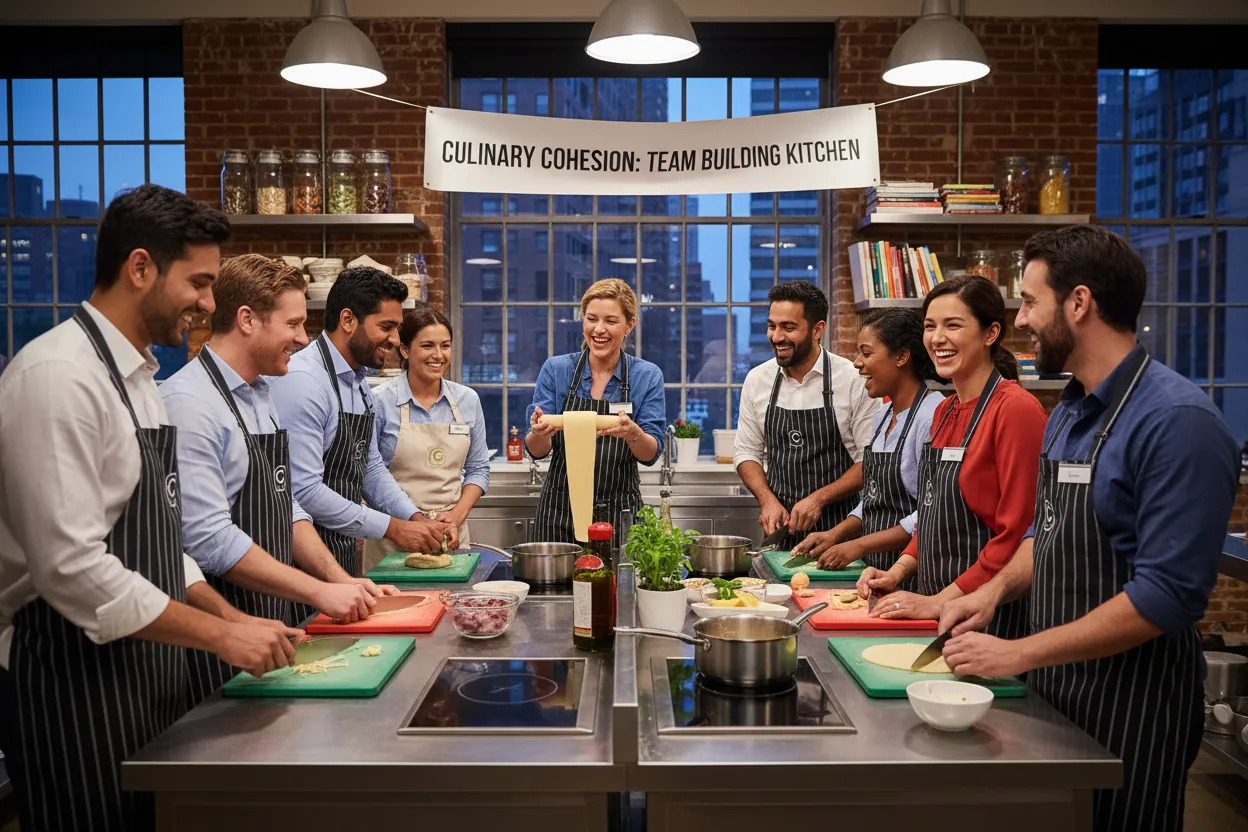
Cooking classes are built around small-group collaboration. Teams gather in a commercial kitchen, prep and cook under a chef’s direction, then share the meal.
The format suits close-knit teams who enjoy food. Colleagues talk while they chop and plate, and the recipe gives everyone a shared task. The focus stays on the food.
What to Expect from a Hosted Game Show
A hosted game show shifts the focus from finishing a task to involving the whole room. Live, television-style competition is the vehicle. Connection, camaraderie and interaction are the outcome.
A professional host runs the room with TV-style podiums, buzzers, LED lighting and a sound engineer. Formats such as Face-2-Face Feud, The Challenge and 60 Seconds of Fame are already familiar, so there is no learning curve. For large groups, audience-response keypads or cellphones let every seat play along, not just the people on stage.
Teammates in the audience coach, cheer and react. Nobody sits on the sidelines, and nobody has to leave the building.
Why Team Building Breaks Down Past 150 People
Skill-Based Activities Leave People Watching
Most events struggle to involve the entire room. Extroverts take the lead and introverts fade into the background.
When an activity depends on a specific skill, such as knife work or recipe timing, large parts of the group tune out. Psychological safety matters here: people join in when they aren’t judged on a skill they never claimed to have. If half the room is watching the clock, the event missed its purpose.
Scaling the Activity for Large Groups
An activity that works for 12 people often breaks at 150. Large groups need formats built for mass participation from the start.
When a format can’t handle volume, organizers split the company into separate rooms or staggered sessions. That fractures the team and kills the shared experience.
How Cooking Classes and Game Shows Compare
Group size and your goal drive the decision. Here is how the two formats stack up on the factors planners care about most.
Active participation: In a kitchen, station space sets the limit. Each station has room for a few people at a time.
A game show is built for the whole room. Everyone plays as part of a team, so answers come from the group and nobody is singled out. Great events aren’t measured by how many attend. They’re measured by how many participate.
Group size: Most cooking classes run on stations, so large companies often get split across sessions or locations. A hosted game show keeps 50 to 300 people together in one room, with larger groups by custom quote.
Physical access: A cooking class asks people to stand at a station, handle knives and work near open heat for a long stretch. Colleagues with mobility limits, injuries or other physical needs can end up watching instead of cooking. In a game show the audience plays from their seats, so physical ability doesn’t decide who gets to take part.
Venue needs: Most cooking classes run in a commercial kitchen, so the group travels to the venue. A game show comes to you: your cafeteria, a conference room or a hotel ballroom. No plumbing, gas lines or commercial ovens required.
Dietary and allergy logistics: Cooking puts every participant’s dietary needs at the center of the activity. A game show keeps food out of the activity. Your caterer handles dietary needs as it would for any meeting, and the main event stays on the people.
Time and budget: A cooking class usually takes a long block of the day, plus travel. Game shows run a tight 60 or 90 minutes. Whichever format you weigh, ask for an all-in number so you can see how much corporate team building costs before you compare. A cooking class adds kitchen, ingredients and transport. A hosted game show quotes setup, travel and customization separately.
What the team carries back to work: A cooking class leaves the people who shared a station with a meal and a story. A hosted game show puts people from different departments on the same teams, so they learn names and who knows what. That shows up in Monday’s meetings and emails.
When a cooking class is the better pick: For a smaller team, a long, unhurried afternoon or a shared meal as the reward, a cooking class is hard to beat. When everyone fits at the stations, the meal at the end is the point. A game show has its own trade-off: it doesn’t feed anyone, so catering is a separate booking, and it runs as a 60- or 90-minute session, not an afternoon.
| Option | Best For | Group Size | Venue | Food and Allergy Logistics | Time on the Day | Who Participates | What Carries Back to Work |
|---|---|---|---|---|---|---|---|
| It’s Playtyme Game Shows (hosted game show) | Large groups that need one shared experience | 20 to 300+ people in one room | Your office, ballroom or offsite venue | No meal; catering booked separately | 60 or 90 minutes | Every person, on a team | Connections across the whole group |
| Corporate cooking class | Smaller, food-focused teams with an afternoon to spend | Capped by kitchen stations | Commercial kitchen, usually offsite | Every allergy and restriction tracked | Long block plus travel | Everyone at a station; large groups split into sessions | A shared meal within each station |
Why Large Groups Choose It’s Playtyme Game Shows
Since May 2012, It’s Playtyme Game Shows has worked on one problem: getting large groups to connect. Founder Lisa Lawrence spent 20+ years as a choreographer and kept seeing the same thing at events. A handful of people participated while everyone else watched. She built the company so participation is part of the format, not a favor you ask of volunteers.
After 3,000+ live events, the model is turnkey. Share your date, room size and goal, and you get a custom production plan within two business days.
- Service area: New Jersey, New York City, New York State and Connecticut
- Group size: 20 to 300+ people, with larger groups by custom quote
- Show length: 60 or 90 minutes
- Included: professional host, game-show set, audio/visual equipment and sound engineer
- Quoted separately: setup and breakdown, travel, customization and gratuity
- Pricing: starting at $2,995
Four Questions to Answer Before You Book Team Building for 50 to 300 People
Before you commit budget, put both options through the same four questions.
- Who participates? Ask how the format involves the quietest person on your team, not only the loudest.
- Does the group stay together? If the format splits 150 people into sessions or rooms, the shared experience goes with it.
- Who owns the logistics? A cooking class brings offsite travel and dietary tracking. A hosted game show comes to your office and needs no prep from your staff.
- What does the quote cover? Compare venue, food, travel and setup line by line, so the number you approve is the number you pay.
For a small team that loves food, a cooking class is a fine call. For 50 to 300 people who need to leave the room knowing each other better, pick the format built for the whole room.
Ready to get your whole team in one room with every person playing? Book your corporate team building game show. We bring the host, the podiums and the sound to you. No deposit is required, and every show is backed by our 100% Satisfaction Guarantee.
Solve the participation problem
Ready to get the whole room in the game?
Frequently Asked Questions (FAQs)
Do corporate team building cooking classes work for 300 people?
Not well. Cooking stations limit how many people can work at once, so 300 people usually means multiple sessions or venues. A hosted game show keeps the full group together in one room.
What are the best team building activities for large groups of 100+ employees?
Look for formats built for mass participation: one room, teams instead of solo performers and a host who keeps the pace moving. A hosted game show fits that brief. Every person plays on a team, and audience keypads or cellphones bring in the back of the room. Activities that depend on stations or a specific skill split the group or leave people watching.
How do team building cooking classes compare to game shows in cost?
A cooking class quote depends on headcount, menu and kitchen, and travel to the venue adds to the total. Corporate game shows are priced starting at $2,995 and include the host, set, audio/visual equipment and sound engineer. Setup and breakdown, travel, customization and gratuity are quoted separately, so you see the full number before you book.
How long does a live game show event last?
Our corporate game shows run 60 or 90 minutes. That’s enough time to build energy, get everyone involved and crown a winning team without eating into your meeting schedule.
Can we bring a hosted game show to our office?
Yes. We bring the full production to you and set up podiums, buzzers, lighting and sound in your cafeteria, training room or conference room. Your staff doesn’t travel anywhere.