

Corporate social responsibility has moved far beyond annual donation checks. Gallup’s State of the Global Workplace report found that only 20% of employees worldwide are actively engaged at work, costing the global economy $10 trillion in lost productivity each year. Deloitte’s 2024 Gen Z and Millennial Survey found that more than half of younger workers choose employers based on shared values and social impact commitments.
So companies are investing in CSR team building events. Fewer are asking the harder question afterward: did it actually work, or did it just feel good for an afternoon? Without a way to measure that, CSR team building becomes a line item nobody can defend at budget time.
Why “It Felt Good” Isn’t a Metric
Most organizations run into the same wall when they try to prove a CSR event was worth the spend:
- Low energy, low signal. Volunteering activities like park cleanups or supply sorting are valuable, but they rarely generate strong enough engagement to produce data worth tracking. Employees show up, do the task, and leave.
- Charity and bonding measured separately, or not at all. Most programs treat the donation and the team-building outcome as two unrelated things, so nobody rolls them into one result.
- No baseline. You can’t show improvement in morale, collaboration, or retention if nobody measured it before the event.
- Multi-office inconsistency. Companies running events across New Jersey, New York City, and Connecticut often measure each one differently (if at all), making it impossible to compare results.
The fix isn’t a better spreadsheet. It’s picking a format that produces measurable data by design, and knowing what to track before the event happens, not after.
The Two Things a CSR Event Should Actually Deliver
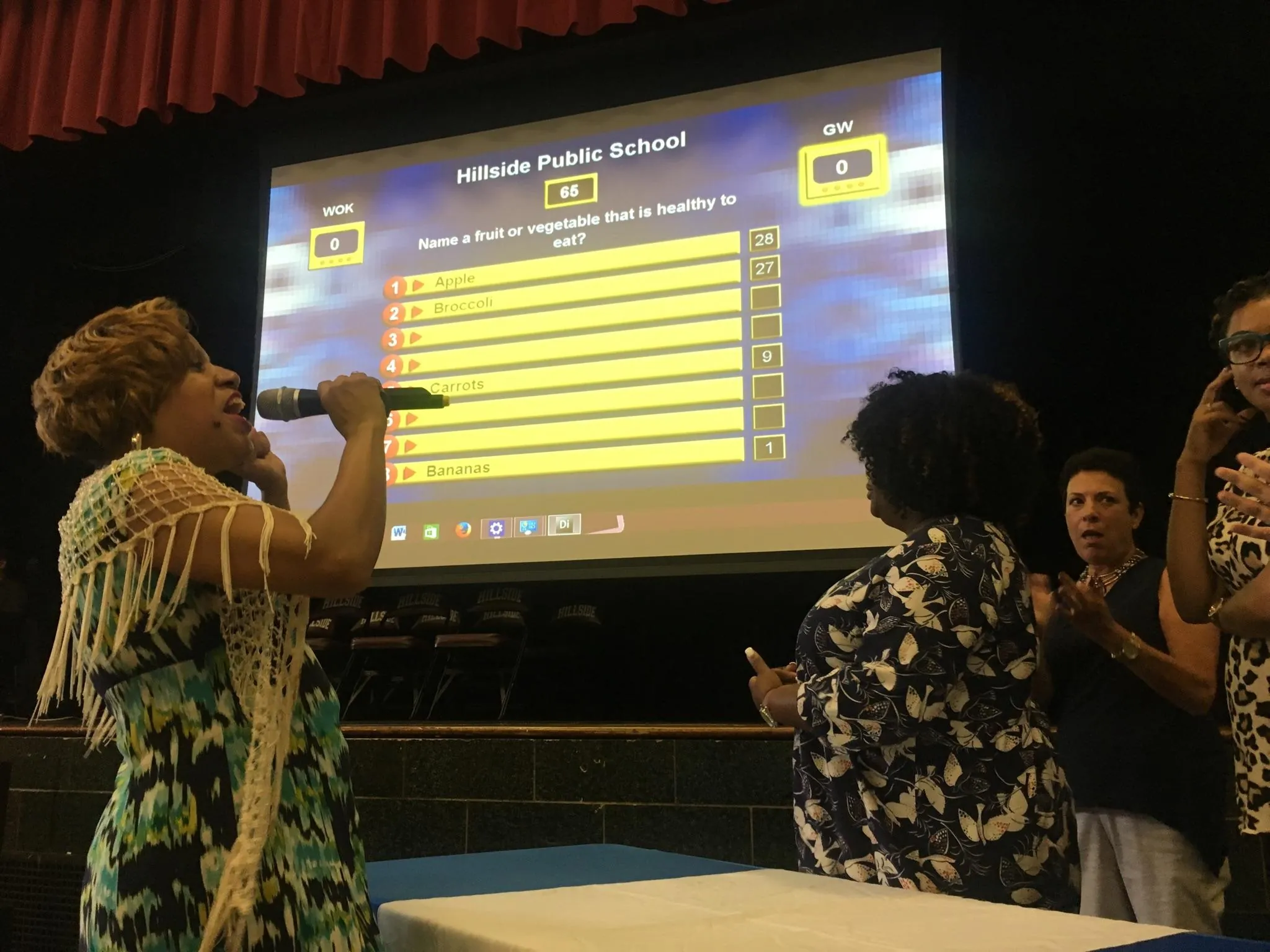
Every CSR team building event is really trying to produce two separate outcomes at once: a charitable result and a team result. Formats like live game shows and charity-themed trivia make both easy to quantify, because scores, donation totals, and participation are captured in real time as part of the game itself, not bolted on afterward as a survey nobody fills out.
That’s the baseline requirement for anything below to work: pick a format where the data comes out the other side automatically.
How to Measure the ROI of a CSR Team Building Event
Proving the value of a CSR team building event means tracking both sides of it, the social impact and the team development outcome, and doing it consistently enough to compare event to event.
Social Impact Metrics
- Total dollars donated to charity from the event
- Number of nonprofit organizations supported
- Items assembled or collected (for hands-on formats)
- Cost per dollar raised (event cost ÷ total donation) — the number finance actually wants to see
- Employee awareness lift: a one-question pre-event and post-event pulse on the featured cause
Team Development Metrics
- Post-event engagement survey (energy, connection, satisfaction — a single 1–5 question sent within 24 hours gets the highest response rate)
- Cross-departmental collaboration rates in the weeks following the event
- Retention and absenteeism trends compared against teams that didn’t participate
- Qualitative feedback: do employees bring the event up unprompted in the following months?
Run the same two pulse surveys (pre-event baseline, post-event follow-up) every time, and you end up with a comparable dataset across every CSR event your company runs, not just a one-off good feeling.
Matching Your Measurement Plan to Your Goals
What you prioritize measuring should match what you’re actually trying to prove:
If the budget conversation is about employee engagement and retention, weight the team development metrics above and track them against a control group who didn’t attend.
If the budget conversation is about community impact and brand reputation, weight the social impact metrics and be ready to share the total donation and cause-awareness numbers externally.
If you need to defend the budget on both fronts at once (most companies do), a hybrid event, cause-themed trivia that converts directly to a donation, gives you both data sets from a single afternoon.
Ready to run a CSR event that produces its own numbers instead of a guess? It’s PlayTyme’s CSR Game Show programs build real-time scoring and donation tracking into the event itself, so the metrics above are captured automatically instead of chased down afterward.
Frequently Asked Questions (FAQs)
How do you measure the ROI of a CSR team building event?
Track two categories: social impact (total donated, nonprofits supported, cost per dollar raised) and team development (engagement survey scores, cross-departmental collaboration, retention trends). Formats that generate this data automatically, like live game shows, make measurement far easier than volunteer days that rely on manual surveys.
What social impact metrics matter most?
Total dollars donated, cost per dollar raised, number of nonprofits supported, and a simple before-and-after survey on employee awareness of the cause. These are the numbers most companies need to justify the budget externally.
Can CSR team building actually improve retention or morale long-term?
It can, but only if you measure it. A single post-event pulse survey isn’t enough on its own, compare engagement and retention trends for participants against a baseline or control group over the following months to see if the effect holds.
How soon after the event should you measure results?
Send the team development survey within 24 hours for the highest response rate. Social impact numbers (total donated, items collected) are usually final the day of the event. Retention and collaboration trends need a few weeks to become meaningful.
Do charity game shows make ROI easier to track than volunteer days?
Yes. Game show formats capture scores, participation, and donation totals in real time as part of the gameplay itself, so the data exists automatically. Volunteer days depend on someone manually logging hours and outcomes after the fact, which is where most CSR measurement efforts break down.
What’s a reasonable benchmark for donation-per-participant?
This varies widely by company size and cause, so there isn’t one universal number. The more useful benchmark is consistency: track cost-per-dollar-raised across your own events over time so you can see whether your CSR programming is getting more efficient, not just comparing yourself to an outside average.