

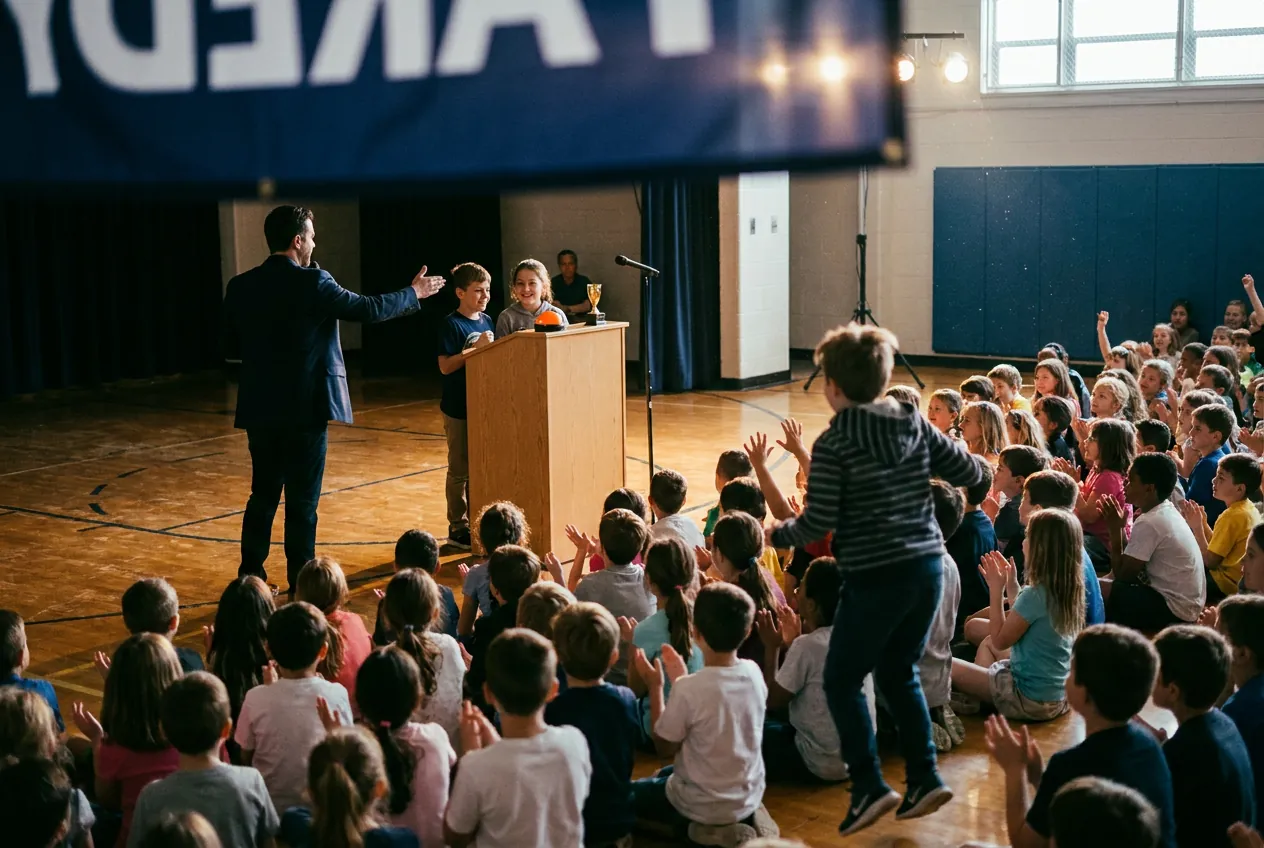

Finding elementary school assembly ideas that hold a full gym is hard. You get five minutes to win a crowd that runs from fidgety kindergarteners to “too cool” fifth graders. A passive presentation that loses the room in ten minutes wastes your budget and a real chance to connect. The best assemblies create a shared experience kids still talk about at the dinner table.
Play-based, interactive activities build the skills young students need. Research highlighted by Edutopia shows how important play is for social-emotional learning (SEL). Strong SEL programs also deliver results: CASEL, the Collaborative for Academic, Social, and Emotional Learning, reports that effective SEL initiatives improve student behavior and academic performance. The right assembly builds school culture in a single hour, not just a fun afternoon.
| Assembly Idea | Recommended Grade Band | Typical Run Time | Participation Level |
|---|---|---|---|
| Hosted Team Game Show | K-5 (Adaptable) | 45-60 minutes | High (Everyone plays in teams) |
| Interactive Science Show | 3-5 | 45-60 minutes | Moderate (Volunteers on stage) |
| Cultural Music and Dance Troupe | K-5 | 45 minutes | Moderate (Group call-and-response) |
| Author Visit and Storytelling | K-2 | 30-45 minutes | Low (Mainly listening) |
| Character Education Skit | K-5 | 45 minutes | Low (Audience watches) |
| ‘Minute to Win It’ Style Challenges | 3-5 | 45-60 minutes | High (Multiple students participate) |
| High-Energy Stunt Show (BMX/Yo-Yo) | 3-5 | 45 minutes | Low (Audience watches) |
| Mobile Planetarium Dome | K-5 | 30-45 minutes per group | Low (Immersive viewing) |
| Magic Show with a Message | K-5 | 45-60 minutes | Moderate (Volunteers on stage) |
| Interactive Puppet Show | K-2 | 30-40 minutes | Moderate (Call-and-response) |
Our Top 10 Most Popular Elementary School Assembly Ideas
Here are ten proven, interactive school assembly ideas that work for elementary audiences. Each one breaks down what you need to know to pick the right fit for your students in New Jersey, New York, or Connecticut.
1. Hosted Team-vs-Team Game Show
This format turns the whole student body and staff into contestants. A professional host runs a fast-paced show, often styled like Family Feud or Jeopardy! but built for a school. Instead of a few volunteers on stage, the entire gym splits into teams. Everyone shouts answers, cheers for their side, and stays in the action.
- Grade Band: K-5. An experienced host adapts questions and pacing for different ages, often by running separate K-2 and 3-5 shows.
- Run Time: 45-60 minutes.
- Participation Level: High. Every student plays from their seat as part of a team, which is the whole point.
- School Supplies: Just the space (gym or auditorium) and the students. Professional providers bring the sound system, visuals, buzzers, and host.
- Curriculum Tie-in: Great for reinforcing curriculum with custom trivia, celebrating school spirit, or rewarding positive behavior. It builds teamwork, sportsmanship, and quick thinking.
2. Interactive Science Show
A high-energy science demo makes tough topics feel like magic. Think bubbling reactions, liquid nitrogen clouds, and safe, controlled bangs. A good presenter explains the “why” behind each experiment in plain language that sparks curiosity.
- Grade Band: Best for 3-5. Younger students enjoy the spectacle but often miss the science.
- Run Time: 45-60 minutes.
- Participation Level: Moderate. A few student and teacher volunteers assist on stage while the rest watch.
- School Supplies: A clear stage area, access to power, and a table. The presenter brings all scientific materials.
- Curriculum Tie-in: Directly supports STEM and STEAM learning by bringing chemistry and physics to life.
3. Cultural Music & Dance Troupe
Bring the world to your students with a professional cultural group. Thunderous Japanese Taiko drumming, quick-footed Irish dancers, or a vibrant African dance troupe all light up a gym. These shows open a window into global cultures.
- Grade Band: K-5. The visual and musical energy appeals to every age.
- Run Time: 45 minutes.
- Participation Level: Moderate. Often includes whole-group call-and-response, clapping rhythms, or a simple dance move from their seats.
- School Supplies: A large, open performance space and a good sound system.
- Curriculum Tie-in: A strong fit for social studies, geography, and music, and it promotes diversity and global awareness.
4. Author Visit & Interactive Storytelling
For younger students, meeting an author who reads their own book sticks with them. The best visits go past simple reading. They use big screens for illustrations, animated voices, and call-and-response to pull kids into the story. Reading suddenly feels exciting and personal.
- Grade Band: Best for K-2. The intimate, focused format matches younger attention spans.
- Run Time: 30-45 minutes.
- Participation Level: Low to moderate. Kids answer questions and repeat phrases.
- School Supplies: A comfortable seating area (often the library or a classroom), a projector or screen, and a microphone.
- Curriculum Tie-in: Supports literacy, reading comprehension, and creative writing by showing the person behind the book.
5. Character Education Skit or Play
Many touring theater groups perform short plays for schools with a positive message. Topics cover anti-bullying (like the “bucket filler” concept), friendship, perseverance, and digital citizenship. Relatable characters introduce social-emotional ideas without preaching.
- Grade Band: K-5. Providers often run different shows for K-2 and 3-5 audiences.
- Run Time: 45 minutes.
- Participation Level: Low. This is a viewing experience, though some include a Q&A with the actors afterward.
- School Supplies: A stage or performance area. The troupe brings its own sets and sound.
- Curriculum Tie-in: Great for launching or reinforcing a school-wide character education or SEL program.
6. “Minute to Win It” Style Challenges
Based on the TV show, students take on simple 60-second challenges with everyday objects. Stacking cups one-handed, moving cotton balls with a straw, rolling cookies down your face. It is funny to watch and a thrill to play, and it rewards creativity under pressure.
- Grade Band: Best for 3-5. The rules and coordination suit older elementary students.
- Run Time: 45-60 minutes.
- Participation Level: High. A few students compete at a time while the whole room cheers. A good host gets dozens of kids involved across the show.
- School Supplies: A stage area and tables. The host or company provides all the props.
- Curriculum Tie-in: Teaches grace under pressure, creative problem-solving, and good sportsmanship.
7. High-Energy Stunt Show
Professional BMX riders, skateboarders, and yo-yo champions put on a show that holds the whole gym. Many weave in messages about practice, dedication, and a healthy, drug-free lifestyle. The skill on display commands attention on its own.
- Grade Band: Best for 3-5, though all ages are impressed. Safety and goal-setting messages land harder with older students.
- Run Time: 45 minutes.
- Participation Level: Low. The audience watches the demonstration.
- School Supplies: A large, flat, smooth surface (gym floor or blacktop) with plenty of clearance. These shows have specific space requirements.
- Curriculum Tie-in: A good match for Red Ribbon Week or themes of physical fitness, helmet safety, and perseverance.
8. Mobile Planetarium Dome
An inflatable dome goes up right in your gym, and classes take turns inside for a tour of the night sky. It feels like a field trip without leaving school. An astronomer guides students through constellations, planets, and galaxies.
- Grade Band: K-5. The visual wonder works for every age, with presenters tailoring the detail to each group.
- Run Time: 30-45 minutes per session. Plan several sessions to get the whole school through.
- Participation Level: Low. Students sit or lie down and watch the projection above.
- School Supplies: A large indoor space with high ceilings and power. The gym is usually the only fit.
- Curriculum Tie-in: A hands-on supplement to any earth science or astronomy unit.
9. Magic Show with a Message
A skilled magician holds a room like few others. Many educational magicians build the show around a theme: the magic of reading, believing in yourself, or standing up to bullying. The tricks grab attention while the message gives it substance.
- Grade Band: K-5. A good family-friendly magician entertains the full age range.
- Run Time: 45-60 minutes.
- Participation Level: Moderate. The magician calls several volunteers on stage throughout the show.
- School Supplies: Usually just a stage or performance area. Professional magicians are self-contained.
- Curriculum Tie-in: Works for character education themes or as a pure reward assembly for positive behavior.
10. Interactive Puppet Show
For the youngest students, a good puppet show is pure magic. Big, colorful puppets and a simple story teach sharing, kindness, or facing fears. The puppets talk directly to kids and ask for their help to solve a problem in the story.
- Grade Band: Best for K-2. Puppetry lands best with younger children who lean into the imaginative format.
- Run Time: 30-40 minutes.
- Participation Level: Moderate. High verbal interaction through call-and-response.
- School Supplies: An indoor space where you can dim the lights to focus on the puppet stage.
- Curriculum Tie-in: Social-emotional learning, storytelling, and conflict resolution for early learners.
Common Challenges When Planning a School Assembly in the Tri-State Area
Choosing an idea is only the first step. Principals, PTO leaders, and school staff hit several logistical hurdles when planning an assembly that works for everyone.
Varying Attention Spans
A kindergartener focuses very differently from a fifth grader. A 60-minute assembly with complex themes loses your K-2 crowd, while a 30-minute puppet show can feel babyish to older kids. The best assembly either splits by grade level or stays interactive enough to hold every age.
For the activity-level detail behind these ideas, see our guide to interactive school assembly games.
Gymnasium Acoustics
Gym echo turns a great presentation into noise. A performer who shows up with a small personal amp loses the back half of the room fast. A professional provider brings a sound system built for large, noisy spaces and delivers clear audio to every seat.
The “One Size Fits All” Trap
The biggest mistake is booking one assembly for 500 K-5 students and hoping it works. Content, pacing, and interaction all have to fit the age. An assembly that tries to reach everyone often reaches no one. Ask presenters exactly how they adapt the program for different grade bands.
Navigating Bell Schedules
A school day runs on tight timing. Fitting a 45- or 60-minute assembly, plus moving classes to and from the gym, takes careful coordination. Experienced providers arrive early, set up fast, start on time, and end on time.
Budget and PTO Approval
Funding is often the real hurdle. You have to justify the cost to your principal or parent-teacher organization. The strongest proposals frame the assembly as a curriculum-aligned experience that supports school goals, whether that means building community, boosting SEL, or rewarding academic achievement.
Vetting a Trustworthy Provider
Not every performer who books schools carries proper insurance or clears background checks. Before you sign, confirm the provider is fully insured, ask for references from nearby schools, and verify their staff are cleared to work around children. A reputable company shares this paperwork without hesitation.
Making the Message Stick
An assembly that lands in the moment can fade by the next morning. Ask the provider for follow-up materials, classroom discussion prompts, or a theme teachers can reinforce all week. The best events give staff a way to carry the lesson forward instead of ending at the final bell.
Reaching Every Student
A packed, loud gym can overwhelm students with sensory sensitivities or other diverse needs. Look for presenters who can adjust the volume, offer a quieter viewing spot, or pace the show so every child can take part. An inclusive assembly plans for the whole student body, not just the average student.
How to Choose the Right Assembly Idea for Your School
Too many options? Use this framework to make a confident call for your students and staff.
- Start with your goal. Kicking off a character education theme, rewarding a successful fundraiser, or exposing kids to the arts? Your objective narrows the field fast.
- Know your audience. Be realistic about the ages you serve. For a single K-5 assembly, prioritize interactive formats that flex across engagement levels. If you can split the groups, choose more targeted content.
- Assess your venue. A proper auditorium with a stage and lighting is different from a multipurpose gym. Confirm the assembly physically works in the space you have.
- Prioritize participation over passivity. The most memorable events make students feel part of the show, not spectators. A great event is measured by how many kids take part, not just how many attend.
- Vet your provider. Look for deep experience in NJ, NYC, and CT schools. Check reviews, ask for references, and confirm they are fully insured. A professional handles everything from booking to show day for you.
Ready to bring a professionally hosted assembly that gets every student off the bleachers? A live game show guarantees participation from every student and staff member in the room. Contact It’s PlayTyme Game Shows today to learn about our 100% satisfaction guarantee and plan your next school event.
Frequently Asked Questions (FAQs)
How long should an elementary school assembly be?
For grades K-2, aim for 30 to 45 minutes. For grades 3-5, 45 to 60 minutes is standard. Match the run time to how long your audience can stay focused.
How do you keep kindergarteners engaged during an assembly?
Engagement for kindergarteners runs on variety and interaction. Use frequent movement, call-and-response, bright visuals, and music. Keep segments short, and pick a host who commands attention with warm, high energy.
What makes a school assembly “interactive”?
An interactive assembly puts students to work instead of just watching. They answer questions, compete in teams from their seats, come up as volunteers, or join group songs and movements. The goal is active involvement for most of the room.
Can one assembly work for both K-2 and 3-5 grades?
It is possible, and it depends on the performer’s skill and how well the content flexes. A team-based game show or a high-energy music performance can span both. For curriculum-heavy topics, splitting into two shows (K-2 and 3-5) almost always works better.
How much does a professional school assembly cost?
Cost depends on the type of show, the number of performers, travel distance, and experience. A solo act can start in the hundreds, while a larger production runs into the thousands. Always get a clear, itemized quote, and ask each provider exactly what is included so there are no surprises.