Only 20% of employees worldwide report feeling engaged at work, according to Gallup’s 2026 State of the Global Workplace report. That disengagement costs companies directly: Gallup’s meta-analysis of over 112,000 business units found that highly engaged teams see 23% greater profitability than their disengaged counterparts.
Employee training games close that gap by turning passive instruction into active participation. When employees solve problems under time pressure, collaborate with teammates in a competitive format, or recall compliance rules during a quiz round, they retain information longer and build stronger working relationships. The result is a workforce that actually applies what it learns.
But most L&D professionals face a familiar set of obstacles. Standard slide decks and recorded webinars fail to hold attention. Budgets are tight, so training needs to prove ROI quickly. Teams spread across multiple offices or remote setups resist yet another virtual meeting. And compliance training, the type employees dread most, still needs to stick. Employee training games solve each of these problems when matched to the right objective.
Why Employee Training Games Outperform Traditional Methods
Lecture-based training treats employees as passive recipients. Games flip that dynamic. Participants make decisions, receive immediate feedback, and compete or collaborate with peers. This active involvement triggers stronger memory encoding than reading or listening alone.
Three factors drive the difference:
- Emotional engagement. Competition and teamwork produce adrenaline and social bonding. Both strengthen recall.
- Repetition without monotony. Game rounds revisit the same material from different angles, reinforcing knowledge without the tedium of re-reading a manual.
- Immediate application. Players use new information in real time, bridging the gap between “I learned it” and “I use it.”
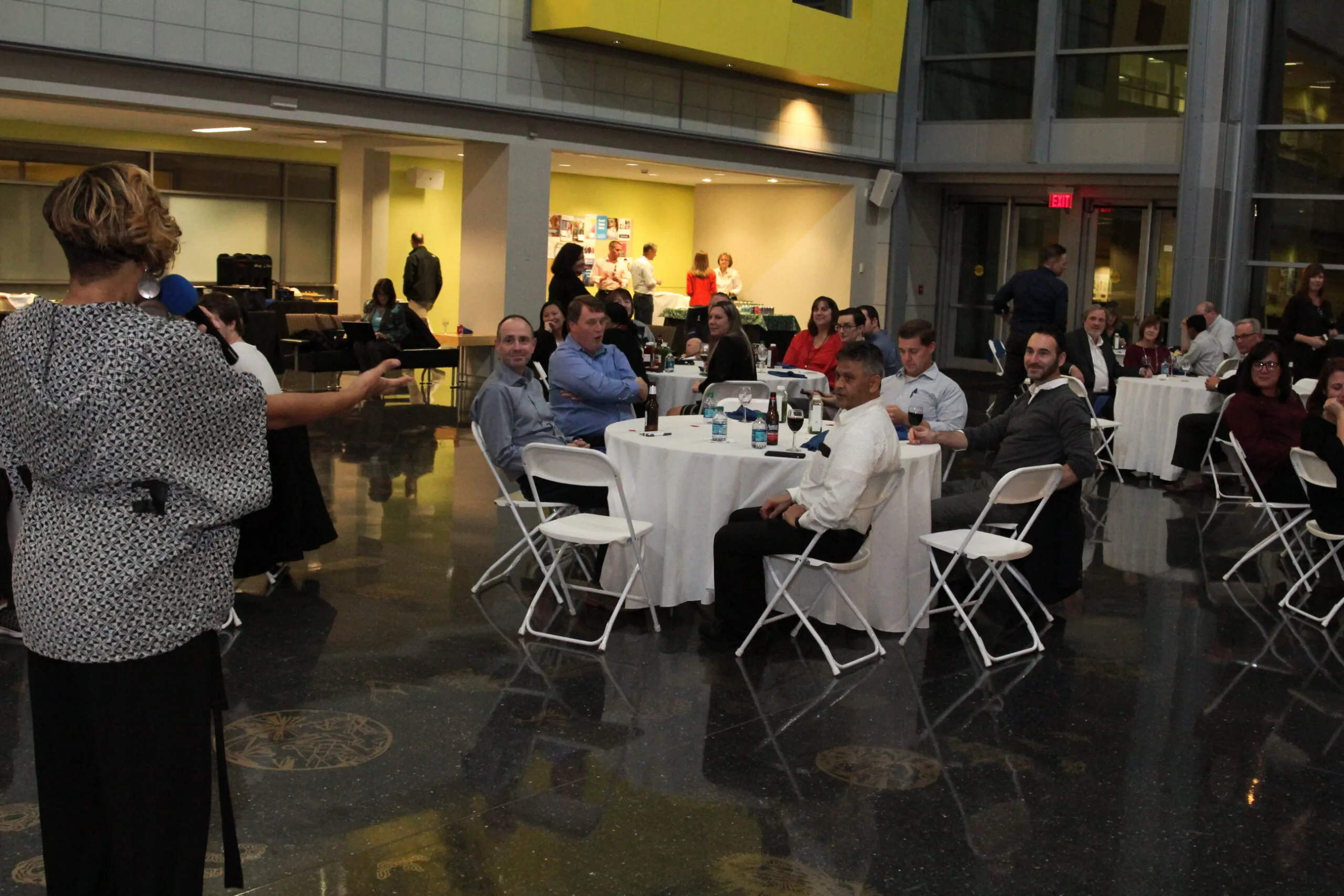
Professionally facilitated game shows take these principles further. A trained host reads the room, adjusts pacing, and keeps energy high in ways that a self-guided app or PDF worksheet simply cannot replicate.
Communication-Focused Training Games
Communication breakdowns cost teams hours of rework every week. These employee training games target listening, clarity, and cross-department collaboration.
Team Feud (Game Show Format)
It’s PlayTyme Game Shows runs a Team Feud format where departments face off answering survey-style questions. Each round requires the team to discuss, agree on an answer, and present it under time pressure. The format forces quick consensus-building and rewards clear communication between teammates. A professional host keeps the pace tight and the stakes fun.
Back-to-Back Drawing
One partner describes an image while the other draws it without seeing the original. This DIY exercise exposes how much meaning gets lost in one-directional communication. It works well for small groups during a lunch-and-learn session.
Telephone Relay Challenge
Teams pass a detailed message through five or six people and compare the final version to the original. The distortions reveal where assumptions replace active listening. Use this as a quick warm-up before a longer training block.
Problem-Solving and Critical Thinking Games
Problem-solving training works best when employees practice under constraints. These games introduce time limits, incomplete information, and team dependencies to mirror real workplace decisions.
Trivia Challenge (Game Show Format)
A professionally hosted trivia game uses custom questions tied to company processes, industry knowledge, or product details. It’s PlayTyme structures these with buzzer systems, scoring displays, and multiple rounds that escalate in difficulty. Teams strategize about which members answer which categories, building delegation and critical thinking simultaneously.
Escape Room Scenarios
Teams solve a series of puzzles to “escape” within a set time. Each puzzle requires a different thinking style: pattern recognition, logical deduction, or lateral thinking. This format works as a DIY option using printed materials or as a facilitated experience.
Case Study Competitions
Present teams with a real (anonymized) business problem your company faced. Give them 30 minutes to develop a solution and present it. Judges score on feasibility, creativity, and presentation quality. This format doubles as a talent identification tool for leadership pipelines.
Onboarding Games for New Hires
The first 90 days determine whether a new employee becomes productive or starts looking elsewhere. Employee training games accelerate onboarding by making company knowledge stick from day one.
Company Knowledge Game Show
New hires compete in teams on questions about company history, values, product lines, org structure, and internal tools. The competitive format motivates them to study pre-reading materials before the session. It’s PlayTyme builds custom question sets around each client’s specific onboarding content, so the game reinforces exactly what HR needs new employees to know.
Scavenger Hunts
Send new hires through the office (or a virtual workspace) to find specific people, tools, or information. Each “find” requires them to introduce themselves to a colleague or locate a resource they will use daily. This DIY option costs nothing and builds familiarity with the physical and digital workspace.
Role-Play Speed Rounds
Pair new hires with experienced employees for 5-minute role-play scenarios. Rotate partners every round. New hires practice customer interactions, internal requests, or common troubleshooting situations with multiple coaching perspectives in a single session.
Compliance and Policy Training Games
Compliance training has the worst reputation in corporate learning. Employees treat it as a box to check, retain almost nothing, and resent the time spent. Games transform this obligation into something employees remember.
Compliance Jeopardy
Structure compliance content into categories (data privacy, workplace safety, harassment policy, financial regulations) and run it as a Jeopardy-style game. The question-and-answer format with point values turns dry policy material into a competitive exercise. When It’s PlayTyme hosts this format, the professional production (buzzers, scoreboards, audience involvement) keeps energy levels high throughout topics that typically put rooms to sleep.
Scenario Voting
Present realistic workplace scenarios on screen. Teams vote on whether the action described is compliant or non-compliant, then discuss the correct answer. This DIY format works well for annual refresher training and generates genuine debate about gray-area situations.
“Myth or Fact” Rounds
Read common misconceptions about company policies. Teams decide if each statement is a myth or a fact. This quick format exposes the specific areas where employees hold incorrect assumptions, giving trainers a diagnostic tool alongside the training itself.
Challenges L&D Teams Face with Employee Training Games
Adopting game-based training is not automatic. L&D professionals run into real obstacles that determine whether a program succeeds or fizzles out after one session.
- Skepticism from leadership. Senior managers who associate games with wasted time need to see measurable outcomes tied to engagement scores, retention rates, or post-training assessment improvements.
- Content alignment. A fun game that teaches nothing relevant is worse than a boring lecture that covers required material. Every game needs direct connections to learning objectives.
- Scaling across locations. A game that works for 15 people in a conference room does not automatically work for 200 people across three offices. Format, facilitation, and logistics all change at scale.
- Measuring retention. Participation metrics (attendance, completion rates) tell you who showed up, not who learned. L&D teams need pre-and-post assessments tied to the game content.
- Sustaining engagement over time. One game session generates excitement. A sustained program requires variety, fresh content, and regular scheduling to maintain momentum.
Professional game show providers address several of these challenges directly. They bring tested formats, scalable production, and facilitation expertise that internal teams rarely have time to develop on their own.
Professional Game Show Formats vs. DIY Training Games
Both approaches have a place in a training program. The right choice depends on group size, budget, training objectives, and how often you plan to run sessions.
| Factor | Professional Game Show | DIY Training Game |
|---|---|---|
| Group size | 20 to 300+ | 5 to 30 |
| Setup time | Handled by provider | 2 to 10 hours internal prep |
| Facilitation | Trained professional host | Internal trainer or manager |
| Customization | Fully custom questions and themes | Template-based, self-built |
| Energy level | High (buzzers, scoreboards, music) | Moderate (depends on facilitator) |
| Best for | Large events, onboarding cohorts, annual training | Weekly team meetings, small group sessions |
| Cost structure | Per-event fee | Internal staff time |
For high-stakes training moments (onboarding classes, annual compliance reviews, company-wide skill-building days) a professionally produced game show delivers consistent energy and retention across large groups. For weekly reinforcement or small team check-ins, DIY games fill the gaps between those marquee sessions.
How to Match the Right Training Game to Your Objective
Choosing an employee training game starts with the learning objective, not the format. Work backward from what employees need to demonstrate after the session.
Start with the outcome. Define it in one sentence: “After this session, employees will be able to [specific skill or knowledge].” If you cannot complete that sentence, the training objective is not clear enough to select a game format.
Match the mechanic to the skill. Recall-based objectives (policy knowledge, product specs, company history) fit quiz and trivia formats. Behavioral objectives (communication, negotiation, conflict resolution) require role-play or collaborative challenges. Analytical objectives (process improvement, troubleshooting) work best with case studies or escape-room-style puzzles.
Factor in group dynamics. New teams benefit from games that force interaction across departments. Established teams respond better to competitive formats that test shared knowledge. Mixed-tenure groups need games where experience and fresh perspective both contribute to winning.
Plan the frequency. A single game session builds excitement but not lasting skill. The strongest training programs pair a quarterly or semi-annual professionally facilitated event with monthly DIY reinforcement games. This rhythm keeps the material fresh without exhausting the novelty factor.
If your team is ready to bring employee training games into your L&D calendar, explore the corporate game show options available across New Jersey, New York City, and Connecticut. Reach out to the It’s PlayTyme team to build a custom training game matched to your specific objectives and group size.
Frequently Asked Questions (FAQs)
What are employee training games?
Employee training games are structured activities that teach workplace skills or knowledge through competition, collaboration, or problem-solving mechanics. They range from professionally hosted game shows with buzzers and scoreboards to simple DIY exercises a manager runs during a team meeting. The goal is active participation rather than passive instruction.
How do training games improve knowledge retention?
Games engage multiple cognitive pathways at once: decision-making, social interaction, emotional responses to competition, and immediate feedback loops. This combination creates stronger memory encoding than reading or listening alone. Repeated exposure through game rounds reinforces material without the monotony of re-reading a manual.
Are game show formats effective for large corporate groups?
Yes. Professionally facilitated game shows scale to groups of 300+ with consistent energy and engagement. Companies like It’s PlayTyme Game Shows use professional sound systems, scoring displays, and trained hosts to keep large audiences actively participating rather than passively watching.
What types of training work best in a game format?
Compliance reviews, onboarding knowledge checks, product training, communication skills, and team-based problem-solving all translate well into game formats. The key is matching the game mechanic to the learning objective. Quiz formats suit recall-based training while collaborative challenges suit behavioral skill development.
How much does a professional training game show cost?
Pricing varies based on group size, event duration, customization level, and location. Most professional game show providers charge a per-event fee that covers hosting, equipment, setup, and custom content creation. Contact providers directly with your group size and objectives for an accurate quote.
What does research say about the business cost of employee disengagement?
Gallup’s meta-analysis of over 112,000 business units found that highly engaged teams produce 23% greater profitability than disengaged ones, making disengagement a direct hit to the bottom line.
Why do slide decks and recorded webinars fail as training tools?
Standard slide decks and recorded webinars fail to hold attention because they rely on passive instruction. Without active participation, employees retain less and are less likely to apply what they learned.