

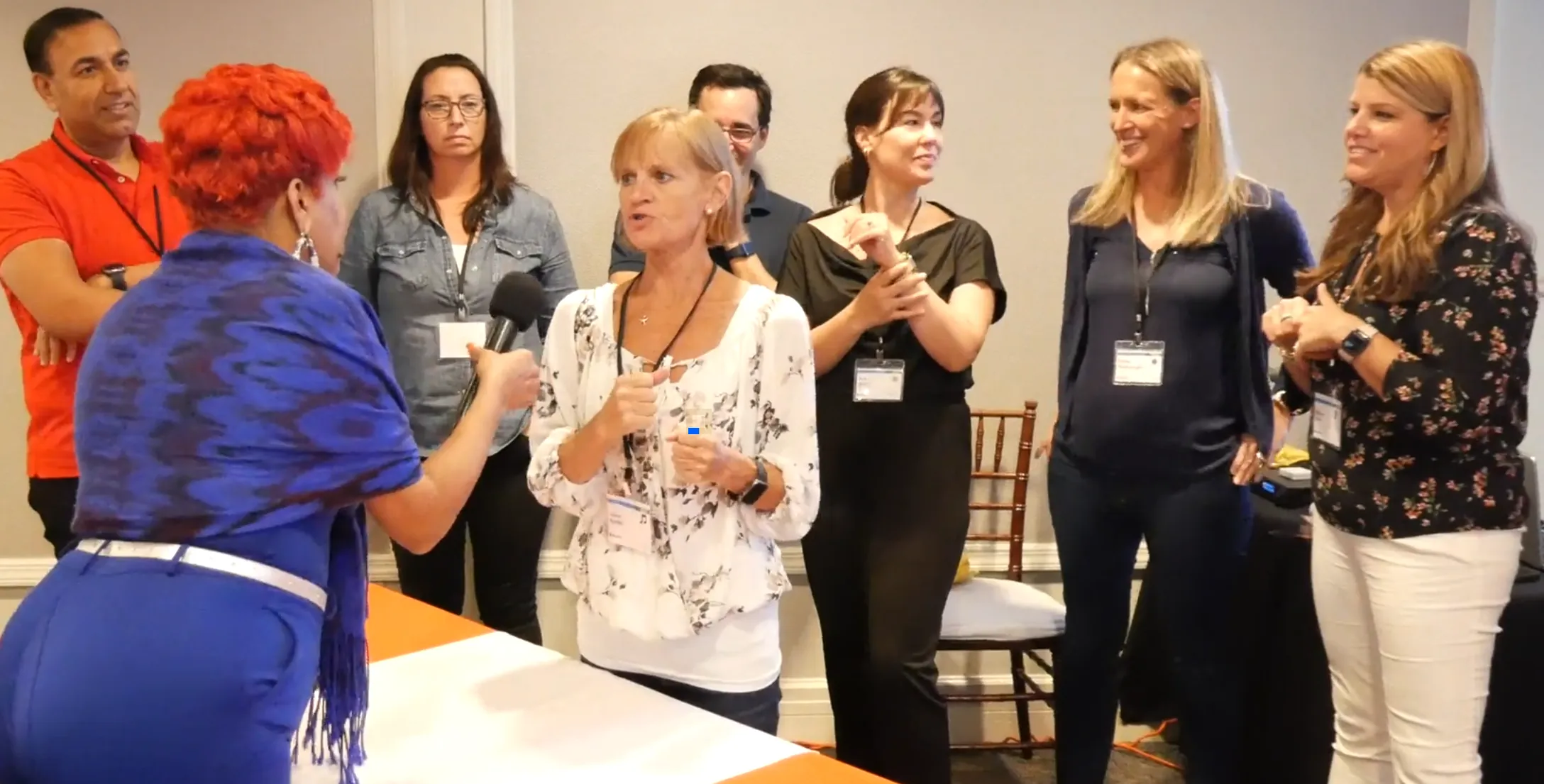

Research from MIT’s Human Dynamics Laboratory, published in Harvard Business Review, found that 35% of the variation in a team’s performance is explained by the number of face to face exchanges among its members. That single metric outweighs individual intelligence, personality, and skill combined. Separately, a Harvard Business Review survey of 425 business decision-makers reported that 95% consider in-person meetings essential for building lasting professional relationships.
Those numbers confirm what most leaders already feel: a video call gets information across, but it rarely shifts how people relate to each other. The gap between “informed” and “connected” is exactly where face to face team building lives.
If your team communicates efficiently on Slack yet still struggles with silos, hesitant collaboration, or flat morale during group projects, the format of your interactions is the likely bottleneck. Screen-based communication strips away the physical signals (posture shifts, laughter timing, eye contact, spontaneous high-fives) that tell people they belong. No amount of breakout rooms or emoji reactions replicates walking up to a colleague, reading their expression in real time, and adjusting on the fly. The exercises matter, but the medium matters more.
What Makes Face to Face Team Building Fundamentally Different
Virtual team building asks participants to perform connection through a rectangle. Face to face team building drops them into a shared physical space where connection happens whether they plan for it or not. That distinction is the entire argument.
When people occupy the same room, three things happen simultaneously that screens cannot reproduce:
- Full-spectrum body language. Webcams capture shoulders and above. In person, stance, gestures, proximity, and micro-expressions all transmit information. A teammate leaning forward during a brainstorm signals genuine interest in a way no camera angle conveys.
- Ambient awareness. You hear side conversations, notice who gravitates toward whom, and pick up on energy shifts across the whole group. On a video call, you only see whoever is speaking.
- Physical co-regulation. Laughter is contagious in a room. Applause builds momentum. Shared physical reactions synchronize groups neurologically, creating a sense of unity that a muted microphone never will.
These are not soft perks. They are the operating conditions under which trust forms fastest.
The Body Language Advantage: Reading the Room for Real
Communication research consistently places nonverbal cues above spoken words in terms of emotional impact. During face to face team building, every participant broadcasts and receives hundreds of nonverbal signals per minute: a raised eyebrow when someone gives a surprising answer, crossed arms during a debate, a genuine smile after a shared win.
These signals do two critical jobs. First, they provide instant, honest feedback. You know immediately whether your idea landed or fell flat, no waiting for a thumbs-up emoji. Second, they allow real-time calibration. A good facilitator reads the room and pivots. A strong teammate notices hesitation in a colleague and offers encouragement before being asked.
Virtual platforms flatten this entire feedback loop. Gallery view turns faces into postage stamps. Latency adds awkward pauses. The result is a group that communicates but does not truly read each other.
The Shallow Bonds That Form Without In-Person Time
Organizations that rely solely on remote or hybrid engagement for team development run into predictable friction:
- Shallow relationships. Colleagues know each other’s Slack handles but not their sense of humor. Without shared physical experiences, relationships stay transactional.
- Misread tone. Text-based communication produces misunderstandings at scale. Sarcasm, urgency, and warmth all look the same in a chat message, and these misreads erode trust over weeks and months.
- Participation imbalance. Virtual meetings default to a few dominant voices while others stay muted (literally and figuratively). Face to face formats naturally pull quieter members into the action through physical proximity and direct eye contact.
- Low emotional recall. People remember how an experience made them feel. A forgettable Zoom activity fades within days. A high-energy, in-person game show sticks for months because it engaged the whole body, not just a screen.
- Missing spontaneity. The best team moments are unscripted: an unexpected joke during a challenge, a surprising talent revealed under pressure, a shared groan after a wrong answer. Virtual formats suppress spontaneity because every interaction passes through a digital bottleneck.
Unscripted Reactions: The Real Engine of Team Chemistry
Planned icebreakers produce planned responses. Face to face team building, done well, creates conditions where unscripted moments surface naturally. These moments carry outsized weight.
Consider what happens during a live, competitive game show format. A normally reserved analyst shouts an answer before the team captain. The entire group erupts. That 10-second exchange rewrites how the team perceives that person. No script produced it. No facilitator guide anticipated it. It happened because everyone was physically present, emotionally invested, and reacting in real time.
These unscripted reactions serve as social proof within the group. They signal authenticity: “This is who I actually am when I’m not performing for a camera.” Teams that collect enough of these moments develop inside jokes, shared references, and a collective identity that makes future collaboration feel less like work and more like coordination among people who genuinely know each other.
Physical Humor and Shared Laughter as Trust Accelerators
Laughter in a room is a full-body event. It spreads through sound, facial expression, posture, and even physical contact (an elbow nudge, a hand on the shoulder). Research on group dynamics consistently shows that shared laughter reduces cortisol, increases oxytocin, and accelerates interpersonal trust.
Physical humor, the kind that emerges when someone fumbles a prop, does an exaggerated celebration, or acts out an answer with their whole body, only works in person. On a video call, physical comedy is clipped by frame edges, flattened by compression, and stripped of the spatial context that makes it funny.
This is why formats like It’s PlayTyme Game Shows generate the kind of laughter that people reference weeks later. Their live game show experiences (Face-2-Face Feud, 60 Seconds of Fame, Lip Sync Challenge) are designed around physical participation. Contestants stand up, move, gesture, and perform in front of their peers. The humor is generated by real people in a real room doing something slightly outside their comfort zone, and that is precisely why it works.
How Format Shapes Outcome: Virtual vs. Face to Face
The following comparison highlights why the delivery format determines the quality of the team building outcome, independent of the specific activity chosen.
| Dimension | Virtual Format | Face to Face Format |
|---|---|---|
| Body language visibility | Shoulders and above, often pixelated | Full body, real-time, high-fidelity |
| Spontaneous interaction | Filtered through mute/unmute | Instant, natural, multi-directional |
| Physical energy | Sedentary, screen fatigue after 45 min | Movement-based, energy builds over time |
| Laughter contagion | Delayed by latency, muffled by speakers | Immediate, visceral, room-wide |
| Participation equity | Dominated by extroverts, easy to hide | Proximity and group dynamics pull everyone in |
| Emotional recall after 30 days | Low (blends with other video calls) | High (distinct physical memory) |
The table is not an argument against virtual meetings for information transfer. It is an argument that team building, the process of forming trust and cohesion, requires a higher-bandwidth medium than a screen provides.
Face to Face Exercises That Demonstrate the Principle
The exercises below are not the point of face to face team building. They are evidence of the principle: that physical presence transforms ordinary group activities into trust-building experiences.
Competitive Game Shows
Formats like trivia battles, feud-style surveys, and timed physical challenges force teams to strategize, communicate, and react under pressure. The competitive element raises the emotional stakes just enough to produce genuine reactions without creating real conflict. It’s PlayTyme’s game show formats (Game Show Mania, The Challenge, Word Play) are built around this dynamic: teams form, compete, celebrate, and bond through shared intensity.
Physical Challenges and Minute-to-Win-It Rounds
Activities that require standing, moving, and using props engage the body and break the “meeting posture” that keeps people guarded. When a senior director is stacking cups against the clock while colleagues cheer, hierarchy dissolves. That dissolution does not happen on Zoom.
Performance-Based Activities
Lip sync battles, act-it-out rounds, and improvisational challenges ask participants to be slightly vulnerable in front of peers. Vulnerability in a safe, fun context is the fastest path to authentic connection. The physical audience (clapping, laughing, reacting) provides the social reward that makes the vulnerability worthwhile.
Why It’s PlayTyme Game Shows Delivers on the In-Person Promise
Not every in-person activity captures the advantages outlined above. A catered lunch is face to face but rarely builds team cohesion. A ropes course is physical but excludes participants with mobility limitations. The format needs to be inclusive, energetic, and structured enough to generate those unscripted moments without forcing them.
It’s PlayTyme Game Shows is a family-owned company serving New Jersey, New York City, and Connecticut that brings fully produced, live game show experiences directly to corporate events, off-sites, and team building days. Their team handles all equipment, setup, and facilitation, so the hosting organization focuses entirely on participation.
What separates their approach:
- Professional facilitation. A trained host reads the room, adjusts pacing, and ensures every team and personality type gets pulled into the action. This is the human equivalent of the “ambient awareness” advantage: someone is constantly calibrating the experience based on live, physical feedback.
- Multiple format options. From survey-style feuds to music rounds to physical minute-to-win-it challenges, the variety ensures that analytical thinkers, performers, and competitive athletes all find a moment to shine.
- Zero logistics burden. The company arrives with everything needed: screens, buzzers, sound systems, props. The client provides a room and participants. That simplicity removes the planning friction that causes many teams to default to “just do another virtual happy hour.”
- Group size flexibility. Their formats scale from small departments to full-company events, maintaining the intimate, high-energy feel regardless of headcount.
How to Decide If Your Team Needs Face to Face Team Building
Not every team interaction requires physical presence. Status updates, project check-ins, and information sharing work fine on video. But ask yourself these questions before defaulting to virtual for your next team building event:
- Do team members know each other’s communication styles, or just their job titles?
- When was the last time the group laughed together, not at a forwarded meme, but in the same room at the same moment?
- Are new hires integrating into the team culture, or just learning the workflow?
- Does cross-departmental collaboration feel forced or natural?
- Has your team had a shared physical experience in the past six months?
If more than two answers point to a gap, a virtual trivia night will not close it. The gap is sensory and relational, and closing it requires putting people in the same room with a reason to interact, compete, laugh, and react together.
Ready to give your team the real thing? Reach out to It’s PlayTyme Game Shows to book a live, fully facilitated corporate game show experience in New Jersey, NYC, or Connecticut. Your team will walk away with inside jokes, stronger connections, and the kind of shared memory that no video call produces.
Frequently Asked Questions (FAQs)
What is face to face team building and how is it different from virtual team building?
Face to face team building brings team members into the same physical space for structured group activities designed to build trust, communication, and cohesion. Unlike virtual team building, it provides full body language visibility, natural spontaneous interaction, and contagious group energy that accelerates relationship formation.
Is face to face team building worth the cost compared to free virtual options?
Yes. Virtual options cost less upfront but produce weaker relational outcomes and lower emotional recall. Research shows that in-person events deliver a higher return on investment because the trust and cohesion they build directly improve collaboration, reduce miscommunication, and increase employee retention over the following months.
How do I convince leadership to invest in in-person team building instead of virtual?
Present the data: 35% of team performance variation traces to face to face interaction frequency, and 95% of business leaders consider in-person meetings essential for relationship building. Frame the request around specific team gaps (new hires not integrating, cross-team friction, low morale) and position the event as a targeted intervention with measurable relational outcomes, not a perk.