

Student engagement remains one of the biggest challenges facing educators today. According to Gallup research, only 50% of students report being engaged in school, with 21% describing themselves as actively disengaged. Schools that incorporate interactive, collaborative experiences see measurable results: a CASEL meta-analysis of 213 school-based programs found that students participating in social-emotional learning activities gained 11 percentile points in academic achievement over their peers.
Family Feud is one of the most recognized game show formats in the country. Students already know how it works. That instant familiarity removes the awkward warm-up period that plagues most assembly programs — getting the entire auditorium involved from the first survey question. For schools looking to boost spirit, reinforce positive behavior, or wrap up a testing season with something memorable, a Family Feud school assembly delivers energy that a standard lecture or movie day simply cannot match.
But booking an assembly program that actually works presents real obstacles. Many schools have tried “interactive” events that fell flat because the format only engaged a handful of volunteers while hundreds of students sat passively in bleachers. Budget constraints limit options. Administrators need content that feels fun but stays appropriate and, ideally, ties back to school values or curriculum. Finding a provider who brings professional equipment, keeps a tight schedule, and handles the logistics without burdening school staff is harder than it sounds.
Why Family Feud Works Better Than Traditional School Assemblies
Traditional assemblies follow a predictable pattern: a speaker talks, students listen (or pretend to), and the program ends without any real interaction. Family Feud flips this dynamic entirely. The survey-style format requires teams to collaborate, discuss, and make quick decisions together. Every student in the audience participates by cheering for their team, shouting out guesses, and reacting to reveals on the scoreboard.
The game’s structure also creates natural suspense. The “strike” mechanic, the steal opportunity, and the Fast Money bonus round keep attention locked in because the outcome stays uncertain until the final answer. Teachers consistently report that students talk about Family Feud assemblies for weeks afterward, a retention effect that no PowerPoint presentation achieves.
Major Problems Schools Face with Assembly Programs
Finding the right assembly program involves navigating several real obstacles:
- Passive audiences: Most assembly formats engage 5 to 10 volunteers on stage while the remaining 200 to 500 students become spectators. Disengagement spreads fast in a gymnasium full of restless kids.
- Budget pressure: Schools operate on tight event budgets. Administrators need to justify every dollar, and a program that entertains without delivering educational or social-emotional value is a tough sell to the principal or PTA.
- Logistical burden on staff: Teachers and administrators already carry full workloads. An assembly provider that requires extensive setup help, AV troubleshooting, or constant supervision adds stress instead of relieving it.
- Age-appropriate content: What works for fifth graders falls flat with eighth graders, and vice versa. A one-size-fits-all approach alienates half the audience.
- Scheduling constraints: Assembly windows are tight. A program that runs long disrupts the rest of the school day. A program that ends too early leaves an awkward gap.
What a Professional Family Feud School Assembly Looks Like
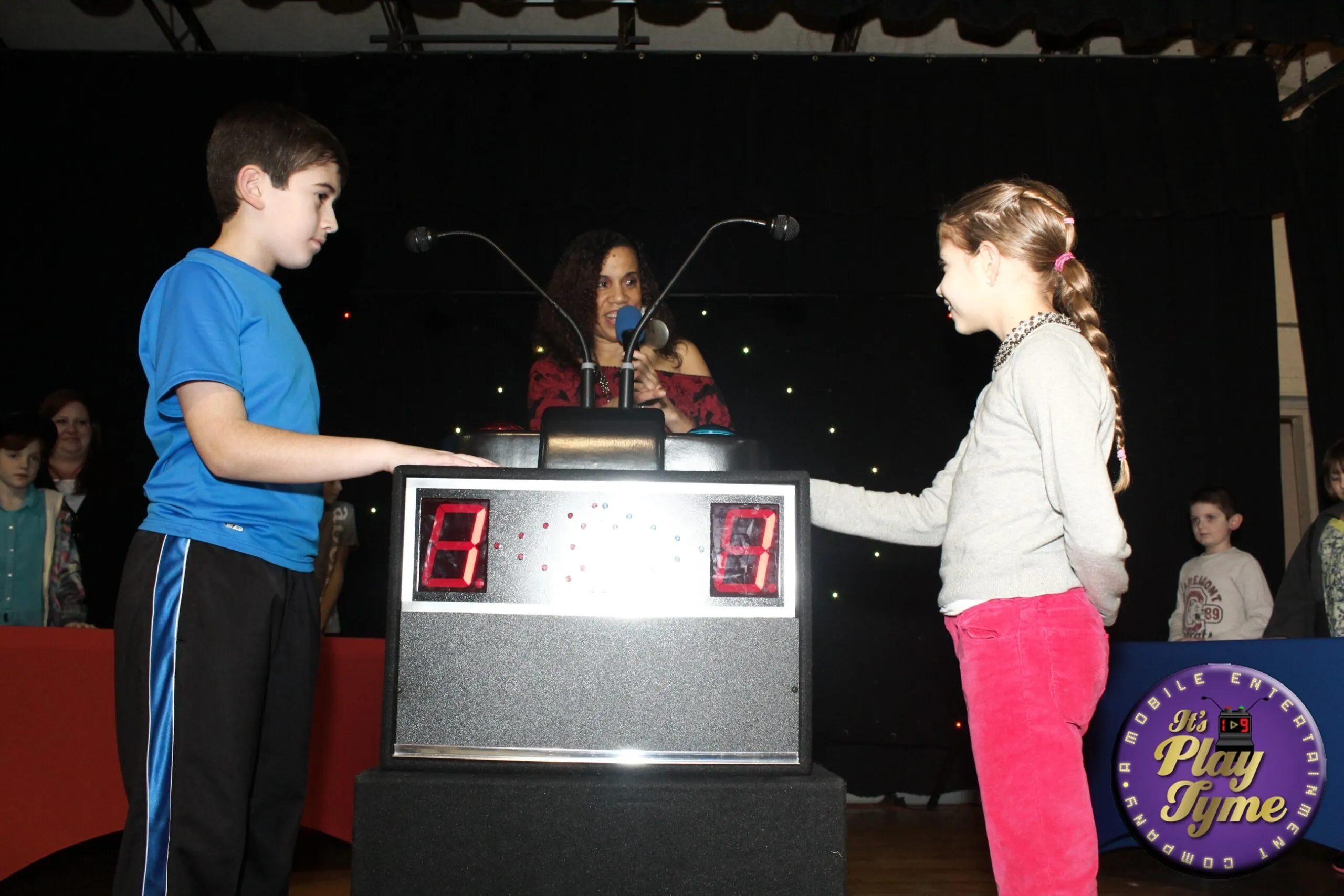
It’s PlayTyme Game Shows brings a full-scale Family Feud production directly into school gyms, auditoriums, and cafeterias across New Jersey, New York City, and Connecticut. This is not a teacher running trivia from a laptop. The setup includes a professional game board display, working buzzers, sound effects, and a trained host who keeps the energy high and the program running on schedule.
Here is what a typical program includes:
- A professional host who manages crowd energy, keeps the game moving, and adapts the pace to the audience
- Full game show equipment (digital scoreboard, buzzer podiums, sound system)
- Custom survey questions tailored to the school’s grade level, curriculum, or spirit theme
- Team rounds that rotate different groups of students onto the stage
- Audience participation segments so every student in the room stays involved
- A Fast Money finale that brings the energy to a peak before dismissal
How Family Feud Assemblies Support School Goals
Administrators approve assemblies faster when the program connects to measurable school objectives. Family Feud assemblies address several priorities at once.
Social-Emotional Learning
The team format requires students to listen to each other, negotiate answers, and handle both winning and losing with composure. These are core SEL competencies (self-management, social awareness, relationship skills) practiced in a high-energy, low-stakes setting.
School Spirit and Culture
Grade-vs-grade or homeroom-vs-homeroom formats build pride and friendly competition. Schools use Family Feud assemblies for spirit weeks, end-of-year celebrations, and reward events for meeting schoolwide goals.
Anti-Bullying and Kindness Initiatives
Survey questions centered on respect, teamwork, and positive behavior reinforce anti-bullying messaging in a format students actually enjoy. The lesson sticks because students associate it with a fun experience, not a lecture.
Curriculum Reinforcement
Survey categories built around science, history, math, or reading standards turn review into competition. Students study harder when they know the answers show up in the game.
Grade-Level Adaptations That Keep Every Audience Engaged
One of the biggest mistakes assembly providers make is running the same program for kindergarteners and eighth graders. It’s PlayTyme Game Shows customizes every detail by grade band.
| Feature | Elementary (K 5) | Middle School (6-8) | High School (9-12) |
|---|---|---|---|
| Question Difficulty | Age-appropriate, visual clues | Subject-aligned, pop culture | Advanced topics, humor |
| Team Size | 5 students per team | 5 students per team | 5 students per team |
| Host Energy Style | High energy, encouraging | Competitive, fast-paced | Quick wit, peer-level tone |
| Audience Involvement | Call-and-response, chants | Section cheering, predictions | Social media moments, rivalries |
| Program Length | 30-45 minutes | 45-60 minutes | 45-60 minutes |
Elementary programs use simpler language, more physical energy from the host, and frequent rotation so younger students stay focused. Middle school programs lean into the competitive edge that this age group craves. High school programs move faster, incorporate humor, and give students more autonomy in their team strategy.
Why It’s PlayTyme Game Shows Stands Out for School Assemblies
Several factors set It’s PlayTyme apart from other assembly providers in the tri-state area:
- Turnkey setup: The team arrives early, sets up all equipment, runs the program, and breaks down without requiring any help from school staff. Teachers get to watch and enjoy the event alongside their students.
- Experienced school hosts: The hosts specialize in school audiences. They know how to manage a gymnasium of 400 students, keep the program appropriate, and adapt on the fly when energy levels shift.
- Custom content: Every program is built around the school’s specific needs. Whether the goal is a reward assembly, a spirit week finale, or a reading initiative kickoff, the survey questions and format reflect that purpose.
- Professional production quality: Students respond differently to a real game show setup than to a teacher with a microphone. The buzzers, the scoreboard, and the sound effects create an experience that feels special.
- Multiple game show formats: Beyond Family Feud, It’s PlayTyme offers other game show themes including trivia, Jeopardy-style, Minute to Win It, and more. Schools that book annually rotate formats to keep the experience fresh.
What to Expect on the Day of Your Assembly
Booking a Family Feud school assembly through It’s PlayTyme follows a straightforward process. After the initial booking, a coordinator works with the school to select survey categories, confirm grade levels, and lock down the schedule. On the day of the event, the team handles everything:
- Arrives 45 to 60 minutes before the program to set up equipment
- Tests all audio, visual, and buzzer systems before students enter
- Runs the full program within the agreed time window
- Breaks down and clears the space within 30 minutes of the program ending
Schools with multiple grade levels or large student bodies often book back-to-back sessions. The team runs separate programs for each group so every student gets the full experience rather than a diluted version crammed into one oversized assembly.
What to Ask Before Booking an Assembly Provider
Not every company advertising game show assemblies delivers the same quality. When evaluating providers, focus on these factors:
- School-specific experience: Ask how many school assemblies the provider has run. A company that primarily does corporate events or birthday parties will struggle with the unique dynamics of a school audience.
- Equipment quality: Request photos or videos of their actual setup. A professional game board, working buzzers, and a sound system that fills a gymnasium matter. A laptop on a folding table does not create the same effect.
- Content customization: Confirm that survey questions are written specifically for your students, not pulled from a generic template. The best providers ask about your grade level, theme, and goals before the event.
- References from other schools: Talk to administrators who have booked the provider before. Ask about professionalism, timing, student engagement, and whether they would rebook.
- Insurance and background checks: Any provider working in a school setting should carry liability insurance and have staff who have passed background screenings.
It’s PlayTyme Game Shows checks every one of these boxes. With years of experience running school assembly programs across New Jersey, New York, and Connecticut, schools trust the team to deliver a program that students love and administrators approve. Ready to bring Family Feud to your school? Get in touch to lock in your date.
Frequently Asked Questions (FAQs)
How long does a Family Feud school assembly last?
Most programs run between 45 and 60 minutes, depending on the grade level and the number of rounds. Elementary programs sometimes run 30 to 45 minutes to match shorter attention spans. The host keeps the pace tight so the program fits within a standard assembly window.
How many students participate in a Family Feud assembly?
Every student in the audience participates through cheering, predictions, and audience poll segments. On stage, teams of five rotate through rounds so that 20 to 40 students get direct gameplay time. For larger schools, back-to-back sessions ensure every grade gets full involvement.
Are the survey questions customized for our school?
Yes. It’s PlayTyme Game Shows writes survey questions specifically for each school’s grade level, curriculum focus, or event theme. Schools running anti-bullying weeks, reading initiatives, or spirit week celebrations receive questions that reinforce those goals.
What areas does It’s PlayTyme Game Shows serve for school assemblies?
It’s PlayTyme serves schools throughout New Jersey, New York City, and Connecticut. The team travels to schools across the tri-state area and handles all logistics, so distance within the service region does not affect the quality of the program.