
Corporate training programs consume billions of dollars annually — yet most of that investment disappears within days. According to SHRM research on gamified learning, organizations that apply game mechanics to training see measurable gains in knowledge retention and business outcomes, including double-digit increases in performance metrics. Meanwhile, ATD’s 2025 State of the Industry report confirms that 94% of employees are more likely to stay at companies that invest in their professional development. The message is clear: training matters, but only when it sticks.
That disconnect between spending and results is exactly why L&D teams are turning to game shows for corporate training. The standard approach (a slide deck, a talking head, a quiz nobody studies for) produces forgettable sessions and disengaged employees. Trainers know this. They watch participants check their phones ten minutes into a compliance refresher. They see onboarding cohorts struggle to recall basic product details a week later.
The core problem is format, not content. Most training fails because it delivers information passively. Employees sit, listen, and forget. There is no urgency, no accountability, and no reason to actively process what they hear. Game show formats solve this by replacing passive consumption with active competition, time pressure, and real-time scoring that forces participants to retrieve and apply knowledge on the spot.
The Short Version
- SHRM research shows gamified training produces double-digit gains in employee performance metrics.
- ATD’s 2025 report finds 94% of employees are more likely to stay at companies that invest in development.
- The standard slide-deck-and-quiz approach produces forgettable sessions and disengaged employees.
- Trainers already see the signs: participants checking phones ten minutes into a session.
- L&D teams are turning to game shows because conventional training formats fail to make content stick.
Why Passive Training Produces Poor Results
Lecture-based training relies on a single transfer method: listening. Research on memory consolidation consistently shows that passive listening produces the lowest retention rates among all learning formats. Attendees retain roughly 10% of what they hear in a lecture after 48 hours. Compare that to active participation methods, where retention jumps to 75% or higher when learners practice, discuss, and apply new information immediately.
Slide-heavy presentations compound the problem. Participants read ahead, tune out the speaker, and assume they will “review the deck later.” They rarely do. Even interactive elements like polls or breakout discussions only partially address the issue. They break up monotony without creating the kind of high-stakes engagement that forces genuine recall.
The result: organizations repeat the same training cycles quarterly or annually, covering identical material because employees never internalized it the first time. That repetition wastes budget, wastes employee hours, and creates a culture where training is treated as an interruption rather than a growth opportunity.
How Game Show Mechanics Drive Training Retention
Game shows work as training tools because they activate three cognitive principles simultaneously: time pressure, competitive scoring, and team accountability.
Time pressure forces rapid recall. When a team has seconds to answer a question about a compliance policy or product specification, there is no time to bluff. Participants either know the material or they don’t. That urgency triggers deeper encoding in memory because the brain treats time-pressured retrieval as a high-importance event.
Competitive scoring adds motivation that no slide deck provides. Leaderboards, point totals, and round-by-round standings create an emotional investment in getting answers right. Adults respond to competition. When a team trails by 200 points going into the final round, every member is focused, engaged, and actively trying to recall what they learned.
Team accountability distributes the learning load. In a team-based game show format, every person’s knowledge (or lack of it) directly affects the group’s score. This creates positive peer pressure to prepare and pay attention. It also surfaces knowledge gaps in real time, giving trainers immediate feedback on which topics need reinforcement.
Challenges of Using Game Shows for Corporate Training
Despite the clear advantages, integrating game shows into a training program presents real obstacles that L&D teams need to address.
- Content alignment. Off-the-shelf game show providers run generic trivia formats. Those are fun but fail to reinforce specific training objectives like regulatory compliance, product feature mastery, or company policy knowledge. The game becomes entertainment rather than education.
- Participant resistance. Some employees view game-based training as childish or unserious. Without proper framing and genuinely challenging content, skeptics disengage or treat the event as a break from “real work.”
- Measurement difficulty. Standard team-building providers rarely track individual or team performance data. Trainers walk away with anecdotal impressions but no measurable outcomes to report to leadership.
- Scalability. Running a game show for 20 people differs dramatically from running one for 200. Audio, visual, and logistical requirements scale in ways that most internal teams are not equipped to handle.
- Content creation burden. Writing game show questions that are challenging, accurate, and aligned with learning objectives takes significant time. Most L&D teams lack the bandwidth to build a full question bank on top of their regular workload.
Training Topics That Work Best in a Game Show Format
Not every training topic translates equally well into a competitive quiz format. The strongest candidates share a common trait: they involve specific, testable knowledge that employees need to recall accurately.
Policy and Compliance Training
Compliance refreshers are notorious for low engagement. Turning OSHA regulations, harassment prevention protocols, or data security policies into game show questions transforms mandatory training from a checkbox exercise into an active recall session. Participants remember the content because they competed over it.
Product Knowledge and Sales Enablement
Sales teams need to know features, pricing tiers, competitive differentiators, and objection responses cold. A game show format tests that knowledge under pressure and quickly reveals which reps need additional coaching. It also builds confidence: a salesperson who dominated a product knowledge round carries that certainty into client conversations.
Onboarding and Culture Integration
New hires absorb enormous amounts of information in their first weeks. A game show session during onboarding reinforces company history, values, internal tools, and role-specific procedures while simultaneously building social connections among the new cohort. The competitive format breaks the ice faster than any icebreaker exercise.
Leadership and Management Development
Scenario-based game show rounds test decision-making skills. Present a management challenge, give teams limited time to choose the best response, and score based on alignment with company leadership principles. This format surfaces how leaders think under pressure, not just what they know.
Why Custom Content Is the Key Differentiator
The difference between a game show that entertains and one that trains comes down to content customization. Generic providers run pre-built question sets: pop culture trivia, general knowledge, or broad “workplace” categories. Those formats generate laughs but zero training ROI.
It’s PlayTyme Game Shows takes the opposite approach. Every game show is built around the client’s specific training objectives. The company works directly with L&D teams, HR departments, and training managers to script custom question content covering the exact material employees need to retain. That means a pharmaceutical company’s compliance game references their actual policies. A tech firm’s product knowledge round covers their real feature set. An onboarding game show tests the new hire handbook, not generic workplace facts.
This fully scripted custom content is what separates a training-grade game show from a party trick. It’s PlayTyme’s team handles the content creation burden so trainers do not have to build question banks from scratch. Clients provide the source material (training manuals, policy documents, product specs), and It’s PlayTyme transforms it into engaging, competition-ready game rounds.
| Training Format | Engagement Level | Knowledge Retention | Custom Content | Real-Time Feedback |
|---|---|---|---|---|
| Slide Presentation | Low | Low (10-20%) | Yes | No |
| E-Learning Module | Moderate | Moderate (30-40%) | Yes | Limited |
| Workshop / Breakout | Moderate | Moderate (40-50%) | Yes | Partial |
| Generic Team Building | High | Low (not training-focused) | No | No |
| Custom Game Show (IPT) | High | High (70%+) | Yes, fully scripted | Yes, scored rounds |
What It’s PlayTyme Delivers for Training-Focused Events
It’s PlayTyme Game Shows operates across New Jersey, New York City, and Connecticut, bringing professional-grade game show productions directly to corporate venues, conference rooms, and offsite locations. The company specializes in TV-style interactive formats (think Feud, Jeopardy, and Wheel-style rounds) that translate naturally into training applications.
For training-focused events, It’s PlayTyme provides:
- Full content scripting. Every question, category, and round is custom-built from the client’s training materials. No generic filler.
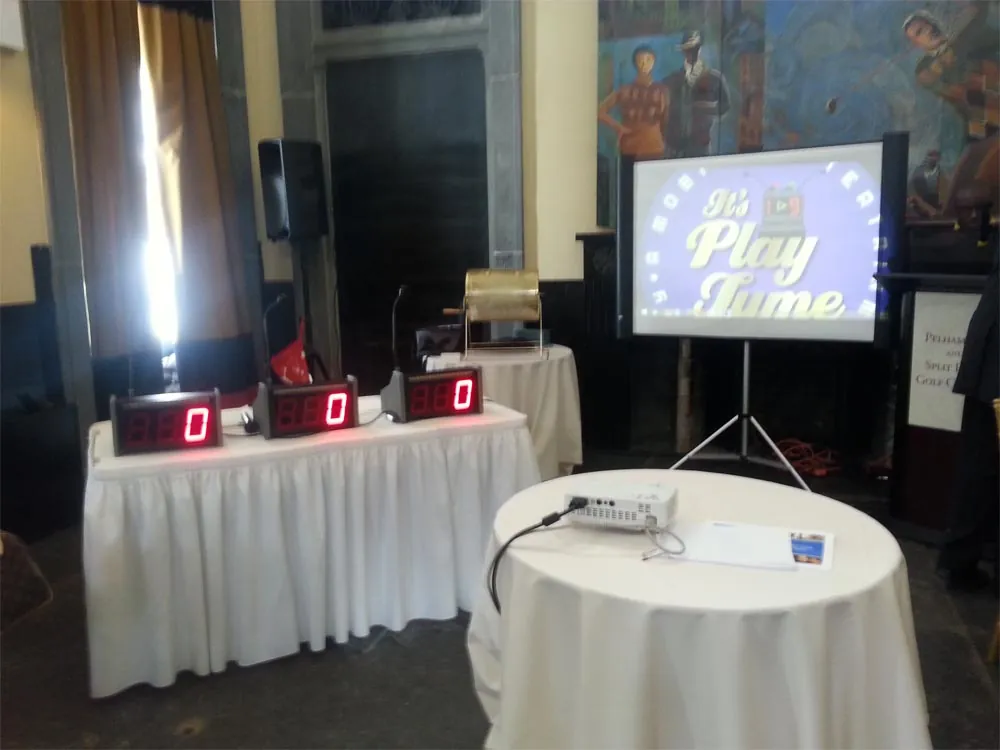
- Professional hosting and production. A trained emcee runs the show with professional sound, lighting, and scoring systems. The production quality keeps even skeptical participants engaged.
- Flexible group sizes. Programs scale from small department sessions of 15 people to company-wide events with hundreds of participants, all using team-based formats that keep everyone involved.
- Multiple game formats. Different training objectives pair with different formats. Rapid-fire recall works for compliance. Category-based rounds work for product knowledge. Scenario rounds work for leadership development.
- No upfront deposit. Payment is collected after the event, not before. That policy reflects confidence in the product and removes a common barrier for L&D teams working within tight procurement cycles.
Building a Game Show Into Your Training Calendar
The most effective approach treats game shows as a recurring component of the training program rather than a one-time event. Quarterly game show sessions create a rhythm of active recall that reinforces material covered in traditional training throughout the year.
A strong implementation sequence looks like this:
- Deliver the core training content through your standard method (workshop, e-learning, or instructor-led session).
- Schedule a game show session 1 to 2 weeks later to test retention and reinforce the material through competitive recall.
- Use the game show scores to identify knowledge gaps by topic area.
- Address those gaps with targeted follow-up training before the next cycle.
This “train, then test through play” model gives L&D teams both the engagement boost and the measurable data they need to demonstrate training ROI to leadership. It transforms the game show from a standalone event into an integrated assessment tool.
How to Choose the Right Game Show Training Provider
Not every game show company delivers training-grade experiences. When evaluating providers, focus on these criteria:
Custom content capability. Ask whether the provider writes questions from your materials or runs pre-built sets. If they only offer generic trivia, they are a team-building vendor, not a training partner. It’s PlayTyme’s ability to fully script every round from client-supplied content is the standard to measure against.
Production quality. A game show loses credibility if the production feels amateur. Professional sound, scoring displays, and an experienced host make the difference between a memorable training event and a forgettable one.
Scalability. Confirm the provider handles your group size confidently. Ask for references from events of similar scale.
Geographic reach. For companies in the Tri-State area, working with a provider based in the region ensures reliable logistics and eliminates travel surcharges. It’s PlayTyme covers New Jersey, NYC, and Connecticut with consistent service quality.
Post-event data. The best providers deliver performance summaries that trainers use to measure knowledge retention by topic. This data closes the feedback loop between training delivery and training assessment.
Ready to turn your next training session into an event employees actually remember? Contact It’s PlayTyme Game Shows to discuss your training objectives and get a custom game show built around your content. Explore the full range of corporate event and team building programs available across the Tri-State area.
Frequently Asked Questions (FAQs)
How do game shows improve corporate training retention?
Game shows use time pressure, competitive scoring, and team accountability to force active recall rather than passive listening. These mechanics trigger deeper memory encoding, resulting in retention rates of 70% or higher compared to 10 to 20% for lecture-based formats. The competitive element also motivates participants to prepare and pay attention.
What types of training content work in a game show format?
Any topic with specific, testable knowledge translates well: compliance and policy training, product knowledge for sales teams, onboarding content for new hires, and leadership development scenarios. The key requirement is that the material has clear right and wrong answers or best-practice responses that participants need to recall accurately.
How does It’s PlayTyme customize game shows for training?
It’s PlayTyme builds every game show from the client’s own training materials. Clients provide policy documents, product specs, handbooks, or other source content, and the team scripts custom questions, categories, and rounds aligned to specific learning objectives. No generic trivia is used.
How large of a group works for a training game show?
It’s PlayTyme runs training game shows for groups ranging from 15 to several hundred participants. Team-based formats keep every person actively involved regardless of group size. The production scales with professional sound and scoring systems designed for both conference rooms and large event venues.
How often should companies schedule game show training sessions?
Quarterly sessions produce the strongest results. Schedule a game show 1 to 2 weeks after delivering core training content to test retention through competitive recall. Use the scores to identify knowledge gaps, then address those gaps before the next cycle. This rhythm turns the game show into a recurring assessment tool rather than a one-time event.