

Team retreats are supposed to recharge your workforce — but most fall flat. According to Gallup’s 2026 State of the Global Workplace report, global employee engagement dropped to just 20% in 2024, the first decline since 2020. That disengagement costs organizations roughly $438 billion in lost productivity each year. Meanwhile, Gallup’s Q12 meta-analysis found that business units with highly engaged teams see 23% greater profitability. The takeaway is clear: how you structure a retreat directly shapes whether your team leaves energized or indifferent.
Game shows for team retreats solve the engagement problem by replacing passive icebreakers with fast-paced, competitive formats that get every person in the room involved. It’s PlayTyme Game Shows brings six distinct, professionally hosted game show experiences to corporate retreats across New Jersey, New York City, and Connecticut. Each format is designed for groups of 20 to 300+ participants, runs 60 to 90 minutes, and arrives with full AV production so your team focuses on competing, not troubleshooting speakers.
But picking the right retreat activity is harder than it sounds. HR managers and event planners face real obstacles: budgets that demand measurable ROI, remote and hybrid employees who barely know each other, time blocks too short for elaborate outdoor activities, and venues with limited space or tech infrastructure. A game show format eliminates those friction points because it works indoors, scales to any headcount, and produces visible results (laughter, collaboration, friendly rivalry) within the first ten minutes.
| Game Show Format | Style | Best For | Energy Level | Group Size |
|---|---|---|---|---|
| Face-2-Face Feud | Family Feud | Cross-department bonding | High | 20-300+ |
| The Challenge | Jeopardy | Knowledge-based teams | Medium-High | 20-300+ |
| Game Show Mania | Trivia Elimination | Large groups, high stakes | High | 20-300+ |
| Word Play | Wheel of Fortune | Communication skills | Medium | 20-300+ |
| 60 Seconds of Fame | Minute to Win It | Physical energy, laughs | Very High | 20-300+ |
| Name That Hit Song | Music Trivia | Multigenerational teams | High | 20-300+ |
The Problems Any Retreat Entertainment Format Has to Solve
Retreat planners juggle competing demands. The activity needs to include introverts and extroverts, new hires and tenured staff, remote workers meeting colleagues for the first time, and executives who think they’re too busy for “games.” Add limited venue space, tight schedules, and shrinking budgets, and most planners default to a generic trust fall or a speaker nobody remembers by Monday.
Game shows for team retreats remove these barriers. They require no athletic ability, no prep from participants, and no outdoor space. A professional host keeps the energy high so even the most reluctant team member gets pulled in. The competitive format gives every person a role, whether they are answering trivia, solving puzzles, or cheering from the audience. That structure turns a forgettable afternoon into a shared story your team references for months.
1. Face-2-Face Feud: The Crowd Favorite
Face-2-Face Feud follows the Family Feud format that audiences already know and love. Two teams face off at a buzzer podium, racing to guess the top survey answers. The familiarity of the format means zero learning curve: people walk up, slap the buzzer, and start competing immediately.
This format works especially well for cross-department retreats where employees from different offices or divisions need a reason to interact. The audience stays involved because they shout suggestions, groan at wrong answers, and erupt when someone steals. For retreats in the NJ, NYC, or CT area, It’s PlayTyme customizes the survey questions around your company, industry, or inside jokes to make every round feel personal.
2. The Challenge: Strategic Trivia Under Pressure
The Challenge is a Jeopardy-style trivia competition that rewards teams for pooling knowledge under a countdown clock. Categories span pop culture, science, history, sports, and company-specific topics, so no single person dominates. Teams huddle, debate, and commit to an answer together.
This format reveals hidden strengths. The quiet analyst who knows every world capital suddenly becomes the team’s MVP. That kind of recognition builds respect across roles and seniority levels. For leadership retreats, The Challenge doubles as a low-pressure way to observe how teams communicate, delegate, and handle disagreement.
3. Game Show Mania: High-Stakes Elimination Trivia
Game Show Mania raises the intensity with an elimination structure. Teams answer rapid-fire trivia questions, and incorrect answers knock them out round by round until one team stands. The shrinking field creates natural suspense that keeps the entire room locked in.
This format is ideal for large retreats (100+ attendees) where you need the whole room engaged simultaneously. The elimination rounds move fast, so even teams that exit early stay to watch the final showdown. It’s PlayTyme’s professional host keeps the pace tight and the commentary entertaining, turning a trivia game into a spectator event.
4. Word Play: Puzzle-Solving That Builds Communication
Word Play brings the Wheel of Fortune experience to your retreat. Teams take turns guessing letters and solving word puzzles projected on a large screen. Every guess is a group decision: teammates whisper strategies, weigh vowel purchases, and race to solve before the other side.
Word Play is the strongest format for teams that need to improve communication. The puzzle-solving structure forces teammates to listen, build on each other’s ideas, and think quickly. It also runs at a slightly lower physical intensity, making it a smart choice for retreats that include senior leadership or teams returning from a long day of meetings. It’s PlayTyme brings all the AV equipment (screen, sound system, buzzer stations) and handles setup, so venue constraints in New Jersey, NYC, or Connecticut are never an issue.
5. 60 Seconds of Fame: Physical Challenges That Break the Ice
60 Seconds of Fame follows the Minute to Win It format. Participants tackle absurd, hilarious physical challenges (stacking cups, bouncing balls into targets, balancing objects) with just 60 seconds on the clock. The room erupts every time someone fumbles under pressure or pulls off an unlikely win.
This is the go-to format when your retreat goal is pure fun and energy. The physical challenges get people out of their chairs, moving, laughing, and cheering. It works especially well as an opening act to loosen up a group before a more strategic session. For hybrid or newly formed teams, 60 Seconds of Fame breaks down social barriers faster than any icebreaker questionnaire.
6. Name That Hit Song: Music Trivia for Every Generation
Name That Hit Song tests teams on their music knowledge across decades and genres. The host plays short clips, and teams race to identify the song and artist. Rounds cover everything from classic rock and Motown to current pop hits, so every generation on your team has a moment to shine.
Music is a universal connector. This format gets people singing along, debating whether that was Fleetwood Mac or Heart, and celebrating when someone nails an obscure deep cut. For retreats with multigenerational teams (a growing reality as Gen Z joins the workforce alongside Gen X and Boomers), Name That Hit Song levels the playing field because musical knowledge does not correlate with job title or tenure.
What a Game Show Retreat Looks Like in Action
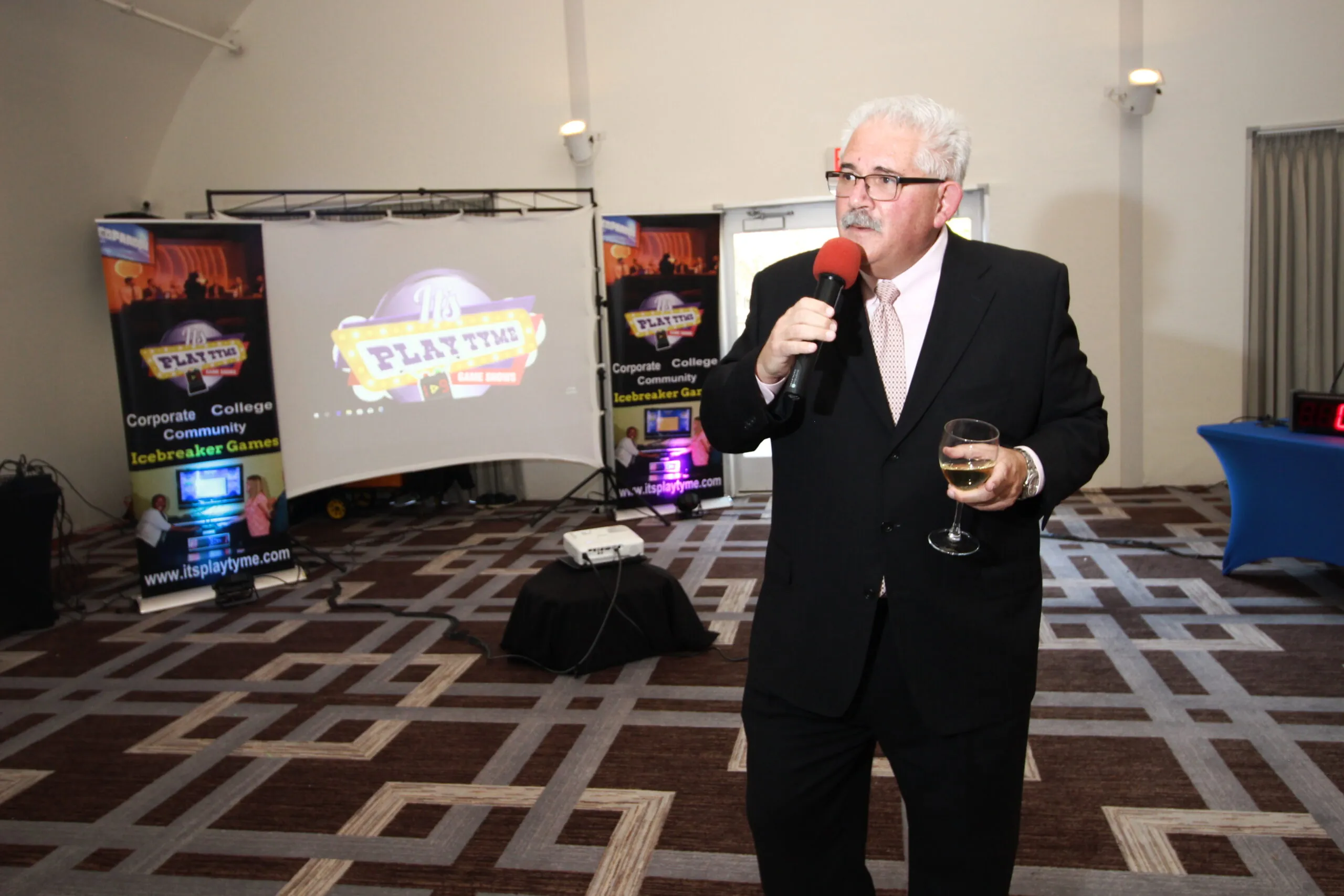
A typical It’s PlayTyme engagement runs like this: the team arrives and sets up all AV equipment (professional sound, HD screens, wireless buzzers, and stage lighting) about 45 minutes before the event. Participants split into teams of 4 to 8. A trained host takes the stage, explains the rules in under two minutes, and launches the first round. Over the next 60 to 90 minutes, teams rotate through rounds that build in intensity. Scores display on screen in real time. The final round brings the top teams head to head in front of the full audience. Winners get bragging rights (and often a trophy). The entire experience requires zero preparation from your team and no cleanup from your venue.
One corporate retreat in northern New Jersey featured 120 employees from five regional offices who had never worked together in person. The event planner booked a Face-2-Face Feud and Game Show Mania double header. Within 15 minutes, strangers were high-fiving over correct answers. Post-event surveys showed a 94% satisfaction rate, and three departments requested follow-up sessions at their next quarterly meeting.
How to Narrow Your Retreat Format Down to One
Start with your retreat goal. If you want to strengthen communication across departments, Word Play or Face-2-Face Feud forces collaboration. If energy and laughter are the priority, 60 Seconds of Fame fills the room with noise from the first round. For large groups where you need everyone competing at once, Game Show Mania’s elimination format keeps 100+ people engaged. Multigenerational teams bond fastest over Name That Hit Song. And if your leadership team wants to observe group dynamics, The Challenge reveals how teams strategize under pressure.
Consider your logistics too. All six formats work indoors, require no participant prep, and fit within a 60 to 90 minute window. It’s PlayTyme handles all AV production and arrives with everything needed, so you do not need to rent extra equipment or stress about technical setup. For retreats across NJ, NYC, and CT, the team travels to your venue (hotel ballroom, conference center, office common area, or offsite retreat space) and transforms it into a game show stage.
Ready to book game shows for your next team retreat? Request a quote from It’s PlayTyme Game Shows and lock in your preferred date. Browse the full lineup of game show formats or explore corporate event options to find the right fit for your group.
Frequently Asked Questions (FAQs)
How many people participate in a game show for a team retreat?
It’s PlayTyme Game Shows accommodates groups from 20 to 300+ participants. Teams typically split into groups of 4 to 8 players, and the audience stays involved through cheering, side challenges, and live scoring. The format scales to fit department meetings, leadership offsites, and company-wide retreats.
How long does a game show team retreat event last?
Most events run 60 to 90 minutes, though double-header formats (two game shows back to back) extend to roughly two hours. Setup takes about 45 minutes before the event starts, and breakdown happens after your team leaves, so you lose zero retreat time to logistics.
What AV equipment do we need to provide?
Nothing. It’s PlayTyme arrives with a complete production setup: professional sound system, HD display screens, wireless buzzer stations, stage lighting, and a trained host. All you need is a room with power outlets and enough space for your group.
How much do game shows for team retreats cost?
Pricing depends on the format, group size, and event location within the NJ, NYC, and CT service area. Most corporate retreat bookings fall within a range that compares favorably to hiring a DJ, renting escape room slots, or booking outdoor adventure activities for the same headcount. Contact It’s PlayTyme directly for a custom quote based on your specific event.
Do game shows work for remote or hybrid teams meeting in person?
Game shows are one of the strongest formats for teams meeting face to face for the first time. The competitive structure gives people an instant shared experience and a reason to interact beyond small talk. Formats like Face-2-Face Feud and 60 Seconds of Fame break social barriers within the first ten minutes, making them ideal for hybrid team retreats and annual company gatherings.
What did the 2026 Gallup report find about global employee engagement?
Gallup’s 2026 State of the Global Workplace report found that global employee engagement dropped to just 20% in 2024, the first decline since 2020.
How much does employee disengagement cost organizations each year?
According to Gallup research, disengagement costs organizations roughly $438 billion in lost productivity each year.