Poor communication costs organizations far more than most leaders realize. According to Gallup, managers account for 70% of the variance in team engagement, and the biggest factor separating strong managers from weak ones is how they communicate expectations, feedback, and recognition. Meanwhile, McKinsey research found that the average knowledge worker spends 28% of their workweek managing email and nearly 20% searching for internal information or tracking down colleagues who hold the answer.
Those numbers point to a clear pattern: teams that communicate well perform better, and teams that don’t waste hours every week just trying to get on the same page.
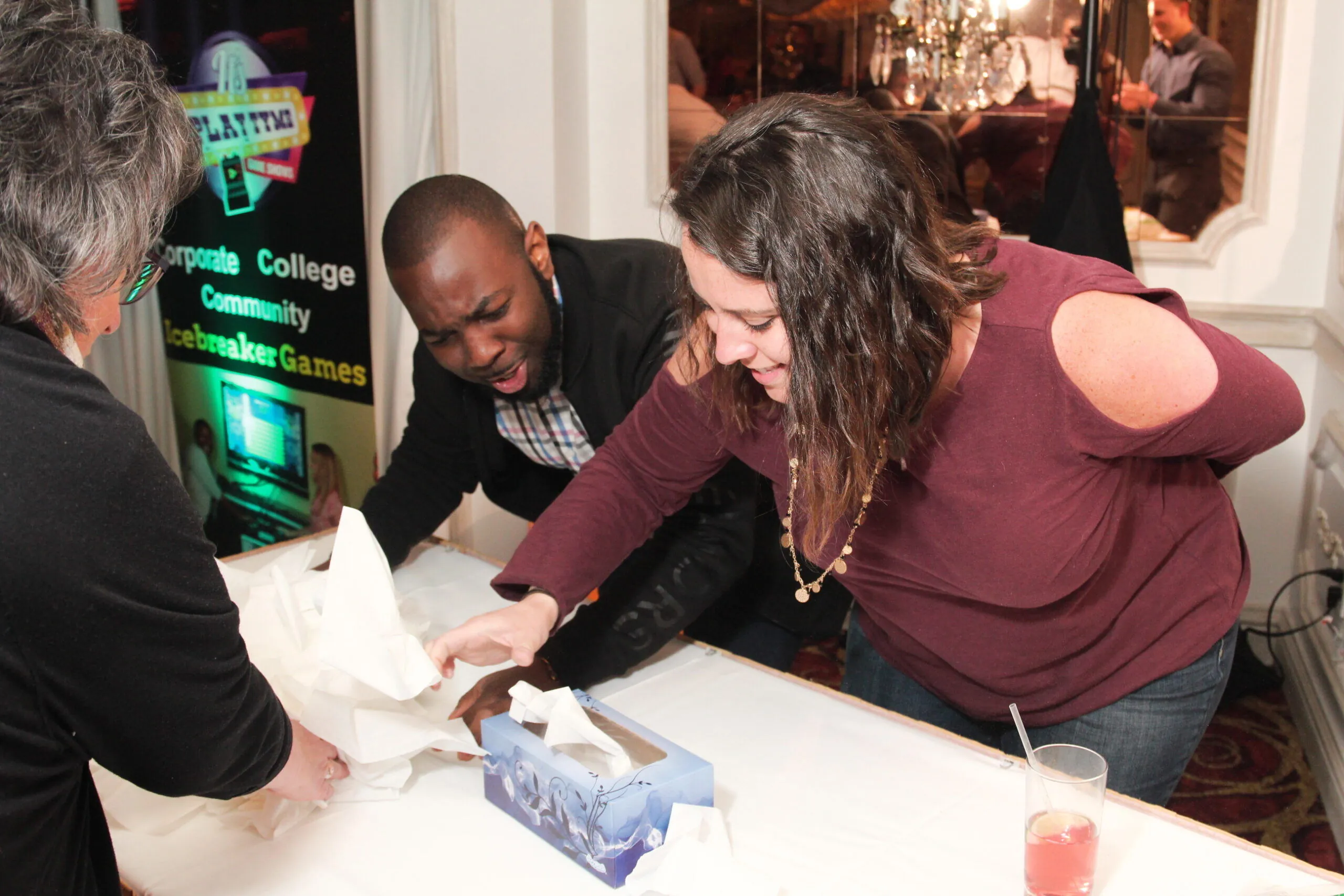
If your team talks past each other in meetings, struggles to give concise updates, or defaults to email chains when a two-minute conversation would do, you already know the problem. The harder question is how to fix it. Traditional communication workshops often feel forced. Employees sit through slide decks, nod along, and return to the same habits by Monday. What actually changes behavior is practice under pressure, in a setting where people forget they’re “training” because they’re too busy competing, laughing, and collaborating.
That is exactly what game shows deliver. Below are nine specific game show formats, each tied to a concrete communication skill your team needs.
What This Comes Down To
- Managers account for 70% of team engagement variance, with communication being the primary differentiating factor.
- Knowledge workers spend 28% of their workweek managing email alone.
- An additional 20% of work time goes to searching for information or tracking down colleagues.
- Teams that communicate well outperform those that do not by avoiding hours of weekly misalignment.
- The problem shows up as talking past each other in meetings and defaulting to email chains over direct conversation.
Where Workplace Communication Usually Goes Wrong
Before selecting a game show format, it helps to name the specific breakdowns your team experiences. Most communication failures fall into a few categories:
- Passive listening. Team members wait for their turn to speak instead of absorbing what a colleague just said. Instructions get missed, questions get repeated, and meetings run long.
- Vague or wordy updates. People bury key information inside paragraphs of context. Status updates that should take 30 seconds stretch to five minutes.
- Decision paralysis in groups. When six people need to agree on a direction, nobody wants to commit first. The group circles the same three options until someone with authority picks one by default.
- Over-reliance on text. Nuance disappears in Slack messages and email. Tone is misread, context is missing, and small misunderstandings escalate into real friction.
- Siloed knowledge. People hoard information (not out of malice, but because no structure exists to share it). New hires spend weeks figuring out what veterans know by instinct.
Each of these problems responds to a different type of practice. The game show formats below target them individually.
Why Game Shows Work as Communication Training
Game shows create conditions that no lecture or workshop replicates. Teams operate under time pressure, with real stakes (even if those stakes are bragging rights and a plastic trophy). Players must listen carefully, speak clearly, and make group decisions in seconds rather than days.
It’s PlayTyme Game Shows has hosted over 3,000 corporate events across New Jersey, New York City, and Connecticut. Across those events, certain patterns emerge consistently: teams that start the session with awkward silence end it finishing each other’s sentences. Colleagues who barely interact at work discover shared knowledge. Quiet employees surprise everyone (including themselves) with sharp instincts under the buzzer.
The format matters because it determines which skill gets exercised. Here are nine formats matched to the communication skills they build.
| Game Show Format | Primary Communication Skill | How It Works | Best For |
|---|---|---|---|
| Jeopardy-Style Trivia | Active listening | Teams parse answer-phrased clues and respond precisely | Cross-functional teams |
| Charades / Win-Lose-or-Draw | Nonverbal communication | One player acts or draws while teammates decode | Breaking down silos |
| Word Puzzles (Wheel of Fortune style) | Concise speaking | Players guess letters and solve phrases with minimal cues | New teams or onboarding |
| Family Feud / Face-2-Face Feud | Collaborative decision-making | Teams debate survey answers under a countdown | Leadership groups |
| Password-Style Rounds | Word economy | One-word clues only, partner must guess the target | Pairs or small teams |
| Pyramid-Style Descriptions | Descriptive clarity | Describe a category without using its name | Sales and client-facing teams |
| Name That Hit Song | Listening under pressure | Identify songs from short clips while teammates consult | Large groups, icebreakers |
| 60 Seconds of Fame | Clear instruction-giving | Rapid-fire physical and verbal challenges on the clock | High-energy kickoffs |
| Trivia Relay | Turn-taking and coordination | Each player answers in sequence; no helping until your turn | Departments of 20+ |
Jeopardy-Style Trivia: Active Listening in Action
Jeopardy-style rounds force a specific listening discipline. The host reads a clue phrased as an answer, and players must identify the question. That inversion alone demands attention. You cannot zone out and guess. You have to hear every word, process the category context, and respond in the correct format.
For workplace teams, this translates directly. Employees practice hearing information fully before responding, rather than jumping in with assumptions. When customized with company-specific content (product knowledge, client facts, industry terminology), Jeopardy rounds also surface knowledge gaps across departments. The sales team discovers what engineering actually does. HR learns the acronyms operations uses daily.
Why It Sticks
Active listening is hard to teach in a classroom because nobody believes they’re a poor listener. A buzzer-based trivia round proves it in real time. When you lose a point because you misheard “this 1990s policy” as “this 1990s product,” you remember.
Charades and Win-Lose-or-Draw: Nonverbal Communication
Strip away words entirely and communication becomes a different skill. In charades and drawing-based rounds, one team member must convey a concept using only gestures or sketches. The rest of the team interprets those signals, asks yes-or-no confirmation questions, and builds toward the answer together.
This format exposes how much workplace communication depends on body language, facial expression, and visual cues that people usually ignore. Remote and hybrid teams benefit especially: after a round of charades, employees become more aware of the nonverbal signals they send (and miss) on video calls.
What Teams Learn
Players discover that effective communication is not about saying more. It is about choosing the right signal and making sure the receiver understood it. That lesson carries directly into presentations, client meetings, and cross-team handoffs.
Word Puzzles and Wheel-of-Fortune Rounds: Speaking with Precision
Word puzzle formats reward players who think before they speak. Guessing random letters wastes turns. Solving requires pattern recognition, strategic guesses, and the confidence to commit to an answer before the full picture is visible.
In a team setting, word puzzles teach concise communication. Players who ramble lose time. Players who say “I think it might be, possibly, something like…” get beaten by the team whose member says “Buy the vowel. It’s QUARTERLY REVIEW.” The format rewards direct, confident speech.
Family Feud Formats: Collaborative Decision-Making
Family Feud (run as Face-2-Face Feud in It’s PlayTyme events) is the strongest format for practicing group decisions under time pressure. The host reveals a survey question. The team huddles, debates, and commits to an answer before the clock runs out.
This mirrors real workplace scenarios: a client asks for a decision on the spot, a project deadline forces a choice between two approaches, or a leadership team must align on priorities during a 30-minute window. The teams that win at Face-2-Face Feud are not the ones with the smartest individual player. They are the ones who listen to every suggestion, weigh options quickly, and trust the group’s consensus.
The Observed Outcome
Across thousands of hosted events, the It’s PlayTyme team consistently sees that groups performing well in this format share a pattern: one person facilitates (not dominates), others contribute without repeating what was already said, and the group commits without second-guessing. Those are the exact habits HR managers want to see in Monday morning standups.
Password and Pyramid Rounds: The Art of Precise Language
Password limits each clue-giver to a single word. One word to get your partner from zero to the correct answer. Pyramid works similarly but allows short phrases while forbidding the target word and its obvious synonyms.
Both formats train a skill that most professionals lack: saying exactly what you mean in the fewest possible words. Engineers who write 400-word Slack messages learn to distill their point. Managers who give circular feedback discover what a direct, specific prompt actually sounds like.
These rounds also build trust between partners. When your one-word clue lands perfectly and your teammate nails the answer, you experience a moment of genuine connection. That shared success creates rapport that no icebreaker question (“what’s your favorite pizza topping?”) ever achieves.
Music Rounds and Rapid-Fire Challenges: Listening Under Real Pressure
Name That Hit Song plays a short audio clip. Teams must identify the song (and sometimes the artist) before the opposing team. The skill here is pure auditory focus: filtering background noise, catching a melody in two seconds, and communicating your answer to your team before someone else buzzes in.
60 Seconds of Fame adds physical and verbal speed challenges. Teams rotate through stations, giving and following rapid instructions (“stack these cups in this order,” “spell this word backward,” “describe this image to your blindfolded partner”). The pace strips away overthinking. Players default to their natural communication style, which reveals habits they did not know they had.
These formats work best as openers or energizers. They set the tone for a session by raising energy, lowering inhibitions, and showing the room that competition is fun, not threatening.
Why It’s PlayTyme Game Shows Delivers Consistent Results
Plenty of companies offer “team building.” What separates It’s PlayTyme is specificity. Every event is hosted by a professional emcee who reads the room, adjusts pacing, and makes sure quiet participants get pulled in without being put on the spot. The game content is customized to each client’s industry, inside jokes, and training goals.
With over 3,000 events across corporate team building programs, school assemblies, and private parties, the It’s PlayTyme team has observed firsthand what works and what falls flat. That experience shapes every recommendation: which formats pair well together, how long each round should run for a group of 40 versus 200, and which games suit a sales kickoff versus a leadership retreat.
The difference between a generic activity and a targeted communication exercise is the host’s ability to debrief each round, call out the communication patterns the group just demonstrated, and connect those patterns to the team’s real work. That is what turns 90 minutes of fun into lasting behavioral change.
Matching the Game Show to Your Communication Problem
Start with the specific communication breakdown you want to address. If your team struggles with listening, Jeopardy-style and music rounds give that skill the most direct workout. If group decisions stall in meetings, Family Feud formats force the practice your team is avoiding. If people write too much and say too little, Password and Pyramid rounds build the habit of precision.
Consider your group size and energy level. A team of 12 thrives in Password pairs. A department of 80 needs the shared energy of Name That Hit Song or Face-2-Face Feud. Mixed groups (where not everyone knows each other) benefit from charades and drawing rounds that level the playing field regardless of seniority or tenure.
The strongest events combine two or three formats in a single session, progressing from icebreaker rounds to skill-specific games. This keeps energy high and gives every personality type a format where they shine.
Ready to build a game show event around your team’s specific communication goals? Reach out to It’s PlayTyme Game Shows to talk through formats, group size, and scheduling for your next corporate event.
Frequently Asked Questions (FAQs)
How do game shows improve workplace communication?
Game shows place teams in time-pressured scenarios that require active listening, concise speaking, and fast group decisions. Because the setting feels like play rather than training, employees practice these skills naturally and retain them longer than they would from a lecture or workshop.
What is the best game show format for large corporate groups?
Family Feud (Face-2-Face Feud) and Name That Hit Song both scale well for groups of 50 to 200+. They keep the full room engaged simultaneously and require team-level collaboration, so no one sits idle on the sidelines.
How long does a typical game show team building event last?
Most events run between 60 and 120 minutes. A 90-minute session is the most popular choice because it allows time for two or three game formats, team rotations, and a brief debrief connecting the experience to workplace goals.
Do game show events work for remote or hybrid teams?
Yes. Many formats (trivia, Password, Pyramid) adapt well to virtual platforms with breakout rooms and screen sharing. The core communication skills transfer regardless of whether teams are in a conference room or on a video call.
What areas does It’s PlayTyme Game Shows serve?
It’s PlayTyme is based in Teaneck, New Jersey and serves the entire NYC tri-state area, including New Jersey, New York City, and Connecticut. The team hosts events at offices, hotels, conference centers, restaurants, and virtually.
How much does a manager’s communication style affect team engagement?
Gallup research found that managers account for 70% of the variance in team engagement, and the single biggest differentiator between strong and weak managers is how they communicate expectations, feedback, and recognition to their teams.
How much time do employees lose each week to poor internal communication?
McKinsey research found that the average knowledge worker spends 28% of the workweek managing email and nearly 20% searching for information or tracking down colleagues — hours that better communication habits, reinforced through structured team activities, can recover.