
Teams that genuinely know each other outperform those that don’t. Research from Harvard Business Review shows that employees with a best friend at work are twice as likely to be engaged in their jobs. Meanwhile, Gallup reports that 70 percent of the variance in team engagement is determined solely by the manager, making intentional relationship-building a leadership responsibility, not a nice-to-have.
Get to know you questions for work are the fastest way to move a group past surface-level small talk and into real connection. Whether your team is remote, hybrid, or all in one office, the right questions open conversations that build trust, spark laughter, and give people a reason to look forward to Monday.
But most managers run into the same wall: people show up guarded, the questions feel forced, and the whole exercise fizzles within five minutes. New hires sit silently. Tenured employees give one-word answers. Remote team members multitask with cameras off. Without structure or energy behind the questions, even the best list falls flat. That is exactly why pairing these prompts with an interactive format (like a hosted game show event from It’s PlayTyme Game Shows) turns awkward icebreakers into something people actually enjoy.
The Fast Version
- Employees with a best friend at work are twice as likely to be engaged, per HBR research.
- Seventy percent of team engagement variance is determined by the manager, making connection a leadership responsibility.
- The right questions move a group past surface-level small talk and into real connection faster.
- Get to know you questions work equally for remote, hybrid, and in-office teams without extra setup.
- Most sessions fizzle because questions feel forced; a hosted format keeps energy up and guards down.
What Goes Wrong With Icebreaker Questions at Work
Before diving into the questions themselves, it helps to understand why so many icebreaker attempts miss the mark. These are the most common obstacles teams face:
- Social pressure kills honesty. When a manager asks “tell us something interesting about yourself” in a conference room, most people default to safe, forgettable answers. The format matters as much as the question.
- Remote and hybrid teams lose energy fast. A Zoom call with 15 people answering the same question in sequence drains momentum. Without a game-like structure, participation drops after person three.
- Questions feel childish or irrelevant. Asking adults “what’s your spirit animal?” signals that the organizer didn’t think about the audience. Professionals want questions that respect their intelligence while still being fun.
- No follow-through after the event. One round of icebreakers in January does nothing for team culture in June. Teams need a rhythm of connection, not a single checkbox activity.
- Introverts get steamrolled. Open-floor icebreakers naturally favor loud personalities. Without structured turn-taking (the kind a professional host provides), quieter team members stay invisible.
Light and Fun Get to Know You Questions for Work
Start here. These questions require zero vulnerability and work well as warm-ups before a team activity or team-building event. They get people talking without putting anyone on the spot.
Quick-Fire Favorites
- What is your go-to lunch order on a busy workday?
- What song gets stuck in your head the most?
- What is the best snack to have at your desk?
- Are you a morning person or a night owl?
- What is the last show you binged?
- Coffee, tea, or something else entirely?
- What is your most-used emoji?
- What would your walk-up song be at a company event?
Weekend and Downtime
- What does a perfect Saturday morning look like for you?
- What hobby have you picked up in the last year?
- What is the best meal you have cooked recently?
- Do you prefer mountains, beach, or city for a vacation?
- What is one thing on your bucket list?
- What is the most spontaneous thing you have ever done?
Work-Specific Get to Know You Questions
These questions connect personal style to professional life. They reveal how people think, communicate, and recharge at work without crossing into uncomfortable territory.
- What is the best piece of career advice you have received?
- Describe your ideal workspace in three words.
- What was your very first job?
- What skill outside your job description are you secretly good at?
- How do you prefer to receive feedback: written, verbal, or in a meeting?
- What is one tool or app you rely on every day?
- If you could swap roles with anyone in the company for a day, who would it be?
- What is something your coworkers would be surprised to learn about you?
- What work accomplishment are you most proud of from the last year?
- Do you prefer brainstorming alone first or jumping straight into a group session?
Deeper Connection Questions for Established Teams
Once a team has moved past small talk, these questions build the kind of trust that improves collaboration on real projects. Save these for groups that already have some rapport, or use them in smaller breakout rounds during a game show event.
- What is a professional goal you are working toward right now?
- Who has had the biggest influence on your career?
- What is a mistake that taught you something valuable?
- What does “work-life balance” actually look like for you?
- If you could go back and give your first-day-at-work self one piece of advice, what would it be?
- What is something you wish more people understood about your role?
- When do you do your best thinking: early morning, midday, or late at night?
- What motivates you more: recognition or autonomy?
- Describe a time a coworker made your day better without realizing it.
- What value do you bring to a team that does not show up on a resume?
Creative and Hypothetical Questions That Spark Conversation
Hypothetical questions work brilliantly in game show formats because they are inherently playful. These are the questions that generate laughter, debate, and memorable moments your team will reference for months.
- If your life had a theme song, what would it be?
- You get to add one rule to the employee handbook. What is it?
- If you could have dinner with any person (living or historical), who would you choose?
- What fictional character would make the best CEO?
- If you won the lottery tomorrow, would you still work?
- You are stranded on a desert island with three items from your office. What do you bring?
- If your team had a band name, what would it be?
- What superpower would make you the best at your job?
- If you could instantly master one skill, what would you pick?
- Your department gets a mascot. What animal is it and why?
This-or-That Questions for Fast-Paced Rounds
These binary-choice questions are perfect for rapid-fire rounds in a game show setting. They keep energy high, require zero preparation from participants, and reveal personality in seconds. For a full list of this-or-that prompts, check out our complete this-or-that questions guide.
- Work from home or work from the office?
- Emails or Slack messages?
- Early meeting or late meeting?
- Solo project or group project?
- Formal presentation or casual check-in?
- Lunch at your desk or lunch away from your desk?
- Music while working or total silence?
- Plan everything or figure it out as you go?
- Video call with camera on or camera off?
- Friday happy hour or Friday early dismissal?
How to Use These Questions Before a Game Show Event
The best get to know you questions for work do not live on a list. They come alive when paired with a format that keeps people engaged. Here is how to use them effectively:
Pre-Event Warm-Up (10 to 15 Minutes)
Pick five to eight light questions from the first two categories. Have a host read them aloud and let small groups discuss for 60 seconds each. This loosens people up before the main event starts.
Integrated Game Rounds
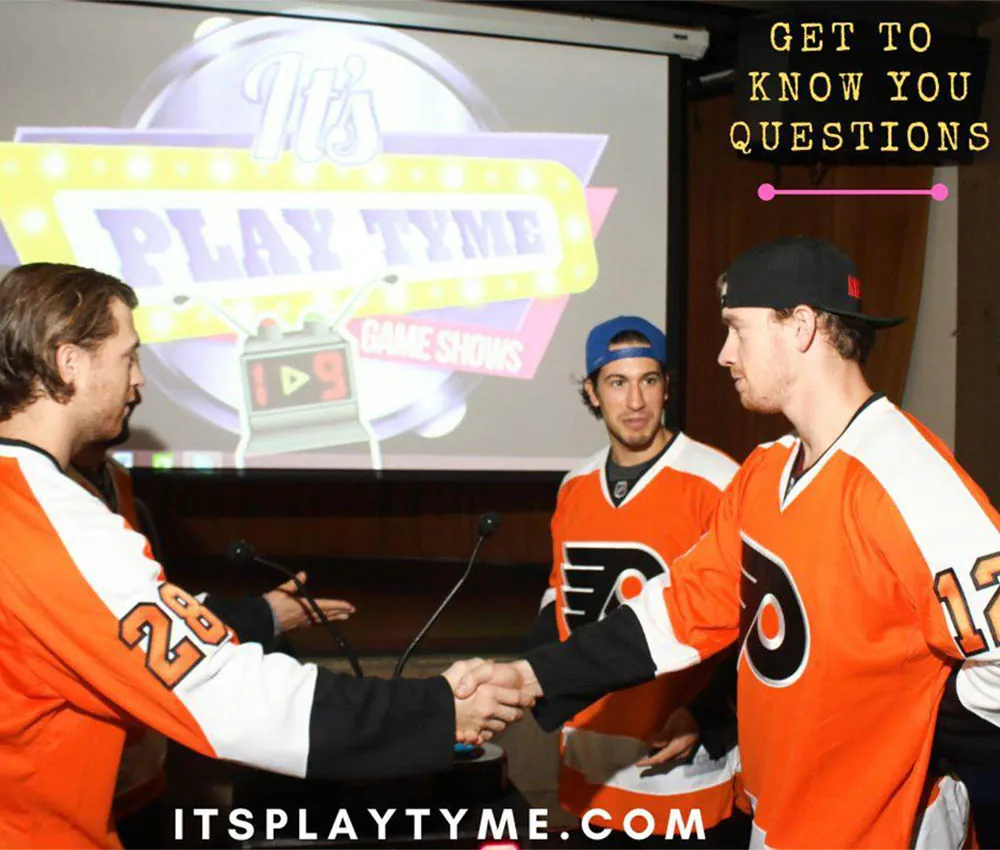
Professional game show hosts weave get to know you questions directly into the gameplay. Teams earn points for answering about their own teammates, turning personal facts into competitive (and hilarious) trivia. It’s PlayTyme Game Shows builds entire rounds around this concept, so the bonding happens inside the game rather than as a separate, forced exercise.
Post-Event Follow-Up
After the event, share a few of the deeper questions in your team Slack channel or next standup. This extends the connection beyond a single afternoon and reinforces the relationships that started during the game.
| Format | Best For | Group Size | Energy Level | Facilitation Needed |
|---|---|---|---|---|
| Round-robin in a meeting | Small teams | 4 to 8 | Low | Minimal |
| Slack or async prompts | Remote or hybrid teams | Any | Low | None |
| Breakout group discussions | Conferences or offsites | 8 to 20 | Medium | Moderate |
| Hosted game show event | All-hands, team days, onboarding | 20 to 300+ | High | Professional host (provided) |
Why a Professional Host Changes Everything
Reading questions off a list and running a live interactive experience are two completely different things. A professional host from It’s PlayTyme Game Shows does three things a manager running icebreakers simply cannot:
They control the energy. A trained host reads the room, speeds up when attention drifts, slows down when a moment lands, and keeps every round feeling fresh. Managers who try this themselves are simultaneously facilitating, participating, and managing logistics.
They remove the awkwardness. When a neutral, entertaining host asks the questions, there is no power dynamic. People answer more honestly because their boss is not the one holding the microphone.
They scale to any group size. It’s PlayTyme runs game show events for groups from 20 to 300+ people across New Jersey, New York City, and Connecticut. That range is impossible to manage with a DIY icebreaker format.
What Separates Good Icebreakers From Forgettable Ones
Not every question works for every group. The right selection depends on three factors: how well the team already knows each other, the setting, and the goal of the event.
For new teams or onboarding events, stick to the light and fun category. Nobody wants to share career regrets with people they met 20 minutes ago. For established teams that work together daily, skip the surface-level questions entirely and go straight to the deeper connection or hypothetical categories.
Match the format to the energy you want. Async Slack questions work for weekly check-ins. This-or-that rounds work for quick meeting openers. But for quarterly team days, holiday parties, or company-wide events, a hosted game show delivers the kind of energy and participation that a shared Google Doc never will.
If you are planning a team event and want these questions brought to life with professional hosting, sound, lighting, and real game show production, reach out to It’s PlayTyme to book a corporate game show experience your team will actually talk about afterward.
Frequently Asked Questions (FAQs)
How many get to know you questions should I ask at a work event?
For a standalone icebreaker session, five to eight questions over 10 to 15 minutes keeps energy high without dragging. During a hosted game show, the host integrates questions throughout the event, so your team answers 15 to 25 without it feeling like a Q&A session.
Are get to know you questions appropriate for remote teams?
Yes. Remote teams often benefit more from structured questions than in-office teams because they lack the casual hallway conversations that build rapport naturally. Use async prompts in Slack for weekly connection and a virtual game show event for larger moments.
What topics should I avoid in workplace icebreaker questions?
Avoid questions about religion, politics, salary, relationship status, and physical appearance. Stick to questions about preferences, experiences, and hypothetical scenarios. The goal is to build connection, not put anyone in an uncomfortable position.
How often should teams do get to know you activities?
A light question at the start of weekly meetings builds steady rapport. Pair that rhythm with a larger interactive event (like a game show) once per quarter for deeper bonding. Teams that mix frequent small touchpoints with periodic big events see the strongest results.
What makes a hosted game show better than running icebreakers ourselves?
A professional host removes the power dynamic, reads the room in real time, and keeps energy high across groups of any size. The game format turns questions into competition, which drives participation far beyond what a round-robin icebreaker achieves. It also frees managers to participate instead of facilitate.