

Quick answer: The Great Kindness Challenge is a free kindness week for K-12 schools, held the last week of January, where every student works through a 50-act kindness checklist. Participation climbs when schools pair daily themes with family take-home activities and one interactive assembly that opens or closes the week.
Every educator knows the mid-winter slump. Energy dips, peer conflicts climb, and classroom routines start to drag. National Center for Education Statistics data shows about 19 percent of students ages 12 through 18 reported being bullied at school during the school year, with the highest rates in the middle grades.
Posters and lecture-style assemblies do not move that number. Students change how they treat each other when they practice it out loud, in front of their classmates. That is the premise of the challenge: hand every student a concrete list, then make the week impossible to ignore.
Before You Read On
- Lock your dates: The Great Kindness Challenge runs in late January. Confirm the exact 2027 week on the Kids for Peace organizer site before you print anything.
- Lead with action: Swap decorative posters for the 50-item checklist so students know exactly what to do at recess, at lunch, and in the hallway.
- Unify the whole building: Tie morning announcements, dress themes, and family take-home tasks together so no grade treats the week as optional.
- Anchor the week with a shared experience: Use a full-participation assembly instead of a seated lecture to launch or close the week, and count how many students take part.
Understanding the Great Kindness Challenge Framework
The nonprofit Kids for Peace created the challenge and gives elementary, middle, and high schools a free toolkit. The centerpiece is a 50-act kindness checklist that goes to every student.
The acts range from simple gestures, like smiling at 25 people or thanking a custodian, to harder social moves, like inviting a classmate who is sitting alone to join your lunch table. Registration and the standard downloadable materials cost nothing.
The week falls in late January, so verify the official dates during fall planning. The materials are editable, which means student councils and administrators rewrite items to fit elementary story time, middle school advisory, or a high school leadership class.
Where Traditional School Kindness Weeks Break Down
- Messaging without practice: Hallway banners look good and change nothing. Students still have no instructions for the unstructured minutes at recess and passing period, which is exactly where exclusion happens.
- One classroom at a time: When teachers run activities in silos, there is no building-wide energy. Older grades read that silence correctly and write the week off as a kid thing.
- Planning load on already stretched teachers: Late January brings report cards, assessments, and makeup lessons. A week that asks staff to invent activities, source props, and run rehearsals loses to the job they already have, and the ambitious plan shrinks to one poster and a morning announcement.
- Leaving out staff and families: Bus drivers, cafeteria teams, custodians, and parents carry a huge share of school climate. Skip them in planning and kindness stays trapped inside classroom walls.
- No real celebration: Closing a week of effort with a loudspeaker thank-you wastes it. Student momentum needs a payoff moment, or it is gone by Monday.
- No participation number to report: Attendance is not participation. When the only record is that an assembly happened, nobody can tell a principal, a PBIS team, or a budget committee how many students actually took part, and that is the figure that gets next year approved.
Day-by-Day Great Kindness Challenge Ideas for K-12
Daily themes keep the week moving across every grade level. Here is a Monday-through-Friday sequence that mixes classroom tasks, hallway events, and campus-wide fun.
Monday: Kickoff and Everyday Appreciation
Hand out the checklist during homeroom or advisory. Point the day at the staff who keep the building running.
- Morning launch: student council shares one operations fact over announcements, such as how many lunches the cafeteria serves or how many miles the custodial team walks in a day.
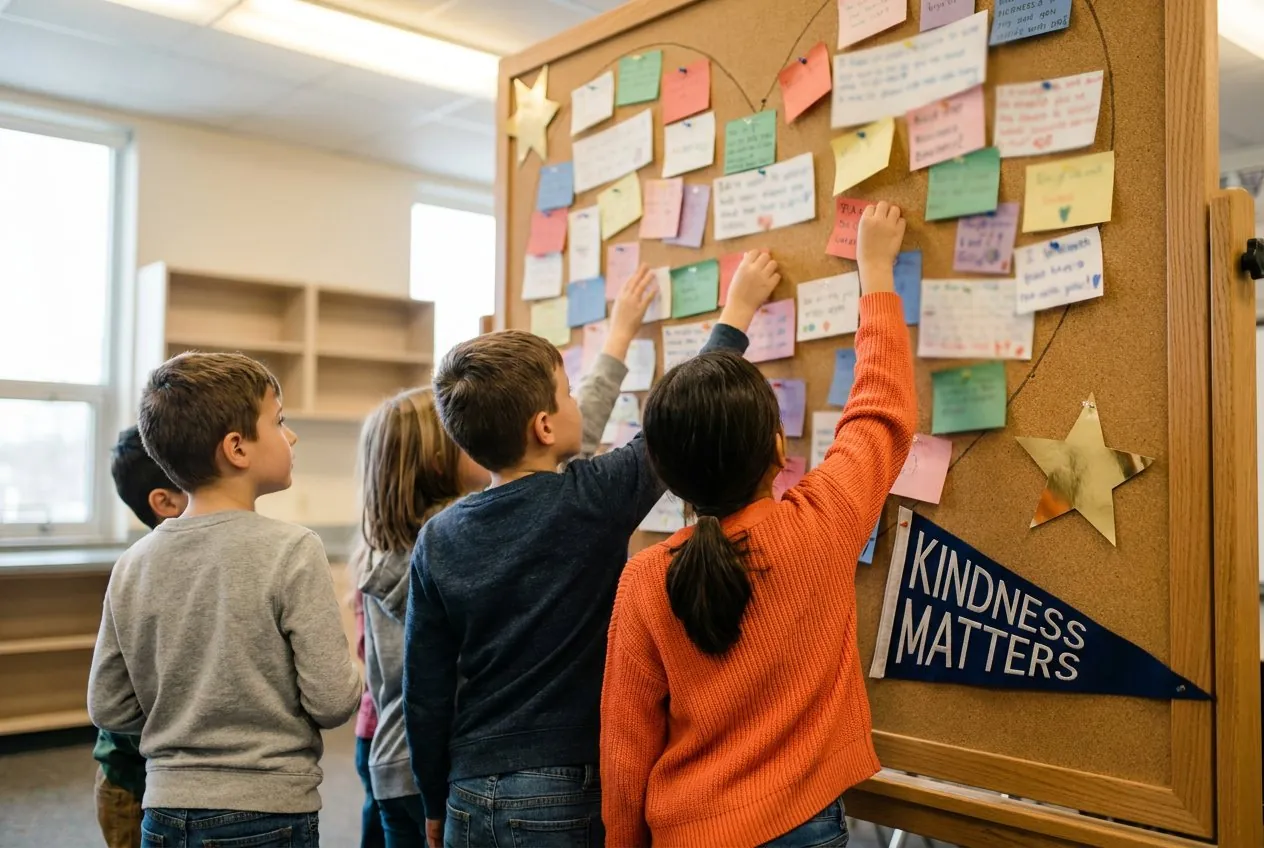
- Sticky-note wall of gratitude: students write named thank-you notes and post them on office doors, kitchen service windows, and the maintenance shop.
- Dress theme: “Crazy for Kindness” with mismatched socks or wild hair.
Tuesday: Inclusion and New Connections
Break up the usual cliques and push conversation across peer groups.
- Mix-it-up lunch: seat the cafeteria by birth month or random table tokens so students talk to someone new.
- Kindness scavenger hunt: pair older students with younger reading buddies and send them to spot five kind acts before noon.
- Dress theme: “Team Up for Kindness” with jerseys and team colors.
Wednesday: Words That Uplift
Midweek belongs to writing, listening, and compliments that land.
- Compliment clothespins: students write short notes on wooden clothespins and clip them to backpacks during passing period.
- Teacher tribute cards: advisory classes write thank-you notes to a teacher from a previous year.
- Dress theme: “Brighten Someone’s Day” in neon or bright colors.
Thursday: Community and Compassion Beyond Campus
Point the week outward toward local families, shelters, and service organizations.
- Service drive: collect shelf-stable food, hygiene items, or winter coats for a local organization.
- Senior living art exchange: elementary classes make handmade cards for nearby nursing homes and rehab centers.
- Dress theme: “Dreaming of a Kind World” pajama day.
Friday: Celebration and Shared Achievement
Tally the completed acts, celebrate the total, and set the standard for the rest of the year.
- Schoolwide kindness chain: link one paper strip per completed act and run the chain through the main foyer.
- Award presentations: recognize the classrooms with the most completed acts. A traveling trophy that moves rooms each year beats a certificate nobody keeps.
- Dress theme: spirit wear or class colors.
Engaging Families and the Broader School Community
Culture shifts when the conversation continues at home. Send the checklist home on Monday and parents get a script for dinner-table questions all week.
PTO and PTA volunteers run a morning carpool cheer station, holding signs and greeting buses as they pull in. Schools also host a family night with student performances, a service-project showcase, and a shared meal. Translate the checklist into the languages your families actually speak, so no household sits the week out.
Connecting Kindness Week to Bullying Prevention and PBIS Initiatives
Kindness week carries real weight in a school safety plan. Students who practice inclusion in January have a shared vocabulary for February, and staff point back to it the moment a conflict starts.
The checklist also maps onto Social-Emotional Learning (SEL) activities already in your scope and sequence, and onto Positive Behavioral Interventions and Supports (PBIS), where recognition and reward ideas sit at the center of the framework. A schoolwide event works as a Tier 1 reward every student earns rather than a prize a handful of students win. Student-led inclusion campaigns, where the student council writes the acts and runs the announcements, move the work from adult-directed compliance into peer culture, which is where school climate transformation actually starts.
Pair the checklist with live decision scenarios so students rehearse the move from bystander to upstander under a little pressure. Instead of memorizing a definition of harassment, they practice what to say in the hallway. Coordinators who need a schedule for that week often start from these school assembly programs in New Jersey.
Interactive SEL Assembly Ideas That Energize the Whole Student Body
Kindness week lives or dies on student buy-in. A speaker in a dark auditorium gets polite applause and little else. Full-room formats put every student into the activity at the same time, which is why more schools book experiential student engagement as the kickoff or the closer.
| Anchor Event Format | Student Participation | Staff Prep Load | Best Slot in the Week |
|---|---|---|---|
| It’s Playtyme Game Shows (hosted live game show) | Whole room plays in teams, every grade out of their seats | None for teachers. We bring the host, buzzers, screens, and sound | Monday kickoff or Friday celebration |
| Guest motivational speaker | Listening only, light Q&A | Low | Monday kickoff |
| Student council talent show | High for performers, passive for everyone else | High. Weeks of auditions and rehearsals | Friday celebration |
| Spirit week with no assembly | Varies by classroom and teacher buy-in | Medium | All week |
| Video or announcement campaign | Low. Easy to tune out | Low | Daily reinforcement |
A hosted game show is a vehicle for participation, not a performance students watch. At It’s Playtyme Game Shows, we run custom live game shows for schools across New Jersey, New York City, New York State, and Connecticut. A single grade of 50 or a full assembly of 500 or more plays in teams, and the room gets loud.
Our founder has spent more than 20 years getting groups of every size to laugh, compete, and connect, and the standard holds for schools too: a good event is measured by how many people take part, not by how many showed up.
Team formats such as Face-2-Face Feud, The Challenge, and Name That Hit Song reward the exact behavior kindness week teaches, including teamwork, encouragement, and good sportsmanship. Teachers prepare nothing. We arrive with the host, the sound, the screens, and the buzzers, set up around your bell schedule, and run the room. Pricing depends on how many shows you book and how many grades you cover, and every show is backed by a 100% Satisfaction Guarantee, with no deposit required to book. Package details sit on our school assembly programs page.
Four Questions That Settle Your Anchor Event Decision
How many students take part, rather than simply attend? How much prep does the format demand from teachers in a week they are already stretched? Does it work across your full grade span, K through 5 or 9 through 12? And does it reinforce the checklist behavior and feed your SEL and PBIS reporting, or just fill a block on the schedule?
Score each option against those four and the answer arrives fast. Then write down the participation number, because that single figure is what gets next year’s week approved. Pair the Kids for Peace checklist with daily themes, real family involvement, and one high-energy assembly, and an awareness week becomes the thing students bring up in March.
Ready to get your whole student body out of their seats? See what a live game show looks like in your gym and contact It’s Playtyme Game Shows today to put a kindness week on the calendar that students still talk about long after January.
Frequently Asked Questions (FAQs)
What is the official date for The Great Kindness Challenge?
The Great Kindness Challenge runs annually during the last week of January. For 2027, plan on late January and verify the exact registration week on the official Kids for Peace site before you print materials.
How much does it cost for a school to participate?
Registration and the standard downloadable checklist materials from Kids for Peace are free. Your only costs are optional: spirit week supplies, donation drive materials, or a hosted assembly, which is priced by the number of shows and the grades you cover.
How can middle and high schools adapt the checklist for older students?
Secondary schools run the checklist through advisory periods, homerooms, or student council. Older students take on bigger acts of service, such as tutoring younger peers, running a supply drive, or producing a positive campus media campaign.
How do interactive SEL assemblies integrate with a school’s PBIS and bullying prevention goals?
They turn empathy and respect into something students practice instead of something they hear about. A full-participation assembly functions as a Tier 1 PBIS reward every student earns, builds connections across grades, and gives students a low-stakes setting to rehearse bystander intervention. The participation count also gives your SEL and PBIS team a number to report.
What regions does It’s Playtyme Game Shows serve for live kindness week assemblies?
We travel to schools across New Jersey, New York City, New York State, and Connecticut. January dates work best when they are set during fall planning, alongside your daily themes and family take-home activities.
Can teachers and staff participate alongside students?
Yes, and staff participation sets the tone for the building. Many schools hand out an educator checklist with acts like sending positive notes home, complimenting a colleague, and thanking bus drivers and cafeteria staff by name.