

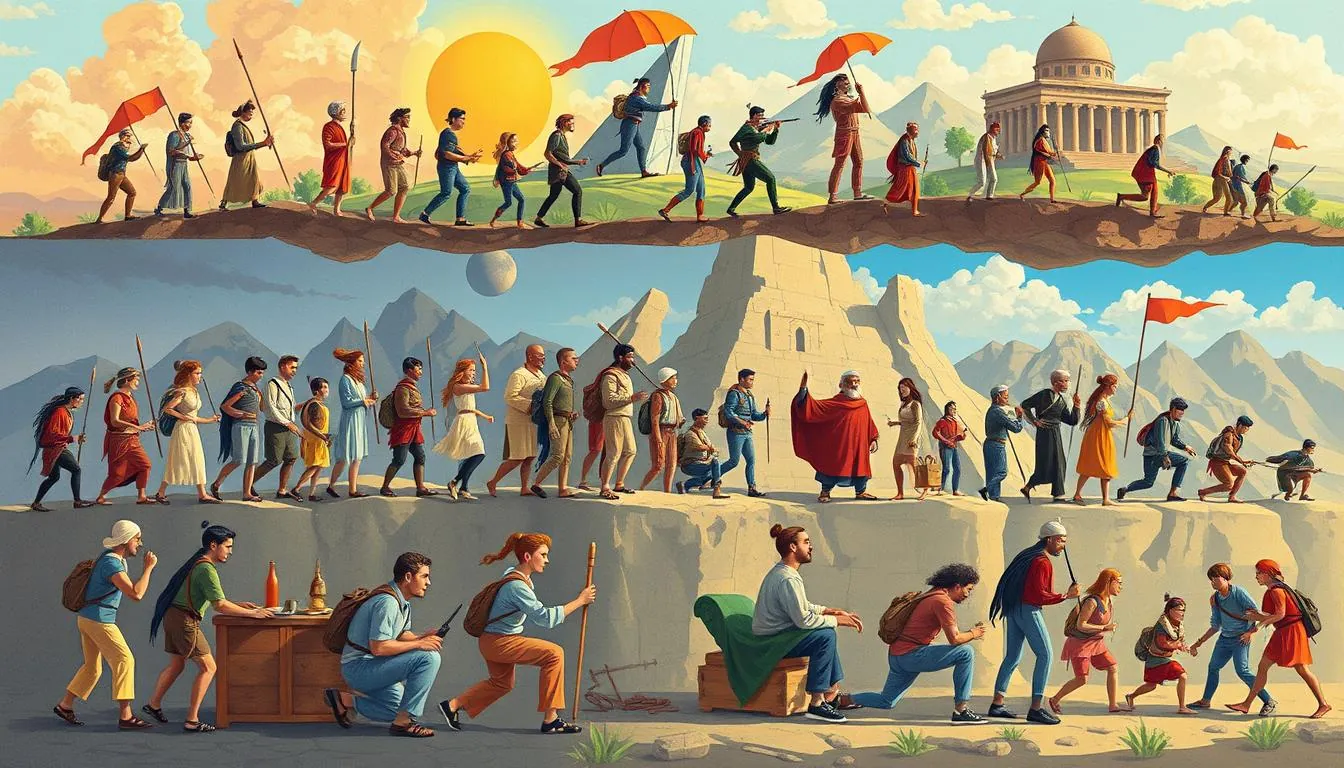
The history of team building stretches back more than a century, yet most corporate programs still recycle ideas from decades past. Gallup’s 2026 State of the Global Workplace report found that only 20% of employees worldwide are actively engaged at work, a figure that has barely moved in twenty years. Research published in Harvard Business Review by MIT’s Human Dynamics Laboratory showed that communication patterns alone account for roughly 40% of the variation in a team’s productivity. The way people interact matters more than individual talent, and every generation of team building theory has tried to crack that code.
Understanding how we got here is more than an academic exercise. Each era introduced a principle that still shapes what companies buy today: social belonging, group dynamics, experiential learning, and shared competition. The question is whether your next team event draws from the strongest of those principles or repeats the weakest ones.
HR directors and event planners face a familiar set of problems when booking a team activity. Half the group disengages within minutes. Introverts retreat while extroverts dominate. The activity feels disconnected from actual workplace dynamics. Budgets tighten while expectations rise. And the Monday after the event, nothing changes. These problems are not new. They have followed team building through every decade, and each era tried a different answer.
The Hawthorne Studies: Where It All Started (1920s—1930s)
The formal history of team building begins at Western Electric’s Hawthorne Works plant near Chicago. Between 1924 and 1932, researchers led by Elton Mayo and Fritz Roethlisberger conducted a series of experiments originally designed to test whether lighting levels affected worker productivity. The results surprised everyone. Output increased not because of brighter lights but because workers felt observed, valued, and part of a group that mattered.
Mayo’s research introduced the concept of the informal work group: the idea that social bonds between colleagues drive output more reliably than pay incentives or physical conditions. This was a direct challenge to Frederick Taylor’s Scientific Management model, which treated workers as interchangeable parts in a machine. The Hawthorne findings argued that belonging and recognition were performance variables, not soft extras.
The practical impact was slow but lasting. Companies began assigning workers to small teams rather than isolated stations. Supervisors received training on group morale. The seed of every team building program that followed was planted in a 1930s factory: people work harder when they feel connected to the people beside them.
Kurt Lewin and Group Dynamics (1940s 1950s)
Social psychologist Kurt Lewin took the Hawthorne insight and gave it a scientific framework. Working at MIT in the 1940s, Lewin developed field theory, which treated a group as a dynamic system where every member’s behavior influenced every other member. He coined the term “group dynamics” and founded the Research Center for Group Dynamics in 1945.
Lewin’s most influential contribution was the T-group (training group), created in 1946 during a workshop in New Britain, Connecticut. Participants sat in unstructured sessions, observed their own interactions, and received feedback on their behavior in real time. The format was intense, sometimes confrontational, and nothing like what most people picture when they hear “team building.”
T-groups spread rapidly through the 1950s and 1960s, especially at the National Training Laboratories (NTL) in Bethel, Maine. Major corporations sent executives to multi-day sensitivity training programs. The legacy of this era is the principle that self-awareness and honest feedback improve group performance. The limitation was accessibility: T-groups required trained facilitators, days of commitment, and a tolerance for emotional discomfort that not every team possessed.
Outward Bound and Experiential Learning (1960s 1980s)
Outward Bound, founded by Kurt Hahn in 1941 in Wales and brought to the United States in 1962, introduced a radically different model. Instead of sitting in a circle analyzing group behavior, participants climbed mountains, navigated rapids, and solved survival challenges together. The theory was straightforward: shared physical adversity builds trust faster than conversation.
By the 1970s, corporations adopted the Outward Bound framework for executive development and team cohesion. Ropes courses, wilderness retreats, and outdoor challenge programs became standard HR offerings. David Kolb’s experiential learning cycle (concrete experience, reflective observation, abstract conceptualization, active experimentation) gave academic credibility to the approach. Learning happened through doing, not listening.
The outdoor experiential model dominated corporate team building for two decades. Its strengths were real: physical challenges created shared memories and broke down hierarchies. Its weaknesses were equally real. Outdoor programs excluded participants with physical limitations. Weather and logistics created unpredictable variables. The connection between scaling a wall and collaborating on a quarterly report was often unclear. And the format favored extroverts and athletes, leaving quieter team members on the sidelines.
The Problems That Reappear in Every Team Building Era
Despite a century of innovation, the same problems reappear in every generation of team building programming.
- Uneven participation. From T-groups to ropes courses to escape rooms, most formats allow a few dominant personalities to carry the activity while others watch. A 2024 SHRM survey found that the number-one complaint about corporate events is that they feel mandatory rather than meaningful.
- No transfer to the workplace. An activity that feels good in the moment but produces no behavioral change the following week is entertainment, not development. Many programs lack a structure that connects the shared experience to daily collaboration.
- Accessibility gaps. Physical challenges exclude team members with disabilities, chronic conditions, or simple discomfort with heights and water. Age, fitness level, and cultural background all create invisible barriers.
- One-size-fits-all formats. A program designed for ten people rarely works for 200. Many providers offer a single format and stretch it across group sizes it was never built for.
- Budget pressure without ROI evidence. Finance teams increasingly demand measurable outcomes from discretionary spending. “The team had fun” is not a business case.
The Indoor Shift: From Wilderness to Conference Rooms (1990s 2000s)
The 1990s brought team building indoors. As corporate liability concerns grew and workforces became more diverse, HR departments looked for activities that worked inside a hotel ballroom or office cafeteria. This era produced a wave of familiar formats: trust falls, two-truths-and-a-lie, building spaghetti towers, and personality assessments like Myers-Briggs and DiSC.
The indoor shift solved the accessibility problem but created a new one: boredom. Many indoor activities lacked the emotional intensity that made outdoor challenges effective. Teams went through the motions, checked a box, and returned to their desks unchanged. The formats were safe, predictable, and forgettable.
This period also saw the rise of team building consulting firms that packaged activities into half-day or full-day programs. Companies like FranklinCovey and the Ken Blanchard Companies integrated team exercises into leadership development curricula. The focus shifted from pure bonding to skill development: communication, conflict resolution, and decision-making under pressure.
The Game-Show Model: Competition as Connection (2010s, Present)
The latest chapter in the history of team building borrows from the format Americans already trust for high-energy group engagement: the television game show. Live game-show events take the best elements of every preceding era (group dynamics, experiential learning, inclusive indoor formats) and add the one ingredient that reliably holds attention across personality types: structured competition with real-time scoring.
It’s PlayTyme Game Shows represents this evolution in its purest form. The company brings fully produced, professionally hosted game-show experiences directly to corporate venues across New Jersey, New York City, and Connecticut. Every participant plays. Wireless buzzers put every person on equal footing regardless of physical ability, seniority, or personality type. A trained emcee reads the room, adjusts pacing, and ensures that quiet contributors get moments in the spotlight.
The format works because it draws on proven principles from every era of team building history. From the Hawthorne studies: belonging and recognition drive engagement. From Lewin: group dynamics shift when every member has a defined role. From Outward Bound: shared intensity creates lasting bonds. From the indoor era: accessibility and logistics matter. The game-show model synthesizes all four into a single event that scales from 20 to 300+ participants without losing energy.
Why the Game-Show Format Outperforms Older Models
The comparison is straightforward when you line up the formats side by side.
| Era / Format | Participation Rate | Accessibility | Group Size | Engagement Driver |
|---|---|---|---|---|
| T-Groups (1940s) | Full but intense | Emotionally demanding | 8-15 | Self-disclosure |
| Ropes Courses (1970s) | Partial (physical limits) | Low | 10-30 | Physical challenge |
| Indoor Icebreakers (1990s) | Low energy | High | 10-50 | Obligation |
| Escape Rooms (2010s) | Split into small pods | Moderate | 4-12 per room | Puzzle solving |
| Live Game Shows (Now) | 100% via buzzers | High | 20-300+ | Competition & humor |
The game-show model does not ask participants to reveal personal vulnerabilities, scale physical obstacles, or sit through awkward icebreakers. It gives every person a buzzer, a team, and a reason to care about the next question. The competitive structure creates natural peaks of excitement that bond teams through shared laughter and collective effort rather than forced intimacy.
What a Century of Research Tells Us About Effective Team Building
A hundred years of organizational psychology points to four non-negotiable elements in any team building program that produces lasting results.
1. Universal Participation
The Hawthorne researchers discovered that belonging drives performance. If 30% of your team sits out an activity, you have reinforced the division you were trying to fix. Effective formats make participation automatic, not optional.
2. Shared Emotional Experience
Outward Bound proved that intensity bonds people. The emotion does not need to come from physical danger. Laughter, suspense, and the thrill of competition produce the same neurochemical response (oxytocin and endorphins) that outdoor challenges generate, without the liability waiver.
3. Skilled Facilitation
Lewin’s T-groups worked when the facilitator was excellent and collapsed when the facilitator was mediocre. The same principle holds today. A professional emcee who reads energy levels, adjusts difficulty, and spotlights quieter participants makes the difference between an event that transforms a group and one that wastes an afternoon.
4. Scalability Without Dilution
Most formats break past a certain group size. A ropes course for 200 people requires 20 separate runs. An escape room for 200 people requires 25 rooms. A live game show for 200 people requires one emcee, one sound system, and wireless buzzers for every seat. The energy stays concentrated.
How to Select the Right Team Building Format
Selecting the right program starts with three questions. First, what percentage of your group will actively participate? If the answer is anything less than 100%, the format is wrong. Second, does the activity scale to your actual headcount without splitting the group into disconnected pods? Fragmented experiences produce fragmented teams. Third, is the event professionally facilitated by someone whose full-time job is reading group energy, or are you relying on a self-guided kit and hoping for the best?
The history of team building shows a clear trajectory: from observation (Hawthorne) to self-analysis (T-groups) to physical challenge (Outward Bound) to passive indoor activities to the current standard of professionally hosted, competition-driven events that put every participant on equal footing. Each generation kept the principle that worked and discarded the barrier that did not. The game-show format is where that trajectory lands.
It’s PlayTyme Game Shows brings this format to your venue with full production, a professional emcee, and a satisfaction guarantee. Whether you are planning a department outing for 25 or a company-wide event for 400, explore corporate event options or request a quote to see how a century of team building research translates into your next event.
Frequently Asked Questions (FAQs)
When did team building start as a formal practice?
The formal history of team building traces back to the Hawthorne studies conducted between 1924 and 1932 at Western Electric’s plant near Chicago. Researcher Elton Mayo discovered that social bonds and group belonging improved worker productivity more than physical working conditions. This finding launched the field of organizational behavior and set the foundation for every structured team activity that followed.
What is the Outward Bound model of team building?
Outward Bound uses outdoor physical challenges (rock climbing, kayaking, wilderness navigation) to build trust and cohesion through shared adversity. Founded by Kurt Hahn in 1941 and brought to the U.S. in 1962, it shaped corporate retreat programming for decades. The model is grounded in experiential learning theory, which holds that direct experience produces deeper learning than classroom instruction.
Why do many traditional team building activities fail?
Most traditional formats fail because they allow uneven participation. Ropes courses exclude people with physical limitations. Escape rooms split large groups into disconnected pods of four to eight. Indoor icebreakers produce low energy and feel obligatory. A format that leaves half the room disengaged reinforces existing silos instead of breaking them down.
How do game-show team building events work?
A professional emcee brings a fully produced game show to your venue with sound, lighting, wireless buzzers, and themed rounds. Participants compete in teams, answering trivia and completing challenges with real-time scoring displayed on screen. The format keeps energy high because every person holds a buzzer and every answer counts toward the team total. Events scale from 20 to 300+ participants.
What makes game-show team building better than older formats?
Game-show events combine the four principles that a century of research identified as essential: universal participation, shared emotional intensity, skilled facilitation, and scalability. Unlike ropes courses or escape rooms, the format requires no physical ability, no splitting into small groups, and no self-guided kits. A trained host manages the energy, pacing, and inclusion in real time, producing measurable engagement across the entire group.