Office game shows do more than fill a lunch hour. They break down silos, spark real conversation, and give teams a shared win that carries back to their desks. Yet Gallup reports that only 31% of U.S. employees were actively engaged at work in 2024, the lowest figure in a decade. That disengagement adds up fast: Gallup’s State of the Global Workplace report estimates low engagement costs the world economy roughly $10 trillion per year in lost productivity. A well-run workplace game show is one of the fastest, most affordable ways to pull a team out of that slump.
The good news: you do not need a television studio or a six-figure budget. Whether your office is in Newark, Midtown Manhattan, or Stamford, you need a clear plan, the right format, and someone who keeps the energy high from round one to the final buzzer. This guide walks you through every step, from arranging the chairs to running the post-show debrief.
Most organizers hit the same obstacles. They pick a format without thinking about group size, write questions that are too hard (or too easy), underestimate setup time, or hand the microphone to a manager who freezes under pressure. The result is an awkward half-hour that people politely endure instead of genuinely enjoy. Follow the steps below and you sidestep every one of those problems.
What You Need to Know
- Gallup found only 31% of U.S. employees were actively engaged in 2024, a ten-year low.
- Low engagement costs the global economy roughly $10 trillion per year in lost productivity.
- A workplace game show breaks silos and delivers a shared win teams carry back to their desks.
- No television studio or large budget is required to run one effectively.
- Success requires a clear plan, the right format, and a host who maintains high energy throughout.
Step 1: Set Up the Room for Maximum Energy
The room makes or breaks a game show. A flat, lecture-style layout kills the competitive buzz before it starts.
Space requirements
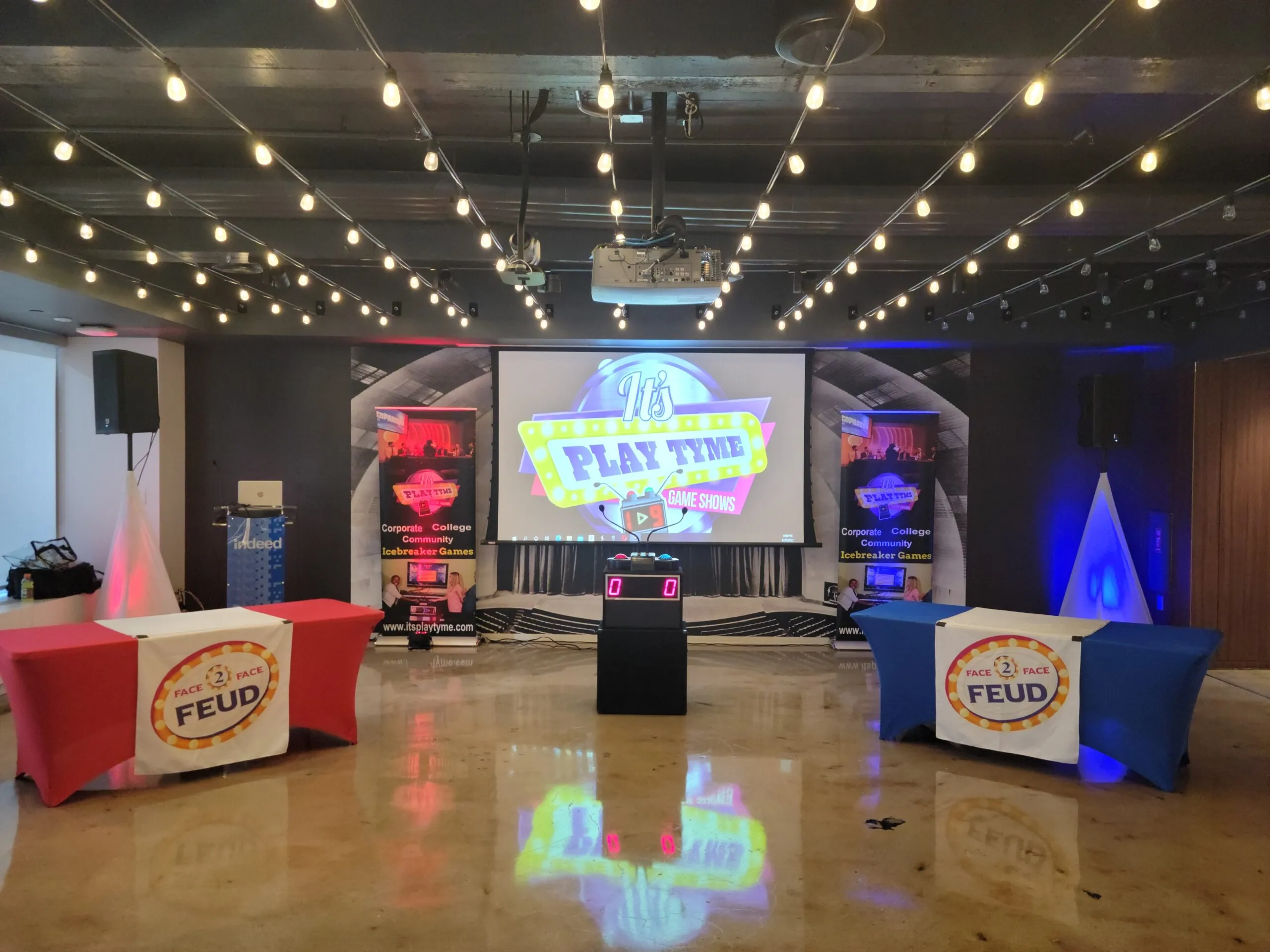
- Clear a front “stage” area roughly 10 feet wide. Push tables back or against the walls so teams have a clear sightline.
- Arrange seating in clusters of 4—8 chairs per team, angled toward the stage. Round tables work best; rows do not.
- Leave a center aisle so the host moves freely between teams.
Equipment checklist
- A large screen or projector (55″ TV minimum for groups under 40; projector for larger rooms).
- A wireless microphone or portable PA speaker. Even 20 people need amplification once the cheering starts.
- A laptop loaded with your game slides, a countdown timer app, and a scoreboard (Google Sheets on a second tab works in a pinch).
- Buzzers or noisemakers for each team. Desk bells from an office supply store cost under $5 each.
Test every cable and connection 30 minutes before showtime. Nothing drains momentum like a five-minute pause to troubleshoot HDMI.
Step 2: Choose the Right Game Show Format
The format sets the tone. Pick one that matches your group size, time slot, and energy goal.
| Format | Best Group Size | Time Needed | Energy Level | Prep Difficulty |
|---|---|---|---|---|
| Family Feud style | 20-300+ | 45-60 min | High | Moderate |
| Jeopardy style | 10-60 | 30-45 min | Medium-High | Higher (need category boards) |
| Wheel of Fortune style | 10-50 | 30-45 min | Medium | Higher (need a wheel or digital spinner) |
| Trivia lightning rounds | Any size | 20-40 min | Medium | Low |
| Hybrid (multi-round mix) | 30-150+ | 60-90 min | High | High |
Family Feud style is the most crowd-friendly option. Two teams face off at the front while everyone else cheers. It scales from a conference room huddle to a ballroom of 200. Jeopardy style rewards knowledge and works well for smaller, quiz-oriented groups. Wheel of Fortune style adds a physical, luck-based element that levels the playing field between new hires and veterans. A hybrid format rotates through multiple rounds, keeping the show fresh for longer events.
Step 3: Decide Who Hosts (DIY Checklist vs. Hiring a Pro)
The host is the single biggest factor in whether your game show lands or falls flat. You have two paths.
The DIY path
Running the show yourself saves money and gives you full control. Before you volunteer, honestly check these boxes:
- You are comfortable speaking to a group of this size without notes.
- You read a room quickly and adjust pace when energy dips.
- You handle hecklers and wrong answers with humor, not awkwardness.
- You have time to build slides, write questions, source buzzers, and rehearse.
- You are not also responsible for catering, A/V, or managing the event schedule.
If two or more of those boxes stay unchecked, the DIY route puts the event at risk.
The professional path
A professional game show host arrives with tested material, professional-grade equipment, and the stage presence to keep 200 people laughing for an hour straight. It’s PlayTyme Game Shows specializes in exactly this format across New Jersey, New York City, and Connecticut. Their hosts have run over 3,000 corporate events, they bring their own A/V and buzzer systems, and they customize every round to your team’s industry, inside jokes, and goals. You show up, sit down, and watch your team come alive.
Hiring a pro also frees you to participate. Instead of managing slides behind a laptop, you join a team and experience the event alongside your colleagues.
Step 4: Customize Your Questions
Generic trivia gets generic reactions. The best game show questions connect directly to the people in the room.
Three tiers of questions
- Company-specific: “Name three values from our mission statement,” “What year did the company open its second office?” These reward tenure and attention.
- Industry knowledge: Questions about your field that test real expertise. A marketing team gets questions about campaign metrics; an engineering team gets logic puzzles.
- Pop culture and general trivia: These level the field and let everyone contribute, regardless of role or seniority.
Mix all three tiers in every round. A good ratio is 40% company, 30% industry, 30% pop culture. Keep each question under 15 words so the host reads it cleanly and the audience processes it fast.
Difficulty curve
Start easy. The first two rounds should feel winnable so every team builds confidence. Ramp difficulty in the middle rounds, then close with a high-stakes bonus question that gets the whole room on its feet.
When you work with It’s PlayTyme, their team handles question writing for you. They send a short intake form before the event, pull your company details, and build a custom question set that hits all three tiers without any extra work on your end.
Step 5: Run the Show Like a Pro
Game day. Here is your minute-by-minute flow.
- Warm-up (5 minutes): The host introduces the rules, divides teams, and runs one practice question so everyone understands the format.
- Round 1 (10 minutes): Easy questions, fast pace. Get the crowd noisy early.
- Round 2 (10 minutes): Medium difficulty. Introduce a twist (bonus points, steal opportunities, or a physical challenge between rounds).
- Round 3 (10 minutes): Hard questions. Stakes rise. The scoreboard tightens.
- Final round (5-10 minutes): A high-value bonus round where trailing teams have a real shot at a comeback. This keeps everyone invested to the last second.
- Awards (5 minutes): Announce winners, hand out prizes (gift cards, trophies, bragging rights). Keep it short and celebratory.
Hosting tips that keep energy high
- Stand, never sit. Move toward teams when you ask questions.
- Call out team names, not table numbers. “Team Rocket, you’re up!” beats “Table 3, your turn.”
- Play walk-up music between rounds. A 15-second clip resets the room’s energy.
- Never let a wrong answer hang in silence. Acknowledge the effort, correct with humor, and move on.
Step 6: Debrief and Capture the Impact
The show ends, but the value does not have to. A short debrief turns 45 minutes of fun into a lasting team-building outcome.
- Immediate recap (2 minutes): While people are still energized, ask three quick questions out loud: “What surprised you?” “Who on your team stepped up?” “What did you learn about a colleague today?”
- Photo and video: Capture candid shots during the event. Post them on your internal Slack channel or company intranet within 24 hours. Visibility reinforces the memory.
- Follow-up survey: Send a 3-question pulse survey the next day. Ask what worked, what they want next time, and how the event made them feel about the team. Use the data to plan your next event.
- Manager nudge: Encourage team leads to reference the game show in their next one-on-one. “I noticed you really led your team during round 3” ties the fun back to real performance recognition.
Key Problems First-Time Game Show Hosts Face
Even with a solid plan, a few things trip up first-time organizers. Knowing them in advance saves you from learning the hard way.
- Low participation from introverts: Not everyone wants to shout answers. Build in written-response rounds or team huddle time so quieter employees contribute without being put on the spot.
- Uneven teams: If one team stacks all the senior leaders, the result feels predetermined. Randomize teams by drawing names or assigning by birthday month.
- Tech failures: Projectors disconnect, speakers cut out, Wi-Fi drops. Always have a backup plan: printed question cards, a portable Bluetooth speaker, and a phone hotspot.
- Time overruns: Game shows expand to fill available time. Set a hard stop, assign a timekeeper, and cut a round if you are running long. Ending on a high note matters more than finishing every question.
- Awkward hosting: An unprepared host turns a game show into a cringe fest. If your internal candidate is not a natural entertainer, invest in a professional. The difference between a good host and a bad one is the difference between a team that bonds and a team that checks their phones.
How to Decide Between a DIY Game Show and a Professional Experience
The right choice depends on three things: your group size, your available prep time, and the stakes of the event.
For a casual team of 10 with a relaxed timeline, a DIY approach works. You know the group, you control the pace, and the informal setting forgives rough edges. For groups over 30, high-visibility events (leadership offsites, client entertainment, annual kickoffs), or situations where the organizer also needs to participate, a professional game show company delivers a noticeably better result.
It’s PlayTyme Game Shows is built for exactly these moments. They serve offices throughout New Jersey, New York City, and Connecticut with fully produced, customized game show experiences. Their team handles every detail: equipment, question writing, hosting, scoring, and prizes. Over 3,000 corporate events and consistent five-star ratings from Fortune 500 companies back that track record. Whether your team is 15 people in a conference room or 200 in a hotel ballroom, they scale the format to fit.
Ready to bring the energy of a live game show to your next team event? Reach out to the It’s PlayTyme team to start planning, or explore their full lineup of corporate event team-building activities to find the right format for your group.
Frequently Asked Questions (FAQs)
How much does it cost to host a game show at work?
DIY game shows cost as little as $50 to $150 for buzzers, printed materials, and small prizes. Professionally hosted 90-minute game shows from It’s PlayTyme start at $2,995 for groups of 20 or more, and our pricing estimator shows the range for your group size. The investment pays back in stronger team morale and engagement that lasts well beyond the event itself.
How long should a workplace game show last?
Most workplace game shows run 45 to 60 minutes. That window is long enough to build competitive momentum across three to four rounds without cutting into productivity. For longer events like leadership retreats or holiday parties, a 90-minute multi-format show with breaks between rounds works well.
What game show format works best for large groups?
Family Feud style formats handle large groups best because two teams compete at the front while everyone else cheers and engages from their seats. This format scales from 20 to 300+ people. It’s PlayTyme’s team-building activities include several large-group formats designed specifically for corporate audiences.
Do I need special equipment to run a game show at work?
At minimum, you need a screen or projector, a laptop, a speaker, and buzzers or noisemakers for each team. Professional game show companies bring all equipment, including wireless microphone systems, professional scoring displays, and branded team stations. This eliminates the setup burden entirely.
How do I get reluctant employees to participate in a game show?
Structure the game around teams, not individuals. When answers come from a group huddle rather than a single person on the spot, even reserved employees contribute comfortably. Mixing question types (written answers, multiple choice, physical challenges) also gives different personality types a chance to shine without pressure.