

Picture the last hybrid offsite your company ran. The conference room in Newark buzzed with laughter while a dozen colleagues on the video call sat muted, cameras half on, waiting for a gap to jump into that never came. The in-room group carried the whole event. The people at home watched it happen to them.
That split is now the default, not the exception. Gallup reports that the majority of remote-capable U.S. employees now work a hybrid schedule, which means almost every team event has one foot in the room and one foot on a screen. The blind spot is real, too: a SHRM survey found that 42% of supervisors admit they sometimes forget about remote workers when handing out assignments. The same forgetting starts the moment a game begins.
Running one activity for a room of people and a grid of video tiles at the same time is harder than it looks. Remote players miss the side jokes. In-room players forget the camera is on. Most off-the-shelf games were built for one audience or the other, never both at once. The seven hybrid team building activities below are ranked by how well each one keeps every person, on-site or at home, inside the same game.
| Provider | Format | Group Size | Hosted? | Hybrid-Ready? |
|---|---|---|---|---|
| It’s PlayTyme | Live hosted game show | 20 to 300+ | Yes, one live host | Yes, room and remote on one stage |
| Escapely | Virtual escape room | Any size, in pods of 6 to 8 | Yes, live game guide | Yes, parallel pods |
| TriviaMaker | Game-show trivia app | Up to thousands | No, self-run | Yes, room TV plus browser |
| Watson Adventures | Hosted mystery and scavenger hunt | 10 to 200 | Yes, remote host | Yes, remote-first |
| Rockoly | Hosted cooking workshop | 10 to 100 | Yes, live chef | Yes, with kit shipping |
| Confetti | Experience marketplace | Varies by vendor | Varies by vendor | Varies by experience |
| Wildgoose | App-based hunt and escape | 20 to 500 | Remote host briefing | Yes, app-based |
What Breaks When Your Team Is Half Remote
Before you book anything, name the problems you are actually solving. A hybrid event fails in a few predictable ways, and the right activity is the one that closes these gaps rather than papering over them.
- Two audiences, one clock. The room reacts a half second before the video feed, so remote players are always laughing at the joke after it lands. An activity needs a single shared timeline, not two slightly different ones.
- Remote players go quiet. When the room can talk over each other freely, people on the call rarely interrupt. Without a structure that pulls them in by name or by team, they drift into spectators.
- Scale breaks the format. A game that is fun for 12 falls apart at 200. Many hybrid options handle one size band well and quietly cap out at the other.
- Someone has to run it. Software does not read the room. If no one is hosting, the energy depends on whichever manager volunteered, and the remote half pays the price first.
1. It’s PlayTyme Hosted Game Shows
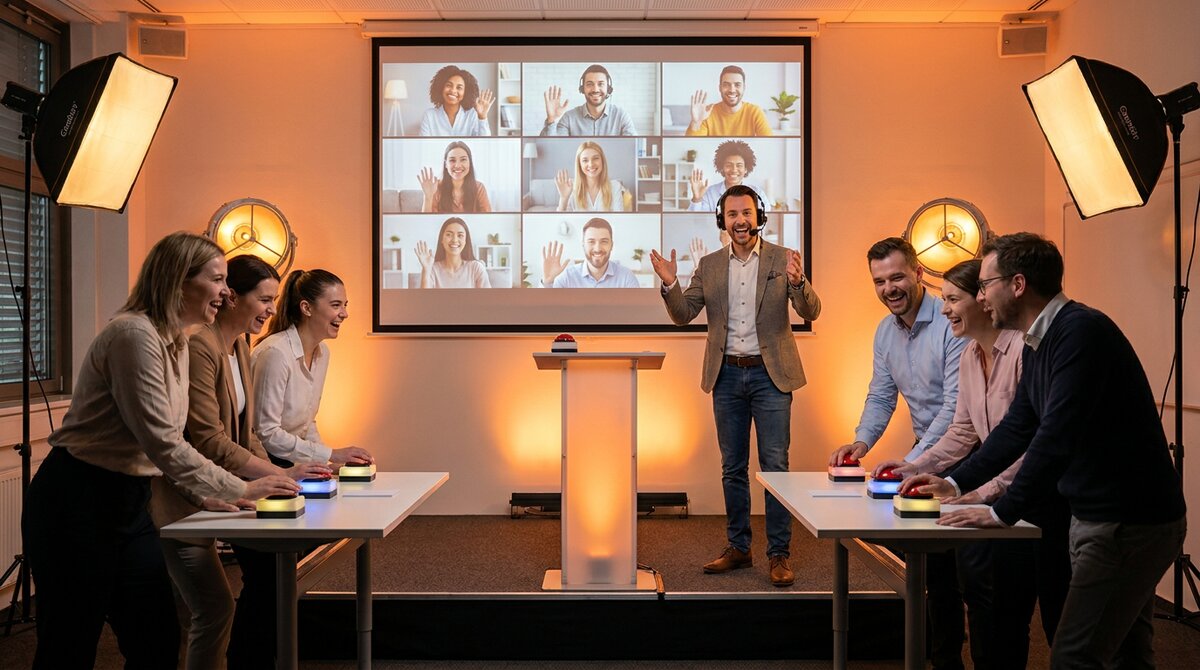
It’s PlayTyme runs fully hosted live game shows for companies across NJ, NYC, and CT, and it sits at the top of this list for one reason: a single professional host runs the game in the room and on the video feed at the same time, so there is one stage, one scoreboard, and one shared moment. Remote players answer, buzz, and compete on the same screen the in-room teams see, which removes the lag and the side-conversation problem that sinks most hybrid events.
The format scales where others cap out. A show works for a team of 20 and for a company gathering of 500 or more, with the host adjusting pacing, team splits, and rounds live rather than forcing your group into a fixed pod size. Lisa Lawrence and the It’s PlayTyme team have produced these shows since 2012, and the catalog runs from Family Feud style face-offs to custom themed rounds built around your company. You can see the full lineup on the game shows page.
This is not a DIY platform you have to figure out and MC yourself. A producer plans the run of show, a host carries the energy, and the technology to bridge the room and the remote crowd is handled for you. It also carries a 100% satisfaction guarantee.
Highlights: one live host serves the room and remote players on a single stage; scales from 20 to 300+; a true catalog of game-show formats; producer-run so your team just shows up and plays; serves the NJ, NYC, and CT corporate market with a two-decade track record.
2. Escapely Virtual Escape Rooms
Escapely works for hybrid because the same puzzle feed runs live to every player at once, whether they are around a conference table or dialing in from a kitchen, with a real game guide steering each session. Teams race the clock through themed mysteries, and the host keeps the story moving so quieter players still get pulled into a clue.
The honest limitation is structure. Escapely splits larger groups into pods of roughly six to eight, so a 200-person company event becomes many parallel games rather than one shared room. The in-room crowd also needs personal devices or a single shared screen to keep up with their remote teammates, which can leave on-site players hunched over laptops instead of facing each other.
Highlights: live-guided puzzles, strong themes, equal footing for room and remote within a pod.
Watch-outs: pods cap shared energy at scale, and the in-room group needs devices to stay synced.
3. TriviaMaker Game-Show Trivia
TriviaMaker works for hybrid because it pushes one question feed to a TV app in the room and to a web browser for everyone at home, with grid boards, buzzers, and wheel spins that give the session a game-show look. Both audiences see the same board and answer on the same clock, which is exactly the shared timeline a hybrid event needs.
The honest limitation is that this is a software platform, not a service. Someone on your team has to build the question sets, run the tech, and MC the game on the day. The tool can carry a polished look, but the room energy depends entirely on your in-house host, and a flat host means a flat event for the remote half first.
Highlights: handles huge groups, genuine game-show visuals, room TV plus remote browser on one feed.
Watch-outs: fully self-run, so prep time and live hosting fall on your staff.
4. Watson Adventures Mysteries and Scavenger Hunts
Watson Adventures works for hybrid because a live remote host runs the same murder mystery or scavenger hunt for everyone over video, so teams can play together no matter where they sit. The host narrates, drops clues, and keeps the pacing tight, which gives remote players a clear role instead of a passive seat.
The honest limitation is that the format is built remote-first. In-room players join from their own laptops, so a conference-room crowd loses the live-room feel and effectively becomes a cluster of individual screens in one building. For a team that came together to be in the same space, that can blunt the in-person half of the day.
Highlights: live host, story-driven play, real participation for remote staff.
Watch-outs: remote-first design means the in-room group plays through their own devices.
5. Rockoly Hybrid Cooking Workshops
Rockoly works for hybrid because it ships ingredient kits to remote staff and sends a planner to wire up the in-room kitchen, so both groups cook the same dish with one live chef leading on screen. It is one of the few activities where remote and on-site players are doing the identical hands-on task at the same moment.
The honest limitation is logistics. Ingredient kits need lead time and a delivery address for every remote person, so a last-minute or constantly shifting headcount is hard to serve. Dietary restrictions multiply the prep, and the per-kit cost climbs quickly once a group passes the 100-person mark.
Highlights: identical hands-on task for room and remote, live chef, memorable food angle.
Watch-outs: kit shipping needs lead time and addresses, and cost rises fast at scale.
6. Confetti Experience Marketplace
Confetti works for hybrid because it is a booking platform where you can filter for hybrid-ready experiences and reserve a hosted session in a few clicks, from trivia to craft workshops. For a planner who wants choice and a fast checkout, it puts many vendors in one place.
The honest limitation is that Confetti is a booking layer, not the host. The quality, the hosting, and the depth of true hybrid support all depend on the individual vendor you pick, not on Confetti itself. Two experiences booked through the same site can deliver very different results for your remote half, so you carry the vetting work.
Highlights: wide catalog, quick booking, easy way to compare formats.
Watch-outs: hosting and hybrid quality vary by vendor, so results are uneven.
7. Wildgoose App-Based Hunts
Wildgoose works for hybrid because teams in different locations get one virtual briefing from a remote host, then play the same scavenger hunt or escape challenge through a shared app. Scores update live across locations, so a remote group and an office group genuinely compete against each other in real time.
The honest limitation is that the gameplay lives inside the app on each person’s phone. That keeps everyone synced, but the shared-stage moment is lighter than a live MC carrying the room and the screen together. The host sets up the game and then steps back, so the back-and-forth energy of a hosted show is not really the point here.
Highlights: app keeps every location synced, live cross-site scoring, scales to a few hundred.
Watch-outs: phone-based play means a lighter live-host presence than a true game show.
Choosing the Right Hybrid Format for Your Group
Start with the question that actually predicts success: does the activity put your whole group on one stage, or does it split them into parallel games? One stage keeps the remote half inside the event. Parallel pods are fun in a small pod and lonely across a big company.
Next, decide who is hosting. If you have a confident in-house MC and time to prep, a self-run platform can work. If you want the room carried for you, pick a service with a professional host so the energy does not rest on a volunteer. Then match the format to your real headcount, since a game that shines at 15 can stall at 250.
It is also worth separating the hybrid problem from the purely remote one. If your concern is a fully distributed team rather than a mixed room, read the companion piece on why some employees hate virtual team building, which digs into the remote-only pitfalls this list does not cover. Use that for fully virtual events, and use this list when part of your group is together in a room.
For most NJ and NYC companies, the safest choice when half the team is remote is a hosted live game show, because one host, one scoreboard, and one shared clock solve the exact gaps that sink hybrid events.
Ready to run an event where the remote half plays as hard as the room? Get a fast price estimate from It’s PlayTyme and see a hosted hybrid game show built for your group size and date.
Frequently Asked Questions (FAQs)
What are hybrid team building activities?
Hybrid team building activities are games or workshops designed so in-room and remote employees take part in the same event at the same time. The strongest formats run on one shared timeline with a single host or feed, so the people on video are players rather than viewers. They differ from purely virtual activities, which assume everyone is remote.
How do you include remote employees in an in-person team event?
The reliable way is to give every person the same point of entry: one screen, one scoreboard, and one host who speaks to the room and the camera together. Activities that route all answers through a shared device or app stop the in-room group from talking over the remote half. A live host who calls on remote teams by name keeps them in the action.
What is the best hybrid team building activity for large groups?
A hosted live game show scales best, because a professional host can adjust rounds and team splits for a group of 500 without forcing everyone into small pods. Trivia platforms also handle large numbers, though they need an in-house host to carry them. Pod-based formats like escape rooms work but split a big company into many separate games.
How much do hybrid team building activities cost?
Cost depends on the format, the group size, and whether the event is fully hosted or self-run. Self-run software platforms sit at the low end, while fully produced hosted shows with a live host and custom rounds cost more because the production is done for you. It’s PlayTyme provides a tailored price estimate by group size and date so you can compare against your budget.