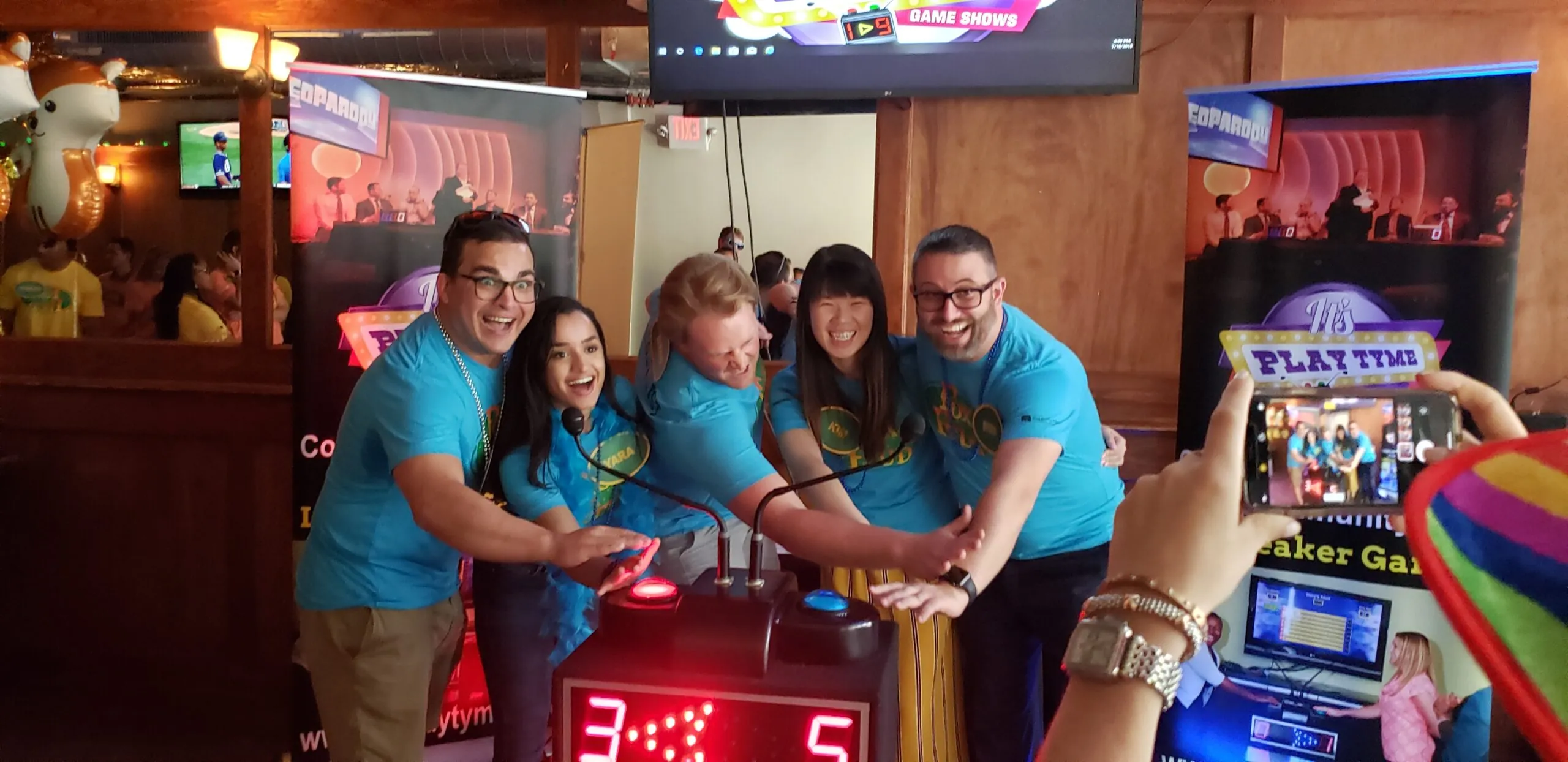
Quick answer: In a hosted large group game show, everyone gets a turn at once. Audience response keypads or cellphones let every guest answer every question, mixed teams share the scoring, buzzer and survey rounds spread the spotlight, and a professional host keeps the pace. Groups of 20 to 300+ play together in one room.
A full room is not the same as a participating room. Gallup’s 2025 workplace data found that only 20% of employees worldwide were engaged at work, and an all-hands, a sales kickoff or a conference session with 200 people in it is where that gap is easiest to see. Seats filled does not mean attention held.
That is why planners ask the same question before booking a game show for a big group: if only a handful of people can stand at the podiums, what are the other 280 doing? The honest answer depends on how the large group game show is built, so this guide walks through the mechanics we use in PlayPad Mania and our other large-group formats, the places where a big room still needs careful handling, and links to the full 90 minute run of show in how a company game show works.
If you are the person approving the budget, the business reason is participation. A show that gives all 300 people a turn spends your money on the whole room instead of a handful of volunteers, and it puts colleagues from different departments on the same team. This guide is written so you can forward it, along with the checklist near the end, to whoever signs off.
Planning a game show for 100 to 300+ people? We host in person across NJ, NYC and CT.
Why a Room of 300 Breaks the Usual Game Show
The television version of a game show gives turns to a few people at a time. Two or three contestants stand behind buzzers, everyone else watches, and that works because the audience at home chose to tune in. A company all-hands is different. The audience did not choose anything. They were told to be in the room.
Do the arithmetic on a large group game show that only ever uses the contestants on stage. Say five players are up at a time. Over a 90 minute show, only a small fraction of a 300 person room ever gets a turn, and everyone else has spent an hour and a half as a spectator. Lisa Lawrence founded It’s Playtyme Game Shows in 2012 after noticing exactly that pattern at events: only a handful of people took part while everyone else watched. Every format we run is built to avoid it.
How Do 300 People Answer at the Same Time?
The biggest lever is the all-play round. In PlayPad Mania, every participant answers every question simultaneously on a handheld response keypad or a cellphone, and the scores update on the screen in real time. Our FAQ puts the range plainly: groups of 20 to 300+ can play trivia at one time through audience response keypads, with larger groups handled by custom quote.
Three things follow from that design.
- No waiting for a turn. Every person is answering during every question, so nobody sits out a round.
- Answers are private. Nobody is exposed for a wrong guess, which matters in a room where the CEO and the new analyst are both playing.
- The scoreboard is live. Teams watch their totals move question by question, so the competition runs for the whole show instead of only at the finish.
How Mixed Teams Spread the Scoring Across the Room
A turn does not have to mean standing at a microphone. In our shows the room is split into teams, mixed on purpose so people land beside colleagues from other departments instead of the people they already have lunch with. Everyone plays as part of a team, and live scoring keeps the pressure on the team instead of on any one person, so a quiet analyst who knows the answer still scores for the whole table.
The questions are written about your company, your departments and your year. That is what keeps a back-row table leaning in: they are competing about things they actually know. For larger rooms, rounds such as office against office or department against department give every table a rivalry to care about before the first question is read.
Different Rounds Give Different People a Way In
People contribute in different ways, and a single format wastes most of them. A show for a big group mixes round types on purpose:
- Buzzer rounds for the quick-reflex competitors.
- Survey rounds for people who know their colleagues and how the company thinks, including answers collected from the team beforehand.
- Physical challenges for those who would rather do than recall.
- Guessing games where a good instinct beats a good memory.
The point is spread. Some people buzz in, some know the survey answers, some are good at the physical rounds, and nobody is put on a stage alone.
Who Goes on Stage, and Who Stays in Their Seat
Some rounds do go to the front of the room, because a live head-to-head is part of what makes a show fun to watch. Our FAQ describes the approach: after the all-play trivia, the best players are called up to the front of the room or onto the stage to play one of our team building game shows. Everyone else stays in the game on their keypad and keeps scoring for their team.
The same page is candid about something planners should hear. Many attendees do not want to be on stage. They want to watch, and a keypad round lets those guests take part without a spotlight. Planners worry about two opposite problems here: pushing quiet people onto a stage, and letting the loudest few take the whole spotlight. Participation in a large room means each person chooses how visible to be, and nobody is forced to the microphone.
What Goes Wrong in a Room of 300, and What Fixes It
Large rooms fail in ordinary ways, and most of them are logistics rather than game design. The back rows cannot see the screens or hear the host. The pace drags because setup took too long. The room is a hotel ballroom with the power in the wrong corner. The planner gave a rough headcount and the final number was 60 higher.
The fixes are mostly on the production side. We bring the screens, sound and a sound engineer, and our team arrives early to test the screens, sound and keypads before anyone walks in. We need a room that fits your group and access to power, and we ask for an approximate head count one week before the event. A named host runs the show from the first round to the final scores, so there is one person responsible for pacing the whole room.
Questions to Ask Before You Book for 200 or More
Whoever you hire for a large group game show, put these to them before you sign. The answers separate a show that is built for a big room from a small show stretched to fill one.
- How does every person in the room answer a question, not just the players on stage, and what audience response setup is used?
- How many people are on stage at once, and how are they chosen?
- Who is the named host, and are they the person who will run my event?
- What exactly does the quote include: host, crew, set, screens, sound, prizes, delivery, setup and breakdown, and whose AV is used, ours or the venue’s?
- If guests answer on cellphones, does the show depend on the venue’s guest Wi-Fi, and what is the plan if it is weak?
- What does the room need: floor space, sightlines to the screens and power?
- Is the show in person at our venue, and does the provider serve our city?
Our own answers are on the page for game show team building. Send us your date, room and headcount, and we reply with a production plan and a straight price.
Solve the participation problem
Ready to get the whole room in the game?
Frequently Asked Questions (FAQs)
How many people can play a game show at once?
Groups of 20 to 300+ can play trivia at the same time through audience response keypads. Groups larger than that are available by custom quote, with a setup that keeps every table in the game.
Does everyone have to go on stage?
No. Everyone answers from their seat on a keypad or cellphone, and the best players are called to the front for team rounds. Guests who prefer to watch can still score for their team without ever leaving their chair.
Do guests use their own phones or a keypad?
Our shows use handheld response keypads or cellphones, depending on the format. Tell us about your room and your group when you request a quote and we will recommend the right setup.
How much does a game show for a large group cost?
Shows start at $2,995 for 60 minutes and $3,595 for 90 minutes, and most run between $2,995 and $10,295 depending on group size and length; groups of 300+ are quoted individually. Pricing covers the host, crew, set, screens, sound, prizes, delivery, setup and breakdown. No deposit is required to hold your date, and every show is backed by our 100% Satisfaction Guarantee. See the pricing page for the estimator.