

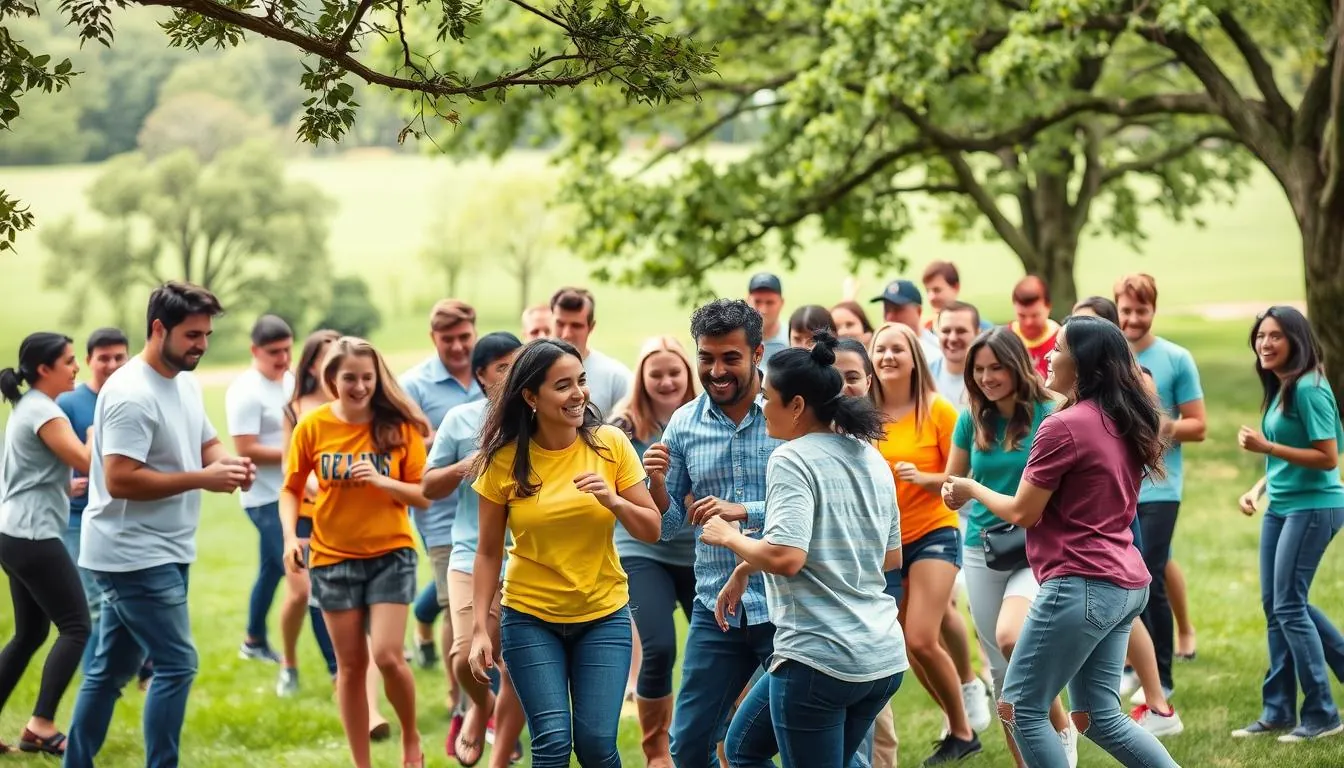
Most team building falls apart the moment the group exceeds 30 people. Side conversations drown out instructions, half the room checks their phones, and the post-event survey reads like a hostage note. Yet the data shows that getting this right is worth the effort. According to Gallup’s State of the Global Workplace report, only 20% of employees worldwide are actively engaged at work. And a separate Gallup meta-analysis of over 2.7 million workers found that highly engaged business units see 21% greater profitability.
Large group team building activities, when designed properly, move the needle on both numbers. The problem is that most organizers treat a 200-person event the same way they would a 15-person workshop: one facilitator, one activity, one prayer that it all holds together.
If you have organized (or been stuck in) a company-wide event where a third of the room mentally checked out before the first round ended, you already know the frustration. Coordinating schedules across departments is hard enough. Getting hundreds of people to participate at the same time, in the same space, with roughly equal energy is a different challenge entirely. Add in mixed personality types, varying physical abilities, and the skeptics who think every team builder is trust falls and forced fun, and the degree of difficulty jumps again.
Biggest Obstacles to Running Large Group Team Events
Scaling from a small team exercise to a large group event introduces problems that no amount of enthusiasm fixes on its own. Here are the ones that trip up even experienced event planners:
- Uneven participation. In groups of 100 or more, extroverts dominate and quieter employees fade into the background. Without a structure that gives every person a defined role, half the room becomes spectators.
- Energy drop-off. Large rooms lose momentum fast. A single long activity with no variation leads to disengagement by the 20-minute mark.
- Logistical complexity. Audio has to reach the back row. Materials have to be distributed quickly. Timing across sub-groups has to stay synchronized. One bottleneck stalls the entire event.
- The “this is cheesy” factor. Adults at a corporate event resist anything that feels forced or juvenile. The format has to earn their buy-in within the first five minutes, or the skeptics set the tone.
- Unclear outcomes. If participants walk away unsure of what the event was supposed to accomplish, the investment in time and money is wasted.
Secret 1: Choose a Scalable Format From the Start
The first operational secret is format selection. Not every team building activity scales. A ropes course tops out at 20. An escape room caps at 10. Trivia nights work for medium groups but get chaotic past 80. The format you choose has to be engineered for scale from the ground up.
Game show-style formats are purpose-built for large audiences. They borrow from a structure that already works: television. Everyone in the room understands how a game show operates. There are rounds, there is a host, there are winners. That shared understanding removes the “wait, what are we doing?” friction that kills momentum in the opening minutes.
It’s PlayTyme Game Shows runs live, interactive game show events built specifically for groups of 20 to 300+ people across New Jersey, New York City, and Connecticut. Their format is designed from the ground up for scale: professional AV, a trained host, and rounds that keep every person in the room engaged simultaneously. It is exactly the kind of activity that solves the problems outlined above.
Secret 2: Build a Sub-Team Structure That Gives Everyone a Role
The fastest way to lose a large group is to let individuals blend into a faceless crowd. The fix is sub-teams. Break the room into groups of 6 to 10, give each team a name or number, and assign specific roles within each group: a captain, a timekeeper, a spokesperson.
This approach does three things at once:
- It creates accountability. When your answer matters to seven teammates sitting around you, you pay attention.
- It builds connections across departments. Assigning teams deliberately (mixing departments, locations, or seniority levels) forces introductions that never happen in a hallway.
- It generates friendly competition. A leaderboard visible to the entire room turns passive observers into invested players.
It’s PlayTyme’s events use this exact sub-team structure. Their hosts divide the room into competing teams, each with buzzers or response systems, and run multiple rounds so that every person contributes to their team’s score. Nobody sits on the sideline.
Secret 3: Invest in Clear, Professional Facilitation
A large group team building activity is only as strong as its facilitator. With 200 people in a room, the host is not just reading questions off a card. They are reading the crowd, adjusting pacing, managing energy, handling technical cues, and keeping the event on schedule down to the minute.
This is where DIY approaches fall apart. An HR manager handed a microphone and a list of icebreakers does not have the stage presence, timing, or crowd-control skills that a professional emcee brings. The difference between a flat event and one that people talk about for months is almost always the person at the front of the room.
What professional facilitation looks like
- A host who projects confidence and humor without being over the top
- Professional sound and visuals so the back row is as engaged as the front
- Real-time score tracking displayed on screens the entire room sees
- Smooth transitions between rounds with zero dead air
It’s PlayTyme provides a professional host and full AV production as part of every event. Their hosts are experienced performers who specialize in corporate and school audiences, not DJs filling time between songs.
Secret 4: Manage Energy With Intentional Pacing
Energy management is the secret most planners overlook entirely. A 90-minute event for 300 people requires deliberate peaks and valleys. Open high to grab attention. Drop into a round that requires strategic thinking. Spike the energy again with a speed round. Give people a moment to laugh and talk to their teammates before the next challenge.
The worst thing an organizer does is run one long, unbroken activity. Attention spans in a large room are shorter than you think. Research on adult attention consistently shows that engagement drops sharply after 10 to 15 minutes of the same stimulus. The antidote is variety within a single event framework.
A sample energy arc for a 90-minute event
- Minutes 1 to 5: High-energy opening, team formation, rules explained
- Minutes 5 to 20: Round 1, moderate difficulty, gets teams talking
- Minutes 20 to 35: Round 2, higher stakes, faster pace
- Minutes 35 to 45: Halftime break, scores displayed, quick team huddles
- Minutes 45 to 65: Round 3, hardest content, biggest point values
- Minutes 65 to 80: Speed round or lightning challenge, highest energy
- Minutes 80 to 90: Final scores, recognition, debrief
Game show formats naturally follow this arc. Each round is a self-contained burst of engagement, and the competitive structure keeps attention locked in between rounds as scores update.
Secret 5: Close With a Debrief, Not Just a Winner
The final secret separates a fun hour from a meaningful team building experience. A structured debrief at the end connects the activity back to workplace goals. It takes five to ten minutes and answers three questions for participants:
- What did we just experience together?
- What did it reveal about how we communicate, collaborate, or compete?
- What is one thing we take back to the office on Monday?
Without this step, the event is entertainment. With it, the event becomes a reference point that teams recall when they face real challenges in the weeks that follow. The debrief is also the moment where leadership reinforces a message: a company value, a quarterly theme, or a cultural shift they are driving.
Why the Game Show Format Outperforms Other Large Group Options
Not all large group team building activities deliver the same results. Here is how the most common formats compare on the factors that matter most for groups of 50 or more:
| Format | Group Size | Participation Level | Setup Complexity | Energy Sustainability |
|---|---|---|---|---|
| Live Game Show (It’s PlayTyme) | 20 to 300+ | 100% active | Handled by provider | High (round-based pacing) |
| Outdoor Field Day | 30 to 200 | Varies by station | High (weather dependent) | Moderate (fatigue sets in) |
| Trivia Night (DIY) | 20 to 80 | Moderate | Low | Low (single format fatigue) |
| Escape Room (Off-Site) | 8 to 12 per room | High within room | Moderate (transport needed) | High but very small groups |
| Cooking Challenge | 20 to 60 | High | Very high (venue, supplies) | Moderate |
| Volunteer/Service Project | 30 to 150 | Varies by task | High (coordination) | Moderate |
The game show format stands out for three reasons: it handles the largest group sizes without losing participation, the provider handles all logistics and equipment, and the round-based structure prevents the energy collapse that plagues single-activity events.
Practical Tips for Planning Large Group Team Building Activities
Beyond format selection, these operational details determine whether a large group event succeeds or stumbles:
Venue and logistics
- Book a room with a clear sightline to the front. Pillars and L-shaped rooms kill engagement for anyone who cannot see the host or screens.
- Confirm the AV setup in advance. A wireless microphone, speakers that reach every corner, and a projector or large screens are non-negotiable for groups over 50.
- Arrange seating in round tables or clusters, not theater rows. Teams need to face each other, not the back of someone’s head.
Timing and scheduling
- Avoid scheduling immediately after lunch. Energy is lowest between 1:00 and 2:00 PM. Mid-morning (10:00 AM) or late afternoon (3:30 PM) slots get better engagement.
- Keep the core activity between 60 and 90 minutes. Shorter feels rushed. Longer tests patience.
- Build in 10 to 15 minutes of buffer for late arrivals and transitions.
Communication
- Tell participants what to expect in advance. A one-paragraph email the day before reduces anxiety and raises anticipation.
- Frame it as competition and fun, not “mandatory team building.” Language matters.
What to Ask Before Signing a Team Building Contract
The decision comes down to five questions. Ask each one before signing a contract:
- What is the largest group they have handled? If they have never run an event for more than 40 people, your 200-person conference is not the place for them to learn.
- Do they provide their own AV and production? A provider who shows up with a laptop and expects your venue to supply everything else will deliver a weaker experience.
- Is the facilitator a trained performer or a volunteer? Ask for video of a past event. Watch how they handle the crowd, not just the content.
- Does the format naturally include everyone? If half the room watches while the other half plays, it is not a team builder. It is a spectator sport.
- Do they customize for your goals? The best providers tailor questions, themes, or rounds to your company’s industry, values, or current initiatives.
It’s PlayTyme checks every box. They bring full production, a professional host, and a format that keeps 20 to 300+ people engaged from the first buzzer to the final score. Their events are fully customizable and they have run programs for corporate teams, schools, and organizations throughout the tri-state area. Get in touch to discuss your upcoming event, or explore their full range of event options to find the right fit for your group.
Frequently Asked Questions (FAQs)
What are the best large group team building activities for over 100 people?
Live game show formats are the strongest option for groups over 100 because they keep every person actively participating through sub-team competition and round-based pacing. Other scalable options include outdoor field days and large-scale scavenger hunts, though both require significantly more logistical coordination.
How long should a large group team building event last?
The ideal length is 60 to 90 minutes for the core activity. Events shorter than 45 minutes do not allow enough time for teams to bond, and events longer than two hours lead to significant energy drop-off. Build in 10 to 15 minutes of buffer time for setup and transitions.
How do you keep everyone engaged during large group activities?
Three elements keep engagement high: sub-team structures that give every person a role, professional facilitation that reads and responds to crowd energy, and round-based formats that reset attention every 10 to 15 minutes. A visible leaderboard also drives participation by making every answer feel consequential.
How much does a large group team building event cost?
Costs vary based on group size, location, and whether the provider supplies AV equipment and production. Professional game show providers typically offer packages that scale with headcount. Contact providers directly for accurate pricing based on your specific group size and event requirements.
Are large group team building activities effective for remote or hybrid teams?
Yes, when the format supports it. Some providers offer virtual or hybrid game show experiences where remote participants join via video and compete alongside in-person teams. The key is choosing a provider with the technology and facilitation experience to keep both audiences equally engaged throughout the event.