Only 31% of U.S. employees qualify as engaged at work, according to Gallup’s ongoing workplace research. That disengagement carries a measurable cost: organizations with low employee engagement experience 18% lower productivity and 16% lower profitability, per Harvard Business Review. For event planners tasked with building culture and connection, the stakes of choosing the right corporate entertainment are higher than most realize.
Yet the typical corporate event still defaults to the same tired formula: a buffet line, a DJ playing background music, and clusters of employees checking their phones. Attendees leave without having spoken to anyone outside their usual circle. The event technically happened, but it produced zero measurable impact on morale, collaboration, or retention.
The core problem is passivity. Most corporate entertainment asks nothing of the audience. There is no reason to interact, no structure that pulls people out of their comfort zones, and no shared experience worth talking about on Monday morning. Event planners know this formula fails, but finding entertainment that genuinely activates a room of 20 to 300+ professionals (without forcing awkward icebreakers) feels like an impossible search. Budget constraints, logistics questions, and the fear of booking something that falls flat make the decision even harder.
What Live Game Show Entertainment Actually Looks Like at a Corporate Event
Live game show entertainment transforms a standard corporate gathering into an interactive, high-energy competition. Picture this: a professional host takes the stage backed by large LED screens, wireless buzzer systems, countdown timers, and a live leaderboard tracking every team’s score in real time. The format pulls directly from the game shows people already love (think trivia rounds, survey-style face-offs, and head-to-head challenges) but adapts them for a professional audience.
Teams of 6 to 10 compete through multiple rounds, answering questions that mix general knowledge with company-specific content. Customized rounds featuring inside jokes, company history, or industry trivia give the experience a personal edge that generic entertainment never delivers. The host reads the room, adjusts pacing, and keeps energy levels high from the first question to the final scores.
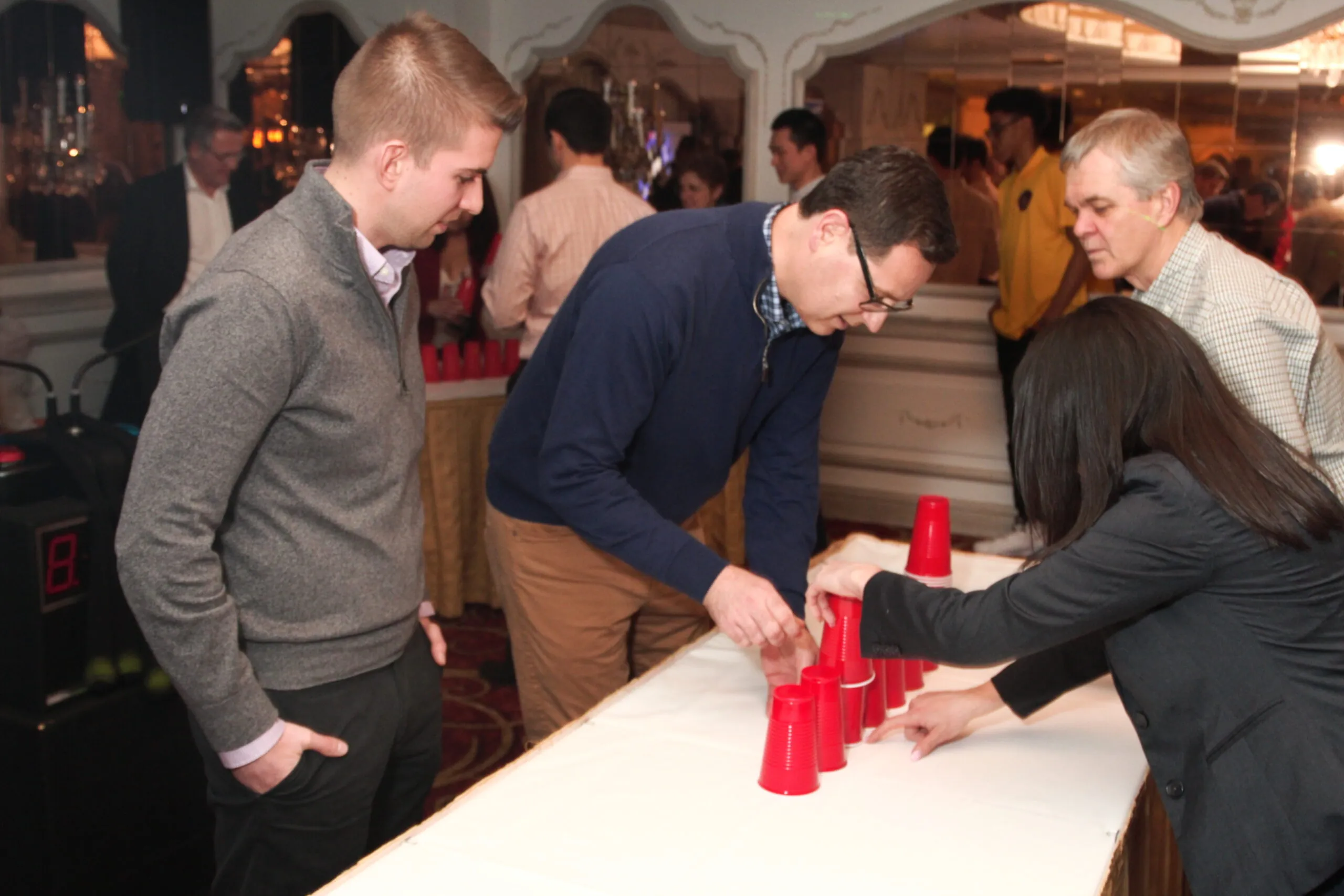
This is not a passive show. Every person in the room holds a buzzer or participates in a team huddle. The competitive structure does what no cocktail hour ever will: it gives strangers a reason to talk, strategize, and celebrate together.
What Event Planners Get Wrong With Corporate Bookings
Booking entertainment for a corporate audience presents a specific set of obstacles that differ sharply from planning a private party or wedding.
- Audience diversity: A single event often includes executives, new hires, remote workers meeting in person for the first time, and employees from multiple departments. Entertainment that skews too young, too physical, or too niche alienates part of the room.
- Logistics and venue constraints: Corporate venues range from hotel ballrooms to office cafeterias to outdoor pavilions. Planners need entertainment that adapts to the space, not the other way around. Setup time, power requirements, and AV compatibility all factor into the decision.
- Proving ROI to leadership: Unlike social events, corporate entertainment carries an implicit expectation of return. Leadership wants evidence that the investment produced stronger connections, higher morale, or improved cross-department communication.
- The “cringe factor”: Forced fun backfires. Planners fear booking an activity that makes employees groan rather than engage. The entertainment has to feel organic, not mandatory.
- Scalability: What works for 30 people in a conference room often collapses at 200. Finding a format that scales without losing energy is a persistent struggle.
The Before and After: Passive Reception vs. Buzzer-Driven Competition
Consider two versions of the same annual company meeting for a 150-person sales team.
The passive version
After the keynote, attendees filter into a reception hall. A bar is open, appetizers circulate, and a playlist runs through wireless speakers. Small groups form along existing team lines. The VP of Sales makes a toast. By 8:30 PM, half the room has left. Post-event surveys come back lukewarm: “It was fine.”
The live game show version
After the keynote, the same attendees walk into a room transformed with stage lighting, large screens displaying a custom-branded game board, and buzzer stations set at every table. A professional host opens with energy, explains the rules in 90 seconds, and launches the first round. Within five minutes, tables of strangers are debating answers, cheering correct responses, and trash-talking rival teams. The leaderboard updates after every round, and the final showdown between the top two teams brings the entire room to its feet. Post-event surveys come back glowing: “Best company event we’ve ever had.”
The difference is not budget. It is structure. Live game show entertainment gives every person in the room a role, a stake, and a reason to participate.
Production Timeline: From Booking to Showtime
Understanding the production timeline removes the guesswork from planning. Here is what a typical engagement looks like when working with a full-service provider like It’s PlayTyme Game Shows.
4 to 6 weeks before the event
Initial consultation covers group size, venue details, event goals, and any custom content requests. The production team confirms the format (trivia, survey-style, hybrid) and begins building custom question rounds if requested.
2 to 3 weeks before the event
Final details are locked: floor plan, AV requirements, schedule integration with other event programming, and any branded visuals for the screens. The client reviews and approves custom content.
Day of the event
The production crew arrives 60 to 90 minutes before showtime. Setup includes LED screens, sound system, wireless buzzer stations at every table, and a host podium. A quick tech check ensures everything runs without a hitch. The show itself runs 60 to 90 minutes, with flexibility to extend or shorten based on the event flow.
After the event
Teardown takes 30 to 45 minutes. Many providers supply post-event photos or a score recap that companies use in internal newsletters or social media.
Group Sizes and Format Flexibility
One of the biggest advantages of live game show entertainment is its scalability. The format works across a wide range of group sizes, with adjustments to keep every configuration engaging.
| Group Size | Format | Team Structure | Best For |
|---|---|---|---|
| 20 to 50 | Intimate trivia or survey game | Teams of 4 to 6 | Department outings, leadership retreats |
| 50 to 150 | Multi-round competition with leaderboard | Teams of 8 to 10 | Annual meetings, holiday parties |
| 150 to 300 | Large-scale game show with stage production | Teams of 10 to 15 | Company-wide events, sales kickoffs |
| 300+ | Tournament-style with elimination rounds | Table-based teams | Conferences, multi-day retreats |
The format adapts to the venue as well. A hotel ballroom, a corporate campus lawn, a conference center breakout room: the equipment is portable and self-contained, requiring only standard power access.
Why Full Production Equipment Changes the Experience
The difference between a professional game show and a DIY trivia night is production value. When attendees walk into a room with LED screens, professional lighting, a wireless buzzer at every seat, and a live leaderboard tracking scores in real time, the energy shifts immediately. The setup signals that this event is worth paying attention to.
Professional-grade equipment includes:
- Large LED screens or projectors displaying questions, timers, scores, and branded graphics
- Wireless buzzer systems that give every participant a physical connection to the game
- Professional sound systems with wireless microphones for the host
- Live digital leaderboards that update after every round, fueling competition
- Custom-branded visuals incorporating company logos, colors, and messaging
This level of production is what separates a forgettable team activity from a corporate event that employees reference for months afterward. It also removes the burden from the event planner: a full-service provider handles all equipment, setup, operation, and teardown.
What Sets It’s PlayTyme Game Shows Apart
Not all game show entertainment providers are equal. It’s PlayTyme Game Shows has spent 14+ years producing live game show experiences for Fortune 500 companies, mid-size firms, nonprofits, and school assemblies across New Jersey, New York City, and Connecticut. That track record matters for several concrete reasons.
- Full production, every time: It’s PlayTyme brings its own screens, buzzers, sound, lighting, and scoring technology to every event. There is no reliance on venue AV or improvised setups.
- Experienced live hosts: The hosts are trained performers who read audiences, manage pacing, and keep energy high across groups of 20 to 300+. This is not a side hustle for a comedian or a DJ adding trivia to their set.
- Custom content: Every show includes the option for company-specific rounds: questions about the organization’s history, inside references, or industry-specific trivia that makes the experience feel personal.
- NJ/NYC/CT proximity: Based in the tri-state area, It’s PlayTyme serves the densest corporate market in the country. No travel surcharges, no logistical headaches, and a team that knows every major venue in the region.
- Proven client roster: A 12-year history with Fortune 500 clients, repeat bookings, and consistent five-star reviews provides the kind of social proof that generic entertainment directories simply do not offer.
How to Select the Right Live Entertainment Format
Selecting the right entertainment starts with three questions.
First, what is the goal of the event? If the objective is team building, choose a format that requires collaboration (team-based trivia or survey games). If the goal is pure celebration, a high-energy competition with prizes works best. If leadership wants to reinforce company values or knowledge, custom content rounds accomplish that naturally.
Second, what is the group size and venue? A provider that brings its own production equipment eliminates most venue limitations. Confirm that the provider has experience with groups your size and that the format scales appropriately.
Third, what is the provider’s track record? Ask for references from companies of similar size. Look for providers with years of documented corporate experience, not general entertainers who added “corporate events” to their website last year. A provider with a long client list of recognizable companies has already solved every logistical problem your event is likely to present.
Live game show entertainment for corporate events works because it solves the fundamental problem of passive attendance. It gives every person in the room something to do, someone to compete with, and a shared experience that carries over into the workplace.
Ready to see what a professional game show does for your next event? Get in touch with It’s PlayTyme Game Shows to discuss your group size, venue, and goals. Explore the full range of corporate event entertainment options to find the right format for your team.
Frequently Asked Questions (FAQs)
How long does a live game show last at a corporate event?
Most live game shows run 60 to 90 minutes, though the format is flexible. A skilled host adjusts pacing based on the event schedule, and shorter 30-minute versions work well as energizers between conference sessions.
What group sizes work best for live game show entertainment?
Groups of 20 to 300+ all work with the right format adjustments. Smaller groups (20 to 50) play intimate trivia rounds, while larger groups (150+) use tournament-style brackets with table-based teams and elimination rounds.
Does the game show provider bring all the equipment?
A full-service provider like It’s PlayTyme Game Shows brings everything: screens, buzzers, sound system, lighting, and scoring technology. The only requirement from the venue is standard electrical power access and enough space for the setup.
How far in advance should I book live game show entertainment?
Booking 4 to 6 weeks ahead gives enough time for custom content creation and logistics planning. Popular dates (holiday season, end-of-quarter celebrations) fill quickly, so earlier booking is better for peak periods.
Is live game show entertainment appropriate for executive-level events?
Absolutely. The competitive, fast-paced format appeals to executives because it mirrors decision-making under pressure. Custom content rounds featuring industry knowledge or strategic trivia keep the experience intellectually engaging for senior leaders.