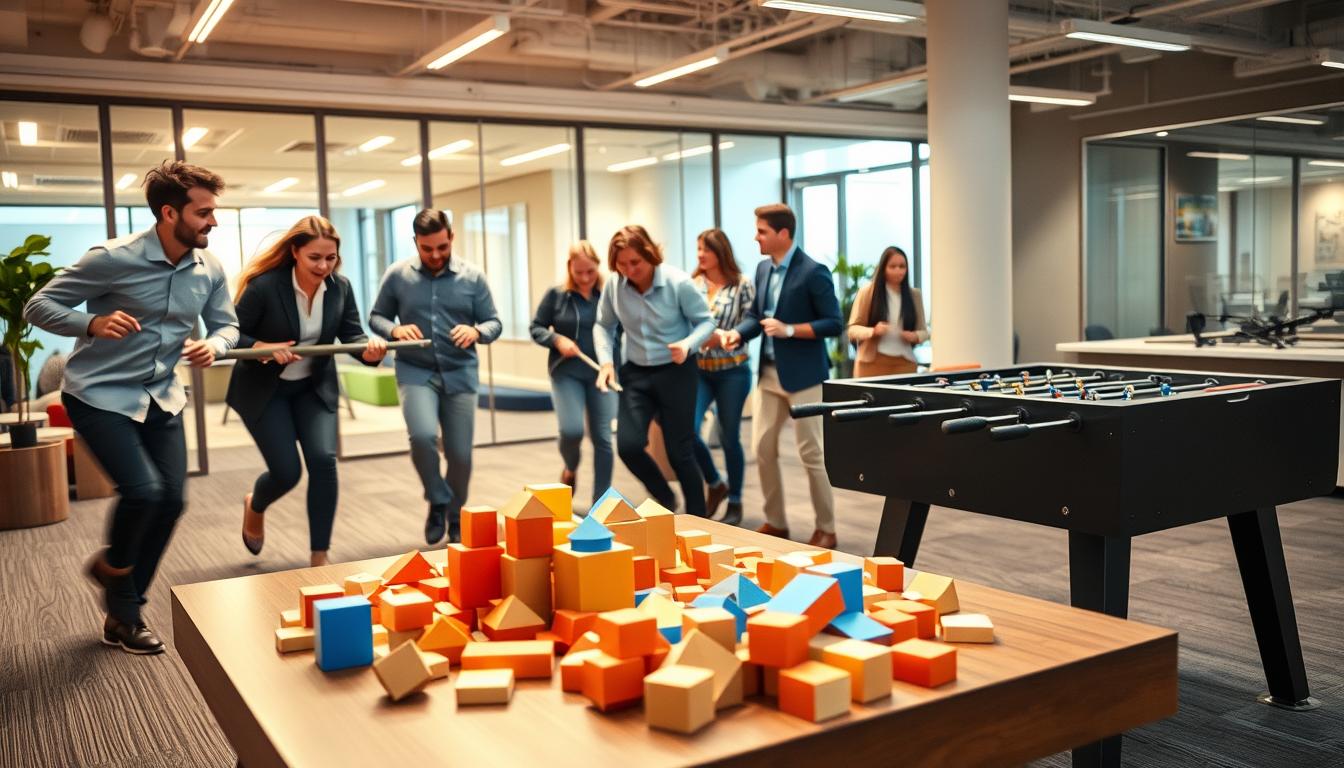
Employee disengagement costs the global economy $10 trillion in lost productivity each year, according to Gallup. Meanwhile, research published in Harvard Business Review found that face-to-face interaction accounts for 35% of the variation in team performance. The takeaway is clear: getting people together in a shared, high-energy experience directly improves how they work afterward.
That is exactly why HR coordinators and office managers are moving past the old standbys (think: a trivia slide deck projected onto a conference room wall) and looking for something that actually gets a room of 50, 100, or 200 people on their feet at the same time. A live office game show team activity fills that gap with professional hosting, real broadcast-style production, and a format designed for large groups from the first minute.
But finding the right provider is harder than it sounds. Most “team building” options fall into two camps: expensive retreat programs that eat an entire day, or bare-bones DIY kits that dump all the work on whoever drew the short straw in the office. Neither solves the real problem. You need something that keeps a mixed group engaged (introverts, new hires, executives, remote staff dialing in), requires zero prep on your end, and actually fits inside a 60- to 90-minute window at a holiday party or all-hands meeting.
The Challenges of Planning a Team Activity That Actually Works
Office managers and event coordinators face a familiar set of obstacles every time a team event lands on the calendar.
- Group size mismatch. Most activities cap at 10 to 20 participants. When your headcount is 80 or 150, you end up splitting people into awkward rotations or leaving half the room watching.
- Prep burden falls on staff. DIY trivia nights, scavenger hunts, and escape-room kits all require someone on your team to build questions, test equipment, and host the event. That person has a real job to do.
- Low energy, low participation. Without a trained host and production elements (sound, visuals, buzzers), events stall. Quiet rooms lead to phone-scrolling, not bonding.
- One-size-fits-all formats. A new-hire orientation has different energy than a holiday party. Most vendors sell a single package and call it done.
A professionally produced live office game show team activity solves every one of these problems by design.
What a Live Hosted Game Show Actually Includes
When people hear “game show,” they picture a TV set. A live corporate game show brings that same energy into your office, banquet hall, or conference venue, but built for participation, not spectating. Here is what a full-production setup looks like:
- Professional emcee. A trained host who reads the room, keeps the pace tight, and makes sure every table or team gets airtime.
- Broadcast-quality A/V. Large LED screens or projectors, wireless buzzers or audience response devices, a sound system with walk-on music and countdown timers.
- Customizable content. Questions, categories, and rounds tailored to your company, your industry, or your event theme.
- Scalable format. Whether you have 20 people or 200+, the game runs the same way. No breakout groups, no awkward waiting.
It’s PlayTyme Game Shows is one of the few providers in the NJ, NYC, and CT corridor that brings this full production package to every event. Their team handles setup, teardown, and hosting so your staff does nothing but show up and compete.
Four Game Show Formats (and When to Book Each One)
Not every corporate event calls for the same format. The best providers offer multiple game structures, each designed for a specific type of gathering. Here are four formats that It’s PlayTyme runs regularly, matched to the events where they perform best.
Game Show Mania: The All-Purpose Crowd Favorite
A multi-round competition that blends trivia, physical challenges, and head-to-head showdowns. Teams rotate through different game styles so the energy never dips. This format works for all-hands meetings, team appreciation days, and any event where you need a single activity to hold 60 to 200 people for 60 to 90 minutes.
Feud-Style Face-Off: Perfect for Holiday Parties
Modeled after the classic survey-says format, this game puts two teams onstage while the rest of the room cheers (or heckles). The holiday party crowd loves it because the stakes feel real, the host plays up the rivalry, and everyone gets a turn. Works best for groups of 30 to 150.
Trivia Throwdown: Ideal for Orientations and Onboarding
New hires learn company history, product knowledge, and team names through competitive trivia rounds with wireless buzzers. It breaks the ice faster than any icebreaker card deck. Rounds are customized with company-specific content, so the event doubles as an engaging training session. Groups of 20 to 100 are the sweet spot.
Minute to Win It Challenges: High Energy for Sales Kickoffs
Fast, physical, loud. Participants complete timed challenges (stacking cups, bouncing balls into targets, building structures) while the room watches on the big screen. Sales teams and competitive departments respond to this format because it rewards hustle, not just knowledge. Scales from 20 to 300+ easily.
| Format | Best For | Group Size | Duration | Energy Level |
|---|---|---|---|---|
| Game Show Mania | All-hands, team appreciation | 60-200+ | 60-90 min | High |
| Feud-Style Face-Off | Holiday parties, celebrations | 30-150 | 45-75 min | Very high |
| Trivia Throwdown | Onboarding, orientations | 20-100 | 45-60 min | Moderate |
| Minute to Win It | Sales kickoffs, team outings | 20-300+ | 60-90 min | Very high |
Why a Produced Game Show Beats DIY Trivia Every Time
The gap between a DIY trivia night and a professionally hosted game show is not a matter of degree. It is a completely different experience. Here is what changes when you hand the event to a production team instead of building it yourself.
Participation rate. A trained host pulls people in. Buzzers, countdown clocks, and team scoreboards give even reluctant participants a reason to engage. DIY events rely on self-motivation, which drops sharply after round two.
Time investment. Building a trivia deck, testing the projector, cueing music, and hosting the event yourself takes 8 to 15 hours of prep. A live game show company handles everything. You send a headcount and a date; they do the rest.
Production value. Sound, lighting, screens, and a host who knows how to work a room create an event people actually talk about afterward. A PowerPoint and a laptop microphone do not.
Scalability. DIY trivia works for 10 to 20 people. Push it past 30 and you get chaos: people talking over each other, no way to track scores, half the room disengaged. A produced game show is built for 20 to 300+ from the start.
The Local Advantage: NJ, NYC, and CT Coverage
Booking a team activity from a national directory or a gig-economy platform means rolling the dice on who shows up. The host is a stranger. The equipment arrives in a rental van with no backup plan. If something breaks, you are on your own.
It’s PlayTyme operates out of New Jersey and covers the entire NJ, New York City, and Connecticut corridor. That local presence means shorter travel, faster setup, and a team that has run events in your area’s hotels, conference centers, and office buildings before. They bring their own production gear (not rented, not borrowed), and the same experienced hosts run the show every time.
For companies in the tri-state area, that consistency matters. You are not hiring a concept. You are hiring a team that has done this hundreds of times within driving distance of your venue.
What HR Coordinators and Office Managers Should Look For
If you are comparing live office game show team activity providers, here are the questions that separate a polished operation from a side hustle.
- Do they own their equipment? Rental gear fails more often, and the operator is less familiar with it. Look for a company that travels with its own screens, buzzers, and sound system.
- Is the host a trained emcee or a freelancer? The host makes or breaks the event. Ask for video of a past event, not just testimonials.
- Do they customize content? Generic trivia questions feel generic. The best providers build rounds around your company, your industry, or your event theme.
- What is their capacity range? If the company only handles groups under 30, it is not the right fit for a department-wide or company-wide event.
- Do they handle all setup and teardown? Your team should walk in, play, and walk out. Anything less shifts the burden back onto your staff.
How to Pick the Right Live Game Show for Your Next Event
Start with the event type. A holiday party calls for a different format and energy level than a new-hire orientation or a quarterly all-hands. Match the format to the goal: high-energy competition for celebrations, collaborative trivia for learning, physical challenges for teams that thrive on action.
Next, confirm the logistics. The provider should handle every piece of production: screens, sound, buzzers, hosting, scoring, and cleanup. If they ask you to supply a projector or a microphone, keep looking.
Finally, book local. A provider based in your region knows your venues, arrives with backup equipment, and builds a relationship with your company for repeat events. For organizations across New Jersey, New York City, and Connecticut, It’s PlayTyme Game Shows delivers a complete, fully produced live office game show team activity with zero prep required from your team.
Ready to stop planning and start playing? Get in touch with It’s PlayTyme to lock in your date, or explore the full lineup of corporate event formats to find the right fit for your group.
Frequently Asked Questions (FAQs)
How many people participate in a live office game show at once?
Most formats support 20 to 300+ participants playing simultaneously. Everyone competes in teams, so there is no sitting on the sidelines. The host and production setup keep the entire room engaged from start to finish.
How much setup does our team need to do?
None. The game show provider brings all equipment (screens, buzzers, sound system) and handles setup, hosting, and teardown. Your only job is to provide the venue and a headcount.
How long does a typical live game show event last?
Most events run 45 to 90 minutes depending on the format and group size. That fits inside a lunch hour, a post-meeting block, or an evening party slot. The provider works with your schedule to keep the event tight.
Are game show formats customizable for our company?
Yes. Providers like It’s PlayTyme build custom rounds using your company history, product lines, inside jokes, or industry topics. Custom content turns the game into a shared experience unique to your organization.
What types of corporate events work best for a live game show?
Holiday parties, all-hands meetings, new-hire orientations, sales kickoffs, and team appreciation events are the most common bookings. The format adapts to the tone of the event, from competitive and loud to collaborative and relaxed.
What does employee disengagement cost the global economy?
According to Gallup, employee disengagement costs the global economy $10 trillion in lost productivity each year, making engagement one of the highest-stakes priorities for any organization.
Why does in-person interaction matter more than remote alternatives for team performance?
Research published in Harvard Business Review found that face-to-face interaction accounts for 35% of the variation in team performance, which is why a shared, in-person experience produces results that remote formats cannot replicate.