Only 20% of employees worldwide are actively engaged at work, according to Gallup’s 2026 State of the Global Workplace report. Meanwhile, MIT research published in Harvard Business Review found that communication patterns alone account for 35% of the variation in a team’s performance. The takeaway is clear: teams that interact more, perform better.
One of the fastest ways to spark that interaction is a majority rules game for team building. The format is simple, inclusive, and surprisingly revealing. Every player answers a question, then the group discovers whether their answer matched the majority. No trivia knowledge required. No athletic ability needed. Just opinions, predictions, and plenty of laughs.
But here’s what most corporate planners run into: organizing a team building event that actually gets people talking is harder than it sounds. Passive activities fall flat. Overly competitive formats alienate quieter team members. Generic icebreakers feel forced. And planning the logistics (questions, scoring, facilitation, tech) on top of your regular workload eats hours you don’t have. That’s exactly where the majority rules format stands out, and where a professional host makes the difference.
Want to play Majority Rules at your next event? We host it live with a pro host and team scoring for 20 to 300+ people across NJ, NYC and CT.
What Is the Majority Rules Game?
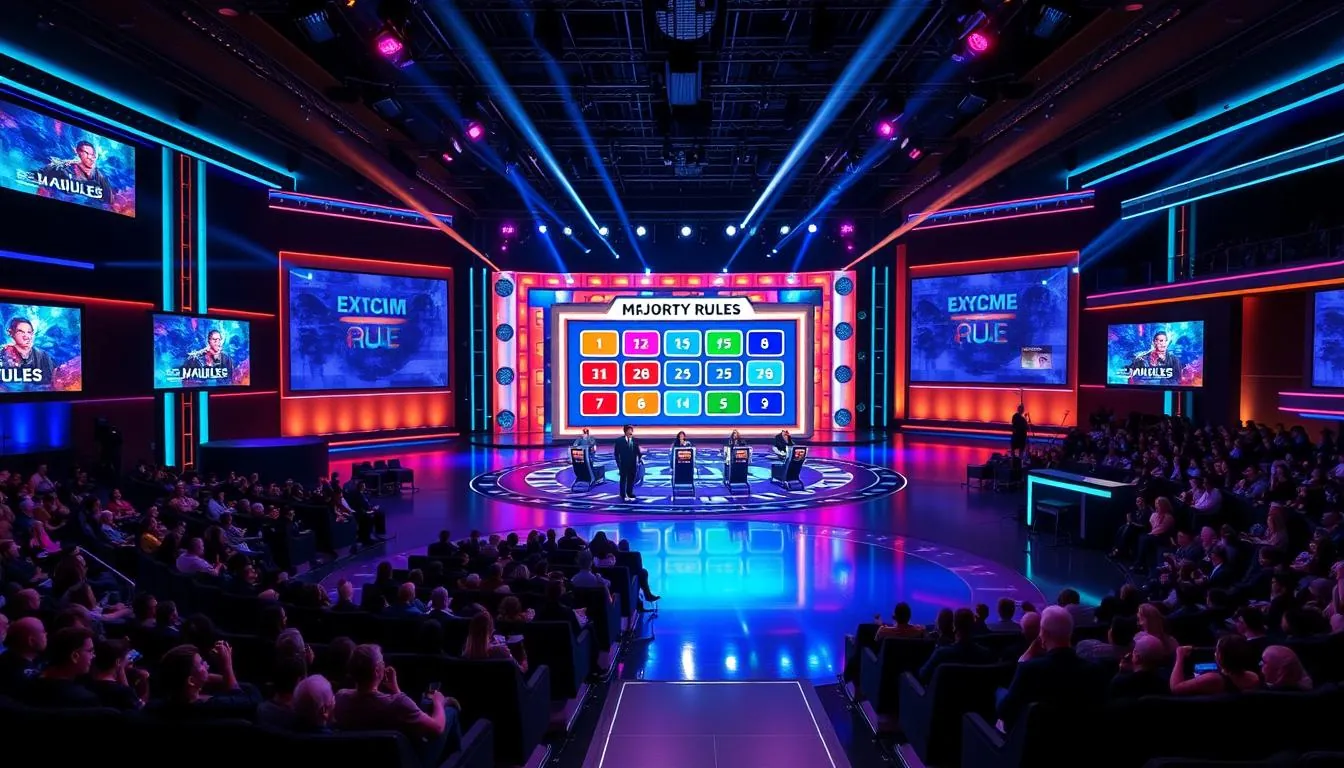
Majority Rules is a group opinion game where every participant answers the same question at the same time. After all answers are locked in, the majority answer is revealed. Players who matched the majority earn a point. Players who didn’t match get nothing for that round. After a set number of rounds, the player (or team) with the most points wins.
The concept borrows from classic TV game shows and survey-style party games, but it works exceptionally well in a corporate setting because:
- There are no “right” or “wrong” answers, only popular and unpopular ones
- Every person participates every round (no sitting on the sidelines)
- It rewards social awareness and group thinking rather than obscure knowledge
- Questions are fully customizable to your industry, company culture, or event theme
Why Majority Rules Works for Corporate Team Building
Most team building games fall into two traps: they either require specialized skills (trivia buffs dominate) or they create winners and losers too quickly (half the room disengages). A majority rules game for team building avoids both problems.
Everyone Has an Equal Voice
The new hire and the VP answer the same question with the same odds. There is no advantage to seniority, tenure, or job title. This flattens hierarchies for the duration of the game and encourages authentic participation.
It Reveals Group Dynamics
When the majority answer is revealed, the conversation starts naturally. “Wait, you all picked pizza over tacos?” These micro-debates are the exact kind of organic interaction that builds rapport between coworkers who normally only communicate through email.
Adaptable to Any Group Size
Whether your team has 15 people or 500, the format scales. Small groups play individually. Larger groups split into teams. The core mechanic stays the same.
Where DIY Team Building Games Consistently Fall Apart
Running a majority rules game sounds straightforward on paper. In practice, corporate planners consistently hit the same walls:
- Question quality: Generic questions (“cats or dogs?”) bore adults within three rounds. Writing 40 to 50 engaging, work-appropriate questions takes real creative effort.
- Facilitation energy: A game like this lives or dies on the host. Reading questions off a laptop in a monotone voice kills the momentum before round five.
- Scoring and technology: Tracking answers from 50+ participants in real time requires a reliable system. Paper ballots create chaos. Free polling apps glitch. Audience response systems need setup time and tech support.
- Time management: Corporate events run on tight schedules. Without an experienced facilitator, games drag on or end abruptly.
- Inclusion concerns: Questions that seem harmless to one group feel awkward or exclusionary to another. Vetting content for a diverse workforce requires thoughtfulness.
These are solvable problems, but solving them yourself adds hours of prep to an already full plate. That’s why many companies turn to professional game show hosts.
How to Play Majority Rules: Complete Rules and Setup
Here is a step-by-step breakdown you can use for your own event or share with a professional facilitator like It’s PlayTyme Game Shows.
What You Need
- A host or facilitator
- A list of 30 to 50 questions (multiple choice or open-ended)
- A way for participants to submit answers (response cards, an app, or an audience response system)
- A scoring system (whiteboard, spreadsheet, or digital leaderboard)
- A screen or projector to display questions and results
Basic Rules
- Display the question. The host reads a question aloud and displays it on screen. All questions are opinion-based or prediction-based, not fact-based.
- Lock in answers. Every player submits their answer within a set time limit (typically 15 to 30 seconds). Answers are hidden until the deadline.
- Reveal the majority. The host reveals which answer the majority of players selected.
- Award points. Every player whose answer matches the majority earns one point. Players in the minority earn zero.
- Repeat. Continue for 20 to 40 rounds, depending on time available.
- Crown the winner. The player or team with the most points at the end wins.
Optional Variations
- Team mode: Divide players into teams of 4 to 8. Each team discusses briefly and submits one consensus answer.
- Speed rounds: Cut the answer window to 10 seconds for bonus rounds.
- Double-point rounds: Announce certain rounds as worth double points to spike energy late in the game.
- Elimination format: Players in the minority are eliminated each round until one remains.
50+ Work-Appropriate Majority Rules Questions by Category
The questions make or break the game. Below are 55 ready-to-use questions organized into categories. Mix and match based on your audience.
Workplace Culture (10 Questions)
- Which is worse: a meeting that should have been an email, or an email that should have been a meeting?
- Would you rather have a four-day workweek or work from home every day?
- Is it acceptable to eat lunch at your desk?
- Office temperature: too cold or too hot?
- Do you read every company-wide email, or skim and archive?
- Monday morning or Friday afternoon: which drags more?
- Would you rather give a presentation to 200 people or write a 20-page report?
- Is “reply all” ever acceptable?
- Standing desk or sitting desk?
- Do you actually use your company swag, or does it sit in a drawer?
Food & Drink (10 Questions)
- Coffee or tea to start the workday?
- Pizza for a team lunch: New York style or deep dish?
- Is pineapple on pizza acceptable at a work event?
- Would you rather have free snacks in the office or a catered lunch once a week?
- Breakfast for dinner: great idea or strange?
- Sweet snacks or salty snacks at your desk?
- Is it rude to microwave fish in the office kitchen?
- Water bottle or coffee mug: which is always on your desk?
- Would you rather cook for your team or order catering?
- Do you eat the same lunch every day, or do you mix it up?
Pop Culture & Entertainment (10 Questions)
- Would you rather have the power of flight or invisibility?
- Are you watching a show right now, or are you between shows?
- Movies in theaters or streaming at home?
- Morning person or night owl?
- Would you rather meet your favorite celebrity or get $10,000?
- Do you listen to music while you work, or do you need silence?
- Board games or video games for a team outing?
- Would you rather live in a movie universe or a book universe?
- Podcasts or audiobooks during your commute?
- Is karaoke fun, or is it a nightmare?
Hypothetical & “Would You Rather” (10 Questions)
- Would you rather always be 10 minutes early or always be exactly on time?
- If you could add one rule to the office, would it involve snacks or naps?
- Would you rather have a personal assistant or a personal chef?
- Would you rather know every language or play every instrument?
- If your team had a mascot, should it be an animal or a fictional character?
- Would you rather never attend another meeting or never write another email?
- Time travel to the past or the future?
- Would you rather work a job you love for average pay or a boring job for double the salary?
- If you could swap jobs with anyone in this room for a day, would you do it?
- Would you rather have unlimited vacation days or a 20% raise?
Team & Company Predictions (10 Questions)
- What percentage of this room prefers working from home? Over or under 60%?
- Who has been at the company longer: the person on your left or your right?
- Do most people on this team prefer texting or calling?
- Will someone in this room be wearing sneakers? Yes or no?
- Does the majority of this group prefer summer or winter vacations?
- Will the next company event be indoors or outdoors?
- How many people in this room have a side project outside of work? Over or under 40%?
- Would the majority of this team choose a bonus or an extra week off?
- Is the average commute in this room over or under 30 minutes?
- Does this group prefer collaboration or independent work?
Rapid Fire Picks (5 Bonus Questions)
- Cats or dogs?
- Beach or mountains?
- Early bird or night owl?
- Call or text?
- Window seat or aisle seat?
Skip the DIY setup. Our host runs every Majority Rules round, so your whole team gets to play.
Customizing Majority Rules for Different Corporate Group Sizes
The format adapts easily, but each group size benefits from specific adjustments.
| Group Size | Format | Rounds | Answer Method | Best Setting |
|---|---|---|---|---|
| 10 to 25 | Individual play | 25 to 30 | Response cards or hand raise | Conference room |
| 25 to 75 | Teams of 5 to 8 | 20 to 30 | Audience response system | Large meeting space |
| 75 to 200 | Teams of 8 to 12 | 15 to 25 | Wireless keypads | Ballroom or auditorium |
| 200+ | Teams of 10 to 15 | 15 to 20 | Wireless keypads with projector | Event venue or theater |
Tips for Small Groups (Under 30)
Individual play keeps energy high. Use a whiteboard for scoring and encourage verbal debate after each reveal. The host should call on specific people to explain their answers. Thirty rounds in 45 minutes is a solid pace.
Tips for Large Groups (75+)
Team play prevents logistical chaos. Assign team names, use wireless audience response systems for instant tallying, and display a live leaderboard on screen. A professional host becomes essential at this size because managing the energy and pacing of 100+ participants is a performance skill, not just a facilitation task.
Why It’s PlayTyme Game Shows Delivers the Best Majority Rules Events
It’s PlayTyme Game Shows has run hundreds of corporate game show events across New Jersey, New York City, and Connecticut. Their majority rules game for team building format comes with everything a corporate planner needs and nothing they don’t.
Professional Hosts Who Read the Room
It’s PlayTyme’s hosts are trained entertainers, not volunteers reading off a script. They adjust pacing, riff on audience reactions, and keep the energy building from round one through the final reveal. That hosting quality is the single biggest factor that separates a memorable event from a forgettable one.
Full Production Setup
Every event includes professional-grade audio, video displays, wireless audience response systems, and a digital scoring platform. The technology runs reliably so you never lose momentum to a tech glitch.
Customized Question Packages
Before your event, the It’s PlayTyme team works with you to build a custom question set tailored to your company, industry, and audience. Want to include inside jokes about your CEO’s fantasy football record? Done. Need every question vetted for a conservative corporate culture? Handled.
Flexible Formats for Any Agenda
Whether you need a 30-minute energizer between conference sessions or a 90-minute standalone team building program, the majority rules format fits your schedule. It’s PlayTyme structures the game to match your time slot, not the other way around.
How to Decide If Majority Rules Fits Your Next Team Event
Not every team building activity works for every group. Here is a quick framework to determine if a majority rules game for team building is the right call for your upcoming event.
Choose Majority Rules if:
- Your group includes people from different departments who don’t normally interact
- You want full participation from every attendee, not just the outgoing personalities
- Your audience ranges widely in age, tenure, or job function
- You need an activity that works in a conference room, ballroom, or virtual setting
- You want something that generates genuine laughter without embarrassing anyone
Consider a different format if:
- Your primary goal is skills training or problem-solving (a workshop format serves that better)
- Your group is under 8 people (an intimate dinner or escape room works better at that size)
For most corporate teams between 15 and 500 people, a majority rules game hits the sweet spot of high engagement, low barrier to entry, and genuine fun. It’s the kind of event people actually talk about at their desks the next morning.
Ready to book a majority rules game for your next corporate event? It’s PlayTyme Game Shows handles every detail, from custom questions to full AV production, so you focus on your team while they focus on the show. Get in touch today to lock in your date.
Solve the participation problem
Ready to get the whole room in the game?
Frequently Asked Questions (FAQs)
How long does a majority rules game for team building typically last?
Most corporate majority rules sessions run between 30 and 90 minutes depending on group size and event schedule. A 45-minute session with 25 to 30 rounds is the most common format. It’s PlayTyme Game Shows structures the game to fit your specific time slot.
Do participants need any special equipment or apps to play?
No. Professional providers like It’s PlayTyme supply wireless audience response keypads that require zero downloads or phone use. For smaller groups, simple response cards work just as well. Participants show up and play.
Is the majority rules game appropriate for remote or hybrid teams?
Yes. The format translates well to virtual and hybrid settings using video conferencing and digital polling tools. It’s PlayTyme can add a hybrid option on request, so remote colleagues join the live, in-person show.
What group size works best for a majority rules team building game?
The game works for groups as small as 20 and scales to 300+. Groups of 30 to 150 tend to produce the most energetic sessions. Larger groups play in teams, which adds a layer of collaboration and strategy to each round.
How are the questions customized for corporate events?
A professional host works with your planning team before the event to build questions around your company culture, industry, and audience. Questions are vetted for appropriateness and tailored to spark conversations relevant to your specific group.
Why does the majority rules format work for employees who dislike trivia or competitive activities?
The majority rules game requires no trivia knowledge and no athletic ability. Every participant simply shares an opinion or prediction, then finds out whether their answer matched the group majority. That low barrier to entry makes it inclusive for employees who typically opt out of competitive team building formats.