

Most corporate teams and adult friend groups share a common problem: gatherings that feel forced, awkward, or forgettable. According to Gallup’s State of the Global Workplace report, only 33% of U.S. employees are actively engaged at work. Meanwhile, SHRM research shows that employee experience and engagement together explain 54% of overall job satisfaction. Translation: the quality of shared experiences at work directly shapes how people feel about showing up every day.
Minute to win it games for adults solve this problem with ridiculous simplicity. Each challenge lasts 60 seconds, requires nothing more than household items, and generates the kind of genuine, unscripted laughter that no icebreaker survey ever will. Adults bring something kids simply do not: competitiveness, self-awareness, and the willingness to look absolutely foolish in front of coworkers for the sake of winning.
But planning these games yourself presents real friction. Picking the right challenges for your group size, keeping energy high between rounds, sourcing props, running a visible countdown timer, and making sure wallflowers actually participate are all problems that quietly sabotage DIY game nights. Below you will find 12 adult-tested minute to win it challenges with complete rules and group size guidance, plus the case for handing the whole thing to a professional host.
At a Glance
- Each challenge lasts 60 seconds and uses only household items, with no special equipment required.
- Genuine unscripted laughter builds team connection more effectively than any icebreaker survey.
- Adult competitiveness and self-awareness make these games more engaging than kid-friendly versions.
- Only 33% of U.S. employees are actively engaged, and shared experiences directly raise that number.
- SHRM research shows employee experience and engagement together explain 54% of overall job satisfaction.
Why Minute to Win It Games Hit Different for Adults
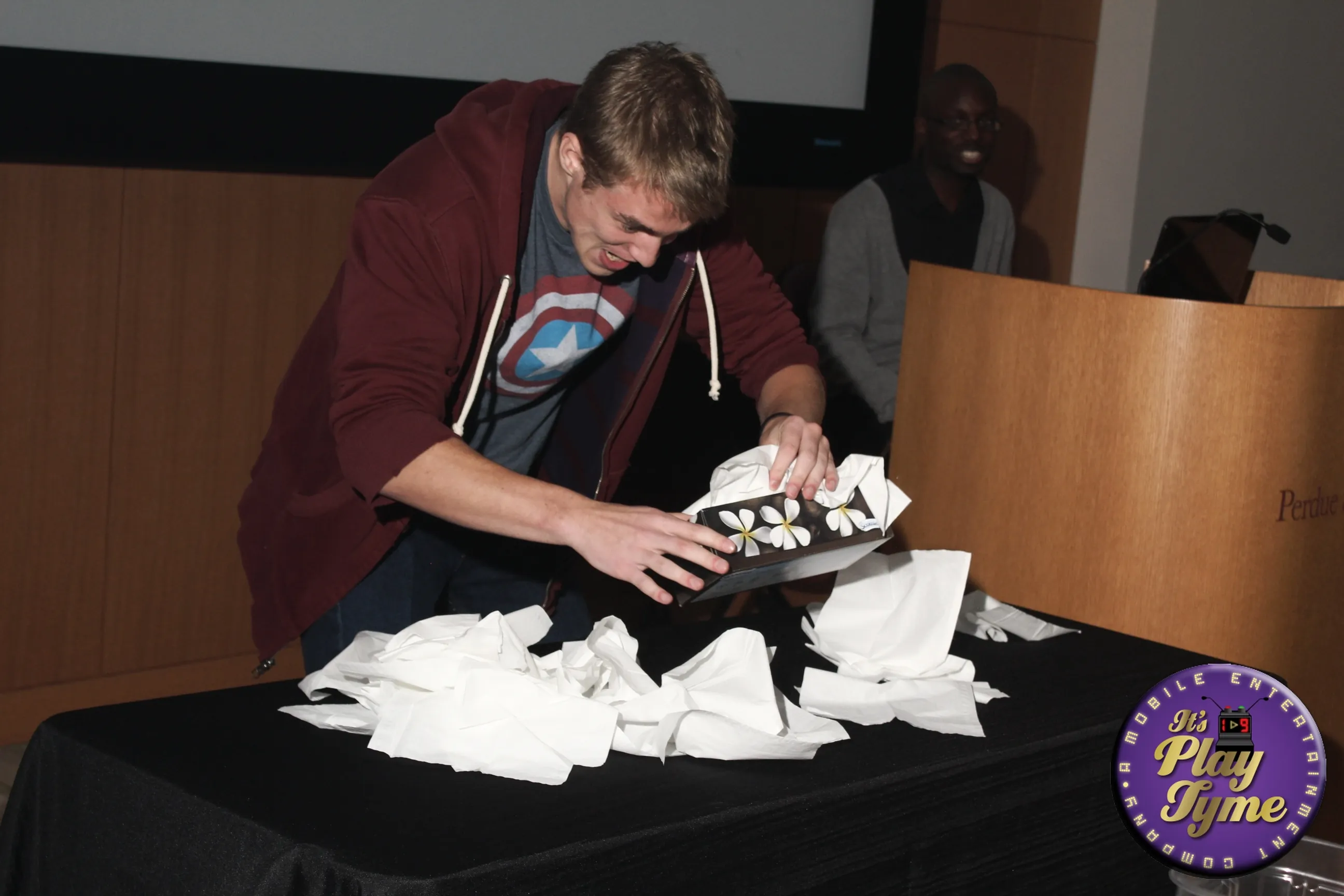
The original NBC game show worked because it combined physical comedy with a ticking clock. Adults amplify both elements. A 10-year-old shaking ping pong balls out of a tissue box is cute. A VP of sales doing the same thing at a company retreat while 60 coworkers chant the countdown is comedy gold.
Adults also bring strategic thinking to games designed to be chaotic. They negotiate, trash-talk, form alliances, and replay losses in their heads for weeks. That competitive edge turns a simple 60-second challenge into a memorable event. And because the games require zero athletic ability or special knowledge, everyone from the new hire to the CEO competes on equal footing.
For corporate groups specifically, minute to win it games for adults break down hierarchy faster than any trust fall ever could. When your manager is trying to balance six dice on a popsicle stick held in their mouth, titles stop mattering.
Challenges of Running DIY Minute to Win It Events
Knowing the games is only half the battle. Executing them smoothly for a group of adults is where most DIY attempts fall apart.
- Dead air between rounds: Without a host driving momentum, the gap between challenges kills the energy. Adults lose interest fast when they are standing around waiting for someone to find the next set of props.
- Wallflower syndrome: In any group of 20 or more, at least a quarter of people will avoid volunteering. A skilled host reads the room and pulls people in without putting them on the spot.
- Prop logistics: Twelve games means dozens of items (cups, cookies, balloons, tissue boxes, ping pong balls, straws, cotton balls, rubber bands). Sourcing, organizing, and resetting props between rounds is a full-time job during the event.
- Scoring and structure: Without a visible scoreboard, tournament bracket, or clear rules explanation, the games feel disorganized. Adults notice disorganization and disengage.
- No hype factor: Music, a countdown clock on a big screen, and play-by-play commentary transform a game from “okay, that was fun” to “that was the best team event we have ever done.”
This is exactly why companies like It’s PlayTyme Game Shows exist. Their 60 Seconds of Fame format packages all of this (professional host, props, sound system, countdown screen, scoring) into a turnkey event for groups across New Jersey, New York City, and Connecticut.
Solo Showdown Challenges
These games put one person in the spotlight while the rest of the group watches and cheers. They work best as openers or finals because the audience energy fuels the competitor.
1. Cookie Face
Rules: Place a sandwich cookie on your forehead. Using only your facial muscles (no hands), move the cookie down to your mouth and eat it within 60 seconds.
Group size: Any size. Run 2 to 4 competitors simultaneously for bigger groups.
Why it is funnier for adults: Adults have less flexible faces and more pride. Watching a grown professional contort their eyebrows, scrunch their nose, and wiggle their cheeks while a cookie slowly slides off their face is peak physical comedy. The combination of concentration and absurdity gets louder laughs from adult audiences every single time.
2. Junk in the Trunk
Rules: Strap an empty tissue box to your waist (opening facing backward) filled with 8 ping pong balls. Shake, shimmy, and dance until all 8 balls fall out. No hands allowed.
Group size: Works for any group. Best as a head-to-head race with 2 to 3 people competing at once.
Why it is funnier for adults: There is no dignified way to do this game. Adults who normally maintain a composed, professional presence are suddenly doing full-body hip thrusts in front of their colleagues. The self-awareness makes it exponentially funnier than when kids play it, because adults know exactly how ridiculous they look.
3. Bobblehead
Rules: Attach a pedometer or fitness tracker to your forehead with a headband. Hit 125 “steps” (head nods) in 60 seconds by shaking your head up and down as fast as possible.
Group size: 1 to 4 competitors at a time. Great for elimination rounds.
Why it is funnier for adults: Adults immediately regret volunteering for this one. The neck soreness, the dizziness, and the undignified head-bobbing create a spectacle that has the audience crying with laughter. Post-game complaints about “feeling that tomorrow” add to the comedy.
Head-to-Head Battle Games
These challenges pit two competitors directly against each other. The face-off format builds rivalries and gives the audience someone to root for.
4. Stack Attack
Rules: Stack 36 plastic cups into a perfect pyramid, then collapse them back into a single stack. First person to finish wins. If the pyramid falls mid-build, start over.
Group size: 2 competitors per round. Run a bracket tournament for groups of 16 or more.
Why it is funnier for adults: Adults overthink it. They develop “strategies,” try to go too fast, and watch their pyramid collapse three seconds before the buzzer. The frustration on an adult’s face after a mid-build collapse is something a kid would never produce with the same intensity.
5. Suck It Up
Rules: Transfer 20 M&M candies from one plate to another using only a drinking straw. Suck on the straw to pick up one M&M at a time, carry it to the second plate, and release. Most transferred in 60 seconds wins.
Group size: 2 to 4 competitors simultaneously. Great for groups of 10 to 50.
Why it is funnier for adults: The concentration required turns grown adults into wide-eyed, cheek-sucking statues. When an M&M drops at the last second, adults react with genuine anguish that kids simply do not feel. The stakes feel absurdly high for a candy-transfer game, which is exactly the point.
6. Rapid Fire
Rules: Set up 6 plastic cups on the edge of a table. Using rubber bands stretched and released from your fingers, knock all 6 cups off the table in 60 seconds. Competitors stand 6 feet away.
Group size: 2 competitors side by side. Works well in tournament format for larger groups.
Why it is funnier for adults: Adults who claim to be coordinated discover they cannot aim a rubber band to save their life. The misses (hitting the ceiling, the audience, themselves) generate bigger laughs than the successful shots. Overconfident competitors who talk trash before missing every shot become instant legends.
Team Relay Challenges
Relay-style games get entire tables or departments involved. They build the strongest team bonds because success depends on every member.
7. Dizzy Mummy
Rules: In pairs, one person stands still while their partner wraps them head to toe in a full roll of toilet paper. The paper must cover the torso, arms, and legs. First team to use the entire roll without it breaking wins.
Group size: 4 to 10 pairs competing at once. Scales to groups of 100 or more.
Why it is funnier for adults: Adults are taller, wider, and far less cooperative as “mummies.” The toilet paper tears constantly, wrapping gets tangled, and the finished product looks nothing like a mummy. Coworkers wrapping each other in toilet paper is inherently funnier than kids doing it because of the professional context.
8. Defying Gravity
Rules: Keep 3 inflated balloons in the air for a full 60 seconds. No grabbing, holding, or trapping allowed. Only open-hand taps. If any balloon touches the ground, you are out.
Group size: Run as a team relay where each member keeps the balloons up for 15 seconds before tagging the next person. Works for groups of 8 to 60.
Why it is funnier for adults: Adults in business casual diving across a conference room to save a falling balloon is a visual that never gets old. The panic, the collisions with furniture, and the absolute refusal to lose at something so simple create moments people talk about for months.
9. Chandelier
Rules: As a team of 3, stack plastic cups and paper plates in alternating layers to build the tallest tower in 60 seconds. The structure must stand on its own for 3 seconds after hands are removed.
Group size: Teams of 3, with 4 to 8 teams competing at once. Best for groups of 12 to 40.
Why it is funnier for adults: Adults argue about engineering. Someone always insists they know the “optimal stacking pattern,” overrides their teammates, and watches the tower collapse. The group dynamics (leadership struggles, blame-shifting, triumphant celebrations) mirror office politics in miniature, which makes the whole room laugh.
Crowd Favorite Spectacle Games
These are the games people film on their phones and post to group chats. Save them for the middle or end of your event when the energy is highest.
10. Nose Dive
Rules: Apply a dab of petroleum jelly to your nose. Transfer cotton balls from one bowl to another using only your nose. Hands stay behind your back. Most cotton balls moved in 60 seconds wins.
Group size: 2 to 4 competitors at a time. The audience factor makes this best for groups of 15 or more.
Why it is funnier for adults: Watching a grown adult bob their face into a bowl of cotton balls while coworkers scream encouragement is the kind of moment that defines a great event. The petroleum jelly on the nose, the cotton balls stuck to cheeks and foreheads, and the sheer determination on adult faces make this a guaranteed highlight.
11. Movin’ On Up
Rules: Start with a stack of 10 cups (bottom cup is a different color). Move the bottom cup to the top, one at a time, cycling through the stack until the colored cup returns to the bottom. Complete the full rotation in 60 seconds.
Group size: 2 to 6 competitors simultaneously. Good for any group size.
Why it is funnier for adults: This game looks deceptively simple. Adults who volunteer confidently discover that speed and dexterity do not scale together. Cups fly off the table, stacks topple, and the colored cup seems to never reach the bottom. The gap between expected ease and actual difficulty is much wider for adults, who assume they should be good at this.
12. Tissue Box Tango
Rules: Two players are tied together back-to-back, each wearing a tissue box on their waist filled with 10 ping pong balls. Working together (moving in sync), both players must empty their boxes in 60 seconds. Communication and coordination are everything.
Group size: 2 to 4 pairs competing at once. Best for groups of 20 or more where the audience creates atmosphere.
Why it is funnier for adults: The back-to-back format forces two adults to coordinate hip movements while shouting instructions at each other. Miscommunication, stepping on feet, and wildly different dance styles turn this into a comedy sketch. In a corporate setting, pairing people from different departments adds another layer of hilarity.
| Game Category | Best For | Group Size | Energy Level | Setup Difficulty |
|---|---|---|---|---|
| Solo Showdown (Cookie Face, Junk in the Trunk, Bobblehead) | Openers, finals, shy groups | Any size | High | Easy |
| Head-to-Head (Stack Attack, Suck It Up, Rapid Fire) | Competitive groups, tournaments | 10 to 50 | Very high | Moderate |
| Team Relay (Dizzy Mummy, Defying Gravity, Chandelier) | Department bonding, large groups | 12 to 100+ | High | Moderate |
| Crowd Spectacle (Nose Dive, Movin’ On Up, Tissue Box Tango) | Peak moments, social media clips | 15 to 100+ | Maximum | Moderate |
How to Structure a Full Minute to Win It Tournament
Running 12 games back-to-back without structure creates chaos. Here is a proven format that keeps adults engaged for 60 to 90 minutes:
- Round 1 (warm-up): Start with 2 solo showdown games to break the ice and set the tone. Pick Cookie Face and Bobblehead because they are visually funny and low-pressure.
- Round 2 (competition): Move into 3 head-to-head battles. Run Stack Attack as a bracket tournament if time allows. This is where competitive energy peaks.
- Round 3 (team bonding): Shift to team relays. Dizzy Mummy and Defying Gravity work best here because they require coordination and get every person involved.
- Round 4 (finale): Close with 2 crowd spectacle games. Nose Dive and Tissue Box Tango produce the biggest audience reactions and end the event on a high note.
Between rounds, a professional host keeps score on a visible leaderboard, plays walk-up music, and interviews competitors. This is the difference between a fun hour and an unforgettable event. It’s PlayTyme’s corporate game show format follows exactly this kind of structure, with a trained host who reads the room, adjusts pacing, and makes sure every person in the group participates.
How to Decide Between DIY and Hiring a Professional Host
If your group is under 15 people and you have someone naturally outgoing who is willing to run the show, DIY works. Grab the props, set a timer on your phone, and have at it. The games themselves are simple enough that anyone with a list of rules and 30 minutes of prep time produces a good experience.
For groups of 20 or more, a professional host changes everything. The energy, pacing, crowd management, and production value (sound system, countdown screen, scoreboard) turn a good activity into the highlight of your corporate calendar. Adults respond to production quality. A visible timer on a big screen with music building to the buzzer creates tension and excitement that a phone timer never will.
It’s PlayTyme Game Shows specializes in exactly this format for corporate teams, holiday parties, sales kickoffs, and team outings throughout New Jersey, NYC, and Connecticut. Their hosts arrive with every prop, run the entire event, and handle all the logistics so your only job is to show up and compete. Get in touch to book a minute to win it event your team will actually remember.
Frequently Asked Questions (FAQs)
How many minute to win it games should I plan for a one-hour event?
Plan 8 to 10 games for a one-hour event, assuming each game takes about 4 to 5 minutes including setup, explanation, and play. If you are running tournament brackets or team relays, reduce that to 6 to 8 games because multiple rounds per game add time. Always have 2 extra games prepared in case some run shorter than expected.
What supplies do I need for minute to win it games for adults?
The most common supplies are plastic cups, ping pong balls, empty tissue boxes, balloons, sandwich cookies, drinking straws, rubber bands, cotton balls, petroleum jelly, toilet paper rolls, and paper plates. A full 12-game event costs under $40 in supplies from any dollar store. You also need a visible timer (phone, laptop, or projector) and a way to keep score.
Do minute to win it games work for large corporate groups of 50 or more?
Yes, but format matters. For groups over 50, assign teams by table or department and run relay-style or representative challenges where each team sends a champion. A professional host is strongly recommended for groups this size because crowd management, scoring, and pacing require dedicated attention that a volunteer organizer struggles to provide while also participating.
Are minute to win it games appropriate for formal corporate events?
They work best at semi-casual to casual events: team building days, holiday parties, sales kickoffs, retreats, and offsite meetings. For black-tie galas or board meetings, they are not the right fit. The sweet spot is any event where leadership wants people to relax, connect, and have genuine fun together. The games are physical but not athletic, so dress code is rarely an issue beyond suggesting participants skip high heels.
What is the ideal group size for minute to win it games for adults?
The sweet spot is 20 to 60 people. Groups smaller than 10 lack the audience energy that makes the games funny. Groups larger than 80 need a professional host, a sound system, and a structured tournament format to keep everyone engaged. Between 20 and 60, you get enough competitors for variety, a loud enough crowd for atmosphere, and manageable logistics for props and scoring.