

Quick answer: Choose a motivational speaker when older students need one serious message delivered well. Choose an interactive game-show assembly when you need every grade involved, because participation is what holds a full gym. The deciding factor is simple: how many students actually take part, not how many attend.
Hundreds of students fill the gym, and half the room checks out inside ten minutes. A microphone alone never holds that crowd.
So the real question is participation. Do you want students listening to one person, or playing alongside each other? That single decision shapes how the whole school remembers the day, and it is the part a department head or principal has to answer before any budget gets approved.
Speakers work for older students who will sit through a long personal story. Interactive assemblies reach every grade because the students become the show. Competition, teamwork, and direct involvement hold attention from the first minute to the last.
| Assembly Format | Participation Level | Best Grade Fit | Classroom Follow-Up |
|---|---|---|---|
| Interactive Game Show (It’s Playtyme Game Shows) | High: the whole room plays | K-12 | High: a shared experience to build on |
| Traditional Motivational Guest Speaker | Low: the audience listens | Middle and high school | Moderate: discussion prompts |
| Magic or Stunt Show | Moderate: stage volunteers only | Elementary | Low: spectacle only |
| Educational Theater Troupe | Low: the audience watches | Elementary to middle | High: study guides and SEL tie-ins |
The Logistics of Keeping a Whole School Focused
Booking one program for a kindergartener and a fifth grader at the same time is hard. Attention spans differ, maturity levels differ, and a loud gymnasium swallows sound. Passive formats lose the room the moment the novelty wears off.
The default move is hiring someone to talk at students for an hour. The front rows listen. Everyone else drifts, teachers spend the event policing behavior instead of enjoying it with their classes, and an unproven presenter who fails to connect with a digitally native audience costs you both the budget and the period. Neither one comes back.
Approval is the other hurdle. Plenty of schools now have to show that an assembly supports PBIS reward criteria or an SEL goal before the spend clears. A passive format hands you a receipt and a thank-you note. An active format produces teamwork, turn-taking, and positive reinforcement that staff can observe in the room and describe afterward.
Sensory load matters too. A packed, loud gym is rough on students who are sensitive to noise and crowds, and a one-way format leaves them nothing to do but absorb it. A hosted program gives every student a team, a role, and a reason to be there, and the host controls volume and pacing throughout.
A strong format commands the room without constant shushing. The message lands, the staff relaxes, and students walk out with a shared memory instead of a lost period. Start by asking how many students actually get involved.
1. Interactive Game-Show Assemblies (It’s Playtyme Game Shows)
In 14 years of hosting live game shows, It’s Playtyme Game Shows has run professionally hosted programs for large groups across New Jersey, New York City, New York State, and Connecticut. Great events are not measured by how many students attend. They are measured by how many take part.
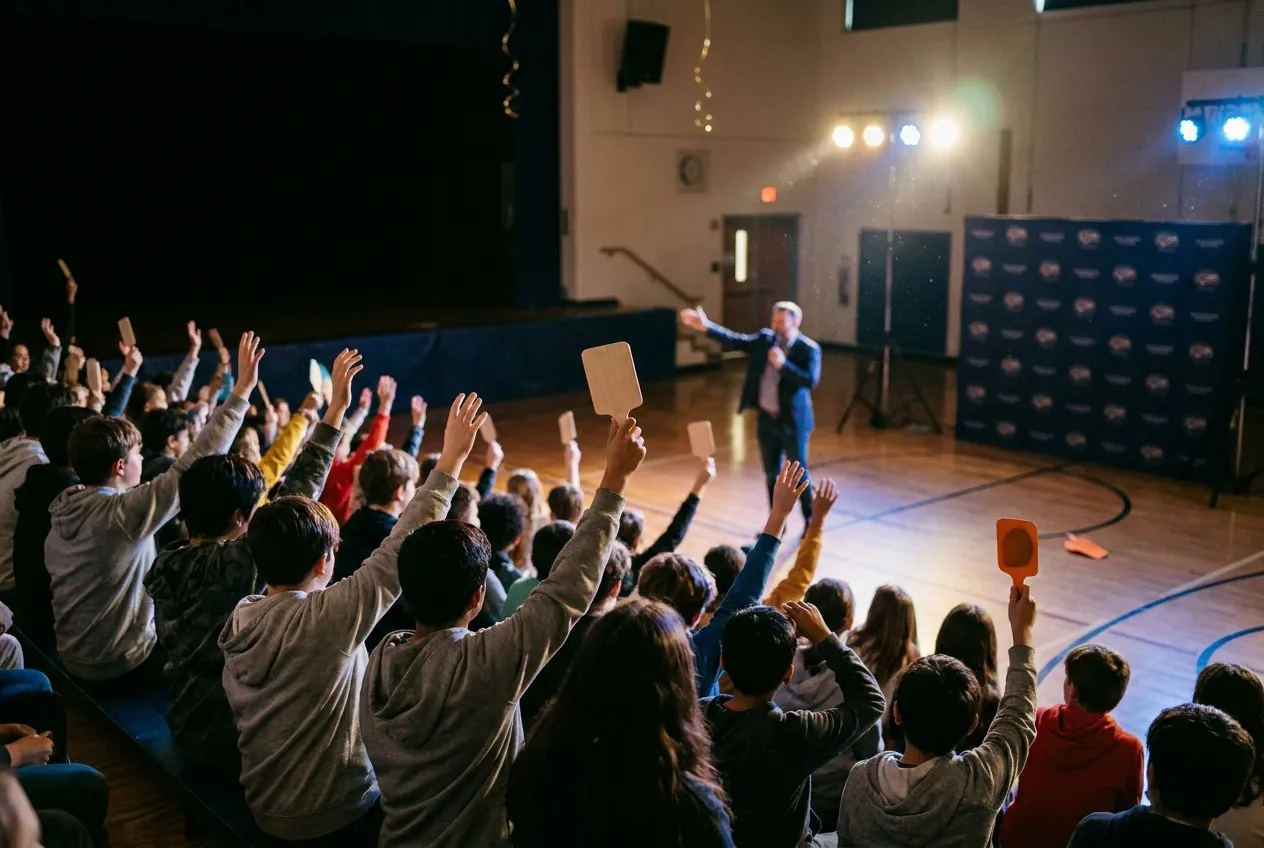
Whether the day carries an anti-bullying message or runs as a straight reward assembly, the host puts real students on stage and works the entire crowd. The game show is the method, not the point: the point is a whole school competing, laughing, and connecting in the same hour.
- Grade fit: K-12. The host sets question difficulty and energy to match the age group in the room.
- Formats: Face-2-Face Feud, The Challenge, and Word Play all run as whole-room competitions rather than stage demonstrations.
- Participation: Everyone plays, not just a vocal few. Students in the back row stay part of the action.
- PBIS and SEL fit: Teamwork, turn-taking, and positive reinforcement are built into how the game runs, so the program lines up with criteria you already report on.
- Space and sound: A full professional audio and video setup that scales to any standard gym, cafeteria, or auditorium.
- Reach: One session handles 300 or more students without losing crowd control.
- Pricing: Depends on how many shows you need and which grades they cover. The school assembly packages page has the details.
- Classroom follow-up: Teachers reference the teamwork moments and trivia facts the next morning.
2. Traditional Motivational Guest Speakers vs. Active Engagement
One presenter delivers a personal story or a message straight to the audience. The event lives or dies on that person’s charisma and stage skill. Middle and high schools book speakers for heavy topics such as mental health, substance use, and overcoming adversity.
That is the trade at the center of this choice. A speaker asks students to receive something; an active format asks them to do something. The larger the audience, the harder the first one gets.
- Best for: High school and mature middle school audiences with the attention span for long narratives.
- Pricing: Varies by reputation, travel distance, and the presenter’s speaking fee.
- Standout features: Deep personal storytelling, simple tech requirements, emotionally driven messages.
- Pros:
- Needs minimal space and a basic microphone.
- Delivers serious messages well to older students.
- Often includes resources for classroom discussion afterward.
- Cons:
- Participation stays low because the audience only listens.
- Retention drops fast with elementary grades.
- Poor gym acoustics cost you a large share of the room.
- Gives staff little observable behavior to tie back to PBIS or SEL reporting.
3. Magic or Stunt Show
Visual performers use illusions, juggling, BMX bikes, or physical stunts to work the crowd. Some wrap a loose educational theme around the act. Schools book these for reward days and the week before a long break.
The spectacle is real, and students cheer for it. The experience still centers on the performer rather than the student body.
- Best for: Elementary reward days and after-school community programs built on visual spectacle.
- Pricing: Depends on the stunts involved and the specialized equipment the performer hauls in.
- Standout features: High visual appeal, fast pacing, specialty props.
- Pros:
- Grabs attention within seconds.
- Gives students a complete break from the academic routine.
- Fills a full gymnasium in one sitting.
- Cons:
- Retention runs low because the tricks carry the show.
- Only a handful of volunteers reach the stage.
- Leaves teachers almost nothing to build on in class.
4. Educational Theater Troupes and SEL Curriculum
A small touring cast performs a scripted piece built around a historical event, a character education theme, or a literary work. The troupe arrives with portable sets and costumes. Students see live theater without a bus or a field trip fee.
Many troupes now position the piece as an SEL or character-education fit and ship study guides with it. The narrative format suits visual learners. The audience also sits in the dark from start to finish.
- Best for: Elementary and early middle grades studying a specific curriculum topic.
- Pricing: A flat troupe fee, and higher because several actors get paid.
- Standout features: Costumes, portable set pieces, scripted storytelling, SEL-aligned study guides.
- Pros:
- Study guides and lesson plans extend the program into the classroom.
- Brings historical figures and academic subjects to life on stage.
- Maps cleanly to elementary curriculum requirements.
- Cons:
- Needs specific stage dimensions and real sound integration.
- Keeps the audience in a viewing role the entire time.
- Loses older students when the script skews young.
Decide What Your Students Will Be Doing for Those 60 Minutes
Answer one question before you sign anything: during the hour you are giving up, do you want students listening or competing? A passive format needs older, patient students and a presenter who can carry a gym alone. An active format works when you need every grade in it together.
If the assembly has to support a PBIS reward or an SEL goal, pick the format that produces behavior your staff can observe and name the next day. If the goal is one serious message for juniors and seniors, a strong speaker earns the slot. Match the format to the outcome you have to report, then put it on the calendar.
Want students out of their seats at the next assembly? Browse the school assembly programs in New Jersey we run, then contact It’s Playtyme Game Shows to book a live game show. Shows run 60 or 90 minutes, and every show is backed by a 100% Satisfaction Guarantee, with no deposit required to book.
Frequently Asked Questions (FAQs)
What is the best assembly show for middle school?
Formats built on peer interaction win with this age group. Interactive game shows tap their competitive streak, which holds focus far longer than a lecture. Put middle schoolers into friendly team challenges and the social guard comes down fast.
What are the best PBIS reward assembly ideas?
The strongest PBIS rewards give students something to do together, not something to sit through. A hosted game show works because teams earn points, students take turns, and the host reinforces the behavior you are already tracking. Grade-level tournaments and staff-versus-students rounds both land well as end-of-quarter rewards.
How much does a school assembly cost?
Cost depends on how many shows you need and which grades they cover, since a K-2 session and a high school session run differently. Travel distance and program length factor in as well. Before you compare quotes, ask every provider how many students actually participate.
Do assembly games work for elementary students?
Yes. Fast, interactive segments match how younger students pay attention. The host dials trivia difficulty and game style to the grade sitting in front of him.
How do interactive game shows improve SEL and message retention?
Students hold onto material they helped produce. Working as a team to answer questions attaches the lesson to a moment they lived, and the format rehearses the SEL skills schools care about: cooperation, turn-taking, handling a loss in front of peers. A shared experience outlasts a speech.
How much space does a live game show need?
A standard gym, cafeteria, or auditorium gives us plenty of room. Our production team handles every piece of audio and video setup, scales the game stations and sound system to your venue, and works around your bell schedule. We travel across New Jersey, New York City, New York State, and Connecticut.