

Quick answer: No One Eats Alone Day is a February program from the nonprofit Beyond Differences that ends lunchroom isolation. Schools run mixed seating, table conversation prompts, and student ambassadors so no child eats alone, then reinforce the message with a whole-school event students actually take part in.
Lunch is thirty unstructured minutes of social pressure, and some students spend all of it alone. The CDC’s Youth Risk Behavior Survey found that 40% of high school students reported persistent feelings of sadness or hopelessness in 2023. Those patterns start earlier, at elementary and middle school lunch tables.
No One Eats Alone Day gives educators, counselors, and student leaders a simple framework to flip that dynamic. Schools run mixed-seating lunches, student-led opening activities, and short peer-led empathy exercises that teach kids how to invite a classmate in.
The program comes from Beyond Differences, a nonprofit that built the day to end social isolation in middle schools. It lands in February each year, so confirm this year’s exact date on the official site before you print anything. The Centers for Disease Control and Prevention reports that school connectedness protects students against emotional distress, and that protection lasts for years.
Why Lunchroom Isolation Happens
Cafeterias run on unwritten rules that students set in the first two weeks of school. Seating hardens into territory. Established friend groups claim their tables, and introverted, neurodivergent, or newly transferred students have nowhere obvious to land.
A student who gets a cold shoulder once stops trying. They head for the empty perimeter table, the library, or the nurse’s office instead.
Most of this has nothing to do with cruelty. Kids sit with their teammates and neighbors because walking up to strangers feels risky. Change the structure and the risk disappears, because the seating chart made the choice, not the student.
Grade-by-Grade Lunchroom Inclusion Ideas for K-8
Inclusion activities look different at every age. Kindergarteners follow colorful cues. Eighth graders need something quiet that protects their social dignity.
Kindergarten to Grade 2: Visual and Play-Based Connection
Early elementary students mix easily when it feels like a game. Hand out a visual identifier at the cafeteria door and let it decide the table:
- Color-coded badges: Give each student a red, blue, green, or yellow sticker that matches a tablecloth.
- Animal match cards: Cards show lions, dolphins, bears, or birds, and matching animals sit together.
- Storybook character tables: Name tables after picture-book characters so every table starts with a shared topic.
Grades 3 to 5: Collaborative Table Challenges
Upper elementary students relax when they have a job to do. The shared goal pulls attention off the awkwardness:
- Table puzzle pieces: One oversized foam piece sits at each seat, and the table assembles the picture during lunch.
- Trivia place mats: Print paper mats with riddles, word puzzles, and trivia the table solves together.
- Commonality checklists: Each table finds three things everyone shares, such as favorite foods, birth months, or weekend hobbies.
Grades 6 to 8: Low-Pressure Middle School Mixers
Middle schoolers spot social engineering instantly and push back. Keep it casual and build it around interests, not mandatory sharing:
- Interest zones: Set up tables by music taste, video game, or book genre so conversation starts on its own.
- Question of the day: Write one lighthearted debate on the cafeteria whiteboard, such as whether cereal counts as soup.
- Tabletop conversation cards: Leave small cards with short, low-stakes questions that skip the small talk entirely.
Mixed-Seating Formats That Break Up Cliques
Randomized seating is the engine of the whole day. Announce it three or four days ahead on morning announcements so nobody walks in blindsided.
Logistics decide whether it works, because the lunch line has to keep moving. Pick one of these four methods and stick with it:
- Raffle ticket sorting: Student council members hand out numbered tickets at the door, and staff point students to tables 1 through 20 as they grab trays.
- Birth-month grouping: Label tables by birth month. The table starts with a built-in connection.
- Alphabetical clusters: Group by last-name letter, which mixes students who never share a homeroom or academic track.
- Token draw: Students pull a colored token from a basket and sit at the table flying that color flag.
Conversation Starters That Keep Tables Talking
Sitting down together is step one. Prompts keep the table from going silent. Stay away from family and grades, and lean on imagination, favorites, and friendly arguments:
- If you woke up an expert at one sport or instrument, which would you pick?
- What is the single best lunch this cafeteria has ever served?
- You get to design one theme park ride. What does it do?
- What is the best field trip this school has ever taken?
- Would you rather jump 100 years forward or 100 years back?
- If animals could talk, which species would be the rudest?
- What is your go-to plan on a completely rainy Saturday?
Student Ambassadors Who Host the Tables
Students follow other students. Recruit ambassadors, peer mediators, or student council reps and let them run the day from inside the student body.
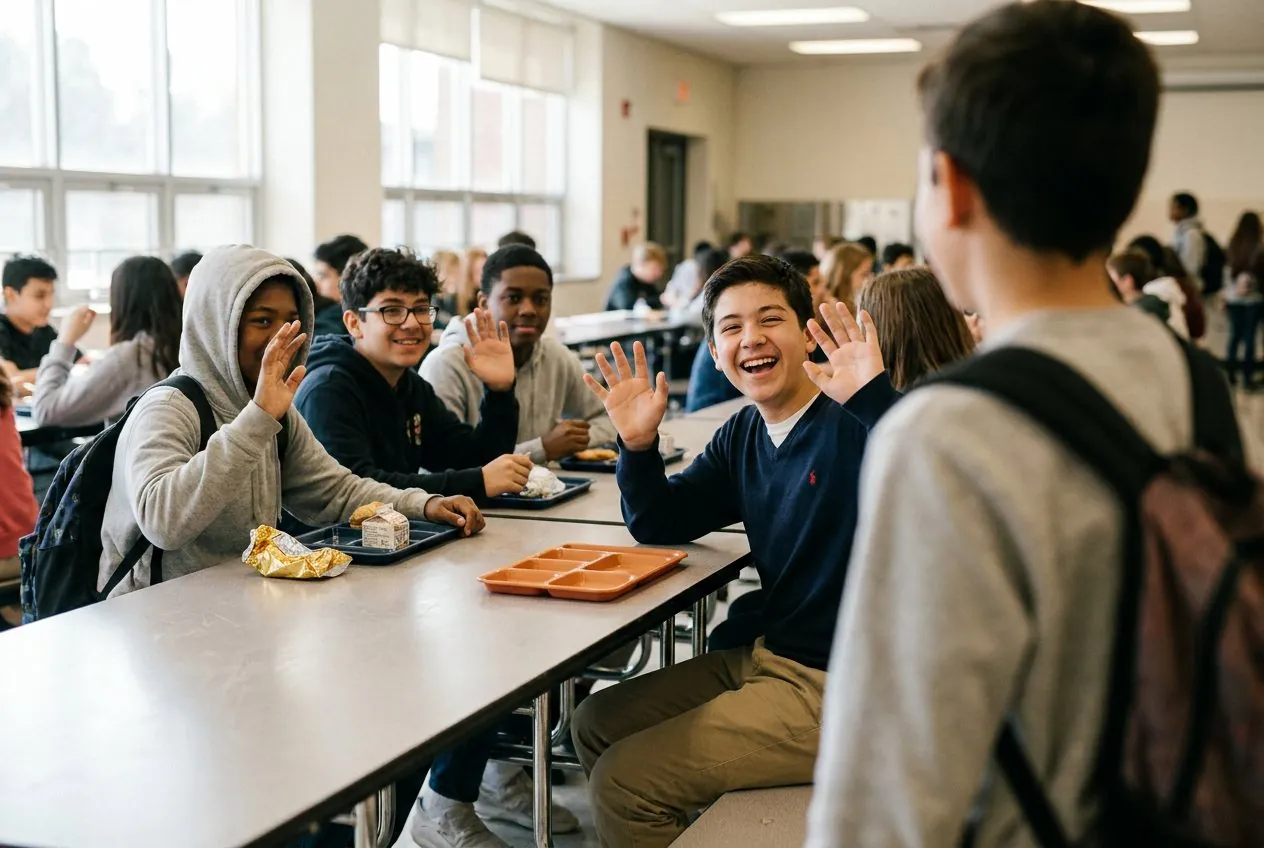
Ambassadors host tables. They do not police them. They introduce themselves to the quiet kids, read conversation cards out loud, and wave in anyone still looking for a seat.
Fifteen minutes of training covers it. Teach them how to redirect a student who dominates the table, how to spot the kids hovering near the doors, and how to offer an open seat with a gesture instead of a speech.
What Gets in the Way Before Lunch Even Starts
Three obstacles sink inclusion day more often than student attitudes do. Name them in the planning meeting and the day survives contact with a real school schedule.
- Staff bandwidth: Teachers already cover lunch duty, recess, and hallways. Sorting 400 students into assigned tables across three lunch periods adds work to people who have none to spare, so pick formats that either run themselves or arrive with an outside host.
- Funding and framework alignment: Counselors rarely hold a discretionary budget line for one February event. Tie the day to your existing Positive Behavioral Interventions and Supports (PBIS) framework or your social emotional learning (SEL) goals, and it stops competing for money as a one-off and starts counting as the school climate work your district already approved.
- Eighth-grade pushback: Older middle schoolers resist anything that feels like forced socializing. Give them roles instead of instructions. Let them hand out tokens, host tables, or run the whiteboard debate, and the resistance turns into ownership.
Reinforcing SEL and Inclusion With Interactive School Assemblies in NJ & NY
One lunch period raises awareness. Pair it with a whole-school assembly and the message sticks. Lectures on empathy lose the room in four minutes, because a passive audience tunes out.
At It’s Playtyme Game Shows, the live game show is the vehicle for group engagement. Since 2012, founder Lisa Lawrence has run these shows for schools across New Jersey, New York City, New York State, and Connecticut. Great events are not measured by attendance. They are measured by participation.
Our anti-bullying awareness game show turns No One Eats Alone week into interactive student engagement students talk about in the hallway afterward. Students and teachers compete on stage, answer custom trivia, and cheer for classmates they barely knew that morning. Administrators building out the year often start with proven school assembly programs in New Jersey and across the tri-state area.
Shows run 60 or 90 minutes for groups of 20 to 300+, and school assembly package details depend on how many shows you run and which grades you cover. No deposit is required to book, and the 100% Satisfaction Guarantee means you pay once the work satisfies you.
How Inclusion Program Formats Compare
Five formats show up on most school calendars. Here is how they stack up on participation, staff workload, and scale.
| Format | Student participation | Staff prep | Best for | Investment |
|---|---|---|---|---|
| It’s Playtyme Game Shows hosted assembly | Students and teachers compete on stage; the whole room is in it | Low. We host, run, and bring the equipment | Whole-school kickoff, groups of 20 to 300+, grades K-8 | Scaled to the number of shows and grades covered |
| Staff-run mixed-seating lunch | Everyone seated, but talking depends on the table | High. Sorting, signage, and door coverage every period | The core No One Eats Alone Day activity | Supplies only |
| Guest speaker assembly | Passive. Students listen and watch | Low to medium | One clear message to an older audience | Varies by speaker |
| Student council self-run mixer | Strong among participants, uneven across grades | Medium. Advisor supervision required | Building peer leadership | Supplies only |
| Classroom SEL curriculum lesson | Moderate. Discussion-based | Medium. Teachers need lead time | Follow-up reinforcement after the event | Free materials available |
Keeping Lunchroom Camaraderie Going After February
Inclusion fails when it ends with the event. Without a follow-up routine, students drift back to their usual tables. Build small traditions that carry the day into spring:
- Mix-it-up first Fridays: Randomize seating the first Friday of every month, with music and table trivia.
- Permanent welcoming tables: Keep two or three tables openly marked for anyone whose friends are absent or who wants to meet someone new.
- Lunchtime game stations: Put board games, chess sets, and conversation boxes in a cafeteria corner for students who want structure.
- Kindness shout-out board: Hang a board by the exit where students thank the classmates who waved them over.
Where to Put Your February Inclusion Budget
Three things decide lunchroom culture: structure that removes the risk of sitting somewhere new, peer leaders who go first, and a shared experience students remember. Posters and morning announcements alone will not change where students sit. If you fund one piece this year, fund the whole-school event and let staff run the mixed-seating lunch around it, because that is the piece students carry back into the cafeteria on Monday.
Ready to get your entire student body out of their seats and cheering for each other? Contact our team today to bring a professionally hosted, interactive game show to your next school assembly.
Frequently Asked Questions (FAQs)
What is No One Eats Alone Day?
No One Eats Alone Day is a national program created by the nonprofit Beyond Differences to end social isolation at school. It runs each February, and schools mark it with mixed seating and group activities that teach students to welcome classmates sitting alone.
How do schools prepare students for mixed-seating lunches?
Announce it three or four days ahead on morning announcements and in advisory. Explain the point clearly. Students who know what is coming walk in curious instead of anxious.
What opening activities work best for shy students at lunch?
Trivia place mats, would-you-rather questions, and tabletop puzzles work best. They give quiet students something to focus on together, and nobody gets put on the spot to share anything personal.
How do educators measure the success of No One Eats Alone Day?
Track participation by period, run a short homeroom survey, and count solo diners in the weeks after. Fewer students eating alone is the number that matters.
How do interactive game show assemblies promote school inclusion and PBIS goals?
They put participation in place of listening. Students and teachers from different grades end up on the same stage team, which gives PBIS and SEL lessons one shared moment every student can point back to. That win carries into the hallways and the cafeteria for weeks.