
Most onboarding programs front-load paperwork, compliance modules, and laptop setup, then leave human connection to chance. New hires spend week one watching slide decks and reading handbooks alone. Gallup finds that only 12% of employees strongly agree their organization does a great job onboarding new employees.
Connection comes from participating, not from listening. Gallup also reports that 70% of employees who had exceptional onboarding experiences say they have “the best possible job.” Employers across New Jersey, New York City, New York State, and Connecticut get there by building shared, active experiences into the first month.
Want the whole thing run for you?
It’s PlayTyme hosts onboarding and new starter events for groups of 20 to 300+ across New Jersey, New York City and Connecticut. Your host, the show and the equipment arrive together. Our most popular 90-minute show starts at $2,995, with no deposit to hold your date and a 100% satisfaction guarantee. Use our pricing estimator to see the range for your group size.
Common Onboarding Challenges That Kill New Hire Engagement
Traditional onboarding methods run on passive information delivery. HR schedules back-to-back sessions on benefits, IT security, and org charts. New hires sit quietly in a conference room or on a video call, absorbing facts and meeting no one.
That format creates overload while ignoring the question every new employee actually has: do I belong here? Culture does not transfer through a slide deck. It transfers through the people in the room.
Forced social exercises backfire just as often. Round-robin introductions and generic get-to-know-you questions put individuals on the spot in front of strangers. Quieter employees freeze, the three most talkative people take over, and the room learns nothing about anybody.
Groups also stall without a shared objective. Real connection forms when people solve a lighthearted problem together, compete in a friendly matchup, and laugh at the same moment. Team building works when attention moves off individual performance and onto a group result.
Then there is the planning load. Designing workplace culture activities that hold up for 40 people, or 200, takes internal hours HR does not have while offer letters, benefits enrollment, and I-9 verification are stacking up, so the interactive half of the program is the first thing cut.
Measurement is the last gap. Traditional onboarding methods report completion rates, not whether anybody connected, which leaves HR with no way to tie the new employee experience to early performance, team cohesion, or employee retention when finance asks what the program bought.
The Four Phases of High-Engagement Onboarding
Strong onboarding activities move a new hire from orientation to real collaboration on a schedule. Four phases keep company values and professional relationships developing at the same pace.
- Phase 1, arrival and welcome (day 1): low-stakes introductions, a warm room, and early peer contact.
- Phase 2, cultural immersion (week 1): company values and history delivered as interactive quizzes and team challenges.
- Phase 3, cross-departmental networking (weeks 2 to 3): structured problem-solving with veterans from other divisions.
- Phase 4, capstone collaboration (month 1): group competition that reinforces job skills and celebrates early wins.
Phases turn a static orientation calendar into milestones people look forward to. Add one live interactive challenge to each phase and the rapport outlasts the first month.
Opening Activities That Cut First-Week Awkwardness
Traditional opening activities ask individuals to share personal trivia with strangers. That creates tension, not warmth. Team formats work better because they give people something to do together.
Start with a paired company quiz. New hires work in twos on questions about company fun facts, department milestones, and team trivia, then submit answers for points. The pairs talk through the history instead of reading it, and the scoreboard gives them a reason to keep talking.
Speed match networking is the other reliable format. Participants rotate through timed rounds with prompt cards on work style, favorite tools, and professional interests. Three-minute rounds keep energy high and put every new hire in front of several colleagues from other departments.
Cohort Challenges That Build Cross-Departmental Connection
New hires who start in cohorts need more than a warm welcome. Cohort challenges ask small groups to divide work, debate a little, and solve a creative problem against the clock.
A company strategy sprint does this well. Small teams get a lighthearted fictional scenario from your industry, then 20 minutes to build a pitch, assign roles, and present to the room. New hires learn how different functions talk and how decisions actually get made.
Larger cohorts do better with interactive trivia built on company lore, industry jargon, and leadership fun facts. Teams of four to six argue their answers, form an identity fast, and put new hires on equal footing with tenured staff.
See a Hosted Game Show in Action
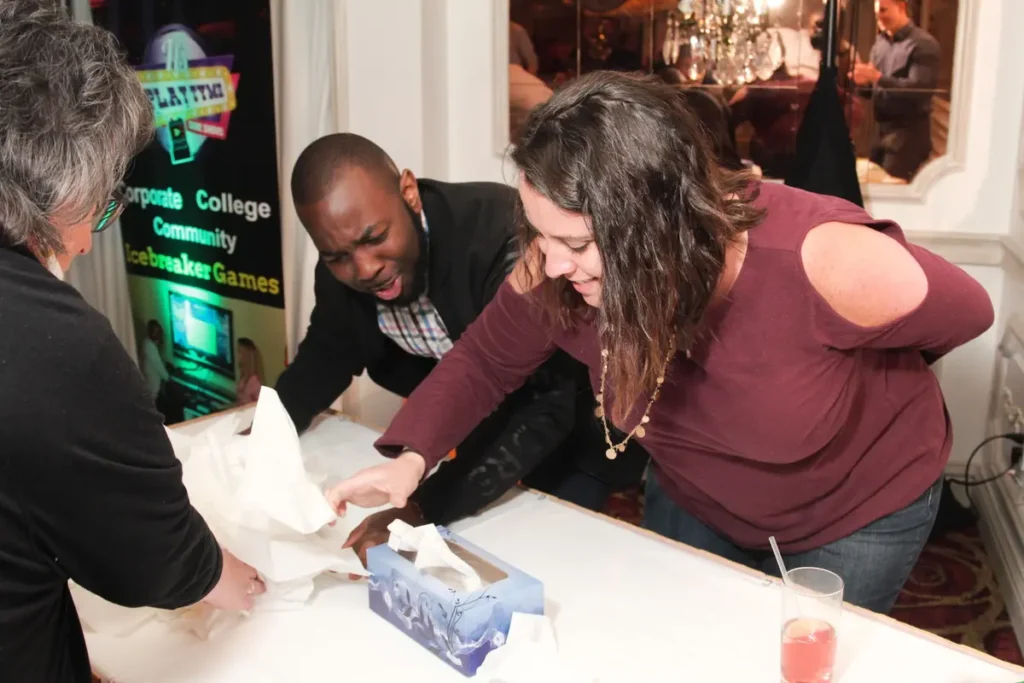
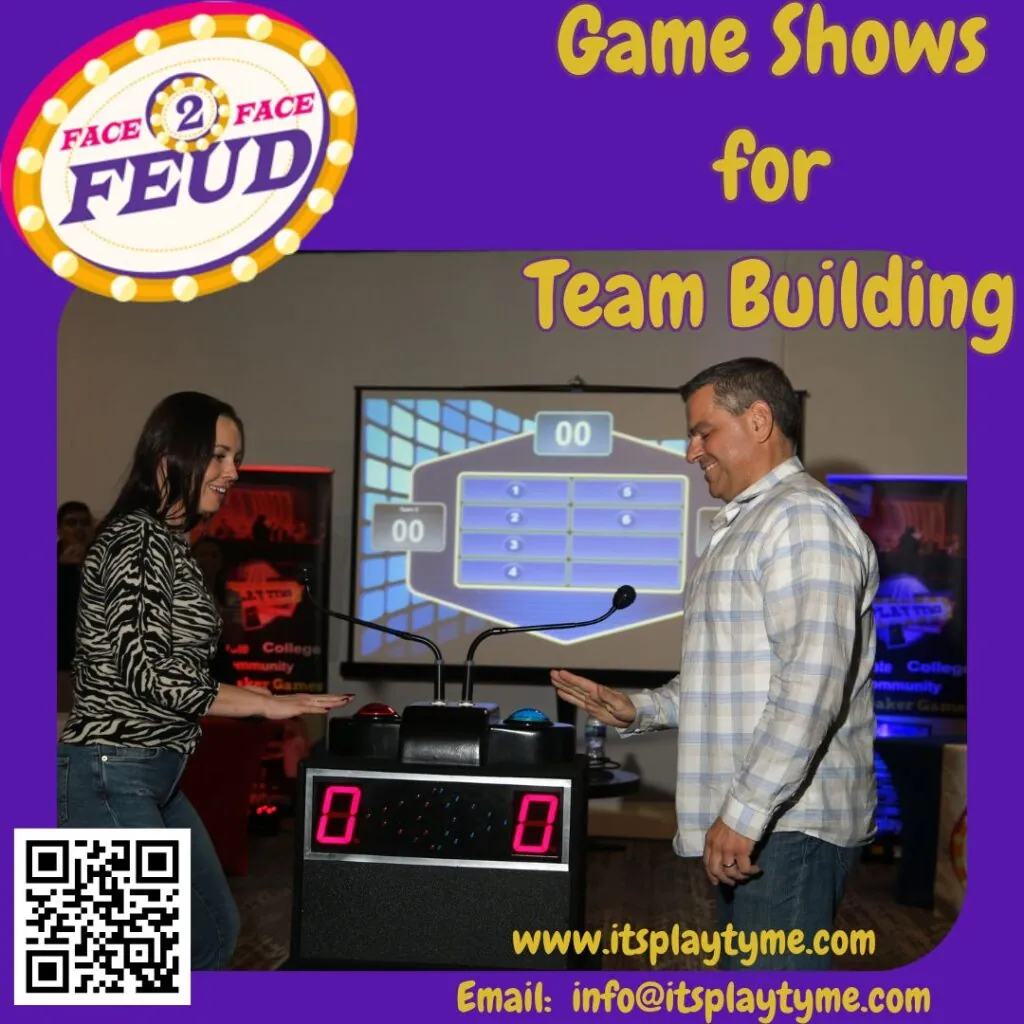
Here is a look at that energy during a live hosted trivia challenge.
Hosted Game Shows as the Vehicle for New Hire Connection
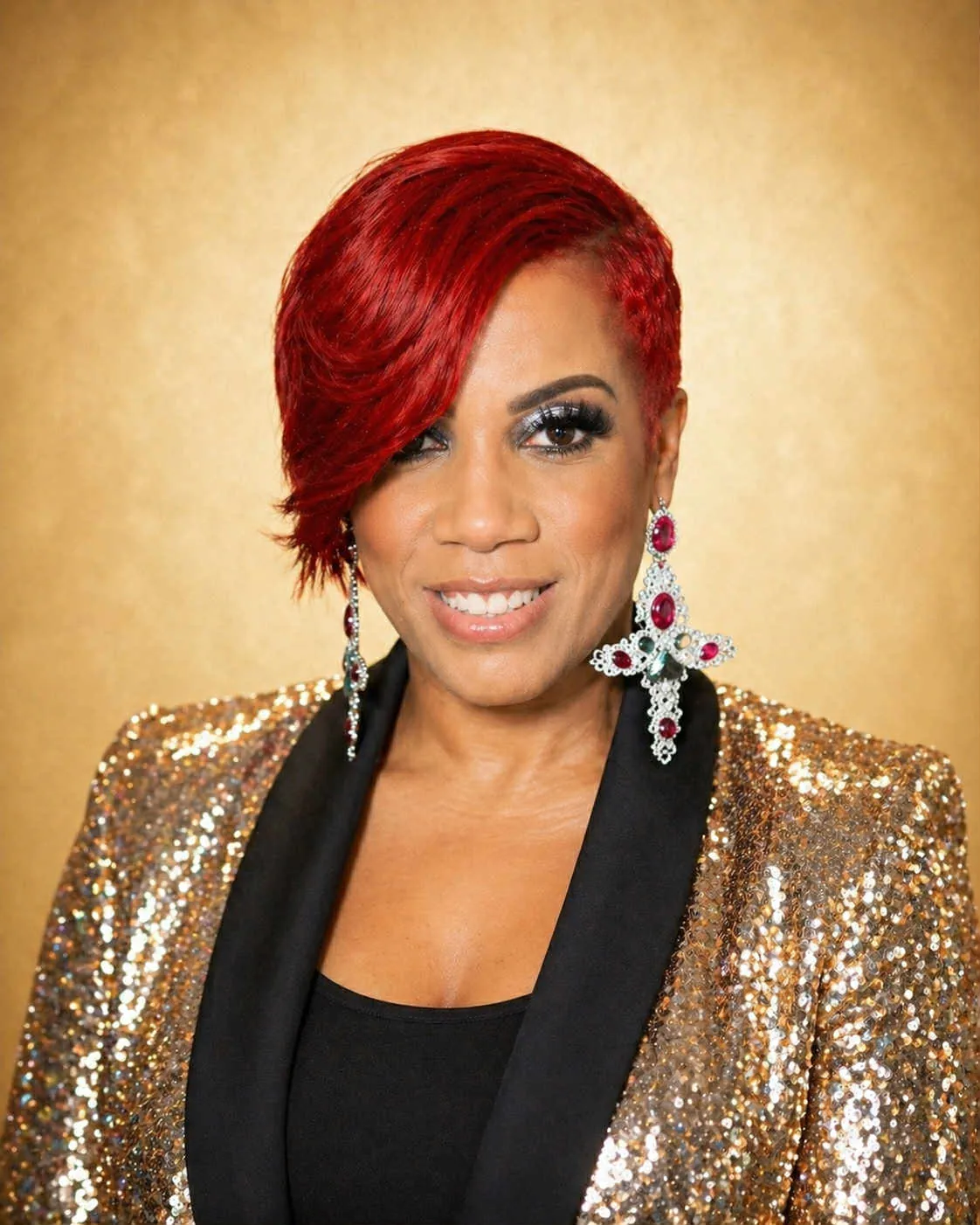
DIY games work for a dozen people. Large groups need professional structure and a host who runs the room. It’s PlayTyme Game Shows uses professionally hosted live game-show experiences as the vehicle for connection across New Jersey, New York City, New York State, and Connecticut. Lisa Lawrence founded the company in May 2012, and the team has produced more than 3,000 live events since.
Real production does the heavy lifting: custom buzzers, audio and visual equipment, a sound engineer, electronic scoring, and a host who controls the pace. Formats such as Face 2 Face Feud, 60 Seconds of Fame, PlayPad Mania, and Word Play get a full room playing at once. New hires stand shoulder to shoulder with senior leaders, cheer for teammates, and answer questions written about your company.
Nobody gets singled out. Everyone plays, not just the loudest few. Our most popular show runs 90 minutes for groups of 20 to 300+ participants, and the setup is turnkey for HR managers, event planners, and executives.
Gamification in onboarding works when the game is run for the group rather than assigned as homework. A hosted show carries your orientation content inside it: company history, values, and product details become questions people compete to answer. See custom options for team building for new hires built around your culture.
Comparing Popular Onboarding Activity Formats
The right format depends on group size, prep time, and the outcome you need. Use this comparison to match a cohort to an engaging onboarding experience.
| Activity Format | Best Group Size | Prep Time | Participation Level | Primary Outcome |
|---|---|---|---|---|
| It’s PlayTyme Game Shows (hosted live game show) | 20 to 300+ participants | Turnkey, no host prep | Whole room plays at once | Team connection and morale |
| Company strategy sprint | 12 to 40 participants | 1 hour to build the scenario | High, small-group work | Cross-functional problem solving |
| Speed match networking | 10 to 40 participants | 30 minutes | High, one-to-one contact | Fast peer introductions |
| DIY trivia or board games | 10 to 30 participants | 2 to 3 hours | Moderate and uneven | Casual downtime |
| Lecture and slide orientation | 10 to 200+ participants | 1 hour | Low, passive listening | Policy and compliance delivery |
How to Structure Onboarding Activities for Maximum Participation
Participation is a design decision, not luck. These five moves raise turnout and keep the room comfortable.
- Score teams, not individuals: Frame every activity around collective points and keep the competition lighthearted.
- Mix the room on purpose: Seat new hires with cross-functional peers and tenured staff to break departmental silos on day one.
- Write your own questions: Work your mission, founder story, and product details into the game so people learn while they play.
- Protect the time: Book a real block on the calendar instead of squeezing an activity into the last ten minutes of a training session.
- Hire a host for large groups: An experienced host holds the energy, manages the clock, and pulls in the quiet people.
Those five moves turn orientation from an HR checkbox into a business asset. Our guide to corporate event entertainment covers more ways to energize a large gathering.
Decide What Your Next New Hire Cohort Walks Away With
Two versions of week one are on the table. The first treats new employees as an audience: stacked presentations, unstructured social time, no rules. People leave tired, tense, and still unsure who anybody is, and the second week starts with strangers.
The second gives the group a structure to connect through: clear rules, a shared goal, a facilitator running the clock, and mechanics that include everyone without risk of embarrassment. New hires who spend orientation collaborating, competing, and laughing absorb culture faster and start contributing sooner. Choose that version, and every later stage of the program gets easier to run.
Ready to give your next new hire group something they will actually talk about? Contact Lisa Lawrence at It’s PlayTyme Game Shows to book your event across New Jersey, New York City, New York State, and Connecticut. Every event comes with a 100% satisfaction guarantee.
Frequently Asked Questions (FAQs)
What are the best onboarding activities for large groups of new hires?
Structured team formats beat open-ended mingling. Hosted live game shows, custom team trivia, and speed networking rounds all scale. Formats such as Face 2 Face Feud and PlayPad Mania put groups of 20 to 300+ people in the game at the same time without singling anyone out, which holds energy and mixes departments.
Do interactive onboarding activities actually improve retention and workplace culture?
Gallup reports that employees who had exceptional onboarding experiences are 2.6 times as likely to be extremely satisfied with their workplace, and satisfied employees are far more likely to stay. Shared, active experiences make culture concrete in week one instead of leaving it on a values slide, which is what employee retention strategies are trying to buy.
Can onboarding game shows be customized with company-specific content?
Yes. Custom questions are standard. Organizers work in company history, core values, product details, leadership fun facts, and industry jargon, so orientation material lands as a game instead of a slide.
How do interactive onboarding activities help remote or hybrid workers?
They give distributed employees one live shared experience instead of another silent video call. Playing in real time alongside peers builds fast familiarity, makes culture concrete, and connects people who otherwise only meet in a meeting grid.
What does a fully hosted game show include that a DIY onboarding game does not?
A professional host, a game-show set, audio and visual equipment, a sound engineer, buzzers or audience-response keypads, and prizes, all brought to your location. Our most popular show runs 90 minutes for groups of 20 to 300+ participants across New Jersey, New York City, New York State, and Connecticut, so nobody on your team spends a week writing questions and running the clock.