Sales teams that feel connected outperform those that don’t. According to Gallup’s State of the Global Workplace report, business units with high employee engagement see 23% greater profitability than their disengaged counterparts. Meanwhile, SHRM research on engagement confirms that shared team experiences directly drive the kind of discretionary effort that separates quota-crushers from clock-watchers.
Yet most sales meetings look the same: a pipeline review, a forecast update, and a motivational quote on the last slide. Reps tune out. Managers sense the energy draining but default to the same agenda because nothing better is planned. The result is a room full of competitive people with zero competitive outlet.
Sales managers and HR buyers searching for sales meeting games for teams face a specific set of frustrations. Off-the-shelf “team building” content skews toward icebreakers designed for onboarding, not revenue teams. Training-platform articles from CRMs and sales enablement tools push individual skill drills disguised as games. And generic party games feel unserious in a professional setting. What sales leaders actually need are structured group activities that tap into their team’s natural competitiveness, reinforce product knowledge, and fit inside a real meeting window.
The Essentials
- Gallup found business units with high engagement earn 23 percent greater profitability than disengaged counterparts.
- Most sales meetings follow the same format: pipeline review, forecast update, and a closing motivational quote.
- Reps disengage when meetings offer no competitive outlet for competitive people.
- SHRM links shared team experiences directly to the discretionary effort that separates quota-crushers from clock-watchers.
- Off-the-shelf team building content typically skews toward icebreakers rather than sales-specific engagement.
Why Sales Teams Respond to Competitive Group Games
Salespeople are wired for competition. Leaderboards, SPIFFs, and quota clubs already drive daily behavior. Structured games channel that same competitive energy into a shared experience instead of an individual race. When reps compete as teams rather than against each other, collaboration replaces internal rivalry.
Group games also break the pattern of one-directional communication. Instead of listening to a manager present, reps actively participate. They talk, strategize, and laugh together. That shift from passive to active transforms a forgettable Tuesday meeting into something the team references for weeks.
The format matters more than the content. A well-facilitated 20-minute game delivers more engagement than a 60-minute lecture with a quiz at the end. Structure, pacing, and a clear winner create the dopamine loop that keeps reps invested from start to finish.
Challenges of Keeping Sales Meetings Energized
Sales managers know the symptoms: phones under the table, cameras off on Zoom, side conversations during the forecast review. But the root causes run deeper than short attention spans.
- Repetitive agendas teach reps that nothing new will happen, so they mentally check out before the meeting starts.
- Individual-focused content (call reviews, personal pipeline updates) puts one person on the spot while everyone else disengages.
- No built-in interaction means the loudest voices dominate and quieter reps fade into the background.
- Time pressure makes managers skip anything that feels “extra,” even though a 10-minute game would make the other 50 minutes more productive.
These problems compound over time. A disengaged sales meeting becomes a disengaged sales culture. Games that are designed for group participation solve each of these issues directly: they break patterns, distribute participation, and fit inside tight schedules.
Game Show Formats That Energize the Whole Room
Game shows work for sales teams because the format is instantly familiar. Everyone knows how Jeopardy, Family Feud, and Wheel of Fortune work. That built-in familiarity eliminates the “learning the rules” phase and lets teams jump straight into competition.
It’s PlayTyme Game Shows specializes in exactly this format for corporate groups across New Jersey, New York City, and Connecticut. Their professionally hosted game show events use real buzzers, scoreboards, and a live emcee to run sales meeting games that feel like a television production, not a DIY icebreaker. The difference is immediate: teams compete in rounds, energy builds naturally, and every person in the room participates.
A hosted game show removes the planning burden from sales managers entirely. There is no need to build slides, buy supplies, or awkwardly facilitate an activity while also trying to participate. A professional host controls pacing, keeps score, and maintains energy from the first question to the final round.
Best formats for sales meetings
- Team trivia tournaments: Split the sales floor into groups of 4 to 6. Rounds cover product knowledge, company history, industry facts, and pop culture. Mixing categories keeps every personality type engaged.
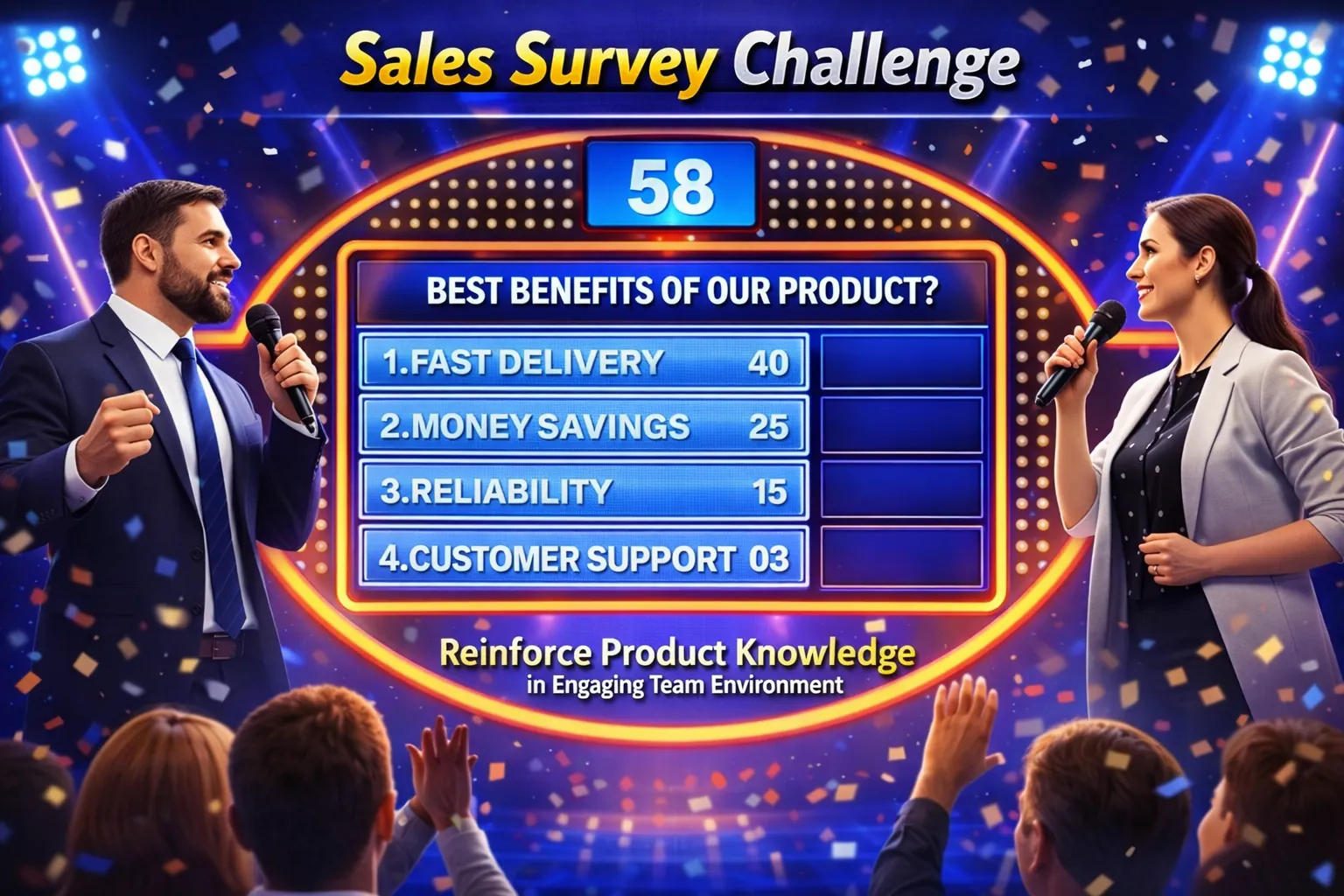
- Feud-style face-offs: Two teams compete head-to-head on survey-style questions. Fast-paced, loud, and perfect for groups that thrive on direct competition.
- Wheel and prize rounds: Add a physical wheel spin between rounds to keep the energy unpredictable. Tie prizes to sales-relevant rewards (gift cards, PTO hours, prime parking spots).
Trivia Games That Reinforce Product Knowledge
Trivia is the easiest game format to customize for a sales meeting because the questions themselves become a training tool. Instead of running a product update as a presentation, turn it into a quiz. Reps retain more information when they have to recall it under pressure than when they passively read a slide.
How to build effective sales trivia
- Mix product specs with customer scenario questions (“A prospect asks about X feature. What’s the correct response?”).
- Include competitor knowledge rounds so reps practice objection handling in a low-stakes environment.
- Add a “speed round” where teams answer as many questions as possible in 60 seconds. This mirrors the fast decision-making reps need on live calls.
The key is making the trivia competitive, not academic. Leaderboards, team names, and a visible scoreboard turn a knowledge check into an event. Professional game show providers build these elements into every session, so the experience feels polished rather than thrown together.
Strategy and Negotiation Games for Sales Groups
Not every sales meeting game needs to be fast-paced. Strategy games develop the skills reps use in complex deals: reading the room, allocating resources, and making decisions with incomplete information.
Formats that build sales skills
- Deal or No Deal scenarios: Present reps with a fictional deal and let them decide when to hold, negotiate, or walk away. Debrief the decisions as a group to surface different selling styles.
- Auction games: Give each team a budget to “bid” on leads, territories, or resources. The team that allocates most effectively wins. This teaches prioritization and resource management.
- Role-reversal rounds: One team plays the buyer, the other plays the seller. Switch halfway. Reps gain empathy for the buyer’s perspective, which sharpens their real-world pitch.
These formats work best when a facilitator guides the debrief. The game itself is engaging, but the conversation afterward is where reps connect the experience to their pipeline. A professional host keeps the game moving and ensures the debrief stays focused.
Quick Games for 15-Minute Sales Huddles
Not every sales meeting is a 90-minute offsite. Weekly huddles and Monday kickoffs often run 15 to 20 minutes. Games for these windows need to be fast, require zero setup, and end with a clear winner.
- Two Truths and a Lie (Sales Edition): Each rep shares two real customer objections they handled this week and one fake one. The team guesses which is the lie. This doubles as a coaching tool.
- Pitch Slam: One rep has 60 seconds to pitch a randomly assigned product (or a completely unrelated object) to the group. The team votes on the best pitch. It builds confidence and impromptu speaking skills.
- Sales Bingo: Create bingo cards with common sales activities (booked a demo, got a referral, closed a deal over $X). Reps mark squares as they complete activities throughout the week. First bingo wins at the Friday huddle.
These micro-games keep the competitive spirit alive between larger team events. They also give managers a low-effort way to make every meeting feel different from the last one.
How to Run Sales Meeting Games Without Losing Focus
The most common objection to adding games to sales meetings is time. Managers worry that 15 minutes of gameplay means 15 fewer minutes of pipeline review. In practice, the opposite happens. A short game at the start of a meeting raises energy levels, which makes the business discussion that follows more productive.
Practical guidelines
- Place the game first. Open with 10 to 15 minutes of competition, then transition into the business agenda. Reps arrive on time (nobody wants to miss the game), and the energy carries into the rest of the meeting.
- Tie games to business goals. If the team is launching a new product, make the trivia about that product. If close rates are down, run a negotiation game. Alignment eliminates the “this is a waste of time” objection.
- Rotate formats monthly. Trivia one week, a feud-style face-off the next, a strategy game the following month. Variety prevents any single format from going stale.
- Bring in a professional for quarterly events. DIY games work for weekly huddles. For quarterly kickoffs, annual meetings, or SKOs, a professionally hosted game show from a provider like It’s PlayTyme delivers a polished experience that internal facilitators simply cannot replicate.
| Game Format | Best For | Group Size | Time Needed | Setup Required |
|---|---|---|---|---|
| Hosted Game Show (It’s PlayTyme) | Quarterly kickoffs, SKOs, team celebrations | 20 to 300+ | 45 to 90 min | None (fully hosted) |
| Team Trivia | Product launches, knowledge reinforcement | 8 to 50 | 15 to 30 min | Question list, scoreboard |
| Feud-Style Face-Off | High-energy mid-week meetings | 10 to 40 | 15 to 25 min | Survey questions, buzzer app |
| Strategy/Negotiation Game | Complex sales teams, deal review sessions | 6 to 20 | 20 to 40 min | Scenario cards or slides |
| Quick Huddle Game | Daily or weekly standups | 4 to 15 | 5 to 15 min | Minimal or none |
How to Pick the Right Game for Your Next Sales Meeting
Choosing the right sales meeting game comes down to three variables: the size of the group, the length of the meeting, and the outcome you want. A Monday morning huddle with eight reps calls for a fast, no-prep game like Pitch Slam. A quarterly sales kickoff with 80 people demands a professionally produced game show that keeps every person in the room engaged for a full hour.
Start by identifying what your team needs most. If morale is low, pick something purely fun with no training component. If product knowledge is lagging, build a trivia tournament around your latest release. If collaboration between reps is weak, choose a team-based strategy game that forces communication.
For high-stakes meetings where the experience needs to be flawless, corporate event specialists remove the guesswork entirely. It’s PlayTyme Game Shows brings the equipment, the host, and the energy to every event across NJ, NYC, and CT. Sales managers show up, participate alongside their teams, and walk away with a group that is more connected than when they arrived.
Ready to turn your next sales meeting into the event your team talks about all quarter? Get in touch with It’s PlayTyme to book a team building game show that fits your group size, schedule, and goals.
Frequently Asked Questions (FAQs)
What are the best sales meeting games for large teams?
Game show formats like team trivia tournaments and Feud-style competitions work best for large groups of 20 or more. These formats use team-based rounds so every person participates, and a professional host keeps the energy high across the entire room. Hosted events from providers like It’s PlayTyme scale to 200+ participants without losing engagement.
Do sales meeting games actually improve performance?
Yes. Structured team games build trust, improve communication, and reinforce product knowledge through active recall. Teams that regularly engage in competitive group activities report stronger collaboration on deals and higher energy during pipeline discussions. The performance lift comes from sustained engagement, not a single event.
How do I convince my manager to add games to sales meetings?
Frame the request around outcomes, not entertainment. Present data on engagement and retention, propose a 10-minute pilot during one meeting, and measure participation and energy levels before and after. Most managers who try a single structured game continue using them because the difference in meeting quality is obvious.
What is the difference between sales training games and sales meeting games for teams?
Sales training games focus on individual skill development: objection handling drills, call simulations, and CRM quizzes. Sales meeting games for teams prioritize group interaction and shared competition. The goal is team bonding and energy, not individual assessment. Both have value, but they serve different purposes and belong in different parts of your sales calendar.