

U.S. employee engagement fell to 30% in 2024, the lowest level in over a decade, according to Gallup. That same research estimates disengagement now costs American businesses $2 trillion per year in lost productivity. For leadership teams — those numbers represent a direct threat to retention, performance, and growth.
Leadership retreats remain one of the most effective ways to pull managers and senior teams out of reactive mode and rebuild the working relationships that drive results. But the retreat itself is only as good as its activities. HR and L&D planners across New Jersey, New York City, and Connecticut know this firsthand: booking a venue is straightforward, but filling the agenda with leadership retreat games that produce measurable outcomes is the real challenge.
Too many retreats rely on icebreakers that feel forced or outdoor activities that half the group dreads. Leaders return with photos but no new behaviors. The gap between “we had a great time” and “our team actually works differently now” is where most retreat planning falls short. What works is a structured, competitive format that mirrors real workplace dynamics and ties every round to a specific leadership skill.
Where Traditional Leadership Retreats Usually Go Wrong
Most leadership retreat activities share the same structural flaw: they prioritize fun over outcomes. Ropes courses generate adrenaline but not strategic alignment. Cooking classes fill a pleasant afternoon but nothing transfers to quarterly planning. Trust falls became a punchline years ago.
The specific challenges HR and L&D planners face include:
- Low participation from senior leaders. Activities that feel juvenile or physically demanding lose executive buy-in before they start.
- No connection to actual work dynamics. A scavenger hunt does not teach cross-functional decision making.
- Short-lived impact. Without structured debrief or skill reinforcement, retreat energy fades by Wednesday.
- One-size-fits-all formats. A team rebuilding trust after a reorganization needs something different from a team celebrating a record quarter.
- Logistical risk in the Tri-State area. Coordinating outdoor activities across NJ, NYC, and CT adds weather uncertainty, venue complexity, and travel friction.
Game show formats address these problems by design. They are indoor, structured, competitive, and adaptable to specific leadership goals.
Why Game Show Formats Work for Leadership Retreats
Game shows succeed as leadership retreat games because they replicate the conditions leaders face daily: time pressure, incomplete information, team coordination, and public accountability. Every round forces a group to communicate, decide, and execute within constraints. That is not recreation. That is practice.
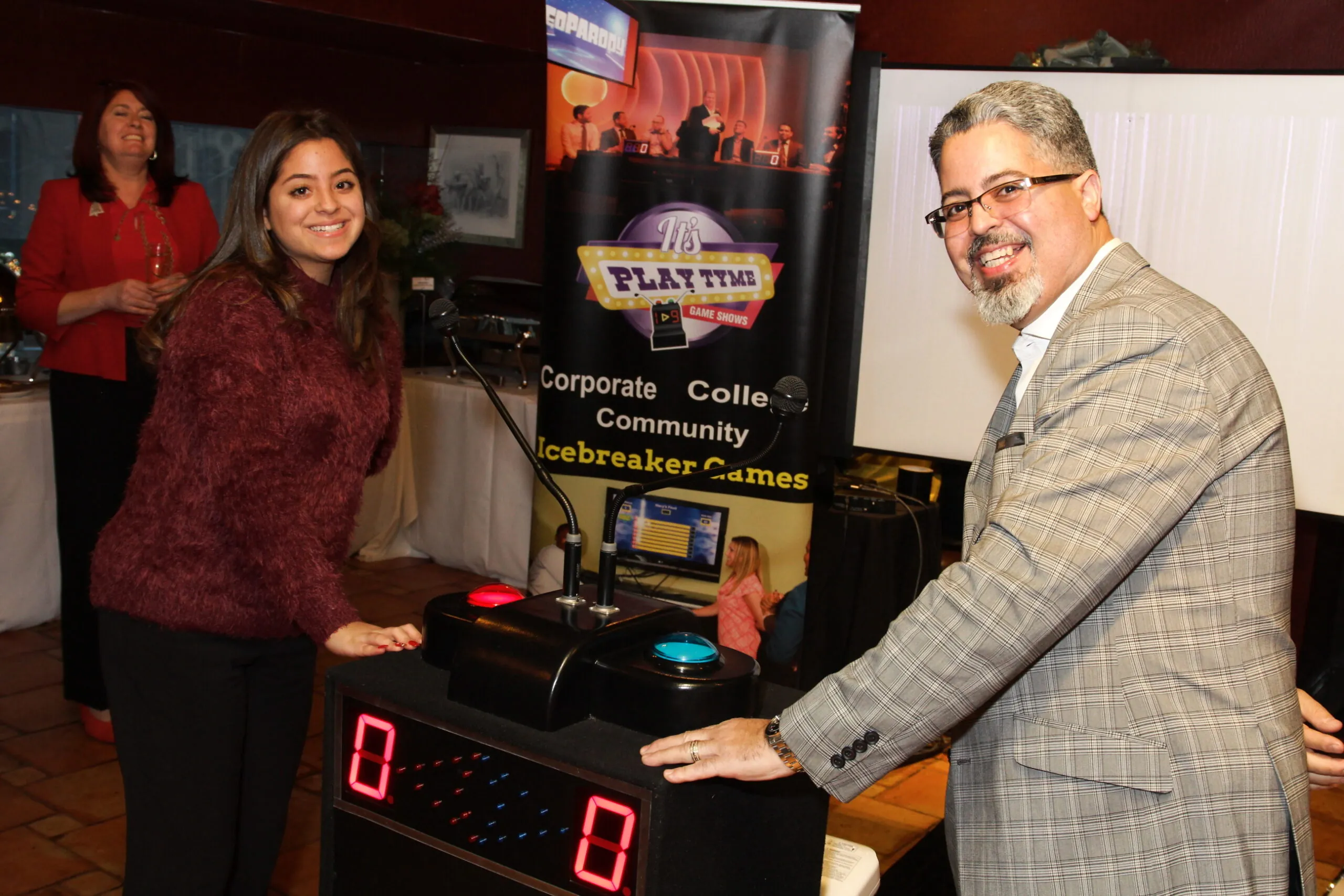
It’s PlayTyme Game Shows has produced over 3,000 corporate events across New Jersey, New York City, and Connecticut with exactly this approach. Each format is a fully hosted, TV-style production with professional AV equipment, a live host, and customizable content. The difference between a professionally produced game show and a DIY trivia night is the difference between a keynote and a staff meeting: production quality changes participation.
The table below maps each game show format to its primary leadership outcome so you select the right fit for your retreat objectives.
| Game Format | Leadership Outcome | Best For | Group Size |
|---|---|---|---|
| Face-2-Face Feud | Cross-department alignment | Siloed teams, post-merger groups | 20-300+ |
| Game Show Mania | Strategic knowledge sharing | New leadership cohorts, onboarding | 20-300+ |
| 60 Seconds of Fame | Composure under pressure | Sales kickoffs, high-performance teams | 20-150+ |
| Word Play | Creative communication | Cross-functional teams, brainstorming retreats | 20-300+ |
| The Challenge | Trust and collaborative strategy | Newly formed teams, trust rebuilding | 20-300+ |
Face-2-Face Feud: Driving Cross-Department Alignment
Modeled after the classic Family Feud format, Face-2-Face Feud pits teams against each other in fast-paced survey rounds. Two groups face off, huddle for consensus, and deliver answers under time pressure. The leadership value is alignment: teams must quickly agree on a single answer, exposing how well (or poorly) a group communicates and prioritizes.
For leadership retreats, It’s PlayTyme customizes survey questions around company strategy, industry knowledge, or team culture. When a VP of marketing and a director of operations have to agree on the same answer in five seconds, the activity reveals real communication patterns. Debrief conversations after the game address those patterns directly.
This format works especially well for corporate retreat groups of 20 to 300+ participants and runs 60 to 90 minutes depending on the number of rounds.
Game Show Mania: Reinforcing Strategic Knowledge
Game Show Mania is a trivia-based competition that tests teams on topics ranging from industry trends to internal company milestones. For leadership retreats, question categories are tailored to strategic priorities: product roadmap, customer insights, compliance updates, or organizational history.
The leadership outcome is knowledge alignment. When half the room answers a strategy question incorrectly, it surfaces a gap that no slide deck will fix. The competitive format makes the learning stick because nobody forgets the round they lost. Teams of four to six compete across multiple rounds, and scoring is live and visible, adding accountability without making it personal.
This format is a strong fit for new leadership cohorts, annual planning retreats, or any group that needs to get on the same page about where the organization is headed.
60 Seconds of Fame: Building Composure Under Pressure
Inspired by the Minute to Win It television format, 60 Seconds of Fame puts individual leaders and small teams through rapid physical and mental challenges: stack cups, solve puzzles, and complete relay tasks. Every challenge has a visible clock and a cheering audience.
The leadership skill at work is composure. Performing under time pressure with an audience mirrors the reality of board presentations, client pitches, and crisis management. Leaders who freeze or thrive during a 60-second cup-stacking challenge tend to show the same patterns in high-stakes work situations. The format generates energy fast, making it an ideal opener or mid-retreat reset when a group needs a jolt.
It’s PlayTyme brings all equipment, handles timing, and keeps the room energized with a professional host and full sound system.
Word Play: Sharpening Communication Skills
Based on the Wheel of Fortune concept, Word Play challenges teams to solve word puzzles collaboratively. One person spins, the team strategizes on letter choices, and the clock pushes the pace. The leadership outcome is creative communication: how does a group share partial information, build on each other’s ideas, and reach a solution together?
For retreats focused on innovation or cross-functional collaboration, Word Play surfaces how leaders process ambiguity. Some groups guess early and take risks. Others wait for certainty and run out of time. Both tendencies mirror real strategic decision-making patterns, and the game makes those patterns visible without a 360-degree feedback review.
Word Play works well for groups of 20 to 300+ and pairs naturally with a debrief session on decision-making styles.
The Challenge: Deepening Trust Through Team Strategy
The Challenge follows a Jeopardy-style format where teams select categories and wager points based on confidence. The strategic layer (choosing categories, deciding bet sizes, managing a point total) adds a trust dimension that pure trivia lacks. Teams trust each other’s expertise: let the finance leader take the numbers category, let the creative director handle the branding questions.
This format rewards teams that delegate based on strengths rather than seniority. For leadership retreats where trust is the primary goal (post-reorganization, after executive turnover, or during rapid growth), The Challenge creates low-risk opportunities to practice trusting colleagues’ judgment in real time.
Browse the full lineup of available formats on the game show themes page to compare options for your specific retreat objectives.
How to Match the Right Leadership Retreat Game to Your Goals
Selecting the right leadership retreat game starts with one question: what does your leadership team need to do differently after this retreat? If the answer is “align on strategy,” Face-2-Face Feud and Game Show Mania put alignment front and center. If the answer is “rebuild trust after a transition,” The Challenge and Word Play create structured moments for exactly that. If the answer is “bring energy back to a burned-out group,” 60 Seconds of Fame resets the room within an hour.
Consider your group size, the mix of seniority levels, and whether your retreat is a half-day session or a multi-day event. Game show formats scale from 20 to 300+ participants and run 60 to 120 minutes, making them flexible enough to anchor a retreat or complement a larger agenda.
For retreats in New Jersey, New York City, or Connecticut, working with a local vendor eliminates the travel surcharges and logistical uncertainty that come with national providers. It’s PlayTyme Game Shows brings professional AV equipment, a trained host, and fully customized content directly to your venue. The team handles setup and teardown so your planning effort stays focused on leadership outcomes, not production logistics.
Ready to build your leadership retreat around activities that produce real outcomes? Contact It’s PlayTyme Game Shows to discuss your group size, goals, and preferred format. Every event is fully customized to your leadership objectives and delivered on-site at your chosen venue across the Tri-State area.
Frequently Asked Questions (FAQs)
What are the best games for a leadership retreat?
The best leadership retreat games tie directly to a specific outcome like alignment, trust, or communication. Game show formats (trivia competitions, team-based feud rounds, timed challenges) work well because they replicate workplace dynamics: time pressure, collaboration, and public decision making. Choose the format based on what your team needs to practice, not just what sounds entertaining.
How long does a game show take at a leadership retreat?
Most game show formats run 60 to 90 minutes, with larger groups or multi-round events extending to 120 minutes. This makes them flexible enough to fill a dedicated retreat block or serve as an energizer between strategy sessions. Setup and teardown are handled by the vendor, so your agenda stays on schedule.
How many people participate in a leadership retreat game show?
Game show formats accommodate groups of 20 to 300+ participants. Teams of four to eight compete in rounds, keeping every person actively involved rather than watching from the sidelines. The format scales for intimate executive retreats and large leadership summits alike.
Do game show activities work for hybrid or multi-location leadership teams?
In-person game shows deliver the strongest results for leadership retreats because the physical energy, eye contact, and real-time reactions build connection faster than any virtual alternative. For Tri-State teams spread across NJ, NYC, and CT offices, an on-site game show at a central venue brings everyone into the same room for a shared experience that remote formats cannot replicate.
Where do leadership retreat game shows take place in NJ, NYC, and CT?
It’s PlayTyme Game Shows brings all equipment and production to your chosen venue anywhere in New Jersey, New York City, or Connecticut. Whether your retreat is at a hotel conference center, a corporate campus, or a dedicated event space, the team arrives with full AV setup and runs the entire experience on-site.