

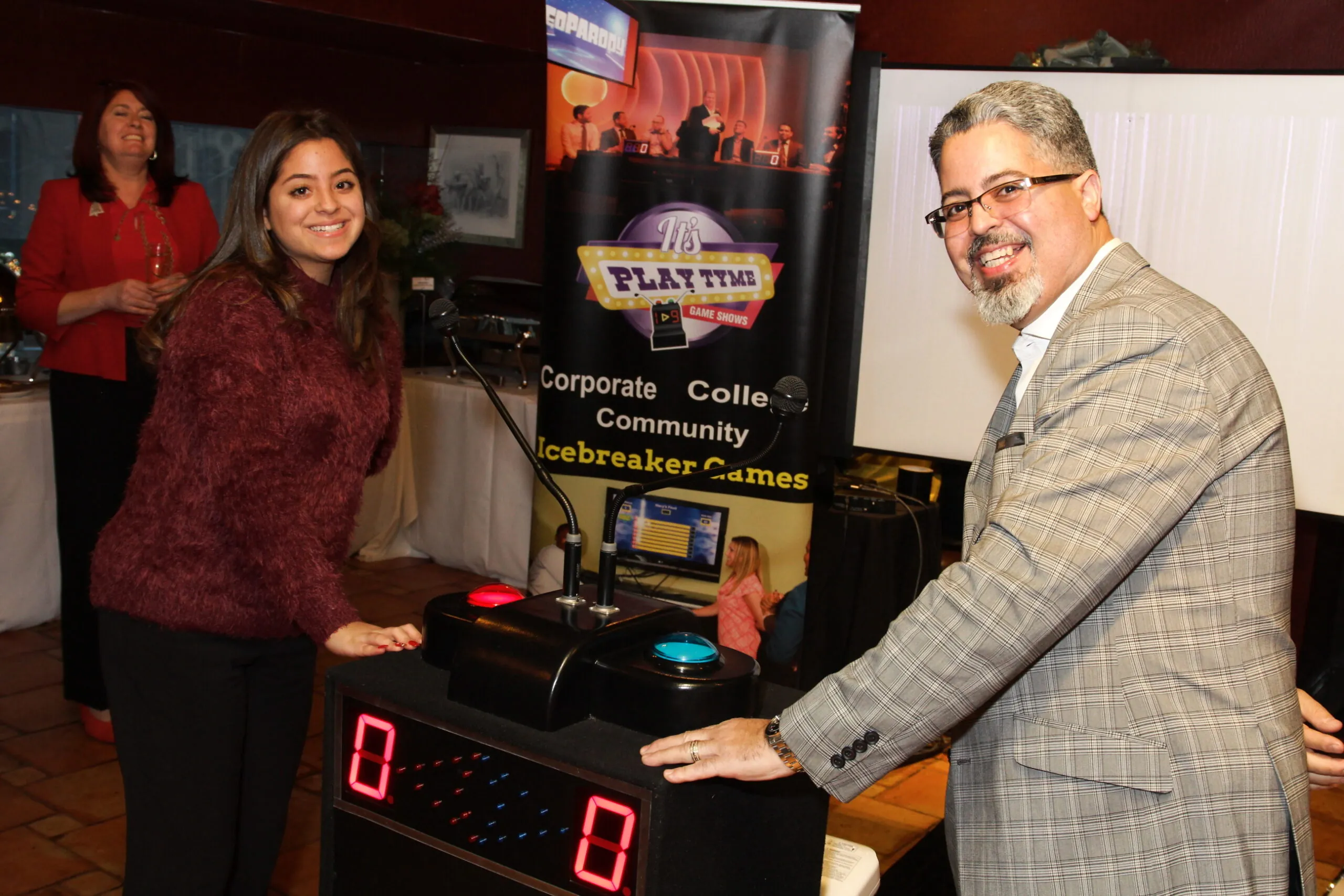

Corporate retreats are supposed to build stronger teams — but the wrong activities turn a promising offsite into an awkward afternoon. According to Gallup’s ongoing meta-analysis, business units with highly engaged employees are 23% more profitable than those with low engagement. Meanwhile, research published in the Harvard Business Review found that face-to-face socialization patterns are the single greatest predictor of a team’s success, accounting for roughly 35% of the variation in performance.
Those numbers explain why so many organizations invest in offsite retreats. The return is real when people connect outside their daily routines. But the size of your group determines whether that connection happens or falls flat.
Here is where most retreat planners hit a wall. The internet is full of retreat game ideas designed for 10 to 20 people: trust falls, two-truths-and-a-lie, scavenger hunts with handwritten clue cards. Try running any of those with 150 sales reps or 300 conference attendees, and the energy collapses. Half the room stands around waiting for a turn. Instructions get lost in the noise. Introverts disappear to check email. Finding retreat games for large groups that keep every person in the room genuinely involved is a different problem entirely, and it requires a different solution.
The Structural Flaws in Standard Large Group Games
Before exploring what works, it helps to understand exactly why standard retreat activities break down at scale. These are not minor inconveniences. They are structural problems baked into the format of most small-group games.
- Participation bottlenecks. Games built for small circles give each person a turn. At 50+ people, turns take forever. Most attendees become spectators, not participants.
- Volume and visibility. A facilitator speaking without professional audio equipment loses half the room past row five. Visual aids designed for a conference table are invisible at ballroom scale.
- Energy management. Large groups have wider ranges of personality types, energy levels, and comfort zones. A single activity format (all physical, all trivia, all improv) alienates portions of the audience.
- Logistics and timing. Splitting 200 people into small breakout teams requires space, extra facilitators, printed materials, and transition time that eats into the schedule.
- Inclusivity gaps. Physical relay races exclude participants with mobility limitations. Language-heavy word games exclude non-native speakers. Without intentional design, large-group games leave people out.
What Makes Retreat Games Work for 20 to 300+ People
Effective retreat games for large groups share a handful of design principles. They are not just bigger versions of small-group activities. They are built from the ground up for scale.
Simultaneous participation
The best large-group formats let every person play at the same time. Wireless buzzers, handheld response devices, and team-based scoring systems mean nobody waits for a turn. Everyone is active from the first question to the final round.
Professional production value
Large-screen displays, stage lighting, a live host with a wireless microphone, and a sound system sized for the venue: these elements transform a retreat game from a classroom exercise into an event. Production quality signals that the organization invested in its people, and it keeps attention locked in.
Mixed-format rounds
Rotating between trivia, physical challenges, music rounds, and visual puzzles ensures that different strengths get their moment. The trivia expert shines in one round. The extrovert thrives in the physical challenge. The music lover dominates the name-that-tune segment. Variety keeps energy high across a diverse group.
Game Show Formats Built for Large Retreat Groups
It’s PlayTyme Game Shows specializes in exactly this scenario: professionally hosted, fully produced game show experiences designed for groups of 20 to 300+ people across New Jersey, New York City, and Connecticut. Their formats solve the scale problem because they were engineered for it from day one.
Team-based trivia competitions
Tables or assigned teams compete through multiple rounds of trivia covering pop culture, company history, industry knowledge, or custom categories. Wireless scoring keeps results live on a big screen. Every table plays every round. No one sits idle.
Survey-style showdowns
Inspired by classic TV game shows, these formats pit teams against each other to guess popular survey answers. The host works the room, pulling volunteers for face-off rounds while entire teams shout suggestions. It is loud, fast, and instantly familiar.
Music and media rounds
Name-that-tune segments, movie clip identification, and decade-themed audio challenges break up knowledge-heavy rounds with pure entertainment. These work especially well for multigenerational groups where pop culture references span different eras.
Minute-to-win-it physical challenges
Quick, silly physical tasks (stack cups, bounce ping pong balls, move cookies from forehead to mouth using only facial muscles) bring volunteers on stage while teams cheer. The challenges are inclusive because they test coordination and humor, not athletic ability.
| Game Format | Best Group Size | Energy Level | Participation Style | Setup Needs |
|---|---|---|---|---|
| Team Trivia Competition | 20-300+ | Medium-High | Full-room simultaneous | AV + scoring system |
| Survey-Style Showdown | 50-300 | High | Team + volunteer hybrid | AV + display board |
| Music & Media Rounds | 20-300+ | Medium | Full-room simultaneous | AV + sound system |
| Minute-to-Win-It | 50-200 | Very High | Volunteer + team cheering | Stage + props |
| DIY Icebreaker Games | 10-30 | Low-Medium | Sequential turns | Minimal |
How Professional Facilitation Changes Everything
The host makes or breaks a large-group game. A professional emcee reads the room in real time, adjusts pacing when energy dips, draws out quieter teams, and keeps transitions tight. This is not a skill most HR managers or team leads have practiced, and there is no reason they should have to improvise it during a retreat they also need to attend.
It’s PlayTyme provides trained hosts who specialize in corporate audiences. They know how to handle the executive who wants to win too badly, the table in the back that starts slow, and the moment when the room needs a quick physical challenge to reset its energy. That read-and-react ability is what separates a professional game show from a DIY activity that stalls halfway through.
Customizing Retreat Games for Your Organization
Generic trivia is fine. Custom trivia built around your company is better. The strongest retreat games for large groups weave in content specific to the organization: founding stories turned into questions, product knowledge challenges, or “guess which department” rounds based on fun facts submitted by employees beforehand.
Customization does three things at once. It rewards people who know the company well. It teaches newer employees things they would not learn in onboarding. And it signals to the entire group that leadership put thought into the event, not just a budget.
It’s PlayTyme works with organizers ahead of the event to build custom question sets, brand the scoring displays, and tailor the format to the retreat’s goals. Whether the objective is celebrating a milestone, reinforcing values after a merger, or simply giving people a reason to laugh together, the content adapts.
Planning Retreat Games for Large Groups in NJ, NYC, and CT
Venue logistics matter as much as the activity itself. A 200-person game show needs a room with enough space for team tables, clear sightlines to a screen, and electrical access for AV equipment. Hotels, conference centers, and corporate campuses across New Jersey, New York City, and Connecticut all work, but the layout affects the format.
It’s PlayTyme handles site visits and load-in coordination for venues throughout the tri-state area. Their team arrives with all production equipment, sets up before guests enter the room, and breaks down after the event. The retreat organizer does not need to rent speakers, screens, or microphones separately.
For outdoor retreats, adapted formats work on lawns, patios, and pavilions with portable equipment. Indoor venues with fixed theater seating require a different configuration than banquet rounds. The format flexes to match the space, not the other way around.
Why DIY Retreat Games Struggle at Scale
There is nothing wrong with DIY games for a team of 12. Printed trivia sheets, a Bluetooth speaker, and a willing volunteer host get the job done. But the same approach at 100+ people creates friction that undermines the retreat’s purpose.
Printed answer sheets require collection, manual scoring, and a long wait before results. The volunteer host runs out of energy or material after 30 minutes. Teams in the back of the room cannot hear questions. Scoring disputes break the flow. The activity that was supposed to bring people together instead highlights how disconnected the logistics are.
Professional retreat game providers exist because this gap is real. The cost of a facilitated game show is a fraction of what most organizations spend on venue rental, catering, and travel for the retreat itself. Skipping the entertainment line item and defaulting to DIY saves a small budget while risking the entire event’s impact.
Which Game Format Fits Your Retreat Size
Start with three questions. How many people are attending? What is the physical setup of your venue? And what do you want people to feel when the game ends?
For groups of 50 to 100, a single game show format with three to four rounds fills 60 to 90 minutes. For groups of 150 to 300, a multi-format event (trivia plus physical challenges plus a music round) keeps variety high enough to sustain energy across a longer session. For 300+, professional AV becomes non-negotiable, and the host needs experience managing crowd dynamics at concert-level scale.
If your goal is pure fun and stress relief, lean toward music and physical challenges. If the retreat has a learning objective, build custom trivia around the content you want reinforced. If team bonding across departments is the priority, assign cross-functional teams and design rounds that require collaboration.
Ready to plan retreat games for your next large-group event in New Jersey, New York City, or Connecticut? Reach out to It’s PlayTyme to discuss your group size, venue, and goals. Their team builds a custom game show format that fits your retreat perfectly. Explore corporate event options to see what’s possible.
Frequently Asked Questions (FAQs)
What are the best retreat games for large groups over 100 people?
Team-based game show formats work best for groups over 100. Trivia competitions, survey-style showdowns, and music rounds let every person participate simultaneously through team play. Professional hosts and AV equipment keep the energy high and the logistics smooth.
How long do large-group retreat games typically last?
Most professionally facilitated game shows run 60 to 90 minutes. Multi-format events with breaks between rounds stretch to two hours. The ideal length depends on your overall retreat schedule and the energy level of your group.
Do retreat game shows work for outdoor venues?
Yes. Portable AV equipment, wireless scoring systems, and battery-powered sound gear make outdoor game shows possible on lawns, patios, and covered pavilions. The host and production team adapt the format to the space and weather conditions.
How much do professional retreat game shows cost?
Pricing varies based on group size, event length, travel distance, and customization level. For the NJ, NYC, and CT area, professional game show packages are typically a small fraction of the total retreat budget covering venue, catering, and travel.
Are large-group game shows appropriate for all ages and abilities?
Professional game shows are designed for inclusivity. Trivia, music, and survey rounds require no physical ability. Physical challenge segments use volunteers only, and the tasks test coordination and humor rather than strength or speed. Hosts adjust content for the audience, whether that is a corporate team or a school assembly.
Why does face-to-face interaction at retreats matter for team performance?
Harvard Business Review research found that face-to-face socialization patterns are the single greatest predictor of a team’s success, accounting for roughly 35% of the variation in performance.