Every annual sales kickoff carries the same risk. You book a full day of slides, and by mid-morning your top closers are answering email under the table. Gallup’s latest global workplace research found that only 20% of employees worldwide were engaged in 2025, a decline that costs the world economy roughly $10 trillion. Passive listening does not move that number.
The second worry is booking something that feels forced. Sales professionals reject cringeworthy team exercises faster than anyone else in the building. They want real interaction, and genuine connection at work is rarer than most leaders assume. Gallup also reports that a mere two out of 10 U.S. employees strongly agree they have a best friend at work. Your headcount then decides the format, because 25 regional leaders and 300 field reps need very different vehicles.
Key Takeaways
- Match the format to the headcount. What lands with 25 executives falls apart with 300 field reps.
- Measure the event by how many people play, not by how many show up.
- Hire a professional host instead of running a DIY activity. Competitive sales teams punish amateur delivery.
- Open the day with the high-energy activity. Burying it at 5 p.m. wastes it.
- For hybrid teams that gather once a year, structured competition beats an open mixer every time.
Why Most Sales Kickoffs Lose the Room
The passive listening trap
Sales teams run on action, competition, and dialogue. Eight hours of slide decks kills all three. Once laptops open, you have lost the afternoon and the product updates land on nobody.
Forced networking nobody enjoys
Unstructured cocktail hours and sharing circles push the work onto your attendees. Introverts drift to the corners while three extroverts run the conversation. A structured competition gives everyone a reason to talk and removes the small-talk tax.
The wrong format for your headcount
Small-group problem solving with 200 people turns into noise. Twenty executives on a large stage feels empty. Sorting corporate entertainment ideas by group size catches that mismatch before you sign anything.
Hybrid teams that only meet once a year
For most distributed sales organizations, the SKO is the single day the remote half of the team stands in the same room as the office half. Field reps arrive as names on a Slack channel. Left to an open mixer, they orbit the two people they already speak to daily and fly home no better connected. Assigned, mixed teams solve that in the first ten minutes.
A sales floor that spans four generations
Your newest SDR and your longest-tenured enterprise rep may be 40 years apart. A trivia set built on 1980s pop culture loses one group; a format built entirely on app-based scoring loses the other. Formats that mix question categories, or that run on teams rather than individuals, keep both ends of the roster scoring.
Fun scheduled last
Entertainment parked at the end of a nine-hour agenda competes with flights, dinner reservations, and inbox backlog. Half the room leaves early. Put it first and the energy carries the content that follows.
Venue and audio-visual charges nobody quoted in New Jersey and New York City
New Jersey and New York City venues bill house labor, power drops, and rigging after the contract is signed. Most also require a certificate of insurance from every vendor. Get those line items in writing before you compare quotes side by side.
No numbers to defend the budget with
Finance defends next year’s line item, not the memory of a good night. When your CFO asks what the entertainment block returned, “everyone had a great time” is not an answer. Track participation rate, post-event survey scores, and how many cross-team names reps can recall the following week, then bring those three figures to the budget conversation.
Sales Kickoff Entertainment Compared by Group Size and Budget
Six formats, six very different planning loads. Published pricing is rare in this category, so treat any verbal quote without a written scope as a starting point.
| Entertainment Format | Best Group Size | Energy Level | Planning Load On You | Published Price |
|---|---|---|---|---|
| It’s Playtyme Game Shows (hosted live game show) | 25 to 300 | High | Turnkey, host and equipment included | Starting at $2,995 (see pricing) |
| Facilitated strategy simulation | 50 to 100 | Medium | Heavy rules briefing and room setup | Not publicly listed |
| Peer recognition awards dinner | 100 to 300 | Medium | Heavy, plus catering and awards | Not publicly listed |
| Pitch competition run in-house | Up to 25 | High | Moderate, needs executive judges | Not publicly listed |
| DIY trivia software tournament | 20 to 500 | Medium | Moderate, you host and run it | Not publicly listed |
| Charity build challenge | 50 to 300 | Medium | Heavy, external charity coordination | Not publicly listed |
Live Game Show Experiences
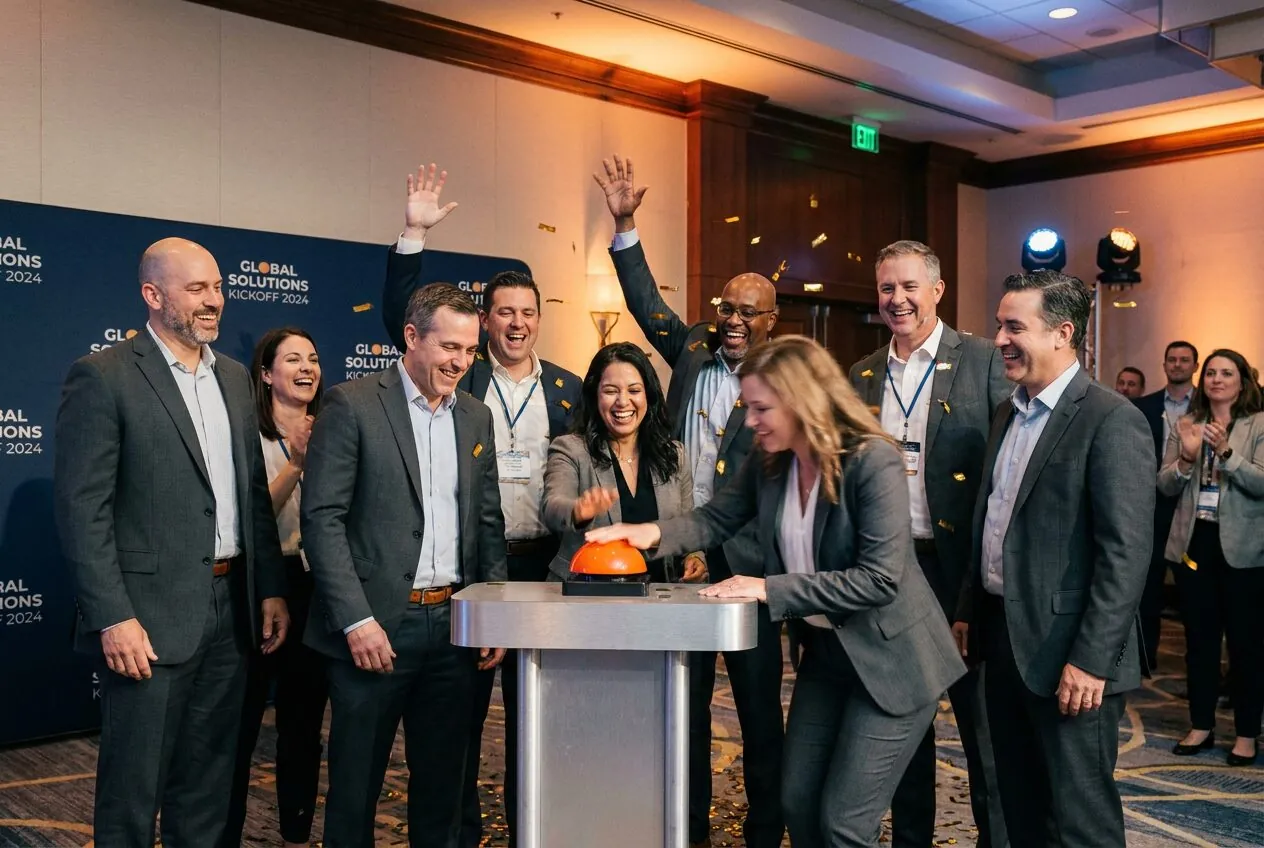
Our philosophy at It’s Playtyme Game Shows is simple. Great events aren’t measured by how many people attend. They’re measured by how many participate. Since 2012, our founder and hosting team have run more than 3,000 events using live game shows as the vehicle for competition, laughter, and connection.
This is a fully hosted opening act. We bring the host, the sound engineer, the equipment, and the pacing, and your reps compete in teams from the first minute. Formats include Face 2 Face Feud, The Challenge, Word Play, 60 Seconds of Fame, Trivia Mania, and PlayPad Mania. We serve corporate and education groups across New Jersey, New York City, New York State, and Connecticut.
Best for: high-energy opening or closing sessions for 25 to 300 people.
Pricing: starts at $2,995 for a 60-minute show and $3,595 for a 90-minute show. Groups of 300 or more receive a custom quote. See full pricing. Price does not include setup and breakdown, travel, customization, or gratuity.
What works well:
- Turnkey execution, so your sales operations team plans nothing.
- Everyone plays. No one sits on the sidelines watching four volunteers.
- Team assignments mix regions and departments, which breaks the usual seating cliques.
Competitive Strategy Simulations
Reps love to solve problems and beat a clock. Strategy simulations drop teams into a fictional market where they allocate budget, negotiate with other tables, and outmaneuver their peers. It channels daily selling skills into a low-stakes contest and works as a midday reset.
These exercises live or die on facilitation. Clear rules keep the room moving, and a good facilitator adjusts difficulty to the seniority in the room. Watch the clock, because rule explanations eat more time than most planners budget.
Best for: mid-sized sales departments of 50 to 100 people who want an analytical challenge.
Pricing: not publicly listed. Cost tracks the facilitation firm and the physical materials.
What works well:
- Puts negotiation and resource allocation skills to direct use.
- Holds the attention of analytical team members who tune out of party formats.
Where it falls short:
- Long setup and rule briefing before anything fun happens.
- Reads like actual work unless the theme is strong.
Peer Recognition Awards Dinners
Celebrating wins matters to sales teams, and a certificate handout does not count as celebrating. A peer recognition dinner hands the awards to teammates rather than to the org chart. Managers write the categories, colleagues present them, and the room does the rest.
Keep the humor positive and specific to the person. The best version of this format produces inside jokes your team still repeats at the next kickoff.
Best for: evening sessions and larger sales organizations of 100 to 300 people.
Pricing: not publicly listed. Catering, venue, and award production drive the number.
What works well:
- Creates shared references that outlast the event itself.
- Adapts to your culture without a vendor rewriting anything.
Where it falls short:
- Every category needs vetting so the jokes stay professional and inclusive.
- People sit with the same team all night, so departments never mix.
Interactive Pitch Competitions
A kickoff is the right moment to sharpen product messaging under pressure. Split the room into random teams, hand each one an absurd fictional product, and give them 20 minutes to pitch a panel of executive judges. The randomized teams do the networking work for you.
The ridiculous product removes the fear of getting it wrong. Reps practice structure, objection handling, and close, and the audience gets a genuinely funny hour.
Best for: intimate sales teams up to 25 people, or regional breakouts inside a larger kickoff.
Pricing: not publicly listed. Run in-house, it needs props, a timer, and a block on the agenda.
What works well:
- Real presentation practice inside a comedic setting.
- Entertaining for everyone watching, not just the presenters.
Where it falls short:
- Extroverts take the mic and quieter reps end up as scribes.
- Executives have to block real time to judge it properly.
Trivia Tournaments
Trivia is the most flexible energy tool on this list. Mix company history with pop culture, sports, and industry questions, and the whole room has a shot at scoring. Buzzers or a scoring app add a competitive edge that a whiteboard cannot.
Trivia scales from a small breakout to a full ballroom and asks nothing physical of attendees, which keeps it comfortable for every person in the room. The tradeoff sits in delivery: the questions are only half the show, and the host is the other half.
Best for: fast opening sessions or the post-lunch slump, at almost any headcount.
Pricing: not publicly listed for DIY platforms. Cost depends on whether you hire a host or run software yourself.
What works well:
- Scales from a 20-person breakout to a ballroom crowd.
- Teams confer quietly, then shout the answer, so nobody is exposed alone.
Where it falls short:
- DIY software versions stall on Wi-Fi and flat delivery.
- People stay seated, so the room never mixes.
Charity Build Challenges
Pairing competition with a cause gives a kickoff a second payoff. Teams race to assemble bicycles, care packages, or wheelchairs for a local nonprofit, then hand them over on site. The shared deadline forces collaboration between people who rarely work together.
The handoff moment is the point. When the charity representatives walk in to collect the donations, the room gets a reason to care beyond the quota slide.
Best for: mid-sized to large organizations that want a purpose-driven afternoon block.
Pricing: not publicly listed. Materials and the donation itself usually make this the priciest option here.
What works well:
- Delivers something tangible to the local community.
- Pulls attention away from internal metrics for an hour.
Where it falls short:
- Logistics and charity coordination start weeks ahead.
- The pace is too gentle to open a kickoff.
How to Choose Sales Kickoff Entertainment That Fits Your Room
Two factors settle it: the exact headcount and where the activity sits on the agenda. A format built for 25 will not hold 300, and the best activity in the world dies in a 5 p.m. slot. Confirm the final headcount before you shortlist anything, then hold the opening block on the agenda rather than the closing one. If half your reps work remotely, weight the decision toward formats that assign mixed teams instead of formats that hope people mingle. Then pick corporate team-building that guarantees participation without putting your planning committee on stage. When the host, equipment, and pacing arrive with the vendor, your sales leaders get to play alongside their teams instead of running the show.
Want a kickoff where the whole room plays? Book your event and we will bring the host, the format, and the equipment to your venue. Every show is backed by our 100% Satisfaction Guarantee.
Frequently Asked Questions (FAQs)
How much does a live game show cost for a sales kickoff?
Pricing starts at $2,995 for a 60-minute show and $3,595 for a 90-minute show. Groups of 300 or more receive a custom quote. See full pricing for details. The price does not include setup and breakdown, travel, customization, or gratuity.
What is the best opening activity for a sales conference?
The best opener creates immediate interaction without putting anyone on the spot. A professionally hosted game show does that in the first five minutes, mixes teams across regions, and sets the energy level for the sessions that follow.
How do you handle large sales kickoff events in New Jersey and New York City?
We scale the format so participation stays high. Large rooms use team-based answering, rotating on-stage players, and faster pacing, which keeps a crowd of 300 locked into the same competition. We bring the full setup to your hotel ballroom, conference venue, or office across New Jersey, New York City, New York State, and Connecticut.
Why does a live hosted format work better for hybrid sales teams?
Remote reps who see each other once a year need structure, not an open room. A hosted game show assigns mixed teams on arrival, so a field rep from Connecticut is competing beside someone from the New York City office within minutes. The connections happen inside the game instead of depending on who is willing to introduce themselves.
Are these activities suitable for introverted team members?
Yes, and often better than open networking. The rules are clear, the attention sits on the game rather than the person, and everyone plays inside a team. Nobody has to walk up to a stranger and start a conversation cold.