Planning a corporate event can feel like a gamble. You book the venue, order the food, and send the invites. Then the real question hits: will people actually talk to each other? Or will they cluster in the same cliques, check their phones, and leave the second it’s polite to go? The hard part isn’t finding something fun. It’s finding an activity that scales, pulls everyone in, and builds real connections without feeling forced.
Weak participation costs real money. A Gallup report on the global workplace puts the price of low employee engagement at $10 trillion a year. Strong group experiences push the other way. McKinsey research on employee experience found that organizations in the top quartile for employee experience deliver twice the innovation and customer satisfaction. The right corporate entertainment isn’t just a party. It’s a tool for building a connected, effective team. Measure a great event by how many people join in, not how many show up. For the full picture, see our approach to corporate event entertainment.
| Group Size | Recommended Idea | Why It Works at This Size | Why It Breaks at Scale |
|---|---|---|---|
| Small (Under 50) | Escape Room | Drives intense small-group collaboration in a structured setting. Everyone gets a role. | Impossible to run all at once. You need multiple rooms, which splits the group and creates chaos. |
| Medium (50-200) | Hosted Live Game Show | Structures participation for the whole room at once. Creates a shared focal point that bridges cliques. | Scales well to larger crowds, though it takes a professional host to manage the energy and logistics. |
| Large (200-500+) | Conference-Style Interactive Breakouts | Splits a big crowd into focused groups for hands-on challenges and discussion. | Can feel disjointed without a strong opening and closing to pull everyone together. |
What This Comes Down To
- The real challenge is finding one activity that scales and pulls your entire group in, not just a few.
- Low employee engagement costs $10 trillion a year globally, according to a Gallup workplace report.
- McKinsey found that top-quartile companies for employee experience deliver twice the innovation and customer satisfaction.
- The right corporate entertainment is a tool for building a connected, effective team, not just a party.
Corporate Entertainment for Small Groups (Under 50 People)
With a smaller team, you can pick more intimate and logistically demanding activities. The goal is depth of connection. A small headcount means everyone gets a voice and a hands-on role.
1. Escape Rooms
An escape room drops your team into a themed space where they solve a chain of puzzles to “escape” before the clock runs out. It works because it forces direct communication among a small team of 6 to 10 people. The shared goal and ticking clock build natural urgency and teamwork. The model breaks down fast with bigger groups. Run several rooms at once and you split the team, killing the shared experience.
2. Cooking Class
A hands-on cooking or mixology class gets people out of their office heads. Building a meal or a cocktail together opens up relaxed, informal conversation. The main challenge is managing dietary restrictions and making sure everyone stays active, since some people hang back while others take over.
3. Volunteer Day
A day of service for a local charity ties your team to a bigger purpose and shows what the company stands for. Sorting food at a food bank or cleaning up a park builds camaraderie through shared effort. Success hinges on picking an activity that is physically accessible to everyone and matches your team’s interests.
4. Upscale Dinner or Wine Tasting
To reward a small, high-performing team, a high-end dinner or guided wine tasting works well. It’s sophisticated and shows appreciation. The catch is that these events turn passive fast. Without structure, people drift toward the colleagues they already know, which defeats the purpose of building new connections.
Corporate Entertainment for Medium Groups (50-200 People) in NJ, NYC & CT
This is often the toughest group size. It’s too big for intimate activities but too small for a full conference format. The fix is an idea that gives the whole group structure at once, so it doesn’t fracture into disconnected cliques.
5. Hosted Live Game Shows: The Whole-Room Solution for Medium Groups
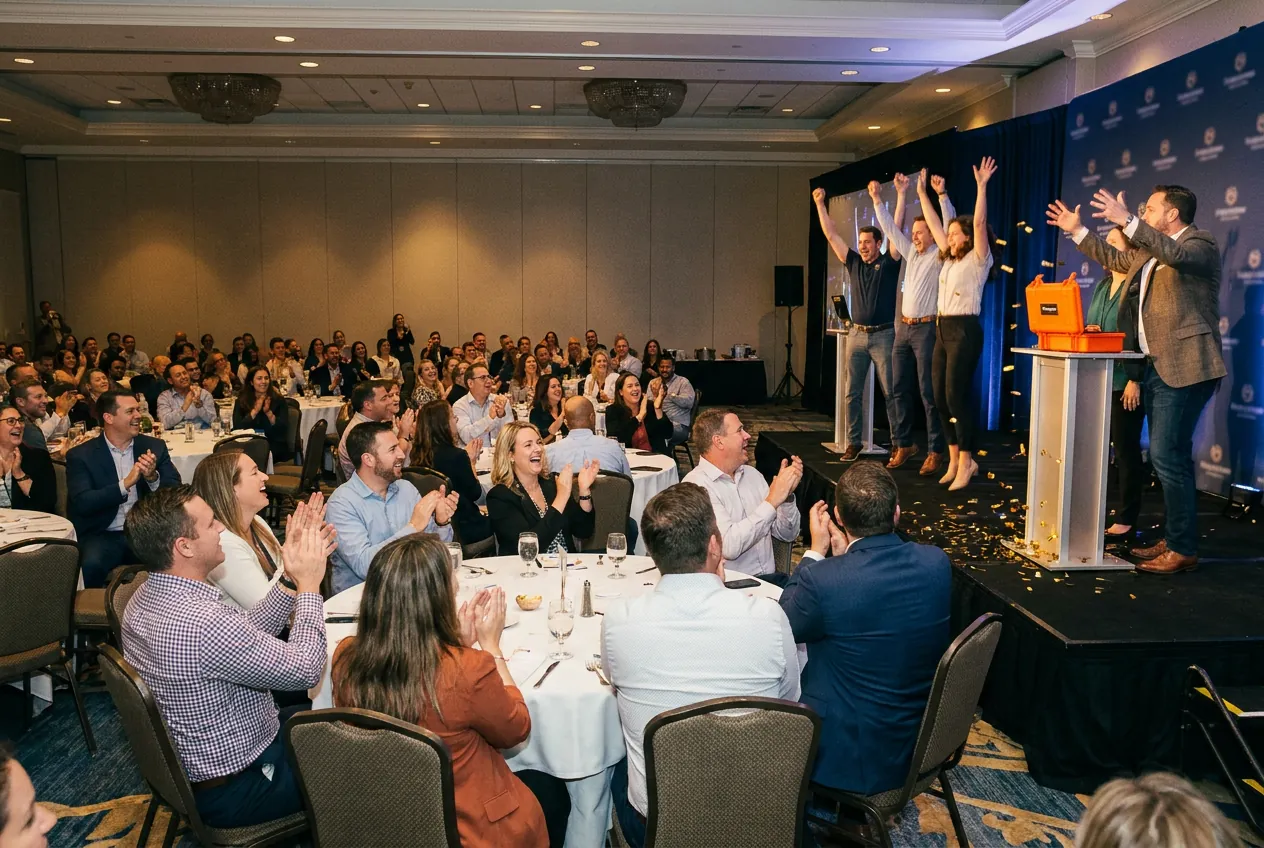
A professionally hosted, TV-style game show fits this size perfectly. Formats like our Face-2-Face Feud or custom trivia get everyone in the room playing at the same time. It’s not a few brave volunteers on stage. It’s teams at every table working together, shouting answers, and competing in a structured, high-energy setting. Since 2012, It’s PlayTyme Game Shows has used these experiences as the vehicle for engagement across NJ, NYC, and CT. We handle every detail, from the host and equipment to the custom questions, so the organizer gets a turnkey event.
6. City-Wide Scavenger Hunts
A scavenger hunt gets teams moving, exploring, and solving clues together. A dedicated app streamlines the game and runs real-time leaderboards that fuel competition. The risks are logistical. These events depend heavily on weather, raise accessibility challenges for some people, and take careful planning so no team gets hopelessly lost.
7. Casino Night
A casino night brings Vegas glitz to your event with blackjack, poker, and roulette, all played for prizes rather than cash. It offers variety and lets people mingle between tables. It also invites self-segregation, with guests locking onto one game or a small group. A gambling theme doesn’t fit every corporate culture, either.
8. Private Movie Screening
Renting a theater for a private screening is easy to arrange and feels like an exclusive perk. It’s low-pressure and relaxing. Its biggest strength is also its biggest flaw: it’s completely passive. There’s zero room for interaction or connection, so it’s really a solitary experience people happen to share in one room.
Corporate Entertainment for Large Groups (200-500+ People)
A group this size calls for a one-to-many approach that creates one unified experience. The challenge is making every person feel part of the main event instead of a face in the crowd.
For smaller in-office gatherings, our office party entertainment ideas guide covers what works in a normal meeting room.
9. Conference-Style Interactive Breakouts
Instead of one giant activity, design a series of shorter, interactive breakout sessions that people rotate through. Think minute-to-win-it challenges, collaborative problem-solving workshops, or group brainstorms on a real business topic. It keeps energy high, but it takes serious coordination to manage the flow of people and activities.
10. Company Field Day
A classic field day of team-based games brings out a nostalgic, competitive spirit. Activities run from low-impact, like giant Jenga or cornhole, to active, like relay races. It’s great for energy and spectacle, yet it demands a large outdoor space, leans entirely on good weather, and can leave out people with physical limitations.
11. Charismatic Keynote Speaker + Live Polling
A dynamic keynote speaker can hold a large audience with a strong message. To turn passive listening into active participation, add live polling. When the audience votes on questions or submits their own by smartphone, they become part of the presentation. The hard part is finding a speaker who commands the room and works the interactive elements in smoothly.
12. Live Band or Private Concert
For a celebration like a holiday party or a major milestone, a live band delivers high-energy atmosphere and a clear focal point. Like a movie screening, though, it stays passive at its core. People may dance together, but it doesn’t spark conversation or build the cross-departmental connections that structured interactive events do.
Why Scaling Up Breaks Most Corporate Entertainment Ideas
Why does an idea built for 30 people, like a cooking class, fall apart for 300? The answer sits in group psychology and logistics. As a group grows, several problems surface that can wreck an event’s goals if you don’t manage them.
- Logistical breakdown: Complexity climbs fast with every added person. An escape room for 10 is simple. Coordinating 20 escape rooms for 200 people, with everyone starting, ending, and debriefing together, is a nightmare.
- The participation gap: In a group of 10, most people speak up. In a group of 200, the majority recede and let a few extroverts take the spotlight. That’s why open Q&A in a big hall usually meets silence. People fear looking foolish in front of a crowd.
- Clique reinforcement: Without a structure that forces mingling, big groups don’t mix. People gravitate to the familiar faces from their own department, and the event reinforces the very silos it was meant to break.
- Shift to passive consumption: Facing all this, many organizers default to safe but passive entertainment like a DJ or a speaker. Guests get entertained, not engaged. They watch a show instead of joining an experience, and the connection goal disappears.
- Planner overload: The DIY route dumps every vendor call, timeline, and run-of-show detail onto one already-stretched person, and the bigger the group, the heavier that load. A fully hosted, turnkey format lifts the coordination off the planner entirely.
- Justifying the spend: Getting budget approval is its own hurdle. The counter is to weigh the cost against the documented drain of a disengaged team, so the event reads as an investment in connection rather than a line-item expense.
Getting Corporate Entertainment Right for Your Group Size
Picking the right activity means thinking like an engagement strategist, not a party planner. Before you sign a contract, run through these decision drivers to make sure your choice matches your goal.
- Start with your “why.” What is the single outcome you need most? Rewarding the team for a strong quarter? Integrating new hires? Breaking down walls between siloed departments? The goal dictates the format.
- Honor your group size. Size is the biggest logistical factor. Be realistic. Choose an activity built for your headcount, not one you hope to stretch to fit.
- Set the level of interaction. Do you want a relaxing experience or an active, high-energy one? Be honest about what your culture will embrace. A competitive sales team might love a field day, while engineers may prefer a structured problem-solving game.
- Consider the personalities in the room. An activity that forces introverts into the spotlight will backfire. The best ideas, like a team-based game show, let people join at their comfort level while still sharing the group energy.
- Factor in every logistic. Look past the price tag to venue needs, transportation, weather backup, food and beverage, and the planning hours your team will spend. A turnkey solution from a professional vendor delivers higher ROI by saving you dozens of hours of coordination.
Ready to skip the planning stress and host an event where people actually participate? It’s PlayTyme Game Shows delivers turnkey, professionally hosted game shows that get groups engaged across NJ, NYC, and CT. We back it with a 100% satisfaction guarantee, because we know we can deliver a memorable, high-participation experience. Let’s plan your event.
Frequently Asked Questions (FAQs)
What’s the best entertainment for a mixed group of ages and job titles?
The best options don’t hinge on physical ability or pop-culture knowledge. Hosted game shows like Face-2-Face Feud shine because they use survey-based questions everyone can guess, which pulls interns and executives into the same team across generations.
How much lead time do I need to plan corporate entertainment?
For simpler events, 4 to 6 weeks is usually enough. For complex activities or peak season, like holidays and summer, plan 3 to 6 months to lock in your date and vendor. Turnkey solutions often book on a shorter timeline because the provider handles most of the logistics.
How much does corporate entertainment cost?
Cost depends on your group size, the format you choose, and your location. Rather than chase the lowest sticker price, weigh the value: a turnkey, professionally hosted game show saves an event planner dozens of coordination hours and drives far higher participation than a passive DJ or speaker. We build a custom quote around your headcount and goals so you know exactly what the event delivers.
Our team is remote or hybrid. What ideas work for them?
This article focuses on live events, but many providers run virtual versions too. Virtual game shows, online escape rooms, and guided virtual tastings bring remote teams together for a shared, interactive experience. The key is a live, professional host to manage the energy and the technology.