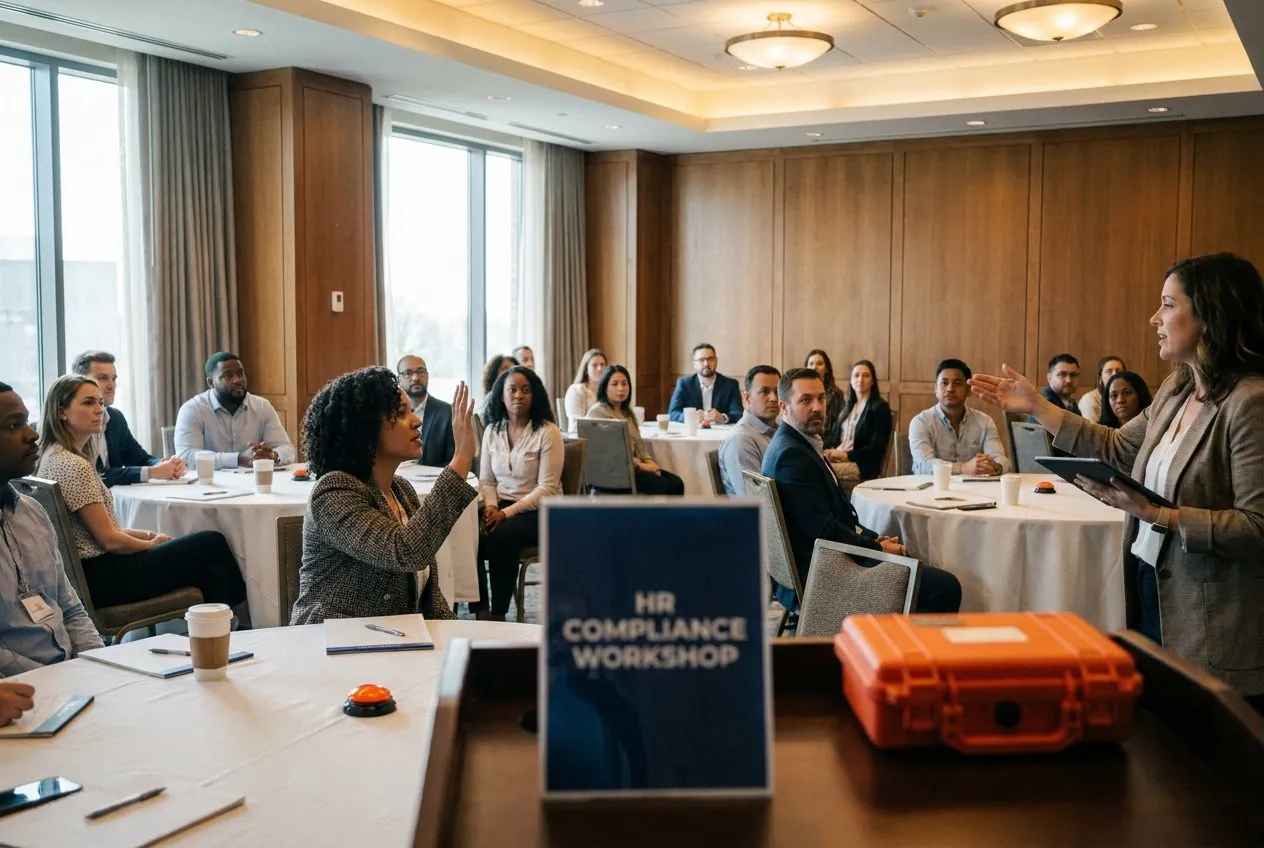
An HR lead with offices in Newark, Manhattan, and Stamford runs three training calendars at once. New York Labor Law Section 201-g requires interactive sexual harassment prevention training for every employee, every year, at every employer with one or more workers. Connecticut General Statutes Section 46a-54(15) sets a different bar: two hours of training for employers with three or more employees, delivered within six months of hire. New Jersey legislates neither.
Handing out a printed policy does not satisfy New York. Neither does playing a video that nobody monitors.
The New York State model policy and training guidance defines interactive in plain terms. The session asks employees questions, answers their questions promptly, or collects written feedback at the end. The current state model materials are dated August 2024, so check you are using the latest version.
This article is general information, not legal or tax advice. Confirm your obligations with licensed employment counsel before you set a training calendar.
Mandatory Sexual Harassment Prevention Training: NY vs. NJ vs. CT Compliance Comparison
The obligation changes the moment you cross a state line. New York sets an annual bar for every private employer. Its neighbors run on different triggers and different clocks.
| Jurisdiction | Covered Employers | Required Frequency | Interactive Component Required? | Governing Statute or Authority |
|---|---|---|---|---|
| New York State | All employers with 1 or more employees | Annually, for every employee | Yes (questions asked, prompt Q&A, or required feedback) | NY Labor Law Section 201-g |
| New York City | Employers with 15 or more workers, or one or more domestic worker, in the prior calendar year | Annually, for every employee | Yes (participatory; need not be live or in person) | NYC Administrative Code Section 8-107(30) |
| Connecticut | Employers with 3 or more employees | Within 6 months of hire; supplemental at least every 10 years | Two hours of training required | C.G.S. Section 46a-54(15) |
| New Jersey | No general private-sector statutory mandate | Voluntary (free state trainings available) | Encouraged for risk reduction, not legislated | NJ Division on Civil Rights guidance |
What Counts as Interactive Training in New York State
New York measures interactivity by participation. The session has to move in two directions, not one. Build in at least one of these elements:
- Embedded knowledge checks: The program asks questions during the session and requires an answer before the employee moves on.
- Prompt answers: Online and recorded formats give employees a clear way to ask questions and get a timely reply from a qualified trainer or HR lead.
- Required feedback: Attendees submit a written evaluation of the training and the materials when they finish.
- Live scenario discussion: A facilitator walks the room through real workplace dilemmas and takes the questions that follow.
New York City adds a layer. The NYC Commission on Human Rights requires annual participatory training for employers with 15 or more workers, or one or more domestic worker, in the prior calendar year. The session does not have to be live or in person.
How Connecticut and New Jersey Regulate Workplace Training
Connecticut wrote its requirements into Section 46a-54(15) of the General Statutes. Any business with three or more employees must deliver two hours of training to every worker.
New hires get trained within six months of their start date. Supplemental training follows at least once every ten years. Connecticut skips the annual refresher, and that is the single biggest difference from New York.
New Jersey runs on a different model. No general statute requires private employers to train staff on harassment prevention.
The New Jersey Division on Civil Rights still offers free trainings on preventing workplace discrimination, including harassment.
5 Interactive Harassment Training Formats That Satisfy NY State & NYC Standards
Meeting the interactive standard does not require a lecture. These five formats raise comprehension and keep the room awake.
- Scenario-based problem solving: Give teams an ambiguous situation. Let them argue over whether the conduct crosses the line and what the right next step is.
- Real-time polling: Collect anonymous answers on policy definitions, reporting steps, and bystander duties while the session runs.
- Small-group discussion: Break large departments into pods of six to eight for ten minutes. Everyone talks instead of three people dominating.
- Knowledge checks: Run a short multiple-choice review after each topic to confirm people understand reporting and non-retaliation rules.
- Dedicated Q&A: Answer submitted questions in full and keep a channel open for follow-ups after the session ends.
Gamified Compliance Reinforcement With Hosted Team Review Sessions
Annual modules cover the legal definitions and the reporting path. What people still remember six weeks later is a different question. Reinforcement keeps the core rules in working memory.
Across more than 3,000 live events since 2012, It’s PlayTyme Game Shows has solved one problem: getting a group of people to connect. A great event is not measured by how many people attend. It is measured by how many play.
We serve New Jersey, New York City, New York State, and Connecticut, with programs built for groups of 20 to 300+.
For training teams, a custom trivia or feud-style round works as a post-training review. You send the policy points, company values, and compliance topics. We turn them into fast rounds and host them live, in person or on Zoom. See how our training and compliance game shows work.
A hosted review never replaces the mandated curriculum. It gives people a reason to use what they just learned, out loud, in front of their team.
Organizations that invest in corporate team-building get a format where every person in the room plays. Shows run 60 or 90 minutes, starting at $2,995, with full facilitation and your questions built into the game. No deposit is required, and your date is reserved once the signed performance agreement is returned. It is corporate event entertainment that also sharpens how your people talk to each other.
Where Tri-State Compliance Training Programs Break Down
Six obstacles show up again and again in tri-state corporate compliance training. Each one compounds the next.
- Click-through completion: unmonitored slide decks invite employees to click without reading, which kills comprehension and fails the participation standard outright.
- Compliance fatigue: the same check-the-box video every year breeds resentment, and people start treating a serious legal duty as an annoyance to clear before lunch.
- Retention drop-off: employees pass the quiz in March, then go quiet in October when a real incident calls for a report or for someone to step in as a bystander.
- Gray-area conduct in chat: managers hesitate over borderline comments in Slack threads, Teams channels, and Zoom chats, where tone is thin and the record is permanent.
- Silence on sensitive topics: people hold back questions about harassment, retaliation, and reporting in a large formal session, because nobody wants to be the one who asked.
- Recordkeeping across cycles: New York’s annual clock and Connecticut’s ten-year clock run side by side, so an annual workplace harassment audit of completion records is what keeps an administrative gap from turning into legal exposure.
Digital Modules or Live Reinforcement: Where Your Next Training Dollar Belongs
The split is tracking versus culture. Self-paced e-learning gives you clean completion records across a distributed tri-state workforce, and it rarely starts a real conversation. Live group review does the opposite: it surfaces the questions nobody types into a quiz box.
Fund both, and give each one its job. The individual modules satisfy the statute and your audit trail. A hosted session is what makes the content stick past the next payroll cycle.
Ready to turn your next policy review into something your team talks about afterward? Contact our event production team to build a custom hosted game-show session for your organization.
Related reading
Frequently Asked Questions (FAQs)
What makes sexual harassment training interactive under New York State law?
The training has to require participation. Ask employees questions they must answer, give them a way to ask questions and get a prompt reply, or require a feedback form at the end. Any one of those clears the bar, and the state encourages employers to include as many as they can.
How do New York City training requirements differ from New York State rules?
State law covers every employer with at least one employee and requires annual interactive training. City law applies to employers with 15 or more workers, or one or more domestic worker, in the prior calendar year, where State law reaches every employer.
Is anti-harassment training legally mandatory for private employers in New Jersey?
No general statute requires it. The New Jersey Division on Civil Rights offers free trainings on preventing workplace discrimination.
How often must Connecticut employers train their employees?
Under Connecticut General Statutes Section 46a-54, employers with three or more employees provide two hours of training to every worker, train new hires within six months of their start date, and deliver supplemental training at least once every ten years.
Can a corporate team game show replace our statutory compliance training?
No. A hosted game show reinforces the material and never substitutes for the state-mandated curriculum. Run it after employees finish their required training to test what stuck and build the culture around it.