Quick answer: Personality assessments give a team a shared language and a clearer picture of each person’s work style. Experiential team building, such as a professionally hosted game show, changes how people work together in the moment. For lasting change, pair them: run the assessment first, then hold a hosted session where the whole team puts that vocabulary to work.
Picture the offsite where everyone filled out a profile, learned their type and went back to work talking to the same three people. The insight was real. The behavior didn’t change.
That gap shows up in the numbers. Gallup reports that global employee engagement has dropped to 20%, down from its 2022 peak of 23%. HR and L&D leaders feel it every time a team session falls flat.
So the real question about personality tests for team building isn’t whether they work. It’s which outcome you need by Monday: people who understand each other, or people who actually work together.
Why Team Sessions Fall Flat
Most team sessions fail for the same reason. They rely on volunteers to step up while everyone else watches. A handful of people take part, and the rest check their phones.
Hybrid schedules make this worse. Colleagues who mostly know each other as faces on a video call arrive in person and fall back on the habits of those calls: stay quiet, stay muted, wait to be called on. Screen fatigue doesn’t switch off at the office door.
Forced interaction doesn’t help. People need to feel safe speaking up before they’ll try something new in front of colleagues. An activity that feels like homework or a trust exercise does the opposite, so they go quiet and wait for it to end.
Then comes the budget conversation. Whoever approves the spend wants to know what changes afterward, and “people enjoyed it” doesn’t answer that. The test we use: great events aren’t measured by how many attend; they’re measured by how many participate.
What a Personality Assessment Workshop Changes
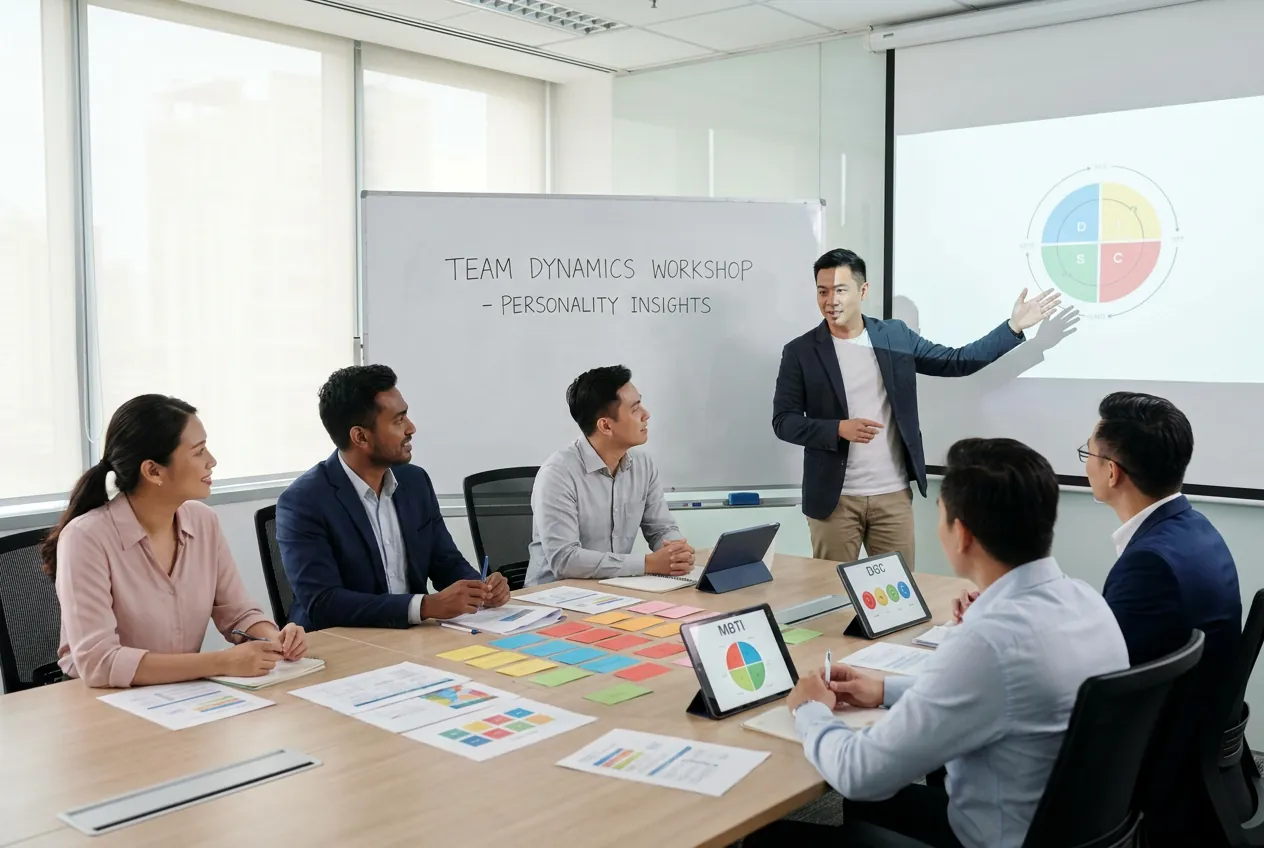
A personality assessment workshop built on a tool like DISC or Myers-Briggs starts on the inside. Each person learns how they prefer to communicate, make decisions and handle pressure. The team leaves with a shared vocabulary for those differences.
That vocabulary is useful. Instead of calling a colleague difficult, a manager can say, “They need the data before they commit.” Conversations get more specific and less personal.
The workshop also asks more of everyone involved:
- Prep time: Each participant completes the assessment before the session.
- Facilitator: A trained or certified facilitator interprets the results and leads the discussion.
- Follow-through: The language only sticks if managers keep using it in one-on-ones and team meetings.
- Cost structure: Usually a per-person assessment fee plus the facilitator’s time.
The gap is practice. Knowing your style is one skill. Using that knowledge with a colleague while the clock is running is another.
What a Hosted Team-Building Game Changes
A professionally hosted game show starts on the outside. People split into teams, face a clock and a scoreboard, and have to talk, decide and adjust together. Within minutes, the quiet analyst and the outspoken sales lead are on the same side, debating the same answer.
The format does the work. Everyone already knows how a game show runs, so nobody has to learn anything first. The pace stays fast, and a professional host keeps the whole room involved, not just the volunteers. Nobody is asked to share feelings or fall backward into a colleague’s arms; they just play on a team.
- Prep time: None for participants. They walk in and play.
- Facilitator: A professional host, backed by a sound engineer and full production support.
- Group size: 20 to 300+ people in a single session.
- Cost structure: A per-event fee, not a per-person charge.
- Follow-through: One 60- or 90-minute session won’t change habits on its own. The carry-over comes from a short debrief afterward and from managers pointing back to what the team saw.
What it doesn’t do is give people a framework for understanding their own personality. That’s the assessment’s job.
Personality Tests vs. a Hosted Team-Building Game: Side by Side
Here’s how the options compare on the factors HR and L&D leads weigh most.
| Option | What it changes | Group size | Participant prep | Who runs it | Cost structure |
|---|---|---|---|---|---|
| It’s Playtyme Game Shows (hosted team-building game) | How people work together, live | 20 to 300+ | None | Professional host plus sound engineer | Per-event fee, starting at $2,995 |
| Personality assessment workshop (DISC, Myers-Briggs) | Self-awareness and shared vocabulary | Limited by how many profiles the facilitator can debrief | Each person completes the assessment | Trained or certified facilitator | Per-person assessment fee plus facilitator time |
| In-house team engagement activities | Depends on who volunteers | Varies | Organizer plans and runs everything | Internal staff | Staff time and supplies |
Why the Strongest Teams Pair Them
You don’t have to choose. Use each tool for what it does best. Run the assessment first so people have the vocabulary. Then bring the team together for a hosted session where they use it live, under friendly pressure, with the whole group watching the scoreboard.
When your L&D lead or assessment facilitator runs the debrief, it gets specific fast. People saw who took charge, who held back and who spotted the answer first. The profile results stop being theory.
One clarification: It’s Playtyme Game Shows doesn’t run or score personality assessments. We provide the hosted team-building session. Your assessment provider or internal L&D team handles the profiles.
What It’s Playtyme Game Shows Brings to the Room
It’s Playtyme Game Shows uses interactive group game shows as the vehicle for team connection. In 14 years and more than 3,000 live events since 2012, our team has focused on one thing: getting every person in the room to participate.
- Formats: Face-2-Face Feud, The Challenge, 60 Seconds of Fame, Word Play and custom game shows built around your company.
- Group size: 20 to 300+ people, with larger groups by custom quote.
- Show length: 60 or 90 minutes.
- Service area: New Jersey, New York City, New York State and Connecticut. The show comes to your office, conference venue or offsite location.
- Pricing: Starting at $2,995.
- Guarantee: A 100% Satisfaction Guarantee, with no deposit required to book.
Assessment, Hosted Session or Both: Match the Tool to Your Team’s Goal
Start with the outcome you need. Then match the tool to it.
- Choose a personality assessment workshop if the team is small, friction comes from misread communication styles and managers will reinforce the language every week.
- Choose a hosted team-building game if people barely know each other, departments rarely mix, hybrid schedules keep the team apart or you need 20 to 300+ people participating at once.
- Pair them if you’ve already invested in assessments and want the team to practice what it learned.
Ask one more question before you book: what will be different on Monday? If the answer is “people will talk to each other more,” you need the whole room participating, not just listening.
Ready to put your team’s new vocabulary into practice? See how our corporate team-building sessions work. Then send us your date, room size and goal, and we’ll return a custom production plan within two business days.
Solve the participation problem
Ready to get the whole room in the game?
Frequently Asked Questions (FAQs)
Do personality tests work for team building?
Yes, for self-awareness and a shared vocabulary. They work best when a trained facilitator leads the session and managers keep using the language afterward. On their own, they don’t give people live practice working together.
Can we pair a DISC or Myers-Briggs session with a hosted game show?
Yes. Run the assessment first, either earlier in the week or the same morning. Then hold the hosted session so people use what they learned with their teammates. We don’t run or score assessments, so keep your current provider for that part.
How much does a hosted team-building game show cost?
Corporate shows from It’s Playtyme Game Shows are priced starting at $2,995. The quote depends on show length (60 or 90 minutes), and groups over 300 get a custom quote. Personality workshops are usually priced per person plus facilitator time, so the comparison depends on your headcount. For a full budget guide, see how much corporate team building costs.
What team-building format works for a large group of 50 to 300+ employees?
A hosted, interactive group game show is built for that size. It’s Playtyme Game Shows runs sessions for 20 to 300+ people, and groups over 300 get a custom quote. Large groups answer with audience-response keypads or their phones, and everyone plays as part of a team, so nobody sits on the sidelines.
Where do you host live corporate team-building game shows?
We serve New Jersey, New York City, New York State and Connecticut, and we bring the show to you. Whether your team meets in a Manhattan conference room, a Connecticut office or a New Jersey offsite venue, the setup works the same way.
Do we need to provide AV equipment?
No. We bring a professional host, a sound engineer, audio and visual equipment, TV-style podiums, buzzers and LED lighting. You provide the room.