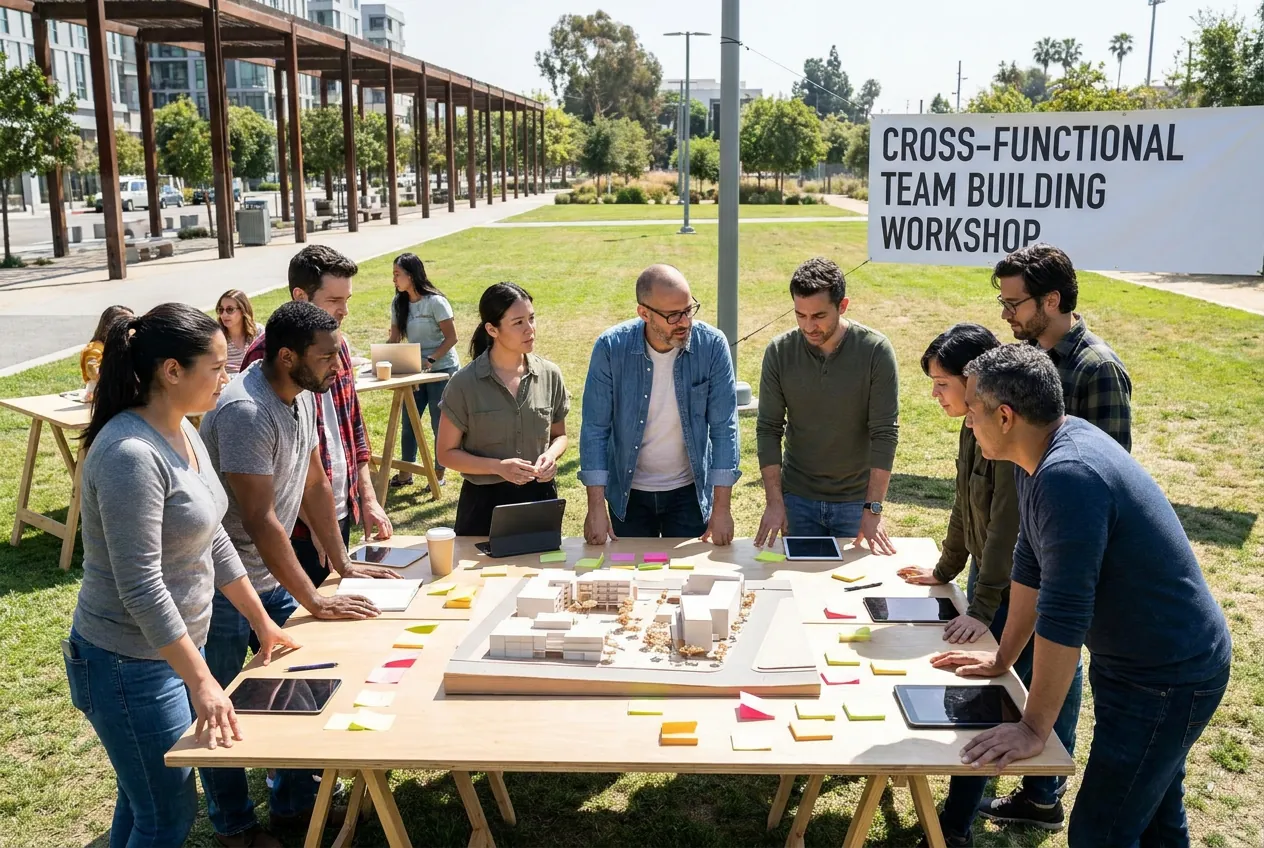
Quick answer: Cross functional team building puts employees from different departments on the same team for a shared challenge. Instead of sales competing against operations, a salesperson, an analyst and a warehouse lead work side by side. They learn names, solve problems together and carry those working relationships back to the office.
A request between two departments should take five minutes. Instead it takes three days and an email chain with six people copied, because nobody on either side has ever met.
That delay is the real cost of organizational silos. Writing in Harvard Business Review, Behnam Tabrizi reported that in a study of 95 teams in 25 leading corporations, nearly 75% of cross-functional teams were dysfunctional, failing on at least three of five criteria, such as budget, schedule and alignment with corporate goals. Projects stall, work gets duplicated and people stop asking questions. Across 3,000+ live events since 2012, we have seen the fix start in the same place: put those people in the same room, on the same team, with a reason to talk.
Why Departments Stop Talking to Each Other
Companies split apart as they grow. Marketing sits on one floor, finance on another, and sales lives on the road. People grow loyal to their own group and treat everyone else in the building like strangers.
None of this happens overnight. It builds slowly. Teams stop asking each other questions and start making assumptions instead. The result is delayed projects, duplicated work and a frustrated workforce.
The duplicated work wears people down. Two teams build the same report without knowing it, and both feel their effort went nowhere. Hybrid schedules widen the gap, because colleagues who come into the office on different days may never cross paths at all. New hires feel it most: they meet their manager and their own team, and nobody else, so every request outside that circle starts with a stranger.
Underneath all of it is a lack of psychological safety between departments. When people don’t know the team down the hall, asking a basic question feels risky, so they guess instead. Breaking down organizational silos starts with making those questions feel safe to ask.
Top-down culture initiatives and standard internal communications won’t fix it. People need to work next to each other, rely on each other and see each other succeed.
Put a developer next to an account manager in a low-stakes setting and they finally talk. They learn names. They find out they want the same outcomes. On Monday, the three-day email chain becomes a two-minute phone call.
Mixed Teams or Department Teams: Choose by Goal
Many planners set up their event as one department against another. Department teams build pride and friendly rivalry inside each group, and they work well when a host runs them fairly. If that is your goal, here is how to run a department contest fairly.
In a department contest, people stay with their own group and talk to the colleagues they already know. When the goal is getting departments to work together, mix the teams.
Scramble the seating chart and every team gets an accountant, an IT specialist and a warehouse manager. Nobody starts with an advantage. Every person has to contribute for the team to win.
In a hosted session, everyone plays as part of a team. The format gives people a direct reason to talk, without the awkwardness of forced networking. They have to agree on an answer before the clock runs out, and that shared goal does the work a mixer never does.
Here is how the common formats compare:
| Format | How teams form | Who participates | Who runs it | Best for |
|---|---|---|---|---|
| It’s Playtyme Game Shows mixed-team live game show | Mixed cross-department teams, assigned in advance | Everyone plays as part of a team | Professional host | Getting departments to work together |
| Department-against-department contest | Teams split by department | Each department as a team | A host or an internal organizer | Pride and friendly rivalry inside each department |
| Unstructured networking events and corporate mixers | People drift to colleagues they already know | Whoever volunteers | No one | Optional mingling |
| Keynote or lecture | No teams, seated audience | The speaker | Speaker | Delivering one message |
How to Build the Mixed Teams
A connected room starts before anyone walks through the door. Use these four steps to plan an event where people actually talk to each other.
-
Map Your Communication Gaps
Look at where projects stall in your organization. Note which departments misread each other or complain about slow responses. Those friction points are your targets, so put those people on the same team.
When a demanding sales team plays alongside the operations staff who fill its orders, they stop seeing each other as obstacles. They start seeing the shared effort it takes to deliver.
-
Assign Every Seat
Never let employees pick their own seats at a company offsite. Given the choice, they sit with the people they already know. Use colored name tags, numbered lanyards or pre-assigned tables to mix the room.
Seat marketing with logistics. This one administrative step stops cliques before they form. It also removes the stress of finding a seat and sets the expectation for collaboration from the first minute.
-
Choose a Format That Requires Participation
Passive formats like a keynote or an unstructured networking event give people permission to tune out. You need a format where every team has to act. It’s Playtyme Game Shows uses professionally hosted live game shows as the vehicle for group engagement.
Formats like Face-2-Face Feud and The Challenge come straight to your venue, with a professional host running every round. The format flattens the org chart, so a junior analyst and a senior director work the same problem as equals.
-
Make Sure Everyone Plays
Lisa Lawrence, who founded It’s Playtyme Game Shows, puts it simply: “Great events aren’t measured by how many attend; they’re measured by how many participate.”
Pick a format that scales so nobody watches from the sidelines. Our hosted shows run for groups of 20 to 300+ people. Every attendee gets a role and a voice on their mixed team. When the whole room is involved, the connections stick.
What Cross-Functional Team Building Costs
Silos are a business problem with a budget owner, so the cost conversation matters. Decision makers want high participation, a clear price and no surprises. Our fully hosted live game shows are priced starting at $2,995.
Shows run 60 or 90 minutes. The price includes a professional host, the game-show set, audio and visual equipment and a sound engineer. You provide the room and the people. We provide the format, the host and a structure where every person participates.
What to Do Afterwards Back at Work
The real return on cross functional team building shows up on Monday morning. Capture the momentum and build it into daily work.
-
Start the Follow-Up Conversations
Share photos and final standings on the company intranet the next day. Mention the standout moments in your weekly staff email.
This gives people an easy reason to walk over to another department and pick up the conversation. Talking across teams becomes normal, not unusual.
-
Assign Small Cross-Department Projects
Build on the new relationships right away. If the IT director and the sales manager worked well together during the show, put them on a short-term committee.
They already know how to communicate under pressure. With the social barrier gone, the project moves faster, and cross-departmental alignment stops depending on a meeting invite.
-
Recognize Collaborative Wins in Public
When two departments ship a project together, call it out at the all-hands meeting. Show the company that leadership notices and rewards cross-team work.
Public recognition prompts other isolated groups to reach out on their next initiative.
Where Cross-Functional Team Building Fits on Your Calendar
You don’t need to wait for the annual executive retreat to mix departments. Any time your people are already in one room is a chance to connect them.
Executive retreats and leadership off-sites put senior leaders from different functions on one team. Staff kickoffs set the tone for the quarter or the year. Conferences and company meetings already have the whole group in one place, and corporate dinners give you a seated room that is ready to play.
For hybrid teams, an in-person kickoff or company meeting may be the rare day everyone shares the same room. That makes it the best day to mix them.
Whatever the occasion, the goal stays the same. Get the whole room participating together, so people leave as one company instead of a collection of departments.
Five Questions to Answer Before You Book a Cross-Department Event
You have a budget, a date and a room full of people who need to connect. Put each option you are weighing through these questions.
- Does every person participate? If half the room watches, the silos stay intact.
- Are the teams mixed across departments? For breaking silos, mixed teams beat department teams, which build pride inside each group instead.
- Is it professionally hosted? A host keeps the pace fast and every team involved, so your organizer takes part too.
- Does it fit your headcount? Confirm the format works for the full group, not just a volunteer few.
- Is the price clear? Know the starting cost and what’s included before you commit.
A format that checks every box changes how people work together after the event, not just during it.
Ready to get your departments working together? Book one of our corporate team-building experiences for your next offsite, kickoff or company meeting. Every show comes with our 100% Satisfaction Guarantee, and there’s no deposit to book. Tell us your date, room size and goal, and we’ll send a custom production plan within two business days.
Solve the participation problem
Ready to get the whole room in the game?
Frequently Asked Questions (FAQs)
How much does cross-functional team building cost?
Our fully hosted live game shows start at $2,995. The price includes a professional host, the game-show set, audio and visual equipment and a sound engineer. You supply the room and the people.
Where does It’s Playtyme Game Shows run cross-functional team building?
We bring hosted live game shows to your venue across New Jersey, New York City, New York State and Connecticut. We have run these programs since 2012 from our base in Teaneck, New Jersey.
Why mix departments instead of having them compete?
A department contest fits when you want pride and friendly rivalry inside each group, and it works well when a host runs it fairly. For breaking down silos, mixed teams work better. Mixing employees into shared teams makes them rely on new colleagues. That builds trust and speeds up everyday communication back at the office.
What are the best examples of cross-functional team building activities?
The strongest examples put mixed teams on a timed, shared challenge where every member has to contribute. Our hosted formats include Face-2-Face Feud, a survey-style team game, The Challenge, a category answer board, and Word Play, a word puzzle round. In each one, a salesperson, an engineer and a finance lead have to agree on one answer before time runs out.
How do cross-departmental activities improve company ROI and workplace culture?
The return shows up in daily work. Requests between departments move faster because people know who to ask, duplicated projects get caught earlier, and new hires have contacts outside their own team. For workplace culture, a shared win gives people a reason to keep talking long after the event ends.
How do you structure a cross-functional activity?
Start by identifying which departments struggle to communicate. Assign those people to the same tables in advance. Then run a hosted format where each team has to agree on answers together. Our formats work for groups of 20 to 300+ people, and every person plays on a team, so nobody watches from the back of the room.