
Quick answer: Team building for municipal employees is a professionally facilitated staff development session for department staff or a council retreat, booked through your normal quote and purchase-order steps. Set the participation goal first. Then confirm the budget line and vendor documents, and place mixed-department teams inside a clearly timed retreat agenda.
The retreat date is on the calendar. Purchasing wants a written scope, department heads need coverage, and staff expect one more meeting with the same familiar faces.
A good booking solves all three, and this guide walks through each one: a clean approval packet for purchasing, a workable schedule that keeps services covered, and structured participation across departments.
The goal is simple. Employees who usually trade requests by email spend an hour solving challenges together. A live game-show format supplies the structure, and a professional host runs the room so your HR director or municipal administrator can focus on the group.
Define the Outcome Before Requesting a Quote
Start with the workplace connection you want to strengthen. Name the departments attending, the occasion, and what success looks like the following week.
For a municipal staff development day or public sector in-service, the outcome is clear: employees recognize colleagues from other departments and start conversations with them. For a council retreat, the priority is shared participation before an afternoon of planning discussions.
Write the scope with public scrutiny in mind. Describe a professionally facilitated session in interdepartmental communication and staff development, with a set duration, location, participant count, and production scope. That language matches what happens in the room, and it tells anyone reviewing the purchase order later why public funds paid for it.
A sample request reads: “We need a hosted session during our staff retreat that puts employees from different departments on mixed teams.” Add expected attendance, room details, preferred timing, and your purchasing contact.
That gives the vendor something concrete to quote. It also gives the approving department head a plain explanation of what the municipality is buying.
What Purchasing Needs in the Vendor Packet
Before you request proposals, ask your purchasing contact which approval process and vendor documents apply to this purchase.
Use the checklist below to assemble the vendor packet, then follow your own office workflow.
- Written quote: Request the vendor name, service description, event date, location, duration, attendance assumptions, inclusions, and quoted total.
- W-9: Ask how purchasing wants the vendor tax form submitted and who handles vendor setup.
- Certificate of insurance: Send the municipality’s insurance requirements to the vendor and have purchasing review the returned documentation.
- Purchase order: Confirm who creates the purchase order, when it is issued, and how the vendor should reference it.
- Budget line: Identify the department, funding source, or budget code your finance team assigns to the purchase.
- Invoice instructions: Provide the billing contact, submission method, and supporting documents your accounts-payable team requires.
Your municipality issues the purchase order, not the vendor. Clarify that handoff early so nobody mistakes an accepted quote for a finished purchasing process.
Ask the vendor to flag any open scope details before your office routes the quote. An unsettled room assignment or attendance estimate creates revisions later.
Get insurance coverage and payment terms confirmed in writing rather than assuming them. Purchasing reviews the vendor’s response before you finalize the booking.
Where Local Government Staff Retreats and Department Days Get Stuck
Municipal employees rarely share one schedule. Public counters need coverage, field crews from public works, parks, and utilities work around operations, and supervisors need clear release times. Settle department-level attendance, essential-duty coverage, and any split attendance blocks before you confirm the session.
The room is the second obstacle. Finance sits with finance, public works forms its own cluster, and newer employees wait for someone to include them. Without assigned mixed teams, a few confident voices take over while quieter employees watch.
Paperwork gaps add pressure to both problems. A quote without a defined scope leaves purchasing with questions, and an agenda without setup access leaves the host guessing. Resolve attendance, team makeup, production access, and document ownership together.
Place the Session Inside the Retreat Agenda
Decide the session’s purpose before you pick its slot. An opening slot gives employees a shared experience before discussion. A midday slot creates a clean break between presentations and group work.
For a council retreat, keep the hosted session separate from official business. Give it its own time block and a stated purpose so participants see how it supports the wider agenda.
Build the schedule around production needs, not just the advertised start time. Ask about room access, equipment placement, sound checks, and the handoff from the previous presenter.
- Confirm which staff members or retreat participants will attend and how service coverage will work.
- Select a session window that fits the retreat’s purpose and the vendor’s confirmed duration.
- Reserve production access before participants enter the room.
- Allow time for instructions, team placement, and the transition to the next agenda item.
- Assign one municipal contact for purchasing details and one onsite contact for room access.
Those contacts are roles, and one person can hold both. The vendor just needs to know who answers paperwork questions and who handles the room on the day.
Keep the agenda realistic. If a department briefing routinely runs long, build a buffer before the hosted session.
Put Departments on Mixed Teams
The strongest reason to invest in team building for municipal employees is interaction that daily workflows never create. Mixed teams support interdepartmental collaboration in local government by connecting people whose work overlaps even when their routines do not.
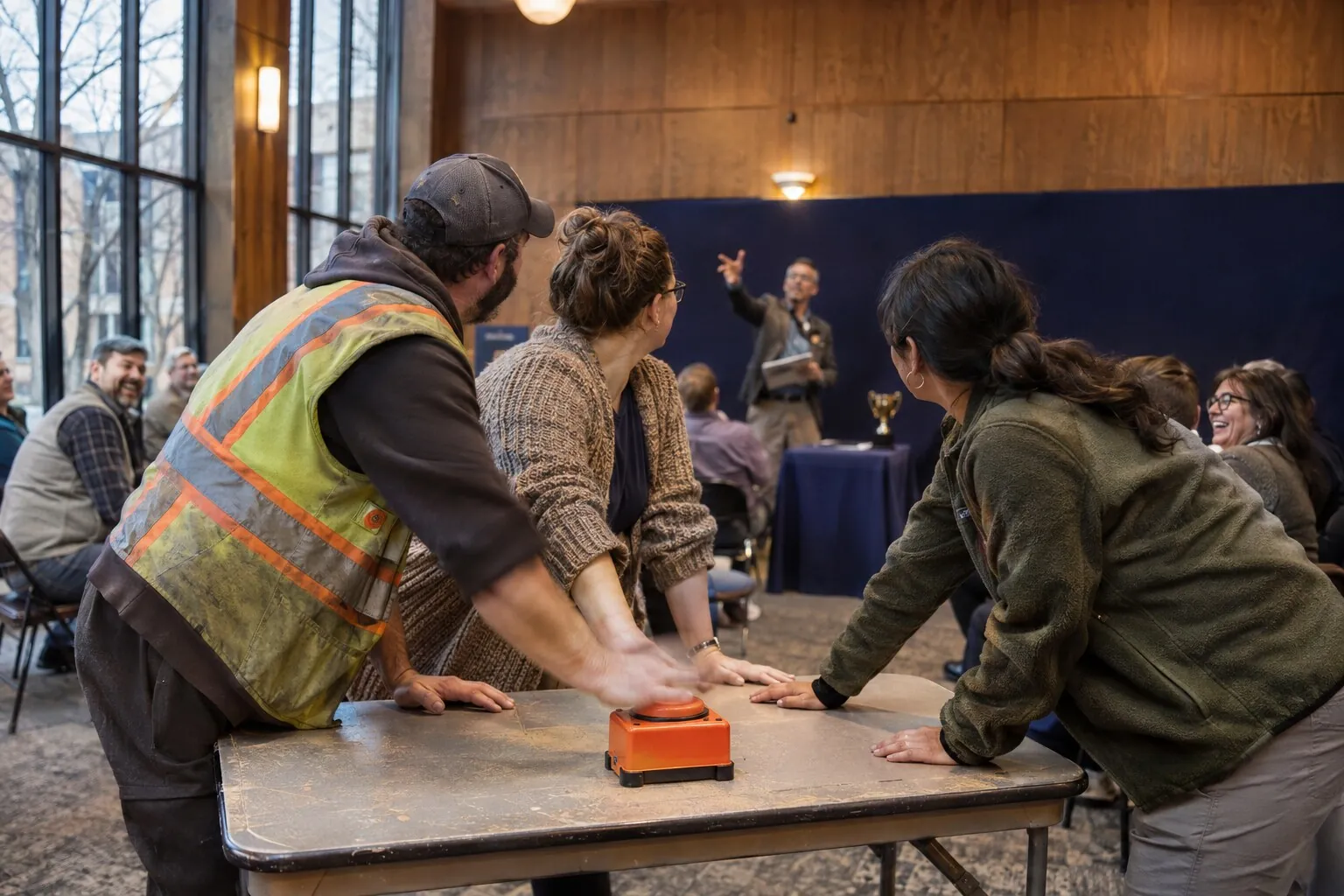
Picture one team with staff from public works, finance, recreation, and the clerk’s office. They share a task, debate answers, and hear each other contribute outside their job titles.
One of the widest gaps runs between field operations and city hall. Public works, parks, and utilities crews spend their days on routes and job sites, while finance, the clerk’s office, and planning work at desks. Ask the host how the format keeps both groups on equal footing, so neither side feels the questions favor the other.
Build those teams in advance. Collect attendance from department contacts, then spread departments across the room so familiar groups do not form on their own. Our guide to cross-functional team building covers mixed-team planning in more detail.
Seat newer employees alongside experienced colleagues without turning introductions into an interview. New hires who are still learning names get a natural way to meet the people they will work with.
Ask the host how participation reaches beyond the front of the room. Team discussion, shared answers, and rotating contributions keep everyone involved.
Confirm accessibility needs, seating preferences, and participation options before you pick a format. Employees should know how they will take part, with no pressure to share personal information or perform unfamiliar physical tasks.
How It’s Playtyme Game Shows Runs a Municipal Session
It’s Playtyme Game Shows uses professionally facilitated live game-show experiences as the vehicle for participation, connection, and camaraderie. Everyone is on a team, the format is already familiar, and a professional host guides every moment. If you also plan sessions for company teams or mixed public-private groups, our guide to team building for corporate events covers that setting.
The company was founded in May 2012 by a choreographer with 20+ years of experience. It is based in Teaneck, New Jersey, and serves New Jersey, New York City, and Connecticut. Sessions are built for groups of 20 to 300+ people, and larger groups get a custom quote.
Start the format conversation with the kind of participation you want:
- Face-2-Face Feud: a survey-style team format where groups share and discuss answers.
- The Challenge: a category question board that gives teams a clear structure for working through questions together.
- Word Play: word puzzles built around shared problem-solving.
- PlayPad Mania: a tablet and keypad team format.
- Name That Hit Song: music recognition worked through as teams.
Check the format against your room, attendance, and accessibility requirements. Ask how the host involves employees seated throughout the room.
Sessions run 60 or 90 minutes. Pick the length that fits your agenda, then confirm the full production window with the vendor.
The company’s guiding line is direct: “Great events aren’t measured by how many attend; they’re measured by how many participate.” For a municipal gathering, that means looking past attendance to whether colleagues actually trade ideas and contribute together.
Build a Budget Packet That Explains the Purchase
A procurement-ready request ties the expense to a defined staff outcome. Explain who attends, why departments are meeting together, and how the session fits the retreat or staff development agenda.
Sessions are priced starting at $2,995. Request a written quote for your attendance, location, format, and production needs. Treat the starting price as a reference point, not your approved total.
The published scope includes a professional host, production crew, game-show set, screens, and professional sound equipment. Delivery, setup, breakdown, and travel within NJ, NYC, and CT are included.
Only a short list of items may add cost: travel outside that area, extensive customization, lodging, multiple event spaces, specialized equipment, or extra staffing. Ask the quote to itemize any that apply so purchasing reviews the complete scope.
Ask finance whether the purchase belongs under a staff development, training, or employee engagement line, then put that code on the request. It’s Playtyme Game Shows offers a 100% Satisfaction Guarantee, and no deposit is required to book. Confirm invoice timing and payment steps with purchasing so they match your municipality’s process.
Attach a one-page approval note covering the objective, participants, session length, funding line, and document status. That page answers most of the questions a department head asks before signing.
Which Local Government Team-Building Option Fits Your Municipal Staff?
Before you approve a session, check whether the proposal answers the questions your purchasing office, department heads, and participants will ask. Start by comparing how each option gets people participating.
| Option | How participation works | Who runs it | Best for |
|---|---|---|---|
| It’s Playtyme Game Shows (hosted live game show) | Every attendee joins a mixed team in a familiar format | Professional host and production crew; setup, breakdown, and travel within NJ, NYC, and CT included | Staff days and council retreats of 20 to 300+ people |
| DIY activity kit | Depends on volunteers stepping up | Your own staff plan and lead it | Small teams with an internal organizer and spare planning time |
| Lecture or seminar-style workshop | A presenter speaks while attendees mostly listen | An outside presenter | Sessions where delivering information is the main goal |
| Social reception or catered lunch | Open conversation, with employees tending to stay with familiar colleagues | Caterer or venue | Recognition moments where relaxed conversation is the goal |
Then run the proposal through five checks:
- Purpose: Does the scope name a specific participation or cross-department connection goal?
- Purchasing readiness: Are the quote, W-9, certificate of insurance, budget line, and purchase-order responsibilities clear?
- Agenda fit: Does the schedule include production access and a realistic transition?
- Participation: Will mixed teams give every employee in the room, from field crews to office staff, a defined role?
- Written scope: Are inclusions, added requirements, and payment arrangements documented?
To plan your municipal staff session or council retreat, request a custom quote with your date, room size, expected attendance, and participation goal. You receive a custom production plan within two business days after sending your date, room size, and goal. Include your purchasing checklist so the proposal covers both the experience and the approval process.
Solve the participation problem
Ready to get the whole room in the game?
Frequently Asked Questions (FAQs)
What paperwork should we request before booking?
Ask purchasing which documents apply, typically a written quote, a W-9, and a certificate of insurance. Confirm the budget line, purchase-order process, and invoice instructions. Get each document and payment arrangement confirmed by the vendor in writing.
How much does team building for municipal employees cost, and how is it coded on a municipal budget?
Sessions with It’s Playtyme Game Shows are priced starting at $2,995, and the written quote sets your total based on attendance, session length, location, and format. Travel within NJ, NYC, and CT is included. Your finance team assigns the budget code, such as a staff development or training line, and your municipality issues the purchase order after approval.
How does team building for municipal employees fit a council retreat?
Give the hosted session its own agenda block and a clear participation goal. An opening slot builds shared interaction, and a midday slot creates a break between discussions. Confirm production access and keep the session separate from official business.
How do you engage both field crews (like Public Works) and City Hall office staff in the same session?
Schedule the session when field crews can be released, and build mixed teams that seat public works or parks staff beside finance, clerk, and planning colleagues. Choose a format built on shared knowledge, such as a survey-style or music-recognition round, so no job title holds an advantage. Ask the host how every table gets a turn to contribute.
What should we send when requesting a quote?
Send your date, location, expected attendance, preferred session length, and retreat objective. Add room details, accessibility requirements, your purchasing contact, and the vendor documents you need. Ask for a written scope listing inclusions and any added production requirements.