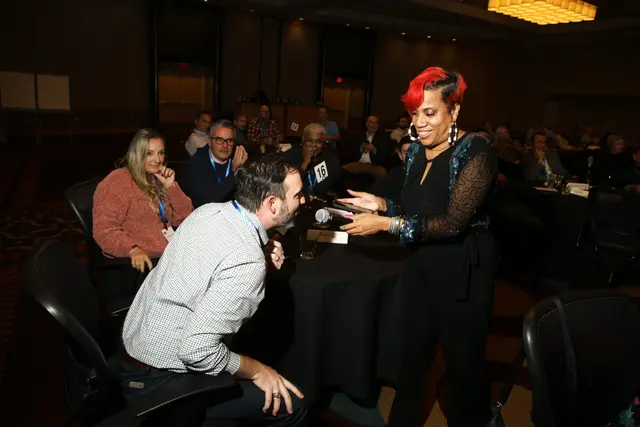

Quick answer: To brief executives for a game show, give each leader a clear role, send a one-page brief a week ahead, place them on mixed teams, clear the question topics with the host, and offer a private opt-out. Leaders who know the plan play well, protect their standing and make the whole room more willing to join in.
When the CEO is called up to a buzzer, the whole room watches how she is treated. A good moment makes the leader more approachable for months. A badly prepared one leaves her stuck on stage with a question she should never have been asked. Both outcomes are decided before the show starts, in the briefing, whether the event runs in New Jersey, New York City or Connecticut.
If you are forwarding this to whoever approves the budget, the business case is short: a leader who plays well in front of staff builds trust that a speech does not, and the briefing costs one page and ten minutes. The hard part is not the game. At a hosted corporate game show, the host runs the format and the room does the laughing. The hard part is that executives carry status into the room, and a game puts status at risk in front of their own staff. A leader who has been told nothing will either refuse to play or play too seriously. A leader who has been briefed plays well and makes everyone else braver. This guide shows you how to brief executives for a game show: what to tell them, how to protect their standing, and which question topics stay off the stage.
You will also see why a hosted game show suits this problem. It’s Playtyme Game Shows describes its shows as a format where “nobody is put on a stage alone” and where “your managers get to play instead of running it.” That second line is the pitch you give your leaders.
How to Brief Executives for a Game Show in Eight Steps
- Name each leader’s role first. Decide whether each executive is a contestant on a team, a guest player pulled up for one round, or a co-host who helps the host for a moment. Tell them which one. Ambiguity is what makes senior people nervous.
- Send a one-page brief a week ahead. Cover the date, the length of the show (It’s Playtyme Game Shows runs 60 or 90 minutes), the format, who they will play with, and what is expected of them. One page. Nobody reads three.
- Explain the format in two sentences. Say what the rounds feel like: buzzer rounds, survey rounds, physical challenges and guessing games. Executives relax when they know the shape of the evening.
- Put leaders on mixed teams, not their own. Teams at a hosted show are mixed on purpose, so people end up alongside colleagues from other departments. An executive on a team with analysts and account managers hears real answers and builds real rapport. An executive team playing alone makes the room a spectator crowd.
- Agree the status rules in advance. Tell leaders they will win some rounds and lose others, and that losing well is the goal. Ask them to credit teammates by name, laugh at their own wrong answers, and never overrule the host or a score.
- Clear the question topics with the host. Give the host a short list of topics that are off limits and a short list of safe, funny ones. The next section has the full list.
- Offer a quiet opt-out. Tell each executive they can pass on being pulled up, privately, to the organizer. Nobody is forced into the spotlight, and the ones who stay in play better for knowing the door is open.
- Walk through it for ten minutes on the day. Meet the host, see the buzzers, find where you will stand. Nerves drop fast once a leader has touched the equipment. Together with the one-page brief, that is under fifteen minutes of an executive’s calendar.
What to Tell Executives Before the Game Show
To brief executives for a game show, five messages cover most of what they need. Put them in the email, then repeat them in the hallway.
The goal is the room, not the score. Your people are watching how you treat being wrong. Laughing at a missed answer does more for morale than any speech you give that year.
You do not have to perform. The format asks people to play, not to be funny. The host carries the room. It’s Playtyme Game Shows puts it plainly: “Nobody has to perform. They just have to play.”
Your team comes first. Hand the buzzer to the person who knows the answer. Leaders who defer to a junior colleague on a question get remembered for it.
The host is in charge. Rulings, scores and timing belong to the host. Questioning a call, even as a joke, turns a game into a power struggle.
Stay for the whole show. A leader who plays one round and leaves for a call tells the room the event was optional. Block the calendar.
How to Keep It Fun and Safe for Status
Status is the real risk in this event. Staff will not laugh freely if they think a joke at the leader’s expense hurts their career, and leaders will not play freely if they think a loss costs them authority. Three design choices solve both.
Give leaders a team, not a spotlight
A leader who is one of five on a team shares every win and every miss. A leader who stands alone at the front owns the result. Choose the team format for executives and keep solo moments short.
Make the humor point inward, and at the whole room
The best laughs are shared ones: a wrong answer everyone would have given, a buzzer pressed a half second too early. Ask the host to keep jokes on the game and the group. A gentle roast of a leader works only when the leader has agreed to it, and only about something harmless like a famously bad coffee order.
Let the leader win at least once, honestly
Do not rig anything. A well-built format has many rounds, so a leader on a mixed team usually gets a moment. Ask the host to work in one question built on something the leader chose beforehand, such as a favorite food or a first job. The win is real and the laugh is warm. Agree the item in the briefing.
Question Topics to Keep Off the Stage
Executives hold information their teams do not. A question on the wrong topic forces a leader to dodge, lie or reveal something in front of the whole company. Give the host this list and ask them to build around it.
- Layoffs, reorganizations and hiring freezes. Even a joke about headcount lands as a signal.
- Pay, bonuses and equity. Salary bands, raises and who earns what stay out of games.
- Revenue, forecasts and deals in progress. Numbers a leader knows and the room does not are a trap, whether the answer is right or wrong.
- Performance and promotions. No question should compare named employees or hint at reviews.
- Politics, religion and health. Leave these to personal conversation.
- Personal life details a leader has not shared. Age, family status and home life are the leader’s to reveal.
- Anything about a rival department’s failures. In a mixed room, a dig at one team stings every person who works there.
Safe and funny topics are easy to find: company history everyone already knows, office habits (the printer, the thermostat), local trivia from New Jersey, New York or Connecticut, pop culture, and favorite things the leader volunteers in advance.
What Goes Wrong When Leaders Play
When you brief executives for a game show, four problems come up again and again, and each has a fix you control. The first is the leader who treats the game as a negotiation and argues a scoring call. Fix it in the briefing by naming the host as the final word. The second is the leader who takes over the buzzer and sidelines the team, which looks like command-and-control in a costume. Ask leaders to let teammates answer first. The third is the leader who does not show up, or leaves early, which tells everyone the event is for them and not for the boss. Put the full show on the executive’s calendar as a meeting with an agenda. The fourth is the surprise: a leader pulled onto the stage with no warning. Surprise feels like a prank to a senior person. Agree the plan in advance and keep the surprise to the question, never the participation.
Decide These Four Things Before You Tell Any Executive
A game show briefing for executives goes badly when the organizer has not made the decisions the briefing announces. Settle four points first: who plays and who watches, which round each guest player joins, who owns the off-limits topic list, and who the leaders can contact with a worry. Then write the one-page brief from those answers.
Ready to plan it? Tell us your date, room size and goal, and It’s Playtyme Game Shows returns a custom production plan within two business days. No deposit is required to book, and the 100% Satisfaction Guarantee applies. Shows start at $2,995 for 60 minutes, and the executive team building page shows how leadership groups use the format. Prices live on the pricing page. To build the event around your leaders, start with the game show team building page.
Solve the participation problem
Ready to get the whole room in the game?
Frequently Asked Questions (FAQs)
How do you prepare a CEO for a corporate team-building event?
Give the CEO a clear role, send a one-page brief about a week ahead, and place them on a mixed team rather than an executive team. Clear the question topics with the host so no company numbers or people issues come up. The whole prep costs the CEO one page of reading and a ten-minute walk-through.
What if an executive does not want to participate?
Let them pass, privately, with no explanation required. Offer a lighter role instead, such as cheering on a team from the front row. A forced participant plays badly and drags the room down.
Can an executive co-host the show?
Ask the host before the event. A short, scripted moment, such as reading one question or presenting the winning team’s prize, works well. Anything longer belongs to the professional host, who knows the pacing.
How far ahead should I brief them?
Send the one-page brief about a week before and hold a ten-minute walk-through on the day. Give the host a head count a week ahead as well, since the vendor needs an approximate number to prepare.