Workplace teams that feel genuinely connected outperform those that don’t. Gallup’s meta-analysis of 2.7 million workers found that highly engaged business units produce 21% greater profitability. Meanwhile, research from MIT’s Human Dynamics Laboratory, published in Harvard Business Review, showed that face-to-face interaction patterns account for roughly 35% of the variation in a team’s performance. The data is clear: unity isn’t a soft skill. It’s a measurable business driver.
Yet most organizations still rely on the same tired icebreakers and trust falls to build cohesion. The disconnect between what the research shows and what companies actually do is striking.
Here’s the real problem. You gather your team for a “fun” afternoon of craft projects or guided meditation, and half the room checks out within twenty minutes. Introverts retreat. Extroverts dominate. Departments cluster with their own people. Nobody walks away feeling more connected to coworkers they didn’t already know. Traditional cooperative activities fail because they lack the one ingredient that bonds strangers fast: a shared opponent. Team building games for unity work best when they create structured competition, not passive togetherness.
At a Glance
- Gallup links highly engaged teams to 21% greater profitability than disengaged ones.
- MIT research shows face-to-face interaction drives roughly 35% of the variation in team performance.
- Unity is a measurable business outcome, not a soft-skill bonus.
- Standard icebreakers fail because introverts check out and departments self-segregate.
Why Competitive Games Build Stronger Unity Than Passive Activities
Social psychology has a name for what happens when groups compete against each other: the in-group bias effect. When people share a common challenge or rival, they instinctively pull together. Identities blur. The accounting team and the marketing team stop being separate tribes and become “Team Blue” fighting to beat “Team Red.”
Cooperative crafts (painting, cooking, building something together) produce pleasant experiences. But they rarely produce the adrenaline spike, the collective celebration after a narrow win, or the shared frustration of a tough loss that creates lasting emotional bonds. Competition compresses relationship-building into minutes instead of months. The “us vs. them” dynamic forces people to communicate, strategize, and rely on each other under pressure. That is exactly how real workplace unity forms.
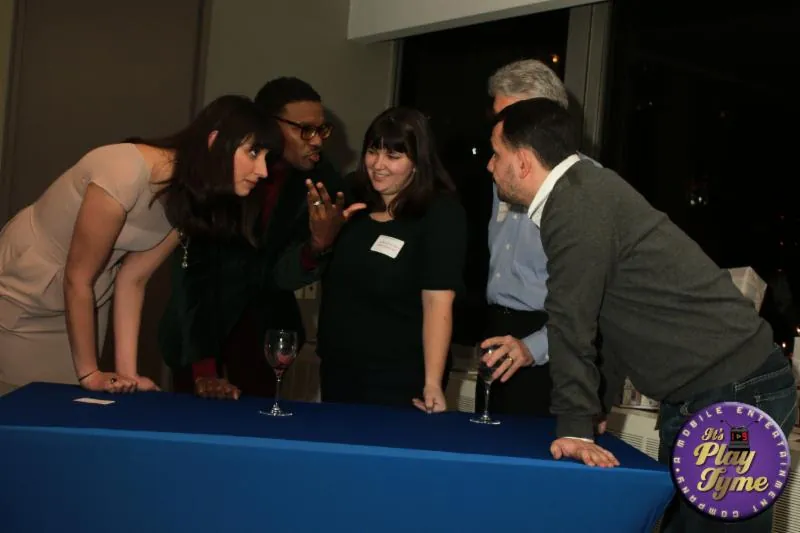
It’s PlayTyme Game Shows builds entire events around this principle. Their structured game show formats across New Jersey, New York City, and Connecticut are designed to trigger exactly this competitive bonding response, with professional hosts who manage energy, pacing, and team dynamics in real time.
Why Forced Fun and Silos Kill Unity
Before choosing specific games, it helps to understand why unity efforts fail so often. These are the obstacles most teams face:
- Forced fun syndrome. Mandatory team building that feels like an obligation breeds resentment, not connection. Employees show up physically but disengage mentally.
- Departmental silos. People default to sitting and working with colleagues they already know. Without a structure that deliberately mixes groups, cross-department bonds never form.
- One-size-fits-all activities. Quiet employees get steamrolled in open-ended group tasks. Competitive employees get bored during slow-paced workshops. No single activity style fits every personality unless the format rotates and includes multiple skill types.
- The “one and done” trap. A single annual outing produces a brief morale bump that fades within a week. Unity requires repeated shared experiences.
- Lack of stakes. Activities without scoring, winners, or consequences feel pointless to achievement-oriented team members. Low stakes produce low engagement.
7 Team Building Games for Unity (and the Specific Mechanism Behind Each)
Not every competitive game builds unity the same way. Each format below targets a different bonding mechanism. The best team building events combine several of these into a single session.
1. Team Trivia Tournament (Jeopardy-Style)
Teams of 4 to 8 players answer questions across multiple categories: company history, pop culture, geography, science, and custom topics. The unity mechanism is knowledge pooling. No single person knows every answer. The quiet analyst who knows obscure history facts becomes just as valuable as the outgoing sales rep who dominates pop culture. Trivia forces teams to recognize and rely on each member’s unique strengths. That recognition persists long after the game ends.
2. Family Feud Face-Off
Two teams compete to guess the most popular survey responses. The unity mechanism here is consensus thinking. Winning requires predicting how “most people” would answer, which sparks genuine discussion about perspectives and assumptions. Teams that communicate well dominate this format. Teams that don’t learn quickly why listening matters. The face-off structure (one player from each team racing to buzz in) also creates individual moments of glory that the whole team celebrates.
3. Minute to Win It Relay
Players complete short physical challenges (stack cups, balance objects, sort items) in 60-second bursts while teammates cheer. The unity mechanism is mutual vulnerability. Everyone looks a little ridiculous trying to stack cookies on their forehead. That shared vulnerability destroys professional facades and creates authentic moments of laughter. The relay format means individual performance directly affects the team score, generating genuine investment in each other’s success.
4. Wheel of Fortune Team Challenge
Teams collectively solve word puzzles, deciding together when to spin, when to guess a letter, and when to solve. The unity mechanism is collaborative risk assessment. Every spin is a gamble. Solving too early risks losing points; waiting too long risks a bankrupt. Teams must debate strategy quickly and commit to a collective decision. This mirrors real workplace dynamics where groups weigh risk and reward under time pressure.
5. Lip Sync Battle
Teams choreograph and perform a lip sync routine to a chosen song, competing for audience votes. The unity mechanism is shared performance risk. Getting on stage together, committing to a bit, and performing in front of peers creates an intense bonding experience. The preparation phase (choosing the song, assigning parts, rehearsing) requires negotiation, creativity, and compromise. Groups that perform together develop a shared identity faster than groups that simply talk together.
6. Cross-Department Tournament Bracket
Multiple game formats are organized into a bracket where teams play different games each round, accumulating points toward a championship. The unity mechanism is sustained narrative. A single game creates a moment. A bracket creates a story: the comeback, the upset, the clutch play. Teams develop a shared history over the course of the event. That shared history becomes the foundation for ongoing workplace relationships.
7. Custom Game Show Mashup
A professional host blends elements from multiple game formats into a single hybrid show, switching between trivia, physical challenges, and audience participation rounds. The unity mechanism is inclusive contribution. Because the format rotates, no single skill set dominates. The trivia expert, the physically coordinated athlete, and the creative performer all get a moment to lead. This rotation ensures every team member feels valued, which is the foundation of genuine unity.
| Game Format | Best Group Size | Primary Unity Mechanism | Energy Level |
|---|---|---|---|
| Team Trivia Tournament | 20 to 300+ | Knowledge pooling | Medium |
| Family Feud Face-Off | 10 to 100 | Consensus thinking | High |
| Minute to Win It Relay | 10 to 80 | Mutual vulnerability | Very High |
| Wheel of Fortune Challenge | 15 to 100 | Collaborative risk | Medium-High |
| Lip Sync Battle | 10 to 60 | Shared performance risk | Very High |
| Championship Bracket | 30 to 300+ | Sustained narrative | High |
| Custom Game Show Mashup | 20 to 150 | Inclusive contribution | High |
What Sets Professional Game Shows Apart from DIY Team Activities
Anyone with a laptop and a projector can run a basic trivia game. But the difference between a DIY activity and a professionally hosted game show is the difference between a pickup basketball game and a coached tournament. Professional game show hosts do three things that amateur facilitators cannot:
- Energy management. A trained host reads the room and adjusts pacing, difficulty, and humor in real time. When energy dips, the host shifts format. When one team falls behind, the host introduces a comeback round. This keeps every participant engaged from start to finish.
- Deliberate team mixing. Professional formats break participants out of their comfort zones by assigning teams across departments, seniority levels, and social groups. The structure itself forces new connections.
- Production quality. Buzzers, scoreboards, sound effects, stage lighting: these details transform a conference room into a game show set. The production quality signals to participants that this event matters, which increases emotional investment and, by extension, the unity-building effect.
It’s PlayTyme brings all three elements to every event, with professional AV equipment, experienced hosts, and game show formats built specifically for corporate team building.
The Science Behind the “Us vs. Them” Effect
Social identity theory, developed by psychologist Henri Tajfel, explains why competition builds bonds so effectively. When people are sorted into groups (even arbitrarily), they immediately begin favoring their in-group. Add a competitive goal, and that preference intensifies. Team members start using “we” language. They celebrate collective wins as personal victories. They defend teammates against the opposing team.
This is not manipulation. It is human nature working in your favor. Structured game show competition channels the same tribal instincts that drive sports fandom into a controlled corporate setting. The result is that coworkers who barely spoke before the event leave with inside jokes, shared memories, and a genuine sense of belonging to the same team.
The key word is “structured.” Unstructured competition (pickup games, informal contests with no rules) often backfires because dominant personalities take over and quieter team members withdraw. Team building games for unity work precisely because they have clear rules, defined roles, time limits, and a neutral host who ensures balanced participation.
Picking Team Building Games for Your Group Size
Selecting the right format depends on three factors: your group’s size, your specific unity goal, and the setting.
For groups under 30: Choose formats where every person participates actively. Minute to Win It relays and Lip Sync Battles work well because hiding in the back row is impossible. Small-group formats maximize individual visibility, which accelerates personal connections.
For groups of 30 to 100: Tournament brackets and Family Feud formats shine here. They create enough team variety to break departmental silos while keeping competitive intensity high. This range is the sweet spot for professional game show events.
For groups over 100: Trivia tournaments and custom mashups scale best. Multiple game stations, simultaneous rounds, and leaderboard tracking keep large audiences engaged without losing the competitive energy that drives unity.
For remote or hybrid teams: Virtual game show platforms replicate the competitive structure online. The “us vs. them” dynamic translates surprisingly well to video when a skilled host manages the energy.
The most effective approach for any size: combine two or three formats into a single session. Start with a high-energy icebreaker round (Minute to Win It), transition into a strategy-based game (trivia or Family Feud), and finish with a performance round (Lip Sync Battle). This rotation engages every personality type and delivers multiple unity-building mechanisms in one event.
Ready to build real unity in your team? Reach out to It’s PlayTyme Game Shows to design a custom game show event for your group across New Jersey, NYC, or Connecticut.
Frequently Asked Questions (FAQs)
Do competitive team building games work for introverted employees?
Structured game shows are actually better for introverts than open-ended group activities. Formats like trivia give quieter team members a defined role (answering questions they know) without forcing them into unstructured socializing. Professional hosts also balance participation so no single personality type dominates, which makes introverts feel included rather than sidelined.
What is the ideal team size for team building games for unity?
Teams of 4 to 8 people produce the strongest unity effects. Small enough that every person contributes, large enough to create real strategic depth. For events with 50 or more participants, groups of 6 to 8 create the right balance between personal connection and competitive energy across multiple teams.
How often should companies run team building games to maintain workplace unity?
Quarterly events produce the best sustained results. A single annual event creates a temporary morale boost that fades within weeks. Quarterly game show sessions build cumulative shared memories, running rivalries, and deepening team identity over time. Many organizations pair a large annual tournament with smaller quarterly sessions to maintain momentum throughout the year.