

Getting a room full of adults to put down their phones and actually engage with each other is harder than it sounds. According to Gallup’s meta-analysis of employee engagement, business units with highly engaged teams see 23% higher profitability. And McKinsey’s research on social technologies found that improving collaboration raises knowledge-worker productivity by 20 to 25 percent.
Those numbers matter because group games for adults are one of the fastest ways to build that engagement and collaboration in real time. Whether it’s a corporate offsite, a holiday party, a fundraiser, or a family reunion, the right game format turns a passive crowd into an active one.
The challenge is finding games that actually scale. Most “icebreaker” lists assume groups of 8 to 12 people standing in a circle. If you have 50, 100, or 300 adults in a banquet hall, those formats fall apart. You also need games that work for mixed ages, mixed fitness levels, and mixed enthusiasm levels (because every group has people who would rather watch). This guide covers 10 group games for adults that work at scale, from low-setup options you run yourself to fully hosted formats that guarantee participation.
Where Group Games for Adults Break Down
Before picking a game, it helps to understand why most group activities fail with adult audiences. Here are the problems organizers run into most often:
- Uneven participation. Competitive extroverts dominate while quieter people check out. The game becomes a spectator sport for half the room.
- Scaling problems. A game that works brilliantly with 10 people turns into chaos with 80. Instructions get lost, teams are too big, and half the group never touches the activity.
- The “this is cheesy” barrier. Adults are self-conscious. Anything that feels forced, childish, or uncomfortably personal gets immediate resistance, especially in professional settings.
- Logistics and setup. Many games require specialized equipment, large open spaces, or extensive prep. Event organizers are already stretched thin managing catering, A/V, and seating.
- No clear host or facilitator. Without someone driving energy and pacing, even a good game loses momentum. Groups stall, rules get confused, and the activity fizzles within 15 minutes.
1. Live Hosted Game Shows
A live game show is the gold standard for group games for adults at large events. A professional host runs the room with music, buzzers, projected questions, and structured rounds that keep every person actively playing. It’s PlayTyme Game Shows runs exactly this format across New Jersey, New York City, and Connecticut, handling groups from 20 to 300+ people. The company brings all equipment, a trained MC, and themed game formats (Family Feud style, Jeopardy style, Minute to Win It challenges, and more). Every guest plays on a team. Nobody sits on the sidelines.
What sets a hosted game show apart from other group games is total coverage. The host manages pacing, scoring, energy, and transitions. Organizers hand off the entertainment block and focus on everything else. It’s PlayTyme also backs every event with a 100% satisfaction guarantee.
2. Team Trivia Tournaments
Trivia is the most universally accessible group game for adults. It requires no physical ability, no special skills, and no willingness to get up on stage. Tables of 4 to 8 people form teams, answer rounds of questions across categories (pop culture, history, science, sports, current events), and track scores on a leaderboard.
For small groups, a free trivia app and a projector are all you need. For groups over 40, a dedicated host and sound system make or break the experience. Categories should rotate to give different knowledge bases a chance to contribute. Include at least one visual round (photo identification, logo matching) and one music round to break up the text-heavy format.
Tips for scaling trivia
- Cap teams at 6 to 8 people so everyone contributes.
- Use answer sheets rather than buzzers for large rooms (buzzers create bottlenecks).
- Add a wagering “final round” to keep trailing teams engaged until the end.
3. Minute to Win It Challenges
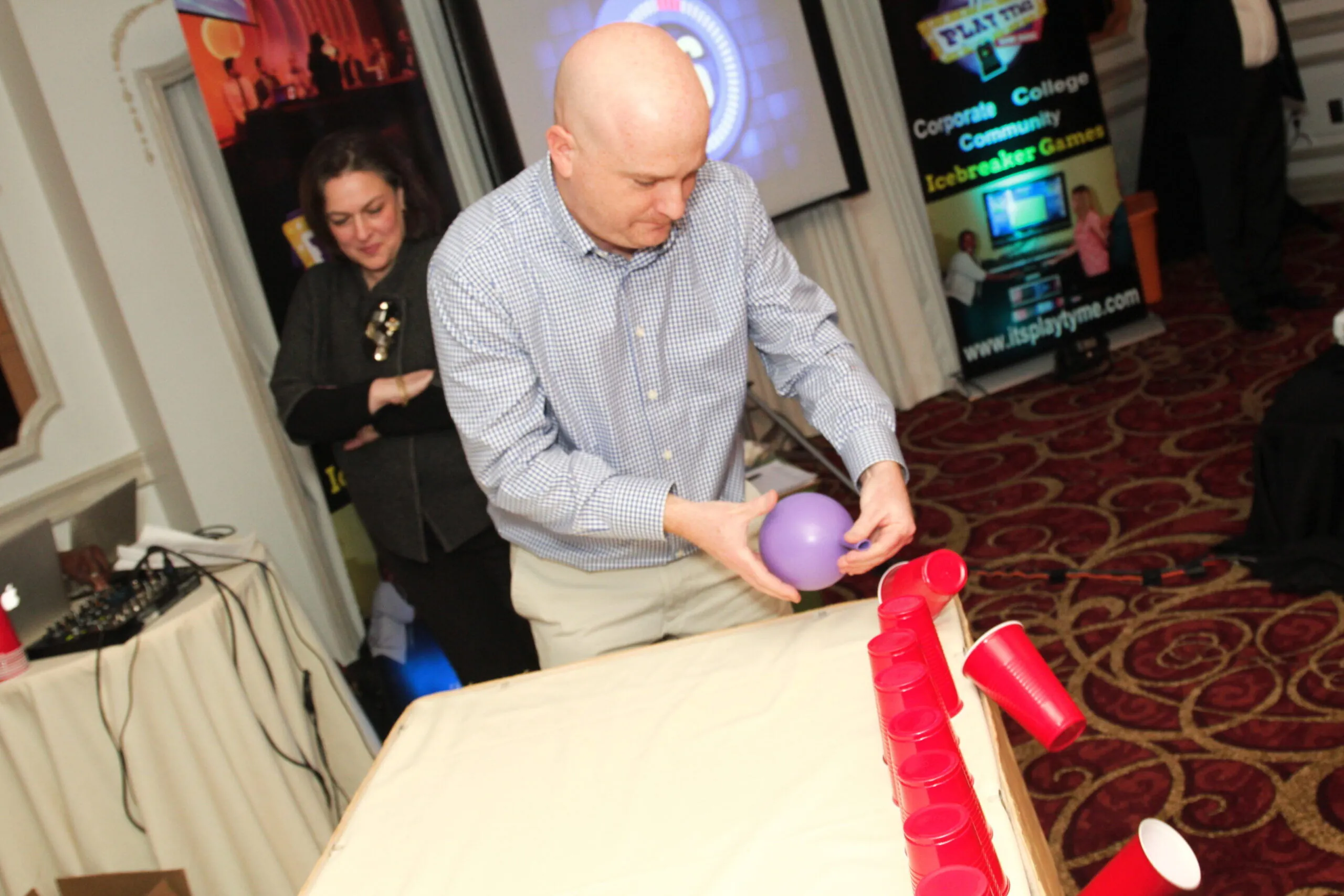
Minute to Win It (MTWI) games give adults 60 seconds to complete a physical or dexterity challenge using simple household items. Stacking cups, bouncing ping pong balls into cups, moving cookies from forehead to mouth without using hands: the tasks are simple to explain and hilarious to watch. They work because even the most reserved adults loosen up when the clock is ticking and the room is cheering.
For large groups, run MTWI as a relay or bracket tournament. Each team sends one representative per challenge. The watching crowd stays engaged because the rounds are fast (literally one minute each) and the failures are entertaining. A good facilitator calls the action like a sports commentator, which raises the energy dramatically.
4. Family Feud Style Survey Games
The Family Feud format works because every adult already knows the rules. Two teams face off. A question appears on screen (“Name something you hide from your boss”). Teams guess the top survey answers. The format creates instant comedy because the wrong answers are often funnier than the right ones.
For corporate events, custom surveys are a strong upgrade. Survey the actual team beforehand (“Name a coworker most likely to survive on a deserted island”) and the game becomes personal, specific, and far more engaging than generic questions. This format scales well to 100+ people when teams rotate through head-to-head matchups.
5. Scavenger Hunts (Indoor or Outdoor)
A well-designed scavenger hunt gets adults moving, problem-solving, and working together under time pressure. Modern versions use smartphone apps to deliver clues, accept photo/video proof, and track scores in real time. This eliminates the old clipboard-and-checklist approach that bogged down traditional hunts.
Indoor scavenger hunts work well in conference centers, hotels, and office buildings. Outdoor versions are ideal for retreats, campus events, and city-based team outings. The key to a good adult scavenger hunt is creative challenges, not just “find this object.” Include tasks like filming a 15-second commercial for your company, getting a stranger to teach you a dance move, or solving a multi-step riddle that requires visiting three locations.
6. Word Games and Puzzle Races
Word-based group games appeal to the segment of adults who prefer brains over brawn. Formats include team crossword races, Boggle-style word searches on a projected grid, Pictionary with a twist (one person draws on a whiteboard while teammates shout guesses), and “password” style clue-giving games where one teammate gives single-word hints while their partner guesses the target word.
These games work especially well as warm-up rounds before a larger activity, or as one station in a multi-game rotation. They require minimal equipment (a whiteboard, markers, and a timer) and accommodate groups of any size when run as a projected, team-based competition rather than a small-circle activity.
7. Physical Relay Challenges
Relay races adapted for adults add a physical dimension that breaks up a long event. Think wheelbarrow races with a twist: teammates must transport a water balloon on a spoon, navigate an obstacle course while blindfolded (guided by a partner’s voice), or move across a room stepping only on provided “stepping stones” (cardboard squares) that teammates must leapfrog ahead.
Physical challenges work best when they are short, mildly ridiculous, and require coordination rather than athleticism. Nobody should need to run a sprint. The comedy comes from the awkwardness of the task, not the difficulty. For groups over 50, run multiple relay lanes simultaneously so wait times stay short.
8. Music and Pop Culture Rounds
Name That Tune, movie quote identification, and “finish the lyric” rounds are some of the most universally popular group games for adults. They trigger instant nostalgia and friendly debate (“That song came out in 1998, not 1999”). Music rounds generate the most crowd energy of any trivia format because people sing along, argue, and celebrate together.
For best results, span multiple decades (1970s through 2020s) so every age group gets songs they recognize. Play 5 to 10 seconds of each track, then teams write down the song title and artist. Add a “bonus points for singing the next line” option to get the whole room involved. This format slots naturally into a larger trivia night or game show event.
9. Human Bingo and Networking Games
Human Bingo gives each participant a card with squares containing descriptions (“has traveled to more than 5 countries,” “plays a musical instrument,” “has worked here less than a year”). Players circulate the room, find someone who matches each square, and get their signature. First person to fill a row wins.
This works well as an opening activity before a main event because it forces people to talk to strangers, which is the hardest part of any group gathering. For professional settings, include squares related to work (“has given a presentation to 50+ people,” “knows how to use pivot tables”) alongside personal ones to keep the tone balanced.
10. Lip Sync Battles and Karaoke Showdowns
Lip sync battles are the performance-based group game that adults consistently love. Teams pick a song, get 5 minutes to choreograph, and perform in front of the group. The audience votes for the winner. The barrier to entry is low (you do not need to actually sing), and the results are almost always hilarious.
Karaoke works similarly but requires a sound system and a catalog of songs. Both formats benefit enormously from a host who keeps the energy high between performances and gives playful commentary. For corporate events, these work best as a climactic activity after the group has already loosened up through earlier games.
Choosing the Right Game for Your Group Size
Start with three questions: how many people, how much space, and how much time. A 90-minute corporate offsite for 200 people calls for a completely different format than a 30-minute warm-up for 20 people at a restaurant.
For groups under 20, almost any format works. DIY trivia, board game tournaments, and casual word games all hold up without a dedicated host. For groups of 40 and above, a professional facilitator becomes the difference between a game that lands and one that dissolves into confusion. The larger the group, the more structure and energy management you need.
For events in New Jersey, NYC, or Connecticut where you want a guaranteed outcome, It’s PlayTyme Game Shows handles the full setup: themed game shows, Minute to Win It tournaments, trivia nights, and Family Feud formats for groups of any size. Every event comes with a professional host, all equipment, and a 100% satisfaction guarantee. Request a quote and hand off the hardest part of your event to a team that runs group games for adults every week.
Frequently Asked Questions (FAQs)
What are the best group games for adults at corporate events?
Live hosted game shows, team trivia, and Minute to Win It challenges rank as the top choices for corporate events. These formats scale to large groups, require no special skills from participants, and keep every person actively playing rather than watching from the sidelines.
What group games work for adults who do not like physical activity?
Trivia tournaments, Family Feud style survey games, word puzzles, and music rounds all work from a seated position. These formats rely on knowledge, creativity, and teamwork rather than physical ability, making them accessible to every participant regardless of age or mobility.
Should I hire a professional host or run group games myself?
For groups under 20 in casual settings, a confident organizer with a good playlist and printed materials runs games effectively. For groups over 30, especially at corporate events, a professional host dramatically improves participation rates, energy, and pacing. The host also frees you to manage the rest of the event.