Trade shows pack thousands of decision-makers into a single venue over two or three days. According to the Center for Exhibition Industry Research (CEIR), 81% of trade show attendees have buying authority. That concentration of qualified buyers makes every minute of booth engagement worth real revenue.
Yet most exhibitors fail to convert foot traffic into measurable results. Bizzabo’s 2026 State of Events Report found that 40% of event organizers still struggle to prove ROI from their trade show investments. The disconnect is clear: exhibitors spend thousands on booth space and signage, then walk away without the contact data or engagement metrics needed to justify the spend.
Conference coordinators and trade show exhibitors face a shared set of obstacles. Hundreds of booths compete for the same crowd. Attendees walk past static displays in seconds, glancing at banners without stopping. Breakout sessions fight for attendance against a packed schedule of competing talks. And when someone does pause at your booth, there is no structured way to hold their attention long enough to capture a name, email, or conversation. Interactive game shows for trade show conferences solve these problems by turning passive foot traffic into active, measurable participation.
Challenges Trade Show Exhibitors Face with Attendee Engagement
The average trade show floor hosts hundreds of exhibitors, all chasing the same pool of attendees. Standing out requires more than a well-designed booth. Here are the core challenges exhibitors and conference coordinators deal with every event season.
- Short dwell time: Most attendees spend under five minutes at a booth before moving on. That window shrinks further at large conferences with packed agendas.
- Passive engagement: Banner displays, looping product demos, and printed brochures do not create interaction. Attendees observe without participating, and passive observers rarely convert to leads.
- No built-in lead capture: Many booth setups rely on a fishbowl of business cards or a tablet with a sign-up form. Neither approach gives attendees a compelling reason to share their contact information.
- Breakout session fatigue: Conference attendees sit through multiple presentations each day. A standard slide deck in a breakout room struggles to hold attention past the first ten minutes.
- Proving ROI: Without quantifiable engagement data (time spent, contacts collected, participation rates), exhibitors have no way to demonstrate that the trade show investment paid off.
What Makes Interactive Game Shows Different from Standard Booth Activities
When most exhibitors hear “trade show game,” they picture prize wheels, scratch cards, or digital spin-to-win kiosks. Those promotional tools serve a different purpose entirely. They offer a quick giveaway moment but no sustained engagement, no crowd formation, and no meaningful content delivery.
Interactive game shows for trade show conferences are a fundamentally different product. A professional host runs a live, structured experience that transforms your booth or breakout session into an event within the event. The difference breaks down across several dimensions:
- Live hosting: A trained emcee draws passersby into the experience, maintains energy, and guides the audience through rounds of play. The visible crowd attracts even more onlookers.
- Sustained attention: Game shows run 15 to 45 minutes, holding participants at your booth five to ten times longer than a typical visit.
- Custom content integration: Questions, challenges, and categories are built around your product, industry, or conference theme. Attendees absorb your messaging while they compete.
- Built-in lead capture: Participation requires registration. Every player provides contact information as part of joining the game, giving your sales team a warm list of engaged prospects.
Four Game Show Formats That Scale to Any Trade Show Setup
Not every trade show booth is the same size, and not every exhibitor has a breakout session slot. The right game show format matches your physical space, audience size, and engagement goals. Here are four formats that conference coordinators and exhibitors use to drive traffic and capture leads.
1. Booth Trivia Challenge
This format fits inside a standard 10×10 or 10×20 booth space. A host runs rapid trivia rounds using questions customized to your brand, product line, or industry. Rounds last 10 to 15 minutes, and the host cycles new groups of players throughout the day. Attendees register on a tablet before playing, providing their name, email, and company. The fast pace and visible energy draw foot traffic from adjacent aisles.
2. Feud-Style Face-Off
Modeled after the classic survey showdown format, this game works best in a breakout session or a larger booth with seating. Two teams compete head to head, answering survey-based questions about your industry or conference topic. Sessions run 30 to 45 minutes and accommodate 20 to 100 participants. The competitive format keeps energy high and gives attendees a reason to stay for the full session instead of leaving early.
3. Wheel of Knowledge
A branded prize wheel anchors this format, but the game goes beyond a simple spin. Attendees answer a question about your product or service before they spin. Correct answers earn a spin for prizes ranging from branded merchandise to premium giveaways. Every spin requires a completed lead form. This format works at any booth size and runs continuously, making it ideal for high-traffic periods on the show floor. For additional booth-level ideas, explore our guide to trade show booth games that attract crowds throughout the day.
4. Main Stage Game Show Experience
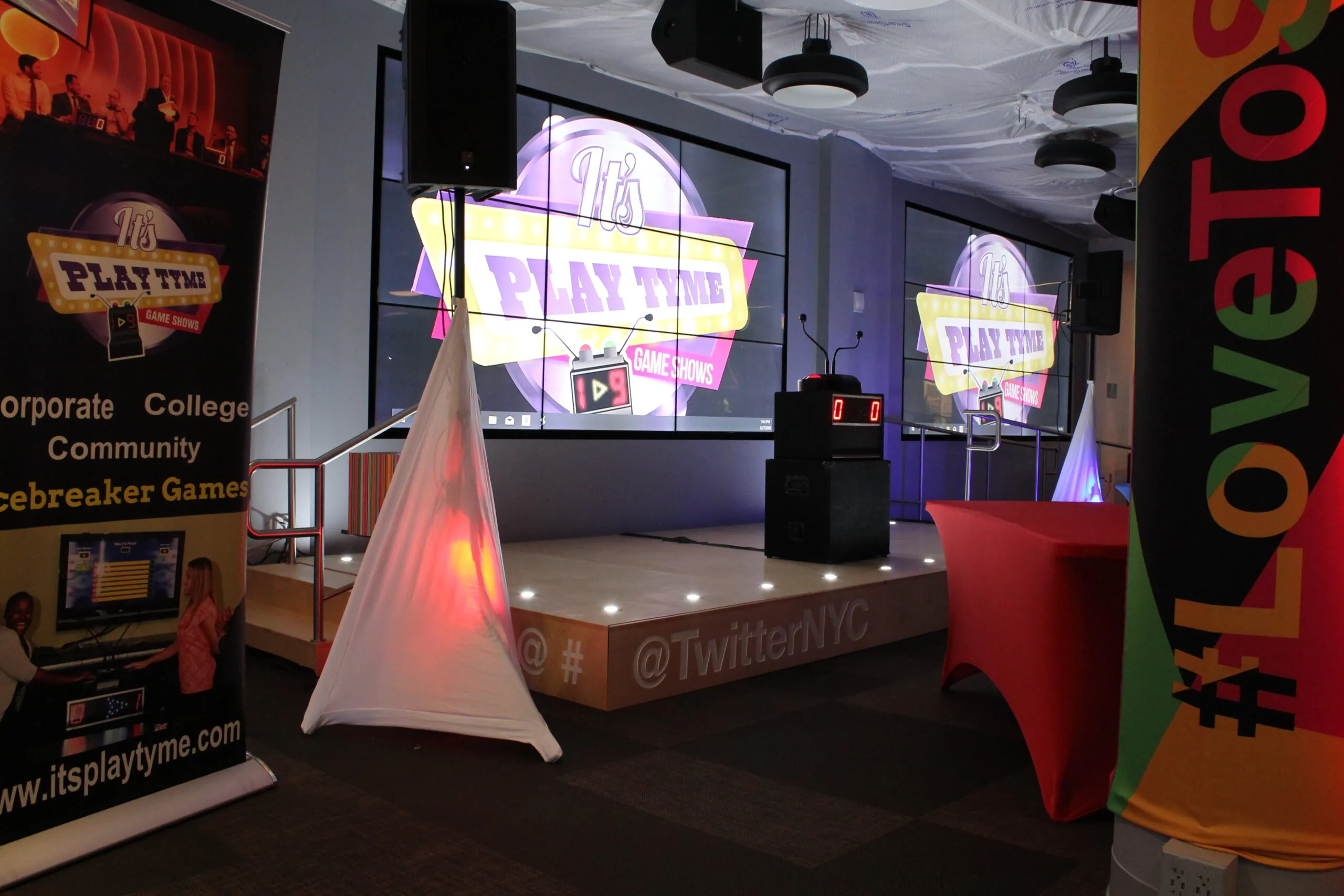
For exhibitors with a keynote slot, sponsor stage time, or a large breakout room, a full game show production fills the space. A professional host runs a multi-round competition with buzzers, scoreboards, music, and audience participation segments. Sessions run 45 to 60 minutes and hold audiences of 20 to 300+. This format positions your brand as the most memorable experience of the entire conference.
| Format | Best For | Space Needed | Group Size | Session Length | Lead Capture Method |
|---|---|---|---|---|---|
| Booth Trivia Challenge | Continuous booth traffic | 10×10 or 10×20 booth | 5 to 15 per round | 10 to 15 min/round | Tablet registration |
| Feud-Style Face-Off | Breakout sessions | Breakout room or large booth | 20 to 100 | 30 to 45 min | Team sign-up |
| Wheel of Knowledge | High-traffic lead gen | Any booth size | 1 at a time (continuous) | Runs all day | Lead form per spin |
| Main Stage Experience | Keynotes, sponsor stages | Stage or large room | 20 to 300+ | 45 to 60 min | Audience registration |
The ROI Framework: Attention Plus Contact Data Equals Qualified Leads
Trade show ROI comes down to a simple equation: the longer someone engages with your brand, the more likely they are to convert. Interactive game shows for trade show conferences attack both sides of that equation by increasing dwell time and automating contact capture.
Dwell time: A standard booth visit lasts two to four minutes. A game show session holds participants for 15 to 45 minutes. That extended exposure means attendees hear your messaging multiple times, see your branding from every angle, and form a stronger memory of your company.
Contact capture: Every game show format requires registration to participate. Instead of hoping attendees drop a business card in a bowl, you collect structured data: name, email, company, and role. Your sales team walks away from the show with a list of people who actively chose to engage with your brand.
Engagement metrics: A hosted game show generates quantifiable data that static displays never produce. You track participation count, average session length, correct answer rates (which reveal product awareness), and total contacts captured. These numbers give your marketing team concrete proof of ROI for post-event reporting.
How to Customize Game Show Content for Your Conference Goals
The content inside the game show matters as much as the format. Generic trivia fills time but misses the opportunity to reinforce your brand messaging. The strongest trade show game shows build every question, category, and challenge around the exhibitor’s specific goals.
- Product education: Write trivia questions about your product features, use cases, and differentiators. Attendees learn about your offering while they compete, and the competitive format makes the information stick.
- Industry knowledge: Use questions tied to the conference theme or industry trends. This positions your brand as a thought leader and gives attendees a reason to play beyond winning a prize.
- Audience segmentation: Include registration fields that capture job title, company size, or purchasing timeline. This turns your lead list into a segmented pipeline that your sales team actions immediately after the event.
- Prize strategy: Tie prizes to your product or service. A free consultation, a product sample, or an exclusive demo session creates post-show follow-up opportunities that generic swag does not.
Why It’s PlayTyme Game Shows Delivers Results at Trade Show Conferences
It’s PlayTyme Game Shows brings 14+ years of live event experience to the trade show floor. With more than 3,000 corporate events completed and a client roster that includes Fortune 500 companies, the team understands what it takes to fill a booth and hold an audience.
Every game show is fully customized. The It’s PlayTyme team works with exhibitors and conference coordinators to build questions, categories, and game rounds around the client’s specific products, messaging, and event goals. The company provides professional hosts, all necessary AV equipment, and complete setup and teardown, so exhibitors focus on their attendees instead of logistics.
Based in the New Jersey and New York City metro area, It’s PlayTyme serves trade shows and conferences across New Jersey, New York, and Connecticut. The team regularly works large convention centers, hotel ballrooms, and corporate campus event spaces throughout the tri-state region.
How to Pick the Right Game Show Format for Your Next Conference
Choosing the right format starts with three questions. How much space do you have? How many people do you want to engage at once? What is your primary goal?
If your booth is a standard 10×10 and your goal is continuous lead capture throughout the show, the Booth Trivia Challenge or Wheel of Knowledge formats keep a steady stream of participants flowing through your space. If you have a breakout session slot and want to fill every seat, the Feud-Style Face-Off gives attendees a reason to show up and stay. If you are a title sponsor with main stage access and want to create the event everyone talks about, the full Game Show Experience puts your brand at the center of the conference.
Match the format to your sales funnel, too. Top-of-funnel brand awareness calls for high-volume formats like the wheel or trivia. Mid-funnel qualification works best with longer sessions like the feud or full show, where you capture detailed registration data and hold conversations during breaks.
Ready to turn your next trade show booth into the busiest spot on the floor? Contact It’s PlayTyme Game Shows to discuss formats, pricing, and availability for your upcoming conference. Explore the full range of corporate event programs and see how interactive game shows transform exhibitor results.
Frequently Asked Questions (FAQs)
How much space does a trade show game show require?
The smallest formats (Booth Trivia Challenge and Wheel of Knowledge) fit inside a standard 10×10 booth. Larger formats like the Feud-Style Face-Off work in breakout rooms or 20×20 booths. Main stage productions use the venue’s existing stage and AV setup.
How far in advance should exhibitors book a game show for a trade show?
Book at least four to six weeks before the event to allow time for content customization. Popular conference dates in the tri-state area fill up quickly, so earlier booking secures your preferred date and format.
Do interactive game shows work for lead capture at trade shows?
Every format requires participant registration before play begins. Exhibitors collect names, emails, company names, and job titles from every participant. This structured data gives sales teams a qualified lead list to follow up on immediately after the show.
What types of companies use game shows at trade shows?
Companies across industries use trade show game shows, from technology firms and pharmaceutical companies to financial services and manufacturing brands. Any exhibitor that wants to increase booth traffic, extend dwell time, and capture more leads benefits from a hosted game show format.
Are game show questions customized to the exhibitor’s brand?
Every game show is fully customized. The host company works with the exhibitor to build questions around specific products, services, industry topics, and conference themes. This turns the game into a branded content experience rather than generic entertainment.
What percentage of trade show attendees have buying authority?
According to the Center for Exhibition Industry Research, 81% of trade show attendees have buying authority, making every minute of booth engagement worth real revenue.
Why do so many exhibitors leave trade shows without proof of ROI?
Bizzabo’s 2026 State of Events Report found that 40% of event organizers still struggle to prove ROI from trade show investments, often because they walk away without the contact data or engagement metrics needed to justify the spend.