

Student engagement at school is dropping — and traditional assemblies are part of the problem. A Gallup K 12 survey found that fewer than half of students say their schoolwork positively challenges them. Yet the upside of getting engagement right is enormous: according to Gallup’s follow-up research, the most engaged students are more than four times as likely to strongly agree they have a great future ahead of them.
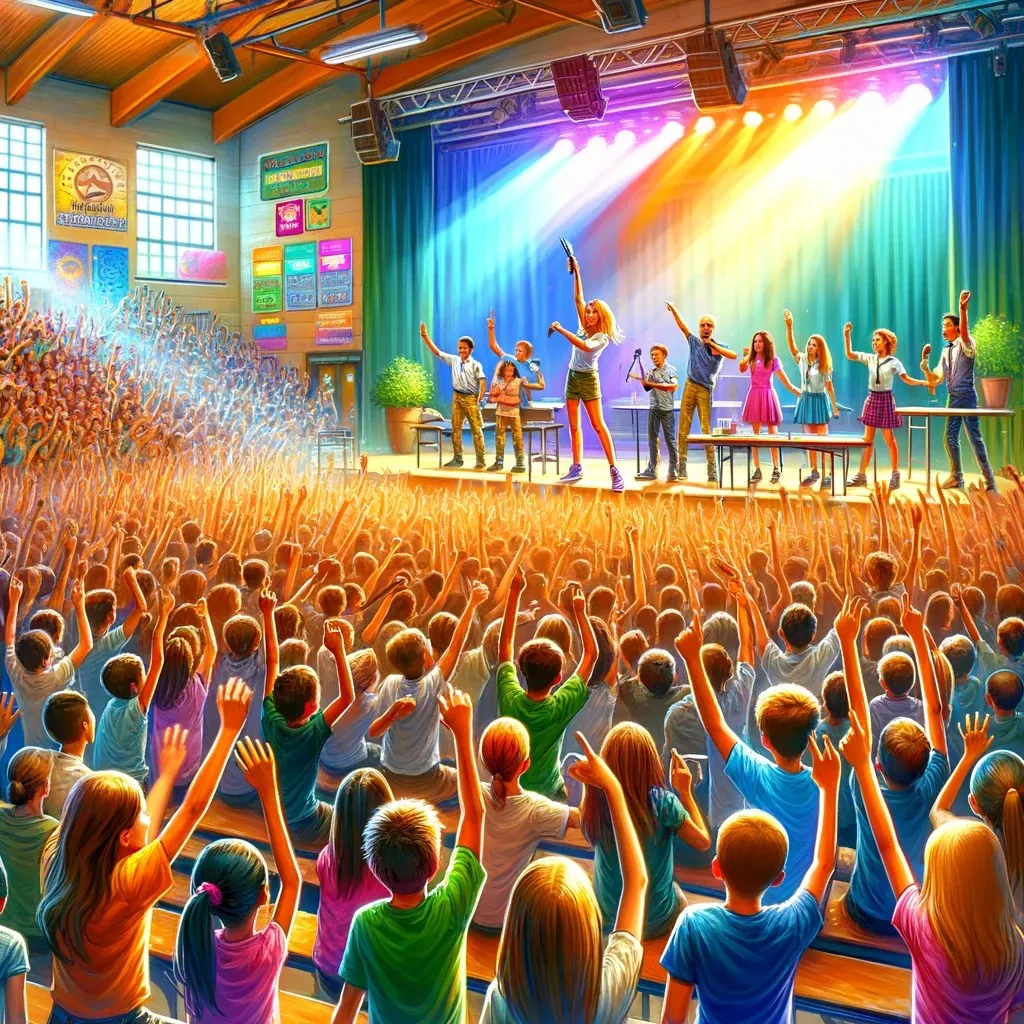
Pep assembly themes are one of the most direct tools a school coordinator has for turning a gym full of distracted teenagers into a room that actually pays attention. The right theme gives an assembly structure, energy, and a reason for students to participate instead of scrolling their phones under the bleachers.
But choosing the right pep assembly themes is harder than it sounds. Coordinators deal with shrinking budgets, short planning windows, pressure to align with school values, and the reality that what excited students five years ago falls flat today. A theme that works for elementary schoolers bombs in a high school gym. An idea that sounds great in a planning meeting turns out to be impossible to execute with available staff and space. These are real problems, and they deserve real solutions.
Why Pep Assembly Themes Matter More Than a Pre-Game Hype Session
There is a meaningful difference between a pep rally and a pep assembly. A pep rally exists to build excitement before an athletic event. A pep assembly serves a broader purpose: reinforcing school culture, recognizing achievement, building community across grade levels, and delivering messages around character, safety, or academic goals. The theme is what ties the whole event together and gives it purpose beyond “everyone sit in the gym for 45 minutes.”
Strong pep assembly themes also give teachers and staff a framework for participation. When there is a clear theme, faculty know how to dress, what to reference in class beforehand, and how to connect the assembly to ongoing instruction. Students arrive with expectations and context instead of confusion. The theme transforms a scheduling block into a shared experience.
Assembly performance ideas work best when they connect to a theme rather than standing alone. A dance routine, a skit, or a musical number hits harder when it reinforces a message the whole school is rallying around. Disconnected performances feel like a talent show. Themed performances feel like a movement.
Key Issues Coordinators Hit When Planning Pep Assemblies
Planning a pep assembly that actually lands is a coordination challenge. Here are the obstacles that trip up even experienced organizers:
- Engagement across grade levels. A theme that captivates sixth graders often bores seniors. Finding assembly performance ideas that bridge that gap requires careful selection.
- Budget constraints. Schools rarely have dedicated assembly budgets. Coordinators piece together funding from student council funds, PTA contributions, and whatever they find in the supply closet.
- Time pressure. Most coordinators plan assemblies on top of their regular teaching or administrative duties. A theme needs to be executable without weeks of rehearsal or custom set design.
- Relevance fatigue. Students see through recycled ideas. The same spirit week formula repeated every semester loses its impact. Fresh pep assembly themes require ongoing creativity.
- Measuring impact. Administrators want to know that assembly time is well spent. Without a clear theme tied to school goals, it is difficult to justify pulling students from class.
School Spirit and Pride Themes
The classic category of pep assembly themes centers on school spirit. These work best when tied to a specific moment in the school calendar: homecoming week, rivalry games, or the start of a new school year.
Color Wars
Divide the school by grade level or house and assign each group a color. The assembly becomes a series of competitive challenges (relay races, trivia, cheer-offs) where points accumulate throughout the event. Color Wars assemblies generate visible energy because students have a team to represent.
Decades Throwback
Pick a decade (the ’80s, ’90s, or 2000s work best) and build the assembly around music, fashion, and pop culture from that era. Students and staff dress in costume. Assembly performance ideas include lip-sync battles, decade-themed trivia, and choreographed group dances to era-specific songs.
School Pride Showcase
Dedicate the assembly to highlighting what makes the school unique. Feature student clubs, athletic teams, academic achievers, and community service projects in rapid-fire presentations. This format works especially well at the start of the year when new students need orientation to school culture.
Academic Achievement and Recognition Themes
Pep assembly themes do not have to center on athletics. Some of the most effective assemblies celebrate academic accomplishment and intellectual curiosity.
Academic Awards Ceremony
Turn honor roll recognition into an event students look forward to. Add music, stage lighting, and short video profiles of top achievers. When academic success gets the same production value as a sports pep rally, it sends a clear message about school priorities.
STEM Challenge Assembly
Host a live science or engineering challenge on stage. Teams of students compete to build the tallest tower, solve a logic puzzle, or complete a coding task in real time. The audience watches the clock and cheers for their favorites. This format turns passive viewers into invested spectators.
Character Education and Social Themes
Schools increasingly use assemblies to address character development, anti-bullying, and social-emotional learning. The right theme makes these messages stick without feeling like a lecture.
Kindness Week Kickoff
Launch a school-wide kindness initiative with an assembly featuring student testimonials, a pledge wall, and interactive activities. Students sign a banner, write anonymous compliments to classmates, or participate in a “kindness chain” challenge. The assembly sets the tone for the entire week.
Unity and Inclusion
Celebrate the school’s diversity through student performances representing different cultures, languages, and traditions. This theme works well during heritage months and creates space for students who rarely see themselves represented in school programming.
Game Show and Interactive Performance Themes
Interactive formats consistently outperform passive ones when it comes to student engagement. Game show-style assemblies turn students from an audience into participants, and the competitive energy keeps attention high from start to finish.
It’s PlayTyme Game Shows specializes in exactly this format. Their live, interactive game show assemblies bring professional-grade production (big screens, sound systems, and hosted competition) directly into school gyms across New Jersey, New York City, and Connecticut. What sets them apart is customization: coordinators choose the subject matter (spelling, math, science, history, character education) and It’s PlayTyme builds the game around it. Students compete in teams, answering questions and completing challenges on stage while the entire student body cheers them on.
This format solves several coordinator headaches at once. The production is handled by professionals, so staff are not stuck building sets or running sound. The content aligns with school goals because it is customized to the curriculum. And the game show structure works across every grade level, from elementary through high school, because competition is universally engaging.
Why Game Show Assemblies Work as Pep Assembly Themes
Game shows create natural dramatic tension. Students watch classmates compete, root for their grade or section, and react in real time to correct and incorrect answers. That emotional investment is exactly what traditional assemblies struggle to produce. The format also provides built-in assembly performance ideas: the competition itself is the performance, and every round brings new energy.
Seasonal and Event-Driven Themes
Tying pep assembly themes to the calendar gives coordinators a natural planning rhythm and ensures assemblies feel timely rather than arbitrary.
Back-to-School Rally
Set the tone for the year with an assembly that introduces new staff, previews upcoming events, and gets students excited about the months ahead. Include a mix of performances, competitions, and announcements to establish the school’s energy from day one.
End-of-Year Celebration
Cap the school year with an assembly that highlights the year’s biggest moments: athletic championships, academic milestones, service projects, and memorable events. Student-produced video recaps and live performances make this a send-off students remember over the summer.
Holiday and Seasonal Themes
Winter holidays, spring testing season kickoffs, and fall harvest events all provide natural assembly themes. A winter assembly with a giving-tree initiative combines entertainment with community service. A spring “finish strong” rally builds momentum for final exams.
Picking the Right Pep Assembly Theme for Your School
Choosing between pep assembly themes comes down to four practical questions:
What is the goal? Every assembly should have a purpose beyond filling time. If the goal is school spirit, choose a competitive or pride-based theme. If the goal is character education, choose a values-driven theme. If the goal is academic motivation, bring in an interactive format like a game show that ties competition to curriculum content.
Who is the audience? A K-5 assembly has different energy than a 9-12 assembly. Themes that require audience participation work across age groups. Themes that rely on student-led performances work best when the performers are peers the audience admires.
What are the resources? Some themes require minimal setup (Color Wars needs colored t-shirts and a scoreboard). Others require professional production. Know the budget and staff availability before committing to a theme. Bringing in an outside provider like It’s PlayTyme shifts the production burden off school staff entirely.
How does it connect to the bigger picture? The best pep assembly themes reinforce something the school is already working on. An anti-bullying assembly during kindness week has more impact than the same assembly in isolation. A STEM challenge during science fair season reinforces classroom learning. Alignment multiplies impact.
If you are planning a pep assembly for a school in New Jersey, New York City, or Connecticut and want an interactive, game show-style experience that students talk about for weeks, reach out to It’s PlayTyme to discuss your school’s needs. Their school assembly programs are built to fit your theme, your curriculum, and your schedule.
Frequently Asked Questions (FAQs)
What are the best pep assembly themes for high school students?
High school students respond best to competitive and interactive themes. Color Wars, decade throwbacks, and game show-style assemblies consistently generate high engagement because they give students a role beyond sitting and watching. Themes tied to school rivalries or senior traditions also perform well.
How do pep assembly themes differ from pep rally themes?
Pep rallies focus on building excitement before a specific athletic event. Pep assembly themes serve broader goals: academic recognition, character education, community building, or school culture. Assemblies are structured programs with intentional messaging, while rallies center on energy and school spirit for a game.
What assembly performance ideas work for elementary schools?
Elementary assemblies work best with high-energy, participatory formats. Interactive game shows, sing-alongs, dance-alongs, and live demonstrations keep younger students engaged. Themes around kindness, reading, or science exploration give the performance educational value while keeping the energy high.
How much does it cost to hire a professional assembly provider?
Professional assembly providers typically charge between $500 and $2,500 depending on the format, duration, group size, and customization level. Interactive game show providers like It’s PlayTyme include all production equipment and a professional host, which eliminates the need for schools to rent or set up their own A/V gear.
How often should schools hold pep assemblies?
Most schools benefit from three to five themed assemblies per year, spaced throughout the calendar. Monthly assemblies work for schools with strong student council programs and administrative support. The key is quality over quantity: a few well-produced, themed assemblies have more lasting impact than frequent, unstructured gatherings.