
You have a budget, a room, and a couple hundred people who expect the next hour to earn its place on the agenda. What most planners do not have is a straight answer about who actually runs that hour. That gap is where event entertainment bookings fall apart.
The stakes are measurable. Gallup reports that global employee engagement fell to 20% in 2025, costing the world economy an estimated $10 trillion in lost productivity. Gallup also finds that only two out of 10 U.S. employees strongly agree they have a best friend at work, and that organizations moving that ratio to six in 10 could realize 12% higher profit.
So the hour matters. Yet planners sign a contract and then learn on event day that the vendor brought a microphone, a speaker, and nothing else. No host. No format. No plan for the 40 people hovering near the door. When the vendor leaves out the hosting, the job of energizing a passive room lands on you.
Here is how the main booking categories compare on what they actually deliver.
| Vendor Type | Setup and Equipment | Professional Host | Engagement Guarantee |
|---|---|---|---|
| It’s PlayTyme Game Shows | Full turnkey setup | Dedicated pro host and sound engineer | 100% satisfaction guarantee |
| Standard corporate event DJ | Audio and lighting only | Music mixing, not facilitation | None |
| Do-it-yourself activity kits | Shipped materials only | Planner runs the room | None |
| Stage acts and speakers | Varies by performer rider | Solo performance | None |
Nine Gaps That Sink a Large-Group Booking
Most booking failures are predictable. They start with a quote that describes gear instead of an experience.
- Equipment gets mistaken for engagement. Speakers and a microphone do not make 200 people participate. Gear is a tool. The value sits in the facilitation.
- The opening activity falls to you. Budget vendors expect the organizer to warm up the room. Once a planner is begging colleagues to volunteer, the energy is gone for the rest of the night.
- There is no run-of-show. Plenty of contracts skip the minute-by-minute schedule. Large groups fragment into cliques within ten minutes of unstructured time.
- The format does not scale. An activity built for 20 people collapses at 300, and the back half of the room turns into an audience. Our corporate event planner checklist walks through sizing before you book.
- Venue logistics arrive as surprises. Hotels and conference centers around New Jersey and New York City ask for certificates of insurance, union load-in labor, and fixed setup windows. Vendors who have never worked those rooms miss the window and eat into your program time.
- Venue exclusivity clauses block the vendor you picked. Some hotels and catering halls contractually restrict outside entertainment or route everything through the in-house audio and visual desk. Read that clause before you countersign a vendor agreement.
- Hidden fees surface after the signature. Setup and breakdown, travel, custom content, extra guests, gratuity. Hidden fees in entertainment contracts are almost always those same line items, so get the full number in writing first.
- Quieter attendees never get in. Formats that run on individual volunteers quietly penalize introverted and neurodivergent employees. Team play with familiar rules and no solo spotlight keeps the whole room in, which is the difference between real employee engagement activities and a performance that a third of your people simply endure.
- Nothing gets reported upward. Your executive sponsor will ask what the hour bought. Without participation counts, photos, and one post-event pulse question, the experiential team building ROI discussion collapses into a shrug at the next budget review.
It’s PlayTyme Game Shows
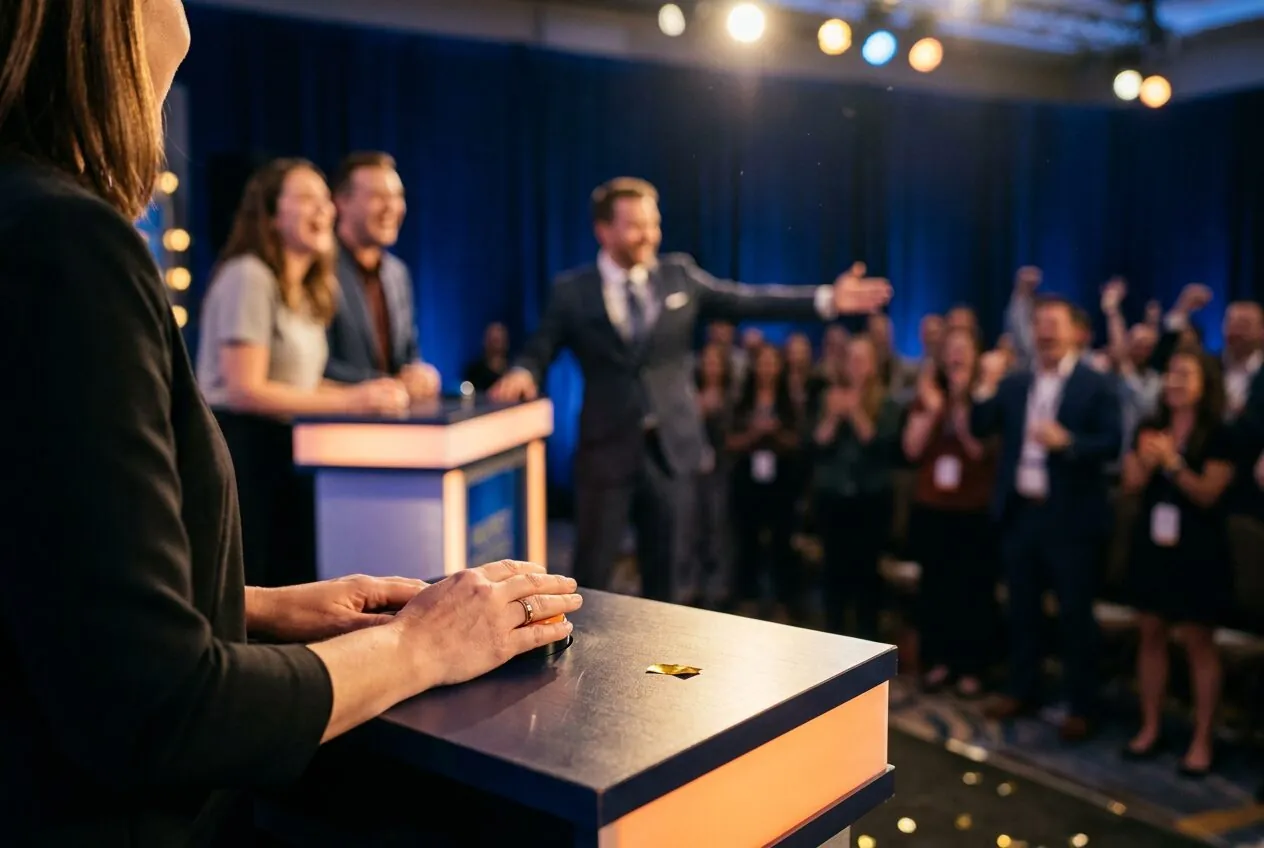
It’s PlayTyme Game Shows runs live, fully hosted game show experiences for corporate and school groups across New Jersey, New York City, New York State, and Connecticut. Founder Lisa Lawrence started the company in 2012 after two decades as a choreographer, and the team has produced more than 3,000 live events since.
The operating belief is blunt: “Great events aren’t measured by how many attend; they’re measured by how many participate.” Everyone plays on a team. The formats are already familiar, so there is no learning curve and no awkward explanation of rules.
Formats include Face 2 Face Feud, The Challenge, Word Play, 60 Seconds of Fame, and PlayPad Mania. Interactive event entertainment packages here are quoted as one production: the host, the sound engineer, the game show set, the audio and visual equipment, the podiums and buzzers, the keypads for big rooms, and the prizes. You provide the room and the people.
Best for: holiday parties, executive retreats, staff morale days, conference entertainment, and school assemblies for groups of 20 to 300+.
Pricing: 90-minute hosted shows start at $2,995 for groups of 20 or more. Use our pricing estimator to see the range for your group size.
What sits outside the package: setup and breakdown, travel, custom content, and gratuity. We publish that list because those four line items are exactly where surprise invoices come from elsewhere.
Standout feature: every booking carries a 100% satisfaction guarantee.
Advantages:
- Turnkey execution. The planner hosts nothing and gets to play along.
- Team formats pull in the quiet half of the room without putting anyone on the spot.
- Published prices and a written exclusion list before you sign.
Standard DJ and Music Services
A standard corporate event DJ supplies the background soundtrack. Ask what is included in an event entertainment booking with a DJ and the contract covers a sound system, lighting, and a setlist. Guests mingle, eat, and dance while music plays.
That works for a cocktail hour where atmosphere is the whole goal. It does very little for colleagues from three departments who have never spoken to each other.
Best for: receptions and open-floor parties where structured participation is not the point.
Pricing: not publicly listed. DJs quote per event and per market.
Standout feature: custom playlists and strong audio gear.
Advantages:
- Sets a mood with almost no floor space.
- Flexible across the whole run of an evening.
Disadvantages:
- Nothing in the format starts a conversation between strangers.
- Announcements and agenda control stay with the planner.
Do-It-Yourself Activity Kits
Kit vendors ship materials or a digital guidebook to your office. You unbox it, read the rules, and lead your own team through trivia, puzzles, or a building challenge.
The trade is straightforward. You buy the supplies and you supply the labor. Whether the hour works depends entirely on one internal organizer’s ability to command a room, explain rules over crosstalk, and hold the energy with no backup. Past roughly 20 people, one unamplified voice cannot explain rules, keep score, and carry the energy at the same time.
Best for: small departments on a tight budget.
Pricing: not publicly listed in a comparable form. Kit vendors price per person or per box.
Standout feature: reusable materials and flexible timing.
Advantages:
- Cheapest option for groups under 20.
- Runs on short notice with no outside staff.
Disadvantages:
- The planner becomes the host and never gets to take part.
- No professional to rescue the room when the first activity stalls.
Stage Acts and Keynote Performers in an Experiential Event Lineup
Comedians, magicians, and motivational speakers deliver a rehearsed set to a seated audience. The room watches while the performer works.
Ask what is included in an event entertainment booking with a stage act and you usually get a rider: stage dimensions, lighting cues, green room requirements. Production quality is high. The format is also one-directional, so your people spend the hour facing forward instead of facing each other.
Best for: conference keynotes and formal gala dinners.
Pricing: not publicly listed. Fees track the performer’s profile and travel.
Standout feature: polished production and recognizable talent.
Advantages:
- Holds a big crowd’s attention with no work from your team.
- Fits neatly into a tight conference agenda.
Disadvantages:
- No interaction between attendees at all.
- Material that misses your audience leaves you with 45 minutes and no plan B.
How to Choose an Entertainment Booking That Fits Your Group Size
Start from the outcome, not the category. Want background atmosphere for a reception? Hire a music service. Want a polished hour your people watch? Book a stage act.
Want participation, laughter, and colleagues who remember each other’s names on Monday? You need a fully hosted interactive format sized to your headcount. Get four things in writing before you sign: the named host, the run-of-show, the complete price with exclusions listed, and the venue’s position on outside entertainment.
Tell us the date, the room, and the group size. Ask It’s PlayTyme Game Shows for a quick discovery call, and we will put your proposal together after we talk, with no deposit and no upsell.
Frequently Asked Questions (FAQs)
What is included in an event entertainment booking for a game show?
A professional host, a sound engineer, the game show set, audio and visual equipment, podiums and buzzers, audience keypads for large rooms, prizes, and the full run-of-show. Setup and breakdown, travel, custom content, and gratuity sit outside the package price.
How much does a hosted game show cost, and how long does it run?
90-minute hosted shows start at $2,995 for groups of 20 or more. Use our pricing estimator to see the range for your group size.
What hidden fees do event entertainment vendors usually leave out of contracts?
Four line items account for most surprise invoices: setup and breakdown, travel, custom content, and gratuity. Venue-side charges such as union load-in labor, power drops, and in-house audio and visual minimums are the second layer. Ask every vendor to state those in writing, then compare totals rather than headline quotes. Our published price excludes exactly those four items, and we say so before you sign.
How do you get a quiet room to participate?
Nobody performs alone. The opening activity builds momentum in small steps, and every format is team-based, so people compete alongside colleagues instead of standing up solo in front of 200 coworkers. That structure is also what keeps introverted and neurodivergent attendees in the game.