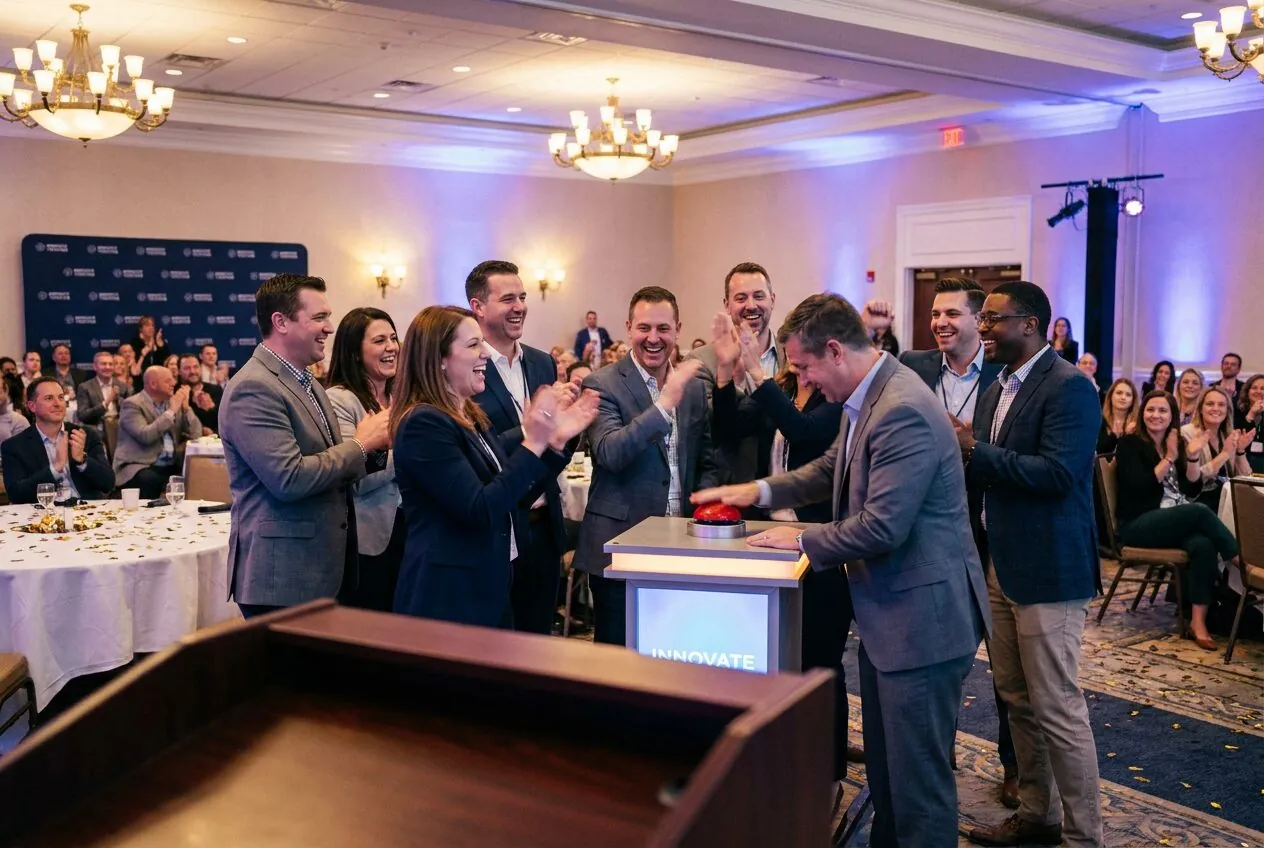
Most employee appreciation events fail for one reason. The people being appreciated never get to do anything.
Gallup reports that only one in three U.S. workers strongly agree they received recognition or praise for doing good work in the past seven days. Gallup’s 2026 workplace report also found that global employee engagement fell to 20% in 2025, costing an estimated $10 trillion in lost productivity.
A plaque and a catered lunch will not move those numbers. People remember the night they went head to head with their own CFO on stage. They forget the gift card.
The ideas below are ranked by one test: how many people in the room actually play.
What You Need to Know
- Participation beats attendance: Count how many people play, not how many walk through the door.
- Group size picks the format: A cooking class fits a dozen people. A hosted game show holds 300.
- A professional host removes the awkward part: Your organizer plays along instead of working the microphone.
- Shared experiences outlast branded merchandise: Inside jokes come back to the office on Monday. Water bottles do not.
| Event Idea | Engagement Level | Best Group Size | Setup Effort |
|---|---|---|---|
| Interactive Live Hosted Game Shows | High (full room plays) | 20 to 300+ | Turnkey |
| Private Culinary Classes | Medium (small pods) | 10 to 30 | Moderate |
| Corporate Escape Rooms | High (small groups only) | 5 to 20 | Low |
| Casino Night Rentals | Low (table by table) | 100 to 500 | High |
| Comedy or Improv Shows | Low (spectator) | 50 to 300 | Moderate |
Why Most Employee Appreciation Events Miss the Mark
- Everyone reassembles into their usual cliques. A standard happy hour puts accounting in one corner and sales in another. Nobody crosses the room without a reason to.
- The entertainment turns the staff into an audience. A magician or a slideshow gives people something to watch. It gives them nothing to do with each other.
- The format breaks at scale. Amateur trivia works for a department of twelve. Run it for a hundred and the back half of the room checks their phones.
- The organizer works the whole night. When the HR director books the venue, writes the questions, and runs the microphone, one person leaves without a single good memory.
- Hybrid and remote staff get stranded. Teams that fly in once a quarter need structured interaction, not free time in a ballroom where they know three people.
- Dry venues lose the crutch. Alcohol-free events, school buildings, and daytime programs need real content, because the open bar is not there to carry the energy.
- Finance wants to know what the spend bought. Morale on its own rarely survives a budget review, so the request has to connect to something the CFO already tracks: employee retention, cross-department communication, and the company culture leadership keeps describing in all-hands meetings.
- The activity quietly excludes part of the staff. A 24-year-old and a 62-year-old, a marathon runner and a colleague who uses a wheelchair, all have to be able to play the same game. Bar crawls, physical challenges, and pop-culture trivia written for one generation are not inclusive team activities, however well they are meant.
- The department that needs it most calls it forced fun. A team coming off a rough quarter reads any scheduled activity as an obligation. Competition and a professional host give skeptics cover, because they are playing a game rather than attending a morale exercise.
1. Interactive Live Hosted Game Shows
It’s PlayTyme Game Shows runs professionally hosted live game shows for large groups across New Jersey, New York City, and Connecticut. Formats include Face-2-Face Feud, Jeopardy Challenge, Name That Hit Song, and Game Show Mania.
The game show is the vehicle. The product is a room full of people competing, laughing, and talking to colleagues they normally email. Founder Lisa Lawrence has run this format since 2012, across more than 3,000 events.
A professional host controls the pace, so your office manager sits with a team and plays.
Best for: appreciation nights, holiday parties, executive retreats, and interactive team building activities in New Jersey and Connecticut for groups of 20 to 300+ people.
Pricing: our shows start around $2,995 for groups of 20 or more. Use our pricing estimator to see the range for your group size. A 60-minute show is also available, and half-day and full-day team building programs are custom-priced through a rep.
Standout features: turnkey setup and sound, whole-room formats where every table competes, and content customized with your company’s own inside jokes and milestones. Planners building a longer evening of corporate event entertainment in NYC pair the show with other corporate entertainment ideas by group size before or after dinner.
2. Private Culinary Classes and Food Tours
A private cooking class or a guided neighborhood food tour treats a small department well. Attendees cook alongside a chef or walk between local restaurants, and conversation happens naturally over the work of the meal.
Best for: executive retreats and single departments of 10 to 30 people.
Pricing: not publicly listed. Kitchens and tour operators quote per head, and the menu plus alcohol drive the final number.
Standout features: hands-on instruction, a full meal included, and a relaxed room for unstructured conversation.
Advantages:
- A shared task starts conversation on its own, with no forced opening exercise.
- Everyone leaves with a new skill and a dinner they remember.
Disadvantages:
- Cost and logistics break down above roughly thirty people.
- Allergies, dietary restrictions, and religious requirements add real planning work.
3. Corporate Escape Rooms
Escape rooms drop small teams into a themed set and give them a clock. Employees solve puzzles together, and quiet problem solvers often lead the room.
Most facilities now sell corporate packages with private bookings and a debrief space for drinks afterward.
Best for: small teams that want pure problem solving under time pressure.
Pricing: not publicly listed. Venues quote per person and add a fee for a private buyout.
Standout features: a hard time limit, immersive sets, and a clear win condition that keeps focus.
Advantages:
- Forces tight communication between people who rarely work together.
- The physical sets and puzzle themes stick in memory for months.
Disadvantages:
- Room capacity splits a large group into separate games that never reconnect.
- Time pressure stresses some employees instead of rewarding them.
4. Casino Night Rentals
Casino nights bring blackjack, roulette, and poker tables into a rented venue or a cleared office floor. Professional dealers run the games while employees play with chips instead of cash.
The format pairs well with cocktail attire and a December party, and it gives a large ballroom a clear visual centerpiece.
Best for: large holiday parties and end-of-year galas.
Pricing: not publicly listed. Rental companies quote by table count, dealer hours, and delivery.
Standout features: real casino equipment, trained dealers, and a social floor people move through at their own pace.
Advantages:
- Guests join and leave the action whenever they want.
- Chip counts create an easy prize structure at the end of the night.
Disadvantages:
- Interaction stays fragmented, because people only talk to the five others at their table.
- The room never shares one moment together.
5. Comedy or Improv Shows
A corporate comedian or improv troupe delivers a performance written around workplace humor. Strong acts take suggestions from the audience so the material sounds specific to your company.
Most companies slot this after dinner at an annual retreat or kickoff.
Best for: audiences that want to sit, watch, and laugh rather than compete.
Pricing: not publicly listed. Fees track the performer’s profile, the date, and travel.
Standout features: custom material, professional crowd work, and zero physical demand on attendees.
Advantages:
- Attendees do nothing but take a seat.
- One auditorium holds hundreds of people without splitting the group.
Disadvantages:
- The audience stays passive and leaves with no new connections.
- Finding material that lands with every department, and stays appropriate, is hard.
Adapting These Ideas for Schools and Community Groups
The same rule holds outside the office. A staff appreciation morning, a professional development day, or a student assembly collapses the moment the audience becomes a spectator.
Formats that pull people out of their seats work in a gym at 9 a.m. exactly the way they work in a hotel ballroom at 7 p.m. The host and the run of show change. The mechanic does not.
How to Choose Between a Happy Hour and a Hosted Experience
Pick the format by the outcome you want, not by the budget line.
- Under 20 people: A dinner, a class, or an escape room gives everyone airtime.
- 50 people and up: An unstructured mixer splits into cliques. Structured play holds the room.
- Departments that never interact: Team-based competition mixes them faster than any seating chart.
- A mixed-age or mixed-ability staff: Choose a format where sitting at a table is the only physical requirement.
- An organizer who is also an attendee: Hire the host. Nobody enjoys their own event from behind a microphone.
- A dry or daytime event: The program has to carry the energy on its own.
Ready to stop worrying about your next staff appreciation event? It’s PlayTyme Game Shows hosts large-group game show experiences across NJ, NYC, and CT, backed by a 100% satisfaction guarantee. Get a quote and book your date.
Frequently Asked Questions (FAQs)
What makes an employee appreciation event successful?
Active participation. The best events give every person something to do within the first ten minutes, so nobody stands at the edge of the room. Success shows up on Monday, when people are still repeating jokes from the night before.
How do you include employees who dislike team building or have different ages and abilities?
Give them competition instead of exercises, and pick a format where sitting at a table is the only physical requirement. A live game show reads as entertainment rather than a workshop, the stakes stay low and funny, and questions written across several decades of reference points keep a 24-year-old and a 62-year-old in the same game. A professional host also draws in quiet people without singling anyone out.
What group size works best for a live hosted game show?
Anything from 20 to 300+ people. Pricing is set in five group-size bands from 20 to 300+, and the show format stays the same across every band. Larger headcounts simply run more teams.
Do these ideas work for remote or hybrid teams?
They work best when hybrid teams gather in person. A shared room produces energy that a video call cannot match, so use the offsite for the interaction and save the screen time for the update. Book the live activity early in the agenda, before people drift.